Monday, April 17, 2006

Sunday, April 16, 2006
interregnum
I'm taking Latin America on Screen out of mothballs. I aim to blog a film or so a week over the summer. Do check it out. I start again with a post on The Wild Bunch and the interregnum. Here's how it begins...
 The bloody action in Sam Peckinpah's The Wild Bunch takes place either side of the US/Mexican border--and in one memorable scene, on a bridge directly on the border itself--as a new nation is being born to the South, and an old one is dying to the North.
The film depicts, therefore, a moment of transition. All such transitions are times of violence: the painful uprooting of old traditions and the hard-fought emergence of the new. More violence is around the corner, as the film indicates, with World War One ushering in a global realignment of forces, and the definitive mechanization of death. This is foreshadowed by the use, here, of an automobile as instrument of torture, and a machine gun as agent of unparalleled, indiscriminate mayhem.
At first sight the border between North and South may appear blurred, but only at first sight, or so suggests the Wild Bunch's one Mexican. "Mexico lindo," exclaims the character Angel as the group arrive at the Rio Grande. "Just seems like more Texas as far as I'm concerned," replies one of his partners. "Then you have no eyes," responds Angel.
More...
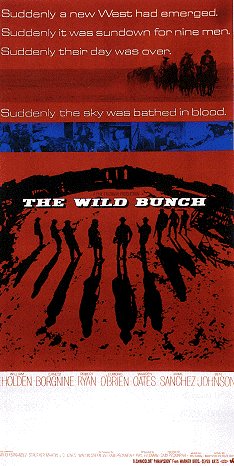 The bloody action in Sam Peckinpah's The Wild Bunch takes place either side of the US/Mexican border--and in one memorable scene, on a bridge directly on the border itself--as a new nation is being born to the South, and an old one is dying to the North.
The film depicts, therefore, a moment of transition. All such transitions are times of violence: the painful uprooting of old traditions and the hard-fought emergence of the new. More violence is around the corner, as the film indicates, with World War One ushering in a global realignment of forces, and the definitive mechanization of death. This is foreshadowed by the use, here, of an automobile as instrument of torture, and a machine gun as agent of unparalleled, indiscriminate mayhem.
At first sight the border between North and South may appear blurred, but only at first sight, or so suggests the Wild Bunch's one Mexican. "Mexico lindo," exclaims the character Angel as the group arrive at the Rio Grande. "Just seems like more Texas as far as I'm concerned," replies one of his partners. "Then you have no eyes," responds Angel.
More...
Saturday, April 15, 2006
brock
 The Brock conference "Metastasizing Capital" left much to think about. I didn't catch everything, in part because I also took the time to do some sight-seeing. But of what I saw, there were plenty of good papers, even among those I disagreed with.
In the end, though, no doubt the point of the thing was to hear from Toni Negri (and Judith Revel), and to engage in some dialogue with them. Kudos to Brock, by the way, for being as far as I know the first place in North America to host Negri.
But as we've started to discuss in comments to my previous post, the reception of what Negri actually had to say was far from completely favourable.
He pointed to some important issues--not least, the problem of evil, that haunts any philosophy of affirmation. Other tidbits included he denial that the disturbances in the banlieus had anything to do with the logic of (post)coloniality (huh?!), and Revel's aside suggesting that we have to distinguish between "good" and "bad" multitudes.
But Negri's over-riding theme, taken up also by Revel, was the "rupture" between what he here framed as modernity and postmodernity. And the more he discussed this rupture, the less convinced I became.
While listening to Judith Revel, I grabbed a piece of paper from Nate (who's already posted some initial reactions to the conference) and came up with the following tables:
| Negri today | |
|---|---|
| Continuities and breaks in the rupture between modern and postmodern. (All theses taken from Negri and Revel's oral presentations at Brock.) | before | after |
| dialectic between labour and capital | NO dialectic between labour and capital |
| exploitation of labour power central to capitalist system | exploitation of labour power central to capitalist system |
| modern subject, defined by rights | postmodern, but not postcapitalist, subjectivities: minorities, multitude |
| Negri beyond Negri | |
|---|---|
| Continuities and breaks in the rupture between modern and postmodern. (All theses taken from Negri's published work.) | before | after |
| NO dialectic between labour and capital [MBM] | NO dialectic between labour and capital |
| exploitation of labour power central to capitalist system | exploitation replaced by pure command [E] |
| modernity traversed by the multitude, a subject misrecognized as people etc. [I] | postmodern, postcapitalist, subject, the multitude, comes into its own |
| Key: MBM=Marx beyond Marx; E=Empire; I=Insurgencies | |
Now, I'm as big a fan of rupture as the next person, but there is some incoherence here. Moreover, what's important is surely the relation between continuity and discontinuity. One of the insights of the workerist and autonomist tradition from which Negri comes (but which, in public at least, he continues rather oddly to underplay) is the notion that it is working class power that's continuous, continually pressing upon capitalist domination. And that capital in response is forced into a discontinuous series of restructurations, which in turn force a series of class recompositions (elite industrial worker -> mass worker -> socialized worker). Still, the red thread remains working class power.
Ironically, though, in that the force of working class power is against its confinement, as a class, within capitalist relations of production, and in that its aim is autonomy, the working class envisaged by the autonomist tradition is a class not for itself, but against itself.
Should the multitude emerge on its own account, then, that would mean the end of the working class as a class, and also the end of exploitation. In so far as that has taken place, in so far as social productivity now has no need of capitalist structures, i.e. in so far as any putative labour/capital dialectic is broken, all that remains is a command that is cruel and unpredictable precisely because it no longer has its roots in economic exploitation. Corruption is all.
After all, "corruption itself," Hardt and Negri argue, "is the substance and totality of Empire" (Empire 391). It is "not an aberration of imperial sovereignty but its very essence and modus operandi" (202).
More on this anon, I'm sure...
Friday, April 14, 2006
arr!
Well, I had to do this...

Get your own pirate name from fidius.org.
My pirate name is:
Black John Read
Like anyone confronted with the harshness of robbery on the high seas, you can be pessimistic at times. Even through many pirates have a reputation for not being the brightest souls on earth, you defy the sterotypes. You've got taste and education. Arr!
Get your own pirate name from fidius.org.
Tuesday, April 11, 2006
Monday, April 10, 2006
Arguedas
Monday Arguediana
 Here is a list of the posts I've written over the semester on the Peruvian author José María Arguedas (1911-1969; a brief biography in English is here).
They trace a reading of what is essentially Arguedas's entire published work (except for his correspondence and translations), in rough chronological order.
See also:
 Here is a list of the posts I've written over the semester on the Peruvian author José María Arguedas (1911-1969; a brief biography in English is here).
They trace a reading of what is essentially Arguedas's entire published work (except for his correspondence and translations), in rough chronological order.
- genre (preview)
- landscape (short stories)
- carnivalesque (Yawar fiesta)
- yawar mayu (Los ríos profundos I)
- solidarity (Los ríos profundos II)
- music (El sexto)
- copy (Señores e indios)
- jetman (poetry)
- cake (review)
- recolonization (Todas las sangres I)
- flow (Todas las sangres II)
- breakdown (El zorro de arriba y el zorro de abajo)
- vendetta (Todas las sangres alongside V is for Vendetta)
- blocks (El zorro de arriba y el zorro de abajo alongside Kafka: Toward a Minor Literature)
See also:
Sunday, April 09, 2006
american
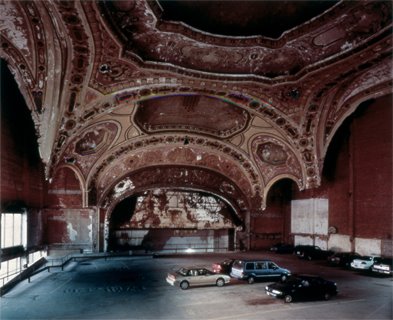
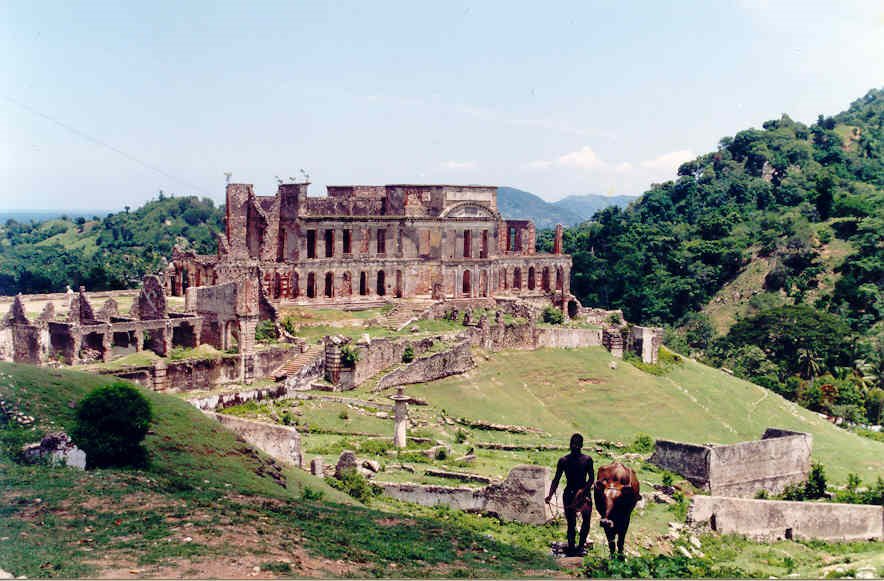 I have discussed ruins before, and one of my side projects is a book on what I call "American Ruins." The idea is to analyze a number of exemplary but rather different ruins from this hemisphere: Vilcashuamán, Peru; Sans Souci, Haiti (which is the image to the right); the Michigan Theater, Detroit (at the bottom of this post); Pino Suárez metro station, Mexico; and the Ochagavía hospital, Chile.
Just now I'm finishing up a paper that focusses on the first of these, Vilcashuamán. Here are the first couple of paragraphs of that paper, outlining the conjunction between American-ness and ruination. (Post-9/11 there are others, of course.) Sadly, Scott won't like the last line. But there we go...
There is no such thing as an ancient ruin, for the ruin is always a modern concept. Ruination and modernity go hand in hand, as the modern displaces the ancient, marks it as irredeemably part of the past precisely by construing it as ruined. Ruins are the site of what has been put behind us. But at the same time they remain front and center: for modernity occasions a sometimes anxious reflection on the conditions and effects of “progress,” on this process of temporal displacement for which the ruin serves as a memento mori. Modernity creates the ruin as something both to be discarded and also to be read, obsessively. We moderns construct and interpret ruins as judgment on the past and warning for the future. “Men moralize among ruins,” observed Benjamin Disraeli, “or, in the throng and tumult of successful cities, recall past visions of urban desolation for prophetic warning. London is a modern Babylon; Paris has aped imperial Rome, and may share its catastrophe” (138). A sign of modernity’s success and vitality is that past civilizations are in ruins all around; but they remind us that there can be no guarantee that today’s proud edifices will not, in turn, fall to rack and ruin. Ruins demonstrate that whole cultures, just like the lives of mortals, are transient. Hence they are invented by cultures that feel their own transience. And no culture feels more transient than the American.
Though the Americas have long been envisaged as the “New World,” and despite Goethe’s assertion that “America, you have it better / Than our old continent; / You have no ruined castles / And no primordial stones” (qtd. Lowenthal 110), in fact the hemisphere has more than its share of ruins. This should be no surprise: modernity was after all abruptly conceived in the encounter between Old and New Worlds, and built upon the ruins of the civilizations first encountered by the Spanish conquistadors. The traces of imperial grandeur are now themselves ruined, and where there are no ruins easily to hand, they have often enough been built from scratch or substitutes have rapidly been found. From Hearst Castle or campus gothic to the dinosaur bones patronized by tycoons such as Andrew Carnegie, as the US became the dominant world power at the end of the nineteenth century and in the first decades of the twentieth, it increasingly sought out its own ruins. Frequently, those ruins were south of the border: this was also the heyday of a burgeoning archaeology, and the discovery of “lost” cities in rainforests and remote valleys the length and breadth of the continent. Today, ruins are big business (Tikal, Tenochtitlan), even as big business leaves its own ruins behind (from the Rust Belt to reclaimed factories).
Saturday, April 08, 2006
blocks
Posthegemony is on something of a diagram spree right now. I have more of Douglas Oliver's diagrams to post shortly--next week, most likely. Meanwhile, however, two from the last couple of books I've read.
First, Arguedas's El zorro de arriba y el zorro de abajo includes, as one element of its decidedly messy mixed-genre text, a diagram.
This comes in the same section that I've discussed already: as the factory manager, Don Angel, is showing his visitor, Diego, around the bowels of the machinic apparatus. Diego asks Don Angel "And the panorama? How do you see the panorama, the conjunction of things?" Angel replies:
But if Diego is indeed "watch[ing his] hand and listen[ing] to [his] words" at the same time, as Don Angel encourages him to do, perhaps it might occur to him that the two are not necessarily consonant. Where does the factory manager come up with these seven blocks, for instance? And where are "we," the elite subject that he first invokes? Part of the Peruvian government, or part of the Peruvian people? What is the logic of the lines' criss-crossing and semi-convergence, also at times semi-divergence? Do these lines construct the face we see, or does that pre-exist the diagram? Is it indeed a face, or a mask, a fetish, set at a distance from all the elements of Peruvian society that are, after all, separated out at the top of the picture?
In other words, for all the narrative verve and confidence that Don Angel brings to his analysis of the social panorama, there's a sense in which the diagram betrays him. The lines of force that he traces take flight, obeying their own logic, suggesting their own conclusions--perhaps a more open future than the inevitable permanence of capitalist rule the manager himself so confidently predicts.
Meanwhile, there's at least a topological similarity between the diagram to be found in Arguedas's book and the two architectures of power outlined in Deleuze and Guattari's Kafka: Toward a Minor Literature.
These two diagrams designate two states of social architectonics, which are both distinct and commingling. The first of these is the image of transcendence, or the quasi-cause: rather than eggs we have blocks, set at a distance from a central tower in which power purports to reside. (There is of course something here of Foucault's analysis of the panopticon, though that's not directly referenced.)
This first state is governed by a logic of
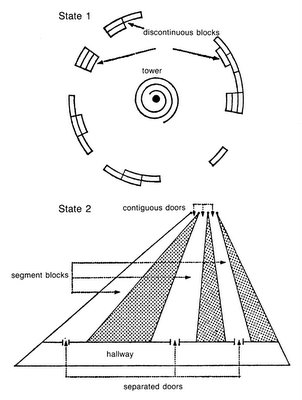
The second architectural state, on the other hand, is governed by a logic of the
To return to Arguedas, then, the task would be to seek out the other diagram, the rhizomatic diagram of the faraway and the contiguous that would start to undo and counter Don Angel's faith in the distant and the close.
As a first approximation, as I have suggested, we may find traces of that other diagram even in the map drawn by the factory manager himself. For is not the shape of his diagram closer to the second of Deleuze and Guattari's diagram (the posthegemonic assemblage) than the first: another triangle, another set of disjunctive convergences, albeit inverted? One step might then be to invert the industrialist's diagram, to put his account of Peruvian society, in which capital is necessarily in the driving seat, back on its feet.
And a second approximation would be to seek that other, missing diagram elsewhere in Arguedas's work. To open up the Arguedas-machine to the immanence of affective contiguity and intensity in the faraway highlands, to follow the set of procedures for achieving the plane of immanence that have governed his writing from the very start.
First, Arguedas's El zorro de arriba y el zorro de abajo includes, as one element of its decidedly messy mixed-genre text, a diagram.
This comes in the same section that I've discussed already: as the factory manager, Don Angel, is showing his visitor, Diego, around the bowels of the machinic apparatus. Diego asks Don Angel "And the panorama? How do you see the panorama, the conjunction of things?" Angel replies:
Yes, Diego my friend; yes I see the panorama more clearly. Wait a moment. This is the way the conjunction is. That's it! Take a good look at this map or diagram, complete with names, that I'll trace and write down; I'll be drawing it. This is how it starts. Watch my hand and listen to my words. I think that something will come out of this; yes, something objective. Look...So we have ten eggs, and ten lines, which converge and cross over a face, a mask, that is the face of Peru. This is a diagram of power (is there any other kind?), a balance of forces, in which the industrialist expresses his confidence in the eternal omnipotence of capital.
Seven white eggs against three red ones. There's us, and industry, and the USA, the Peruvian government, the Peruvian people's ignorance, and the ignorance of the Cardozos [the liberation theology priests] about the Peruvian people, together we all make up the white forces. On the other hand, John XXIII, Communism, and the rage, whether lucid or cock-eyed, of a small section of the Peruvian people against the USA, industry, and the government, all these make up the red forces. Take a look: that's the face of Peru, that's it with its three little red lines. [. . .] In short, Diego my friend, we are seven white eggs against three red ones. And one of the red ones, Communism that is, has maggots infesting its dying body. I know what I'm talking about. And this map won't change ever at all against capital, only in its favour. It's a sure thing! There are just a few people in power through the whole universe, heaven and earth, water and sea. (92-93)
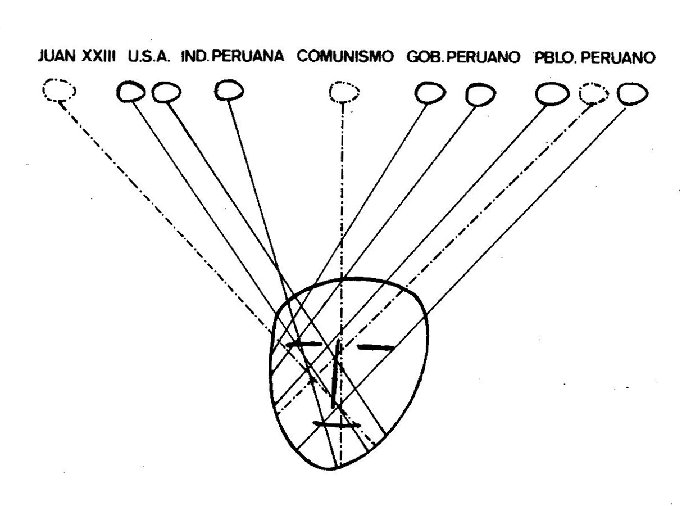
But if Diego is indeed "watch[ing his] hand and listen[ing] to [his] words" at the same time, as Don Angel encourages him to do, perhaps it might occur to him that the two are not necessarily consonant. Where does the factory manager come up with these seven blocks, for instance? And where are "we," the elite subject that he first invokes? Part of the Peruvian government, or part of the Peruvian people? What is the logic of the lines' criss-crossing and semi-convergence, also at times semi-divergence? Do these lines construct the face we see, or does that pre-exist the diagram? Is it indeed a face, or a mask, a fetish, set at a distance from all the elements of Peruvian society that are, after all, separated out at the top of the picture?
In other words, for all the narrative verve and confidence that Don Angel brings to his analysis of the social panorama, there's a sense in which the diagram betrays him. The lines of force that he traces take flight, obeying their own logic, suggesting their own conclusions--perhaps a more open future than the inevitable permanence of capitalist rule the manager himself so confidently predicts.
Meanwhile, there's at least a topological similarity between the diagram to be found in Arguedas's book and the two architectures of power outlined in Deleuze and Guattari's Kafka: Toward a Minor Literature.
These two diagrams designate two states of social architectonics, which are both distinct and commingling. The first of these is the image of transcendence, or the quasi-cause: rather than eggs we have blocks, set at a distance from a central tower in which power purports to reside. (There is of course something here of Foucault's analysis of the panopticon, though that's not directly referenced.)
This first state is governed by a logic of
the distant and the close [. . .] the blocks that form arches of the circle are close to each other--they join up by forming couples. It is also true that they remain distant from each other, since gaps that will never be filled remain between them. Furthermore, the transcendental law, the infinite tower, is infinitely distant from each block; and, at the same time, it is always very close and never ceases to send its messager to each block, bringing one near the other when it moves away from the other, and so on. The infinitely distant law emits hypostases, sends emanations that always come closer and closer. (76-77)

The second architectural state, on the other hand, is governed by a logic of the
faraway and the contiguous. Faraway is opposed to close, contiguous is opposed to distant. But in the grouping of the experiences and concepts, faraway is equally opposed to distant, contiguous opposed to close. In fact, the offices are very far away from each other because of the length of the hallway that separates them (they aren't very close), but they are contiguous because of the back doors that connect them along the same line (they aren't very distant). (77)Rhizome versus arborescence, in short--but also bureaucratic machine versus (myth of) sovereignty. And posthegemony versus hegemony.
To return to Arguedas, then, the task would be to seek out the other diagram, the rhizomatic diagram of the faraway and the contiguous that would start to undo and counter Don Angel's faith in the distant and the close.
As a first approximation, as I have suggested, we may find traces of that other diagram even in the map drawn by the factory manager himself. For is not the shape of his diagram closer to the second of Deleuze and Guattari's diagram (the posthegemonic assemblage) than the first: another triangle, another set of disjunctive convergences, albeit inverted? One step might then be to invert the industrialist's diagram, to put his account of Peruvian society, in which capital is necessarily in the driving seat, back on its feet.
And a second approximation would be to seek that other, missing diagram elsewhere in Arguedas's work. To open up the Arguedas-machine to the immanence of affective contiguity and intensity in the faraway highlands, to follow the set of procedures for achieving the plane of immanence that have governed his writing from the very start.
Friday, April 07, 2006
Mazher Mahmood
 Just doing my bit... The pictures in this entry may or may not be likenesses of Mazher Mahmood, the so-called "fake sheikh." Via Fake Sheikh.
For background, see The BBC, The Guardian, Obsolete, Obsolete again, recess monkey, Guido Fawkes, Lenin's Tomb, and Lenin's Tomb again.
And let me inform Messrs Farrer & Co. (who are also the Queen's solicitors) that this site is hosted outside the UK, and that this blog is written by an individual who is not living within the jurisdiction of the UK.

Update: Play Sheik Invaders! See the man groove. And watch Trailer Crashers (highly recommended). Via Guido.
And a shout out to the folk visiting from woki1.newsint.co.uk, whom my sitemeter tells me have spent
Further Update: Chalk up another small victory to the Internets.
Thursday, April 06, 2006
citizen
Looking for a link for my last post, I note that just now John Latta has a picture of Bobby Sands on his blog, pictured during the Maze "dirty protest". (Though the BBC, featuring the same photograph, identifies the prisoners as Freddie Toal and Hugh Rooney.)
This is something of a coincidence in that recently, as well as turning to Stanley Spencer, I've been thinking about Richard Hamilton's famous picture "The Citizen", a diptych inspired by the Maze protests. Half abstract composition in shit, half altarpiece.
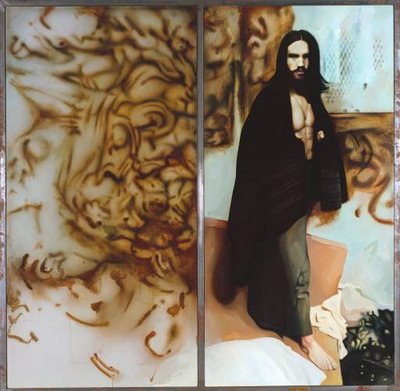
I also remember taking the bus home from school late one night in 1984, and discovering that the top deck of the number 264 had been taken over by Celtic fans, in town to see a recheduled European tie against Rapid Vienna.
A wry account of the match, and the journey to get to it, can be found at Sidenetting. From my perspective, a schoolkid in full uniform, heading back to the suburbs but surrounded by a crowd of loud if good-tempered Glaswegians, the experience was electrifying. They sang songs in praise of Bobby Sands. I found it rather shocking and rather scary. But without doubt also exciting.
 More recently, it seems that the British have been leaning on the Iranians to change the name of Tehran's Bobby Sands Street. Which is a street round the corner from the British Embassy.
This is something of a coincidence in that recently, as well as turning to Stanley Spencer, I've been thinking about Richard Hamilton's famous picture "The Citizen", a diptych inspired by the Maze protests. Half abstract composition in shit, half altarpiece.

I also remember taking the bus home from school late one night in 1984, and discovering that the top deck of the number 264 had been taken over by Celtic fans, in town to see a recheduled European tie against Rapid Vienna.
A wry account of the match, and the journey to get to it, can be found at Sidenetting. From my perspective, a schoolkid in full uniform, heading back to the suburbs but surrounded by a crowd of loud if good-tempered Glaswegians, the experience was electrifying. They sang songs in praise of Bobby Sands. I found it rather shocking and rather scary. But without doubt also exciting.
 More recently, it seems that the British have been leaning on the Iranians to change the name of Tehran's Bobby Sands Street. Which is a street round the corner from the British Embassy.
Diplomats at the embassy of the Republic of Ireland in Tehran admit the street is something of a tourist attraction for Irish nationals visiting the 25-year-old Islamic republic, saying it drew large crowds during an Ireland-Iran World Cup football qualifier in 2001.
Wednesday, April 05, 2006
diagrams III
 The following is Douglas Oliver's own introduction to selected "Diagram Poems" in A Various Art. This book is basically, as far as I can see, an anthology of "Cambridge poets": Prynne et. al. Many thanks to John Latta for the reference.
We used to get the Tupamaros stories on the night shift at Agence France-Presse. Reports of urgent, sometmes bloody events would be wired through in Spanish, translated on the French floor, and reach our desk to be retranslated into English. At every step the events moved away from reality. Orchestrated by the Tupamaros for maximum heroic effect, they were transformed into Spanish news rhetoric, into French, into very different English news rhetoric, and then might appear in the columns of Asahi Shimbum, in whatever rhetoric the Japanese use.I like very much the idea of an "impure art" whose job is "to recreate emotional urgency out of fantasy."
Uruguay itself, the poverty brought about by the crash of world wool and meat markets and by the exploitation of the indigenous population by Western financial interests . . . this lay somewhere behind the bravado of exploit you were reporting. Whether the guerrillas were right or wrong--and you were against extremist violence, along with the rhetoric that falsified events at their origin--you might be dreaming quite obliquely, as you tapped the stories out, of how an authentic politics could combine the mildness of a dead baby of yours, dear in memory, with the stern wisdom of elder ministers truly backed by their people.
In Pando the Tupamaros seized the police and fire stations, the telephone exchange and three banks, before trying to escape as the police closed in on them. These movements could be plotted on to paper, already with some inaccuracy. As the diagrams were plotted, they moved farther away from reality into pictures which both reflected the actual events but were also permitted an infection from personal British fantasy, such as the dead son and your worries about political judgment. Poems emerged, more distorting even than journalism. The final job of this deliberately impure art was to recreate emotional urgency out of fantasy. (214)
For more on the "Diagram Poems," see here. More to come.
Tuesday, April 04, 2006
judgement
 I was reminded the other day of the English artist Stanley Spencer. I doubt he's well known outside of the UK: he was in some ways a very provincial figure.
He lived almost his whole life in the small village in which he was born, Cookham-on-Thames, just to the West of London. And very many of his most famous paintings are of Cookham and its inhabitants, as he translates religious edict and prophecy into the vernacular of rural England.
Here, for instance, is his depiction of the Day of Judgement, set in the Cookham parish churchyard of the 1920s. As the Tate Britain website notes, it shows "risen souls [. . .] transported to Heaven in the pleasure steamers that then ploughed the Thames."

Other subjects of Spencer's paintings include "Christ Preaching at Cookham Regatta" and a "Last Supper" set in the village malthouse.
There is something in Spencer of Orwell's famous evocation of Englishness in terms of "old maids biking to Holy Communion through the mists of the autumn mornings." Though in the same breath Orwell also wrote of "the lorries in the Great North Road, the queues outside the Labour Exchanges," a fact rather overlooked by Tory Prime Minister John Major when he tried to yoke this text to his own nostalgic cause.
And likewise in Spencer, perhaps, the immanence and imminence of this quotidian divinity, in which a day of reckoning might take place around the corner from the village high street, is also on reflection not quite as homely or as comforting a thought as it might first appear. No longer are the provinces a sleepy backwater; they're the site in which cosmic forces are unleashed.
Cross-posted to Long Sunday.
Monday, April 03, 2006
breakdown
Monday Arguediana
 In some ways, and perhaps rather strangely, José María Arguedas's last book, El zorro de arriba y el zorro de abajo, bears more than a passing resemblance to the metafiction characteristic of late twentieth-century postmodernism.
The book is, after all, studded with authorial interventions, written as diary entries, that interrupt the narrative and reflect on the process of writing itself, as well as on the plot and the characters it contains. (Many of these, including the first and final diaries, plus the epilogue and the speech "No soy un aculturado," can be found here.) At an intermediate level, the novel also incorporates another pair of commentators in the eponymous foxes (elements drawn from indigenous folklore) who meet and watch over the action as it unfolds in the Peruvian port city of Chimbote.
Los zorros is, moreover, an eminently nonlinear and open work: it is composed of a series of brief stories, often presented as long dialogues as individual characters recall their past histories and so situate themselves within the rapid transformations of capitalist development affecting them all.
These individual narrative arcs are never fully brought together. Rather they coexist somewhat uneasily, precariously shoulder to shoulder in the shared space of a city that has sprung up almost from nowhere around the fish processing factories driving this dislocated pole of economic expansion.
Plus there is the fact that the book remains unfinished. In the "final diary entry" Arguedas outlines how he might have continued, and reveals some of the fate that he has had in store for individual characters. Then among the other paratexts with which it concludes is a letter from the author to his publisher, apologizing for the text's incomplete state, describing it as "a body that's half-blind and deformed but perhaps still able to walk on its own" (201).
But this same letter reveals what distinguishes the novel from the flamboyant literary exhibitionism of a John Barth or an Italo Calvino. In a postscript, Arguedas writes: "P. S. (on my return to Lima) In Chile I got hold of a .22 caliber revolver. I've tested it. It works. It will do. It won't be easy to choose the day, to carry it out" (203). This is not, in other words, some playful metafiction in which textuality is all. This is a book that begins with a discussion of suicide, ends with a suicide note, and is signed with the author's own dead body.
For Alberto Moreiras observes that in a further letter, also included as part of the novel, dated November 27, 1969, the day before his suicide
What we have here, in other words, is a revelation of the machinic qualities of Arguedas's writing, and perhaps writing tout court. And in some way it may have been this revelation that proved too much for Arguedas himself.
Yet this notion of a productive factory, driven by desire, and the becoming-machinic of those attending to it, is an explicit theme within the novel itself. For in an extended sequence, perhaps the novel's longest, at the (dead?) centre of the book, we are shown around a Chimbote fish factory, shown the workings of the mechanisms that have enabled the city's prodigious growth as in a few short years it has concentrated all the forces of international capital: "corralling in Chimbote bay the Hudson and the Marañon, the Thames and the Apurimac" (76).
The factory manager takes his guest (and so also the novel's readers) to the heart of the productive process, the centrifuges in which the fish oil is extracted, which "nobody has observed." At the threshold, the guest, Diego, takes a step back in some trepidation. And indeed the manager warns of possible danger: "The cyclones have never burned anyone, but even so..." And then there, at the heart of this near-deserted factory in which the workers merely oversee the machines, the membrane between human and machine is suddenly permeable:
 Is there a key here to an Arguedas-machine, comparable to the "Kafka-machine" mapped by Deleuze and Guattari who argue that "a writer isn't a writer-man; he is a machine-man, and an experimental man" (Kafka 7). For surely Arguedas and Kafka have much in common: writers of minor literatures in a tongue that is not their own, stuttering, undoing, and causing breakdowns in the major literature and the culture of majorities.
The machines in the Chimbote factory "shit gold; that is life, isn't it?" (100). Arguedas likewise, and like the character Esteban who is dedicated to spitting out and selling the coal dust in his lungs, aims to make of his mutilated body and psyche a machinic apparatus for the selection and intensification of affects, for the alchemical transformation of shit and suffering into gold and happiness.
Of course, the machine only works in and through its breakdowns: as Deleuze and Guattari say elsewhere, the desiring-machines "work only when they break down, and by continually breaking down" (Anti-Oedipus 8). That's their danger and the risk that the writer takes. And at some point, for Arguedas, that breakdown was terminal. But not before he'd revealed the epiphany at the heart of his anguished, delirious writing assemblage.
 In some ways, and perhaps rather strangely, José María Arguedas's last book, El zorro de arriba y el zorro de abajo, bears more than a passing resemblance to the metafiction characteristic of late twentieth-century postmodernism.
The book is, after all, studded with authorial interventions, written as diary entries, that interrupt the narrative and reflect on the process of writing itself, as well as on the plot and the characters it contains. (Many of these, including the first and final diaries, plus the epilogue and the speech "No soy un aculturado," can be found here.) At an intermediate level, the novel also incorporates another pair of commentators in the eponymous foxes (elements drawn from indigenous folklore) who meet and watch over the action as it unfolds in the Peruvian port city of Chimbote.
Los zorros is, moreover, an eminently nonlinear and open work: it is composed of a series of brief stories, often presented as long dialogues as individual characters recall their past histories and so situate themselves within the rapid transformations of capitalist development affecting them all.
These individual narrative arcs are never fully brought together. Rather they coexist somewhat uneasily, precariously shoulder to shoulder in the shared space of a city that has sprung up almost from nowhere around the fish processing factories driving this dislocated pole of economic expansion.
Plus there is the fact that the book remains unfinished. In the "final diary entry" Arguedas outlines how he might have continued, and reveals some of the fate that he has had in store for individual characters. Then among the other paratexts with which it concludes is a letter from the author to his publisher, apologizing for the text's incomplete state, describing it as "a body that's half-blind and deformed but perhaps still able to walk on its own" (201).
But this same letter reveals what distinguishes the novel from the flamboyant literary exhibitionism of a John Barth or an Italo Calvino. In a postscript, Arguedas writes: "P. S. (on my return to Lima) In Chile I got hold of a .22 caliber revolver. I've tested it. It works. It will do. It won't be easy to choose the day, to carry it out" (203). This is not, in other words, some playful metafiction in which textuality is all. This is a book that begins with a discussion of suicide, ends with a suicide note, and is signed with the author's own dead body.
For Alberto Moreiras observes that in a further letter, also included as part of the novel, dated November 27, 1969, the day before his suicide
Arguedas notes almost casually that his novel is "casi inconclusa" ["almost unfinished"]. It is "almost unfinished" because he had not yet killed himself, but he had already made the irrevocable decision to do so. After Arguedas's suicide the novel will and will not be finished, simultaneously and undecidably [. . .] Arguedas's suicide is, properly speaking, the end of the book. (The Exhaustion of Difference 204)But the suicide is only the last of a series of breakdowns that run through the text, and that have to be read as at one and the same time corporeal, material, as well as textual. And just as the (here very literal) death of the author both puts an end to what Barthes calls the "work" and gives birth to the "text," so these breakdowns both bring writing to a halt and at the same time, by doing so, show the process of its operation, enabling it to start up again.
What we have here, in other words, is a revelation of the machinic qualities of Arguedas's writing, and perhaps writing tout court. And in some way it may have been this revelation that proved too much for Arguedas himself.
Yet this notion of a productive factory, driven by desire, and the becoming-machinic of those attending to it, is an explicit theme within the novel itself. For in an extended sequence, perhaps the novel's longest, at the (dead?) centre of the book, we are shown around a Chimbote fish factory, shown the workings of the mechanisms that have enabled the city's prodigious growth as in a few short years it has concentrated all the forces of international capital: "corralling in Chimbote bay the Hudson and the Marañon, the Thames and the Apurimac" (76).
The factory manager takes his guest (and so also the novel's readers) to the heart of the productive process, the centrifuges in which the fish oil is extracted, which "nobody has observed." At the threshold, the guest, Diego, takes a step back in some trepidation. And indeed the manager warns of possible danger: "The cyclones have never burned anyone, but even so..." And then there, at the heart of this near-deserted factory in which the workers merely oversee the machines, the membrane between human and machine is suddenly permeable:
The visitor stopped short a few steps in. His breathing no longer in the control of his own lungs, but governed by the eight machines; the environs was all lit up. Don Diego started to turn around with his arms outstretched; some kind of bluish vapour began escaping from his nose; the sheen of his leather shoes reflected all the light and compression there inside. A musical happiness arose, something like that produced by the tallest breakers that sound on unprotected beaches, threatening nobody, developing on their own, falling on the sand in torrents more powerful and more joyful than the waterfalls in Andean rivers and streams; so a happiness churned around the vistor's body, churned in silence and Don Angel and the group of workers sat there, eating their anchovy soup, leaning on the gallery walls, felt that the force of the world, centered in the dance and in these eight machines, lapped at them, and made them transparent. (103-104)This is an extraordinary epiphany, again at the heart of the book and in the entrails of industrial capitalism: a vision that seems to supersede even the "yawar mayu," the Andean rivers in flood. A new messianism opens up in a posthuman conjuncture of nature, man, and machine.
 Is there a key here to an Arguedas-machine, comparable to the "Kafka-machine" mapped by Deleuze and Guattari who argue that "a writer isn't a writer-man; he is a machine-man, and an experimental man" (Kafka 7). For surely Arguedas and Kafka have much in common: writers of minor literatures in a tongue that is not their own, stuttering, undoing, and causing breakdowns in the major literature and the culture of majorities.
The machines in the Chimbote factory "shit gold; that is life, isn't it?" (100). Arguedas likewise, and like the character Esteban who is dedicated to spitting out and selling the coal dust in his lungs, aims to make of his mutilated body and psyche a machinic apparatus for the selection and intensification of affects, for the alchemical transformation of shit and suffering into gold and happiness.
Of course, the machine only works in and through its breakdowns: as Deleuze and Guattari say elsewhere, the desiring-machines "work only when they break down, and by continually breaking down" (Anti-Oedipus 8). That's their danger and the risk that the writer takes. And at some point, for Arguedas, that breakdown was terminal. But not before he'd revealed the epiphany at the heart of his anguished, delirious writing assemblage.
Sunday, April 02, 2006
vendetta
 My friend Gareth passed me J Hoberman's Village Voice review of V for Vendetta, which argues:
If The Matrix betrayed the Wachowskis' acquaintance with Jean Baudrillard, V for Vendetta suggests they've been perusing political philosopher Antonio Negri—both the old ultra-left Negri of Domination and Sabotage and the new Michael Hardt–collaborating Negri of Empire and Multitude. (The latter book even name-dropped The Matrix as an example of how Empire feeds on the creative "social productivity" of the ruled.) V's dictum that "people shouldn't be afraid of their government, the government should be afraid of its people"—is a Cracker Jack box restatement of Negri and Hardt's notion of democracy for all. And the theorists would surely approve of V as the antithesis of a Leninist revolutionary elite.Well, I'm not quite so sure about that. V, for instance, is hardly "the antithesis of a Leninist revolutionary elite." If anything, his tactics are a prime example of anarchist propaganda of the deed: sowing the seed of disorder through spectacular but still fundamentally individual assaults on the symbols of power.
And yes, there's something interesting about the crowds that in the final scenes converge on the Houses of Parliament, and overwhelm the security forces. But they aren't "mysteriously networked" as Hoberman goes on to suggest; they have been interpellated by our hero V's appropriation of the airwaves twelve months previously--the same V who personally, it seems, sent out the masks that they have donned as uniform as much as identification with his cause.
V has more in common with Don Bruno Aragón de Peralta, of José María Arguedas's Todas las sangres (All the Bloods). Don Bruno is a Catholic fanatic who goes on a purifying rampage at the novel's climax, an all-out assault both on the cruelties and perversions of feudalism, and on the soullessness and commodification of capitalism. (I discuss this at further length here.) And Guy Fawkes, V's model in insurgency, was likewise a Catholic whose violence was intended to be restorative more than revolutionary.
Moreover, Bruno and V alike act out of ressentiment and revenge, to expunge a founding trauma or stain that they bear (V very literally) upon their bodies. So although in the film Evey suggests at the end that V is a modern-day everyman--he is her father, her mother, her brother, her lover...--in fact the plot depends upon the (only half-explained) idiosyncrasy of V's personal immune system, in that he is the sole survivor of a gruesome programme of biological testing. So, in the final scene, V is singular and the crowd that passively watch his long-planned spectacle are common; but the multitude should in fact combine singularity and commonality, rather than separating them out in this way.
Which is not to say that the multitude is not an ambivalent category, too. And there is something invigorating about seeing Parliament blown up.

Saturday, April 01, 2006
Spivak schedule
 Many have answered the call to read Spivak. Certainly enough for a week-long intensive reading.
Here's a summary of the gathering consensus...
Text: "Scattered Speculations on the Question of Value".
Supplementary and optional: "Ghostwriting"; "History" (Critique of Postcolonial Reason, chapter three); "Subaltern Studies: Deconstructing Historiography"; "The Trajectory of the Subaltern in My Work" (lecture).
Many thanks to Craig for making these texts available for this limited period.
Dates: Week beginning April 17th.
Schedule:
Monday 17: John, Matt, pomegrenade.
Tuesday 18: Craig, Scott.
Wednesday 19: crojas, Nate, s0metim3s.
Thursday 20: Amardeep, Jodi, Keith.
Friday 21: Dominic, whispering dave.
Saturday 22: Amish, az, Squibb.
Sunday 23: Jon, Ken.
There is some method to the above ordering, for instance in allowing John and Matt to set out some stakes at the outset. But don't hesitate to suggest changes. Plus others are welcome to jump in.
Practicalities: I suggest that the posts be divided between Long Sunday and the Valve. I can help arrange the requisite technicalities for guest-posting on Long Sunday nearer the time. I am investigating other forms of aggregation, too, which might accentuate the "blogweave".
 Updates: az has renamed the event a "Carnival of Gayatri Chakravorty Spivak". John is already raring to go, seeking help on the first few sentences. And sepoy, a commenter at Amardeep's, blogmaster at Chapati Mystery, and proprietor of the Chapati Mystery Bazaar, has the necessary apparel.
Further Update: The Carnival of Gayatri Chakravorty Spivak now has its own webpage.
Please add other suggestions in the comments. Occasionally, owing to troll activity, comments are moderated. But non-troll comments will be approved with all due speed.
Subscribe to:
Posts (Atom)