 Ugh.
Ugh.
Showing posts with label terror. Show all posts
Showing posts with label terror. Show all posts
Saturday, February 05, 2011

Tuesday, December 08, 2009
partisan
I've long been fascinated by the FMLN's November 1989 "Final Offensive" (click here for a sequence of photos) and particularly by the incident in the Sheraton Hotel (for which see this image, by Jeremy Bigwood, which will be included in the book).
 Here, a small band of guerrillas made their way into Escalón, San Salvador's most exclusive neighborhood, took over what was then (with the Camino Real) one of the city's two top luxury hotels, and so also effectively took hostage a group of US green berets, "dressed in pajamas and bulletproof vests", who so happened to be staying there at the time. (The Secretary General of the OAS, João Baena Soares, was also caught up in the action.)
I remember following events in the British papers at the time, as it caught the eye of the international press much more than the guerrillas' control of the working-class barrios where the insurrection had started. See Time's contemporaneous account, which focuses on the possibility that for the first time the US military would be directly involved in the civil war. And as Time also points out, there was something carnivalesque about the whole affair:
I've discussed the Sheraton incident before, and also recounted something of a visit two years ago in which I stayed in a Sheraton, if not (it turned out) "the" Sheraton.
In Posthegemony, I deal with the Salvadoran civil war, and particularly the capture of the Sheraton, at some length. I try, among other things, to argue that this brief episode is in fact significant in broader world-historical terms. As I put it there:
Of course, in many ways this argument is simply intended as a provocation. It's a useful corrective to unthinking Eurocentrism, modeled on and extending some of the provocations initially put forward for instance by dependency theory, but the very idea of an "axis of history" is itself rather dubious. Rather, in almost every case phenomena such as modernity or neoliberalism arise in a complex series of interactions, complicities, encounters, and struggles that involve both North and South. And more dependency theory itself, while emphasizing the importance of (say) the mines of Potosí for the development of industrial capitalism, also shows that it is the interaction of (what it calls) "center" and "periphery" that counts. Indeed, in the end the very distinction between center and periphery, North and South, becomes ultimately tenuous.
Hence my suggestion that the Final Offensive is a "hinge" and a "premonition of future actions against tall buildings" is a digression: perhaps (again) an important one, but ultimately not crucial to the main argument. I want rather to establish resonances between the Central American guerrilla and contemporary terrorism, mostly through a phenomenology of terrorist affect, and the ways in which it undermines both liberal and conservative conceptions of the state. Any sense of historical causality or origin is by the by. After all, there were plenty of other things going on in Latin America in that fateful year, not least for instance the Venezuelan Caracazo.
And yet... I continue to have the sense that there is something particularly interesting about the Final Offensive. And now, reading Carl Schmitt's Theory of the Partisan, I feel I have more of an idea as to why that might be. In short, November 1989 demonstrated the final crisis of the figure (or, in Schitt's terms, the "theory") of the partisan. It is here that we see definitively the arrival of "unexpected new forms of the new partisan" with all the implications that has for "the concept of the political, [. . .] the question of the real enemy and of a new nomos of the earth" (Schmitt, 95).
But enough for today. More on this, probably, tomorrow.
Here, a small band of guerrillas made their way into Escalón, San Salvador's most exclusive neighborhood, took over what was then (with the Camino Real) one of the city's two top luxury hotels, and so also effectively took hostage a group of US green berets, "dressed in pajamas and bulletproof vests", who so happened to be staying there at the time. (The Secretary General of the OAS, João Baena Soares, was also caught up in the action.) I remember following events in the British papers at the time, as it caught the eye of the international press much more than the guerrillas' control of the working-class barrios where the insurrection had started. See Time's contemporaneous account, which focuses on the possibility that for the first time the US military would be directly involved in the civil war. And as Time also points out, there was something carnivalesque about the whole affair:
Despite the tension, the scene became like something from a TV situation comedy, with the rebels enjoying a feast of hotel food and the U.S. soldiers resolutely glowering from behind their barricades.But it always seemed to me that there was more to the incident than its value as some kind of spectacular publicity stunt in the middle of an uprising that eventually ended in stalemate. It was a digression, but an important one.
I've discussed the Sheraton incident before, and also recounted something of a visit two years ago in which I stayed in a Sheraton, if not (it turned out) "the" Sheraton.
In Posthegemony, I deal with the Salvadoran civil war, and particularly the capture of the Sheraton, at some length. I try, among other things, to argue that this brief episode is in fact significant in broader world-historical terms. As I put it there:
The Salvadoran civil war was part of a broader, global transition. [. . .] As the guerrilla forces quietly slipped away from the scene, and as the fighting across the country began to subside, on the other side of the world the Cold War was ending. The FMLN offensive had taken place in the brief interlude between the fall of the Berlin wall on November 9, and the first Eastern European Communist regime to collapse (in Czechoslovakia) on November 24. The November offensive ("in all probability, the biggest guerrilla offensive ever mounted against a Latin American government"), and particularly the incident in the Sheraton with which it ended, was a hinge: both the last confrontation of the Cold War era, and the first post-Cold War conflict, a premonition of future actions against tall buildings. [. . .] Perhaps, then, San Salvador provided a better indication then Berlin or Prague of how the world would soon look. For all the euphoria of the border-breaching and deterritorialization in Eastern and Central Europe, Central America offered a clearer index of the low-intensity fear and control societies emerging from the shell of Cold War ideological tussles.In the book's overall argument, however, this is something of a digression. It is part of my general intuition that in some sense (almost) all of modern history starts in Latin America. This is my rejoinder to the self-confidence of someone like Henry Kissinger who, in 1969, declared to the Chilean foreign minister of the time:
Nothing important can come from the South. History has never been produced in the South. The axis of history starts in Moscow, goes to Bonn, crosses over to Washington, and then goes to Tokyo. What happens in the South is of no importance. You're wasting your time.By contrast, I like to say that everything of importance comes from the South: modernity, the industrial revolution, nationalism, neoliberalism... and so on and so forth. The only exception is liberal democracy, but then how important is that, anyway?
Of course, in many ways this argument is simply intended as a provocation. It's a useful corrective to unthinking Eurocentrism, modeled on and extending some of the provocations initially put forward for instance by dependency theory, but the very idea of an "axis of history" is itself rather dubious. Rather, in almost every case phenomena such as modernity or neoliberalism arise in a complex series of interactions, complicities, encounters, and struggles that involve both North and South. And more dependency theory itself, while emphasizing the importance of (say) the mines of Potosí for the development of industrial capitalism, also shows that it is the interaction of (what it calls) "center" and "periphery" that counts. Indeed, in the end the very distinction between center and periphery, North and South, becomes ultimately tenuous.
Hence my suggestion that the Final Offensive is a "hinge" and a "premonition of future actions against tall buildings" is a digression: perhaps (again) an important one, but ultimately not crucial to the main argument. I want rather to establish resonances between the Central American guerrilla and contemporary terrorism, mostly through a phenomenology of terrorist affect, and the ways in which it undermines both liberal and conservative conceptions of the state. Any sense of historical causality or origin is by the by. After all, there were plenty of other things going on in Latin America in that fateful year, not least for instance the Venezuelan Caracazo.
And yet... I continue to have the sense that there is something particularly interesting about the Final Offensive. And now, reading Carl Schmitt's Theory of the Partisan, I feel I have more of an idea as to why that might be. In short, November 1989 demonstrated the final crisis of the figure (or, in Schitt's terms, the "theory") of the partisan. It is here that we see definitively the arrival of "unexpected new forms of the new partisan" with all the implications that has for "the concept of the political, [. . .] the question of the real enemy and of a new nomos of the earth" (Schmitt, 95).
But enough for today. More on this, probably, tomorrow.
Sunday, November 11, 2007
accidental
The Peruvian film theme continues (and there's more to come, too)...
 Paloma de papel is a well-intentioned take on the Peruvian civil war of the 1980s and 1990s, but it never really takes off. The central character is a young boy called Juan, who lives in an Andean village caught between the two sides: Sendero on the one hand, and less the army per se but the state-supported civil guards or ronda on the other. Juan is dragged into the conflict, and moves from playing war games with his friends to making war alongside people who only call themselves friends, when he discovers that his stepfather is a Senderista, and as a result is sent off to be press-ganged into the guerrilla ranks.
After some time training with sticks for rifles and learning to make grenades out of sawdust and nails, Juan, now renamed "Comrade Cirilo," faces the reality of war first when a young companion of the same age steps on a mine and is put out of his misery by the group's chief, and then when in the aftermath of an assault on a military guardpost he is enjoined to kill a soldier for himself. Juan escapes off to his village, only to find himself pursued by the ronderos and guerrilleros alike. But all he wants is to protect his mother, which he signally fails to do in the subsequent firefight in the village square. Still mourning his mother's death, he is arrested as a subversive, and the film's initial and final scenes (for the main body of the plot is effectively told in flashback) see him returning after years in prison, to be greeted and welcomed back by his childhood friends.

But this focus on an accidental terrorist doesn't really tell us much about the Senderistas themselves. Are we to believe that this is how they, too, found themselves in the movement? As almost always (the Argentine film Kamchatka is another good example), presenting political conflict through the eyes of a child tends to stress the conflict at the price of losing the politics. What's more, the conflict is almost all external: bad people arrive from outside to disrupt what would presumably otherwise be an idyllic rural order.
The fact for instance that Juan's mother seems to have married a Senderista, even though (it is hinted) he may have been responsible for the death of Juan's real mother, might have been an entryway into a more complex view both of the war and of the highlands. But she incarnates only generic motherhood, in and of itself precious and to be valued at all costs. Her character is never fleshed out.
Nor indeed are any of the other characters in the movie developed in any significant way. We have the childhood friends, the wicked and drunken stepfather, the hard-hearted terrorists, and the kindly old man, in this case a blacksmith who gives young Juan a paper dove of the title along with a warm but ultimately banal little parable of hope and redemption.
Again, in some cases there are glimpses at further complexity. The terrorists aren't all bad, one feels: they feel regret at having to kill their own, and weep when their siblings die. So at least a minimal humanity still pertains to them. But too often these are mere gestures, shadings to suggest three-dimensionality without the effort to show real multi-facetedness. And so, too, with highland life as a whole. The village occupies itself with communal tasks amidst beautiful scenery, but little more of Andean life or culture is ever shown. Is this kind of two-dimensional nostalgic vision what the critics of Madeinusa would really prefer?
YouTube Link: the film's opening ten minutes.
 Paloma de papel is a well-intentioned take on the Peruvian civil war of the 1980s and 1990s, but it never really takes off. The central character is a young boy called Juan, who lives in an Andean village caught between the two sides: Sendero on the one hand, and less the army per se but the state-supported civil guards or ronda on the other. Juan is dragged into the conflict, and moves from playing war games with his friends to making war alongside people who only call themselves friends, when he discovers that his stepfather is a Senderista, and as a result is sent off to be press-ganged into the guerrilla ranks.
 After some time training with sticks for rifles and learning to make grenades out of sawdust and nails, Juan, now renamed "Comrade Cirilo," faces the reality of war first when a young companion of the same age steps on a mine and is put out of his misery by the group's chief, and then when in the aftermath of an assault on a military guardpost he is enjoined to kill a soldier for himself. Juan escapes off to his village, only to find himself pursued by the ronderos and guerrilleros alike. But all he wants is to protect his mother, which he signally fails to do in the subsequent firefight in the village square. Still mourning his mother's death, he is arrested as a subversive, and the film's initial and final scenes (for the main body of the plot is effectively told in flashback) see him returning after years in prison, to be greeted and welcomed back by his childhood friends.

But this focus on an accidental terrorist doesn't really tell us much about the Senderistas themselves. Are we to believe that this is how they, too, found themselves in the movement? As almost always (the Argentine film Kamchatka is another good example), presenting political conflict through the eyes of a child tends to stress the conflict at the price of losing the politics. What's more, the conflict is almost all external: bad people arrive from outside to disrupt what would presumably otherwise be an idyllic rural order.
The fact for instance that Juan's mother seems to have married a Senderista, even though (it is hinted) he may have been responsible for the death of Juan's real mother, might have been an entryway into a more complex view both of the war and of the highlands. But she incarnates only generic motherhood, in and of itself precious and to be valued at all costs. Her character is never fleshed out.
Nor indeed are any of the other characters in the movie developed in any significant way. We have the childhood friends, the wicked and drunken stepfather, the hard-hearted terrorists, and the kindly old man, in this case a blacksmith who gives young Juan a paper dove of the title along with a warm but ultimately banal little parable of hope and redemption.
Again, in some cases there are glimpses at further complexity. The terrorists aren't all bad, one feels: they feel regret at having to kill their own, and weep when their siblings die. So at least a minimal humanity still pertains to them. But too often these are mere gestures, shadings to suggest three-dimensionality without the effort to show real multi-facetedness. And so, too, with highland life as a whole. The village occupies itself with communal tasks amidst beautiful scenery, but little more of Andean life or culture is ever shown. Is this kind of two-dimensional nostalgic vision what the critics of Madeinusa would really prefer?
YouTube Link: the film's opening ten minutes.
Saturday, September 16, 2006
last301 links
Some internet resources on rights and Latin America. I'll be adding to this as time goes by.
s0metim3s has an extraordinarily useful collection of links, mostly theoretical, on rights. See also her essay "The Barbed End of Human Rights".
All the major human rights organizations have websites: such as Amnesty International (who have their own collection of links) and Human Rights Watch (see their page on the Americas). See also for instance the European Human Rights Centre.
Some Declarations of Rights...
On Latin America in general, a good starting point is the Latin American Network Information Center; they also have a page on Human Rights in Latin America.
The OAS has an Inter-American Commission on Human Rights.
On the sidebar I have links to two blogs that, together, do a pretty good job of covering news on the region as it's reported week by week: Latin America News Review and The Latin Americanist.
I also have a few country-specific blogs there: Blog from Bolivia, Tim's El Salvador blog, and Look for me in the Whirlwind (this last, from Venezuela). But there are lots of other blogs from or about particular countries. You can use Technorati to look for, say, blogs about Argentina or Mexico.
(Technorati also lists many blogs that claim to be concerned with human rights; it'd be nice if you could search for blogs that are tagged both human rights and Latin America, but that doesn't seem to be possible.)
From Georgetown University, an excellent project on Comparative Constitutional Studies, with the text of all the various Constitutions of the Americas.
Many of the Latin American truth commissions have published their work online. Argentina's Nunca más is a particularly useful site, with lots of testimonios. (The testimonios are in Spanish, but the published report is also available in English.) Check out too Guatemala's Report of the Commission for Historical Clarification, whose conclusions and recommendations are available. Then for instance there's Peru's Comisión de la Verdad y Reconciliación.
s0metim3s has an extraordinarily useful collection of links, mostly theoretical, on rights. See also her essay "The Barbed End of Human Rights".
All the major human rights organizations have websites: such as Amnesty International (who have their own collection of links) and Human Rights Watch (see their page on the Americas). See also for instance the European Human Rights Centre.
Some Declarations of Rights...
- Magna Carta.
- US Declaration of Independence, Constitution, and Bill of Rights, including amendments 11 to 27. See also the Library of Congress's site of documents relating to The American Revolution and the New Nation.
- The French Declaration of the Rights of Man and the Citizen.
- The American Convention on Human Rights (note also the signatories and dates of signature and ratification).
On Latin America in general, a good starting point is the Latin American Network Information Center; they also have a page on Human Rights in Latin America.
The OAS has an Inter-American Commission on Human Rights.
On the sidebar I have links to two blogs that, together, do a pretty good job of covering news on the region as it's reported week by week: Latin America News Review and The Latin Americanist.
I also have a few country-specific blogs there: Blog from Bolivia, Tim's El Salvador blog, and Look for me in the Whirlwind (this last, from Venezuela). But there are lots of other blogs from or about particular countries. You can use Technorati to look for, say, blogs about Argentina or Mexico.
(Technorati also lists many blogs that claim to be concerned with human rights; it'd be nice if you could search for blogs that are tagged both human rights and Latin America, but that doesn't seem to be possible.)
From Georgetown University, an excellent project on Comparative Constitutional Studies, with the text of all the various Constitutions of the Americas.
Many of the Latin American truth commissions have published their work online. Argentina's Nunca más is a particularly useful site, with lots of testimonios. (The testimonios are in Spanish, but the published report is also available in English.) Check out too Guatemala's Report of the Commission for Historical Clarification, whose conclusions and recommendations are available. Then for instance there's Peru's Comisión de la Verdad y Reconciliación.
Thursday, April 06, 2006
citizen
Looking for a link for my last post, I note that just now John Latta has a picture of Bobby Sands on his blog, pictured during the Maze "dirty protest". (Though the BBC, featuring the same photograph, identifies the prisoners as Freddie Toal and Hugh Rooney.)
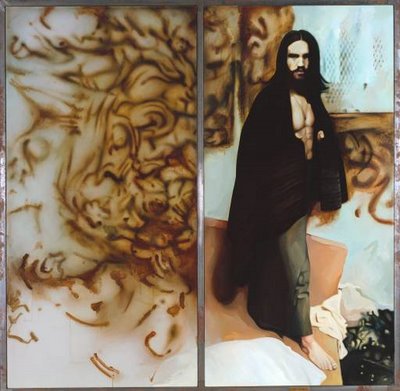
This is something of a coincidence in that recently, as well as turning to Stanley Spencer, I've been thinking about Richard Hamilton's famous picture "The Citizen", a diptych inspired by the Maze protests. Half abstract composition in shit, half altarpiece.
I also remember taking the bus home from school late one night in 1984, and discovering that the top deck of the number 264 had been taken over by Celtic fans, in town to see a recheduled European tie against Rapid Vienna.
A wry account of the match, and the journey to get to it, can be found at Sidenetting. From my perspective, a schoolkid in full uniform, heading back to the suburbs but surrounded by a crowd of loud if good-tempered Glaswegians, the experience was electrifying. They sang songs in praise of Bobby Sands. I found it rather shocking and rather scary. But without doubt also exciting.
 More recently, it seems that the British have been leaning on the Iranians to change the name of Tehran's Bobby Sands Street. Which is a street round the corner from the British Embassy.
This is something of a coincidence in that recently, as well as turning to Stanley Spencer, I've been thinking about Richard Hamilton's famous picture "The Citizen", a diptych inspired by the Maze protests. Half abstract composition in shit, half altarpiece.

I also remember taking the bus home from school late one night in 1984, and discovering that the top deck of the number 264 had been taken over by Celtic fans, in town to see a recheduled European tie against Rapid Vienna.
A wry account of the match, and the journey to get to it, can be found at Sidenetting. From my perspective, a schoolkid in full uniform, heading back to the suburbs but surrounded by a crowd of loud if good-tempered Glaswegians, the experience was electrifying. They sang songs in praise of Bobby Sands. I found it rather shocking and rather scary. But without doubt also exciting.
 More recently, it seems that the British have been leaning on the Iranians to change the name of Tehran's Bobby Sands Street. Which is a street round the corner from the British Embassy.
Diplomats at the embassy of the Republic of Ireland in Tehran admit the street is something of a tourist attraction for Irish nationals visiting the 25-year-old Islamic republic, saying it drew large crowds during an Ireland-Iran World Cup football qualifier in 2001.
Friday, March 24, 2006
normality
Below is the front page of Argentine daily newspaper Clarín, from March 25th 1976, thirty years ago, the day after the coup d'état that ushered in the so-called "Process of National Reconstruction." A "Process" in which some 30,000 would be killed.
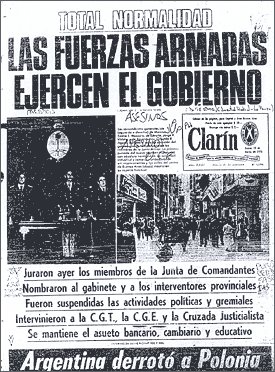
At the bottom of the page, the news of Argentina beating Poland at football. (For fact fans, Ezequiel Fernández Moores tells us that the score was 2-1, with goals from Héctor Scotta and René Houseman.) Ariel Scher explains in "Fuera de juego":
(For more, go here or, better, here [and thanks to Isis in the comments for the second link].)
Cross-posted to Long Sunday.
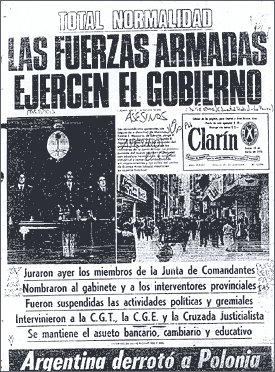
At the bottom of the page, the news of Argentina beating Poland at football. (For fact fans, Ezequiel Fernández Moores tells us that the score was 2-1, with goals from Héctor Scotta and René Houseman.) Ariel Scher explains in "Fuera de juego":
The most brutal of Argentina's brutal dictatorships decided almost from the first minute of its reign that sport would play on its team. It tried to use sport and even mould it in its own manner. Just a few hours after the coup d'état of March 1976, at a time when Argentina could be summed up in terms of a collection of proclamations from the military junta all of which began with the words "It is prohibited," the authoritarian leadership released communiqué number 23, the only one designed to permit rather than prohibit something. And what was permitted was the broadcast of the football game due to take place in Poland between the Argentine and the Polish national teams. And so it was: in the middle of all the crimes against humanity, proscriptions, kidnappings, disappearances, incarcerations, and with television showing otherwise only the national coat of arms, immobile, for a while you could watch the football. And that this happened is not just another anecdote or the result of some whim. Sport was always squarely in the gaze of dictatorial power.Meanwhile, the message at the top of the page: "Total Normality."
(For more, go here or, better, here [and thanks to Isis in the comments for the second link].)
Cross-posted to Long Sunday.
Thursday, October 13, 2005
denarrativization
I've written before about the relation between terror and narrative. But now my former student James passes me a link to Mark Danner's essay "Taking Stock of the Forever War", an account of the "global war on terror" since 9/11, which includes this observation:
At the same time, it is not as though the real--the real opened up in and by terror, the real of the war against terror, the real of the interplay of affect and habit--it is not as though this real were devoid of temporality or historicity. Any suggestion otherwise is psychoanalysis's classic error, the imposition of eternal, unalterable forms onto the psychic life of power.
We need to invent new ways of thinking history adequate to what at first appears to be an eternal present. Deserts lack the recognizable features that otherwise orient us in space and time; but their shifting sands hardly lack differentiation. Indeed they are endlessly, intensively, immanently differentiated, rather than merely distinguished according to fixed relations of extension and transcendent identity.
A war that had a clear purpose and a certain end has now lost its reason and its finish. Americans find themselves fighting and dying in a kind of existential desert of the present. For Americans, the war has lost its narrative.I don't know whether or not Danner's reference to a "desert of the present" is meant to be an allusion to Zizek's "desert of the real". I doubt it. On the other hand, it might as well be: the temporality of the real is, after all, alien to the chronology of narrative history.
At the same time, it is not as though the real--the real opened up in and by terror, the real of the war against terror, the real of the interplay of affect and habit--it is not as though this real were devoid of temporality or historicity. Any suggestion otherwise is psychoanalysis's classic error, the imposition of eternal, unalterable forms onto the psychic life of power.
We need to invent new ways of thinking history adequate to what at first appears to be an eternal present. Deserts lack the recognizable features that otherwise orient us in space and time; but their shifting sands hardly lack differentiation. Indeed they are endlessly, intensively, immanently differentiated, rather than merely distinguished according to fixed relations of extension and transcendent identity.
Sunday, August 21, 2005
theoria
Just a quick note to mark the appearance of Theoria, a new blog whose concerns and those of Posthegemonic Musings are likely to overlap frequently.
Theoria's first entry, on Pirates, Terrorists, Homo Sacer, includes a link to a rather interesting article on how thinking of terrorists as pirates can help win the war on terror.
More on this, anon.
Theoria's first entry, on Pirates, Terrorists, Homo Sacer, includes a link to a rather interesting article on how thinking of terrorists as pirates can help win the war on terror.
Wednesday, August 17, 2005
Salvador
Some days ago, Organic Warfare drew my attention to an entry on the so-called "Salvador Option". Unfortunately, his blog has all comments disabled, but you can see some of our subsequent discussion here.
More recently, I read a long article by Mark Fuller entitled "For Iraq, 'The Salvador Option' Becomes Reality", which draws on a whole number of sources, not least a January Newsweek article on "The Salvador Option" that summarizes this "option" as follows:
Now, I think that it is worth comparing Salvador and Iraq, though not necessarily in the ways that the above articles suggest. Indeed, I agree with Fuller that there are many ways in which Colombia is probably a better direct comparison. Panama might be another, as one of the US's first experiments in "regime change" in the modern style, and so successfully so (from the US perspective) that it might have given false confidence to those who plotted the Iraq War. Panama's president Noriega had, after all, like Hussein been a strategic ally in a strategically important location--in Noriega's case because he was sitting on the canal. But the US turned against their former strong man in the region, bringing him down in a full scale invasion (ordered by Bush père) on the flimsiest of excuses, with the minimum of US casualties. More details can be found from The Panama Deception, a film that was the Fahrenheit 911 of its day, a controversial 1992 Oscar winner. See also John Weeks and Phil Gunson's Panama: Made in the USA.
At the same time, there are many differences between Iraq and Salvador, Colombia, or Panama. None of the three turned into "failed states" in quite the spectacularly implosive and dangerous manner that Iraq has done so. None of these Latin American conflicts had ethnic or religious components. None were about exploitable resources. (Though Colombia does of course have an export crop that has found a fertile market in the USA, there are as yet no multinationals poised to take over its production and distribution.) None was ever more than briefly the focus of world attention. Still here are some snippets of thoughts about Salvador...
What is it about tall buildings? They seem to provoke a kind of fatal attraction among those that, following Deleuze and Félix Guattari, we could call nomads--those homeless, mobile, components of the war machine for whom "weapons are affects and affects weapons" (A Thousand Plateaus 400). New York's twin towers had, after all, been attacked before, while the height of success for El Salvador's Farabundo Martí National Liberation Front (FMLN) and perhaps the single most important moment of that country's ten-year civil war, was the guerrilla group's capture of the San Salvador Sheraton, one of the city's tallest buildings, in November 1989. As José Ignacio López Vigil puts it: "We attacked the big hotel because it was the highest point in the neighbourhood" (Rebel Radio 229).
Beyond strategic concerns, perhaps it is also that building upwards has been a defining mark of homogenizing unification from Babel to Taipei 101. Babel still epitomizes the dream of unimpeded and transparent communication, but it was also merely the first such project (and the first such tower) to fall. One may hesitate to call Babel "modern," but like the Pyramids (the world's highest manmade structures in the ancient era) its height required a kind of cooperation that ultimately only modernity would enable. It's no coincidence that Kuala Lumpur's city center, with the Petronas towers site of among the world's tallest buildings today, is an "intelligent precinct" set at one end of the world's most ambitious communications project, Malaysia's "Multimedia Super Corridor" (MSC), an area of land the size of Singapore that will be fully "wired" and will be site of two new "smart cities." Tall buildings epitomize the desire for transcendence, whether religious, state, or corporate; they enable surveillance and the dream of transparency; it is from the symbolic and material vantage point that height provides that social life can be stratified and ordered.
In El Salvador, the Sheraton proved to be the locus of far more than simply symbolic power. Attracted to its height, and so to its commanding position within the fashionable neighborhood of Escalón in which they were launching a counter-attack during the November 1989 offensive, the FMLN "had no idea who was inside: none other than the secretary general of the Organisation of American States, João Baena Soares, who was in El Salvador to learn about the war and ended up seeing it up close" (López Vigil, Rebel Radio 229). Still more significantly, also staying at the hotel, on the top floor, were twelve US green berets, who suddenly became in effect prisoners of the FMLN. The US president at the time (another George Bush) sent down an elite Delta Force special operations team from Fort Bragg, ready to intervene directly in the Salvadoran civil war for the first time. But after twenty-eight hours the guerrillas left the hotel of their own volition; as far as the press were concerned, they simply vanished: "Reporters who approached the hotel just after dawn [...] said there was no sign of the rebels who took over part of the hotel in the exclusive Escalon district of the capital" (Simon Tisdall, "Green Berets walk free from Salvador Siege," The Guardian [23 November 1989]: 10). Another report again emphasizes the sudden disappearance of the guerrillas ("the rebels were nowhere to be seen") and contrasts it with the US soldiers' territorial immobility and reliance upon direction from above: "The Green Berets, however, were still behind their barricades. 'We've had no orders so we're staying here,' one of them said to a large crowd of journalists" (Tom Gibb, "Sheraton siege ends as rebels withdraw," The Times [23 November 1989]: 10).
Across the country the offensive was now over. The FMLN had shown that they could mount and sustain an engagement at the very heart of middle class Salvadoran society--while, elsewhere, the government had shown that it had no qualms about bombing working class suburbs from the air, or about murdering some of the country's leading intellectuals, six Jesuit priests who worked and lived in the Universidad Centroamericana. State terror more than matched any "outrageous act of terrorism" (in the words of a US State Department spokesman [quoted in Tom Gibb, "US alert as rebels hold four in hotel," The Times (22 November 1989): 1]) that may have been committed by the insurgents. A realization on both sides of the resulting impasse led to the peace accords that ended the war.
Simultaneously, across the world the Cold War was now ending. The FMLN offensive (November 11th to 23rd) had taken place in the brief interlude between the fall of the Berlin wall (on November 9th) and the fall of the first East European communist regime--the Czech president quit and Dubcek returned to Prague on November 24th. The November offensive ("in all probability, the biggest guerrilla offensive ever mounted against a Latin American government" [McClintock, Revolutionary Movements in Latin America 84]), and particularly the incident in the Sheraton with which it ended, was then a hinge: both the last confrontation of the Cold War era and the first post-Cold War conflict, a premonition of future actions against tall buildings. In the incident at the Sheraton, the FMLN crossed the boundary that separates subaltern from hegemonic project, without for that entering into the space of hegemony itself. Rather, they provided a foretaste and example of posthegemony.
More recently, I read a long article by Mark Fuller entitled "For Iraq, 'The Salvador Option' Becomes Reality", which draws on a whole number of sources, not least a January Newsweek article on "The Salvador Option" that summarizes this "option" as follows:
The Pentagon is intensively debating an option that dates back to a still-secret strategy in the Reagan administration’s battle against the leftist guerrilla insurgency in El Salvador in the early 1980s. Then, faced with a losing war against Salvadoran rebels, the U.S. government funded or supported "nationalist" forces that allegedly included so-called death squads directed to hunt down and kill rebel leaders and sympathizers. Eventually the insurgency was quelled, and many U.S. conservatives consider the policy to have been a success—despite the deaths of innocent civilians and the subsequent Iran-Contra arms-for-hostages scandal. [. . .]See also the follow-up article, "Death Squad Diplomacy", by Christopher Dickey, who was a long-time correspondent in Salvador during the 1980s.
Following that model, one Pentagon proposal would send Special Forces teams to advise, support and possibly train Iraqi squads, most likely hand-picked Kurdish Peshmerga fighters and Shiite militiamen, to target Sunni insurgents and their sympathizers, even across the border into Syria
Now, I think that it is worth comparing Salvador and Iraq, though not necessarily in the ways that the above articles suggest. Indeed, I agree with Fuller that there are many ways in which Colombia is probably a better direct comparison. Panama might be another, as one of the US's first experiments in "regime change" in the modern style, and so successfully so (from the US perspective) that it might have given false confidence to those who plotted the Iraq War. Panama's president Noriega had, after all, like Hussein been a strategic ally in a strategically important location--in Noriega's case because he was sitting on the canal. But the US turned against their former strong man in the region, bringing him down in a full scale invasion (ordered by Bush père) on the flimsiest of excuses, with the minimum of US casualties. More details can be found from The Panama Deception, a film that was the Fahrenheit 911 of its day, a controversial 1992 Oscar winner. See also John Weeks and Phil Gunson's Panama: Made in the USA.
At the same time, there are many differences between Iraq and Salvador, Colombia, or Panama. None of the three turned into "failed states" in quite the spectacularly implosive and dangerous manner that Iraq has done so. None of these Latin American conflicts had ethnic or religious components. None were about exploitable resources. (Though Colombia does of course have an export crop that has found a fertile market in the USA, there are as yet no multinationals poised to take over its production and distribution.) None was ever more than briefly the focus of world attention. Still here are some snippets of thoughts about Salvador...
What is it about tall buildings? They seem to provoke a kind of fatal attraction among those that, following Deleuze and Félix Guattari, we could call nomads--those homeless, mobile, components of the war machine for whom "weapons are affects and affects weapons" (A Thousand Plateaus 400). New York's twin towers had, after all, been attacked before, while the height of success for El Salvador's Farabundo Martí National Liberation Front (FMLN) and perhaps the single most important moment of that country's ten-year civil war, was the guerrilla group's capture of the San Salvador Sheraton, one of the city's tallest buildings, in November 1989. As José Ignacio López Vigil puts it: "We attacked the big hotel because it was the highest point in the neighbourhood" (Rebel Radio 229).
Beyond strategic concerns, perhaps it is also that building upwards has been a defining mark of homogenizing unification from Babel to Taipei 101. Babel still epitomizes the dream of unimpeded and transparent communication, but it was also merely the first such project (and the first such tower) to fall. One may hesitate to call Babel "modern," but like the Pyramids (the world's highest manmade structures in the ancient era) its height required a kind of cooperation that ultimately only modernity would enable. It's no coincidence that Kuala Lumpur's city center, with the Petronas towers site of among the world's tallest buildings today, is an "intelligent precinct" set at one end of the world's most ambitious communications project, Malaysia's "Multimedia Super Corridor" (MSC), an area of land the size of Singapore that will be fully "wired" and will be site of two new "smart cities." Tall buildings epitomize the desire for transcendence, whether religious, state, or corporate; they enable surveillance and the dream of transparency; it is from the symbolic and material vantage point that height provides that social life can be stratified and ordered.
In El Salvador, the Sheraton proved to be the locus of far more than simply symbolic power. Attracted to its height, and so to its commanding position within the fashionable neighborhood of Escalón in which they were launching a counter-attack during the November 1989 offensive, the FMLN "had no idea who was inside: none other than the secretary general of the Organisation of American States, João Baena Soares, who was in El Salvador to learn about the war and ended up seeing it up close" (López Vigil, Rebel Radio 229). Still more significantly, also staying at the hotel, on the top floor, were twelve US green berets, who suddenly became in effect prisoners of the FMLN. The US president at the time (another George Bush) sent down an elite Delta Force special operations team from Fort Bragg, ready to intervene directly in the Salvadoran civil war for the first time. But after twenty-eight hours the guerrillas left the hotel of their own volition; as far as the press were concerned, they simply vanished: "Reporters who approached the hotel just after dawn [...] said there was no sign of the rebels who took over part of the hotel in the exclusive Escalon district of the capital" (Simon Tisdall, "Green Berets walk free from Salvador Siege," The Guardian [23 November 1989]: 10). Another report again emphasizes the sudden disappearance of the guerrillas ("the rebels were nowhere to be seen") and contrasts it with the US soldiers' territorial immobility and reliance upon direction from above: "The Green Berets, however, were still behind their barricades. 'We've had no orders so we're staying here,' one of them said to a large crowd of journalists" (Tom Gibb, "Sheraton siege ends as rebels withdraw," The Times [23 November 1989]: 10).
Across the country the offensive was now over. The FMLN had shown that they could mount and sustain an engagement at the very heart of middle class Salvadoran society--while, elsewhere, the government had shown that it had no qualms about bombing working class suburbs from the air, or about murdering some of the country's leading intellectuals, six Jesuit priests who worked and lived in the Universidad Centroamericana. State terror more than matched any "outrageous act of terrorism" (in the words of a US State Department spokesman [quoted in Tom Gibb, "US alert as rebels hold four in hotel," The Times (22 November 1989): 1]) that may have been committed by the insurgents. A realization on both sides of the resulting impasse led to the peace accords that ended the war.
Simultaneously, across the world the Cold War was now ending. The FMLN offensive (November 11th to 23rd) had taken place in the brief interlude between the fall of the Berlin wall (on November 9th) and the fall of the first East European communist regime--the Czech president quit and Dubcek returned to Prague on November 24th. The November offensive ("in all probability, the biggest guerrilla offensive ever mounted against a Latin American government" [McClintock, Revolutionary Movements in Latin America 84]), and particularly the incident in the Sheraton with which it ended, was then a hinge: both the last confrontation of the Cold War era and the first post-Cold War conflict, a premonition of future actions against tall buildings. In the incident at the Sheraton, the FMLN crossed the boundary that separates subaltern from hegemonic project, without for that entering into the space of hegemony itself. Rather, they provided a foretaste and example of posthegemony.
Friday, August 12, 2005
shock
I've been thinking a little more about habit, and what I said earlier, without wanting to go back and edit that entry.
I said that
Prevailing political discourse is rather contradictory on this point. On the one hand, it would have us, if possible, ignore terror and go on our merry way without changing our habits in the slightest. The fact that tube trains were (almost) full a few days after the attacks on the London Underground was touted as a victory for British stoicism, common sense, the "spirit of the Blitz" and so on. Meanwhile, the fact that the bombings on the Madrid train system may well have influenced the subsequent election has been portrayed as "giving in to terror," as allowing the terrorists to win.
On the other hand, we are to be eternally vigilant, to "learn the lessons" that terror has taught. The same people who denounce Spaniards for "giving in" are likely also to describe the attacks on New York and Washington as a "wake-up call" to rouse us out of our earlier somnolence, finally to do something about, whatever, the threat of Muslim fundamentalism or (in the case of the London incidents) the precariousness of multiculturalism.
I think it might be more helpful to think of terror as a "shock to thought" (to borrow a phrase from Brian Massumi) that occupies two temporalities. First, in the event itself, time stands still. Habit is suspended. Thought (by which I now mean the whole biological nervous and synaptic apparatus) is paralyzed. A pause, a ghastly instant of indecision, of an impossibility to decide (run, hide, fight, flight). Confusion. Even sensation may be in abeyance ("I didn't even realize I'd been hurt.") This is the time of the bomb itself, and it is almost outside of politics.
Second, after the event, a new, narrative temporality emerges. This is the time of explanation and recrimination, the elaboration of justifications, apologies, denunciations, or retaliations. Here the non-political event of terror itself is politicized, narrativized, given sense and coherence. Old narratives and habits may be resumed, recycled, reclaimed, but this is also an opportunity for the articulation of new, post-crisis analysis or political projects. Which would also help engender new habits, new ways of being.
And if terror has been put to use by the right (as it undoubtedly has been, to provide justification for imperial adventures in the Middle East and so on), why can it not be put to use by the left?
I said that
in general terror and habit are opposed. Terror seizes up all the processes that had become habitual, semi-automatic: it forces us to rethink our habits, by making us self-conscious about getting on the tube, sitting in an aeroplane, doing our shopping, seeing people with rucksacks, or whatever. Terror shocks us out of our routines; that's part of its trauma and most of its objective.Now, that too is ambivalent. Without becoming an apologist for terror, if it makes us rethink a thing or two, then that's no bad thing.
Prevailing political discourse is rather contradictory on this point. On the one hand, it would have us, if possible, ignore terror and go on our merry way without changing our habits in the slightest. The fact that tube trains were (almost) full a few days after the attacks on the London Underground was touted as a victory for British stoicism, common sense, the "spirit of the Blitz" and so on. Meanwhile, the fact that the bombings on the Madrid train system may well have influenced the subsequent election has been portrayed as "giving in to terror," as allowing the terrorists to win.
On the other hand, we are to be eternally vigilant, to "learn the lessons" that terror has taught. The same people who denounce Spaniards for "giving in" are likely also to describe the attacks on New York and Washington as a "wake-up call" to rouse us out of our earlier somnolence, finally to do something about, whatever, the threat of Muslim fundamentalism or (in the case of the London incidents) the precariousness of multiculturalism.
I think it might be more helpful to think of terror as a "shock to thought" (to borrow a phrase from Brian Massumi) that occupies two temporalities. First, in the event itself, time stands still. Habit is suspended. Thought (by which I now mean the whole biological nervous and synaptic apparatus) is paralyzed. A pause, a ghastly instant of indecision, of an impossibility to decide (run, hide, fight, flight). Confusion. Even sensation may be in abeyance ("I didn't even realize I'd been hurt.") This is the time of the bomb itself, and it is almost outside of politics.
Second, after the event, a new, narrative temporality emerges. This is the time of explanation and recrimination, the elaboration of justifications, apologies, denunciations, or retaliations. Here the non-political event of terror itself is politicized, narrativized, given sense and coherence. Old narratives and habits may be resumed, recycled, reclaimed, but this is also an opportunity for the articulation of new, post-crisis analysis or political projects. Which would also help engender new habits, new ways of being.
And if terror has been put to use by the right (as it undoubtedly has been, to provide justification for imperial adventures in the Middle East and so on), why can it not be put to use by the left?
Wednesday, August 10, 2005
habit
Back over at Fuller's Speed Shop, in response to a post of Glen's about "alternative security", I mused a little about "habit."
Habit has something of a bad press. Radicals (I mentioned Massumi's User's Guide to Capitalism and Schizophrenia, but there are plenty of other examples) see habit either in terms of clinging on to the remnants of convention and subjectivity or (in Marxist vein) as conformism and false consciousness. Meanwhile, liberals and the right too have a hard time with habit: it's regarded as pernicious by the ideologists of the market and the theorists of rational choice. After all, as soon as you do something out of habit, you are exhibiting some kind of unreason. Overall, habit is equated with addiction, with weakness, with bad faith, and with unadventurousness by both left and right.
But habit is simply a form of incorporated memory. I don't see it as essentially problematic in itself. Without the security (to use Glen's word) that habit brings, we would be essentially paralyzed. And while, as I said in a previous entry, being terrorist can and does become habitual, in general terror and habit are opposed. Terror seizes up all the processes that had become habitual, semi-automatic: it forces us to rethink our habits, by making us self-conscious about getting on the tube, sitting in an aeroplane, doing our shopping, seeing people with rucksacks, or whatever. Terror shocks us out of our routines; that's part of its trauma and most of its objective.
And habit goes every which way: it's a posthegemonic mode of control, but could surely also be a means of constructing posthegemonic community.
For while there are certainly (politically) bad habits, such as the unconscious sexism of men interrupting women, or the everyday racism that draws assumptions from skin colour, one could also imagine a political programme that saw itself as the inculcation of good habits: solidarity, say, could be a habit we might want to work on a little more. A solidarity that went beyond consciousness and good intentions, policy-making and self-dramatization, that was a habitual, affective mode of relating to the "other."
(Which somewhat circuitously brings us to "I'm alright, Jack", a recent and rather bizarre entry at Harry's Place that claims that the pro-war left has somehow assumed the mantle of internationalism. I contributed some comments to the discussion. It is a little odd to think that Harry's logic would lead one to nominate Oliver North as one of the foremost internationalists of the twentieth century. Well, I suppose in a way he was, but then we might want to distinguish better between internationalisms.)
Habit has something of a bad press. Radicals (I mentioned Massumi's User's Guide to Capitalism and Schizophrenia, but there are plenty of other examples) see habit either in terms of clinging on to the remnants of convention and subjectivity or (in Marxist vein) as conformism and false consciousness. Meanwhile, liberals and the right too have a hard time with habit: it's regarded as pernicious by the ideologists of the market and the theorists of rational choice. After all, as soon as you do something out of habit, you are exhibiting some kind of unreason. Overall, habit is equated with addiction, with weakness, with bad faith, and with unadventurousness by both left and right.
But habit is simply a form of incorporated memory. I don't see it as essentially problematic in itself. Without the security (to use Glen's word) that habit brings, we would be essentially paralyzed. And while, as I said in a previous entry, being terrorist can and does become habitual, in general terror and habit are opposed. Terror seizes up all the processes that had become habitual, semi-automatic: it forces us to rethink our habits, by making us self-conscious about getting on the tube, sitting in an aeroplane, doing our shopping, seeing people with rucksacks, or whatever. Terror shocks us out of our routines; that's part of its trauma and most of its objective.
And habit goes every which way: it's a posthegemonic mode of control, but could surely also be a means of constructing posthegemonic community.
For while there are certainly (politically) bad habits, such as the unconscious sexism of men interrupting women, or the everyday racism that draws assumptions from skin colour, one could also imagine a political programme that saw itself as the inculcation of good habits: solidarity, say, could be a habit we might want to work on a little more. A solidarity that went beyond consciousness and good intentions, policy-making and self-dramatization, that was a habitual, affective mode of relating to the "other."
(Which somewhat circuitously brings us to "I'm alright, Jack", a recent and rather bizarre entry at Harry's Place that claims that the pro-war left has somehow assumed the mantle of internationalism. I contributed some comments to the discussion. It is a little odd to think that Harry's logic would lead one to nominate Oliver North as one of the foremost internationalists of the twentieth century. Well, I suppose in a way he was, but then we might want to distinguish better between internationalisms.)
Monday, August 08, 2005
money
Another placeholder...
In an entry on "Freelance Freedom Fighters" (which also mentioned a post of mine from a few days back), the folk at Lenin's Tomb point to an article by Loretta Napoleoni on "The New Economy of Terrorism".
I think the point of Napoleoni's article (as is the point of most such articles) is to instruct us about the power of contemporary terrorism, and our powerlessness to do much about it. Lenin's Tomb comments (after some further references to Iraq) that "it looks as if the occupation is fucked."
But Napoleoni's first example is the Red Brigades, and she tells us effectively that soon enough the financial tail was wagging the terrorist dog:
At the very least, the picture Napoleoni provides is of a rather inefficient organization, more concerned with striving to maintain its overheads than with engaging in the activity to which it was purportedly dedicated.
Back to my earlier post, it would seem worth investigating the "tipping points" at which a political organization is transformed into what is effectively a mafia-style commercial (or better, perhaps, financial services) operation. Is that also the point at which such an organization ceases to be politically effective?
Of course, the violence continues. The FARC and the IRA (to use examples I invoked before) continued and continue to terrorize their respective populations in more or less everyday, low-level ways. But they have lost sight of their political goals and, more importantly perhaps, are in any case no longer in a position to accomplish them.
If I were a convinced free marketeer, I might even suggest that at this point (if not before) the best way of combatting such terrorists-turned-financiers would be to ensure that there were other more profitable, legitimate, channels for their financial investments. I.e. follow the money, and construct economic mechanisms (oh, I dunno, reducing taxes, say) to allow it to flow elsewhere. But I'm not, in part because you can't overlook the importance of affect and habit: as being terrorist, even growing up terrorist, becomes a way of life, it also becomes a habit or lifestyle that's hard to shake off. It shapes your affective and emotional life. (Look at the trauma when guerrilla groups disband, as in the Salvadoran case.)
Anyhow, more on this anon.
Oh except, and this does vaguely tie in with what I'm supposed to be doing, all this reminds me of the anecdote that opens Jorge Castañeda's Utopia Unarmed: the question, in the 1970s, of what to do with the Montoneros' $70 million in unspent ransom money, which ended up in trust with the Cubans after an earlier financial arrangement went wrong. The Cubans tried to get the Argentines to give the money to the Sandinistas, but the Argentines initially refused until under pressure they agreed to hand over $1 million, but on condition that the Nicaraguans would spread the word and set up some photo ops to give the impression that the Montonero leader Firmenich was a key figure fighting to defeat Somoza. The principle being that this would cheer up the chaps back home: the fight might be going badly in Argentina, as the military junta busily eliminated up to 30,000 people under the Proceso, but at least the head Argentine rebel honchos were helping out the Revolution elsewhere, rather than simply getting lazy and unfit sipping Havana Club on the Malecón.
In an entry on "Freelance Freedom Fighters" (which also mentioned a post of mine from a few days back), the folk at Lenin's Tomb point to an article by Loretta Napoleoni on "The New Economy of Terrorism".
I think the point of Napoleoni's article (as is the point of most such articles) is to instruct us about the power of contemporary terrorism, and our powerlessness to do much about it. Lenin's Tomb comments (after some further references to Iraq) that "it looks as if the occupation is fucked."
But Napoleoni's first example is the Red Brigades, and she tells us effectively that soon enough the financial tail was wagging the terrorist dog:
Just to give an idea of the vast amount of money required by an armed organization to function, in the 1970s, the Red Brigades had a turnover of $8 to 10 million, equivalent to about $100 million today. This figure was equivalent to the turnover of a medium size Italian company. Generating such vast flow of money required constant attention and absorbed the bulk of the time of the full time members of the organization.If this was indeed the case, one might argue that it was all to the good that the Red Brigades had their hands full trying to keep their financial show on the road, and so had little disposable time to engage in much real political violence.
At the very least, the picture Napoleoni provides is of a rather inefficient organization, more concerned with striving to maintain its overheads than with engaging in the activity to which it was purportedly dedicated.
Back to my earlier post, it would seem worth investigating the "tipping points" at which a political organization is transformed into what is effectively a mafia-style commercial (or better, perhaps, financial services) operation. Is that also the point at which such an organization ceases to be politically effective?
Of course, the violence continues. The FARC and the IRA (to use examples I invoked before) continued and continue to terrorize their respective populations in more or less everyday, low-level ways. But they have lost sight of their political goals and, more importantly perhaps, are in any case no longer in a position to accomplish them.
If I were a convinced free marketeer, I might even suggest that at this point (if not before) the best way of combatting such terrorists-turned-financiers would be to ensure that there were other more profitable, legitimate, channels for their financial investments. I.e. follow the money, and construct economic mechanisms (oh, I dunno, reducing taxes, say) to allow it to flow elsewhere. But I'm not, in part because you can't overlook the importance of affect and habit: as being terrorist, even growing up terrorist, becomes a way of life, it also becomes a habit or lifestyle that's hard to shake off. It shapes your affective and emotional life. (Look at the trauma when guerrilla groups disband, as in the Salvadoran case.)
Anyhow, more on this anon.
Oh except, and this does vaguely tie in with what I'm supposed to be doing, all this reminds me of the anecdote that opens Jorge Castañeda's Utopia Unarmed: the question, in the 1970s, of what to do with the Montoneros' $70 million in unspent ransom money, which ended up in trust with the Cubans after an earlier financial arrangement went wrong. The Cubans tried to get the Argentines to give the money to the Sandinistas, but the Argentines initially refused until under pressure they agreed to hand over $1 million, but on condition that the Nicaraguans would spread the word and set up some photo ops to give the impression that the Montonero leader Firmenich was a key figure fighting to defeat Somoza. The principle being that this would cheer up the chaps back home: the fight might be going badly in Argentina, as the military junta busily eliminated up to 30,000 people under the Proceso, but at least the head Argentine rebel honchos were helping out the Revolution elsewhere, rather than simply getting lazy and unfit sipping Havana Club on the Malecón.
Subscribe to:
Posts (Atom)