Tuesday, January 10, 2006

genre

Jose Maria ArguedasAntonio Melis says of the Peruvian writer José María Arguedas, "To begin with, the writings of Arguedas should be considered as an integrated totality (i.e. without the constraint of barriers such as genre)" (xi). This is indeed a good place to start: with a project to read the whole of Arguedas's writing, from the anthropological writings to the novels, from the poetry to the literary criticism, as constituting a whole life's work.

"It goes without saying," continues Melis, "that there are continuous and fertile exchanges between Arguedas's ethnoanthropological investigations and literary creations, exchanges that open the way to fruitful and reciprocal illuminations" (xi).

Ciro Sandoval makes a similar point about "the extraordinary cultural intertextuality called for when reading Arguedas":
It is arbitrary, therefore, to study Arguedas's literary work as independent or disconnected from his work as ethnographer, folklorist, translator, and interpreter of legends, myths, songs, and especially from his deep preoccupation with the study of autochthonous creativity and culture. If Arguedas is important, it is because he attempted a sociology of art and culture through literary, anthropological, ethnographic, linguistic, and folkloric venues. All these endeavors simultaneously unfold in Arguedas and mutually complement and interconnect at different levels. (xxxiii)
This is not to discard the question of genre completely. Rather, we should understand Arguedas's various incursions into different generic models as strategic interventions, a continuous process of experimentation, by which he attempted ever-new approaches towards the same fundamental problems that concerned him.

Arguedas's shift between genres, and his propensity to mix them up and crosspollinate them, introducing for instance to his novel Los ríos profundos chapters taken verbatim from his anthropological research, is not some exercise in writerly virtuosity. It's a sign of his profound dissatisfaction with all the genres available to him. More fundamentally, it's a sign of his dissatisfaction with writing, and indeed with language itself.

As Sandoval goes on to argue:
Arguedas's life and work represent a drama of the unspeakable, of the undecidable, of the culturally and linguistically untranslatable, a drama that began for him as a struggle with language [. . .]. (xxxiii)
Arguedas's lifework was an attempt to formulate something like a subaltern aesthetics, to translate, incarnate, or record in written, linguistic form a subaltern poiesis.

Arguedas, better perhaps than any other Latin American writer, reveals and explores the problem of subalternity's relation with representation. Nobody was more aware of the fact that the subaltern cannot speak, of the ways in which the Andean world lies outside of, and excluded from, Western frameworks of representation. Nobody was more agonized by the fact that portrayals of the indigenous, from the conquistadors' chronicles to liberal indigenism, always entailed a silencing and occlusion of any hope for subaltern self-expression.

None of which is to imply that the subaltern is mute: Arguedas celebrates and documents both the cultural creativity of (particularly) Quechua song and folklore, and also the force of a kind of collective murmur, the semi-audible rumours that circulate like water through any highland crowd (or multitude), at the same time as he indicates how that fluency and fluidity is broken in its translation to Spanish.

In the first place, then, Arguedas's numerous switches between genres register that brokenness: his work is indeed a "totality," as Melis suggests, but a totality that is fractured, perhaps (Arguedas fears) irredeemably so. But it was the hope that some redemption might be possible that kept him going for as long as he did.

Monday, January 09, 2006

Morales (anticipation)

A week or so ago, Glen nudged me to comment on a recent speech by Bolivian present-elect Evo Morales, translated as "I Believe in the Power of the People".

Evo MoralesFor the moment, though, this is just a placeholder.

And a link, first, to the original text, "Bolivia, el poder del pueblo", as well as to another translation of this same speech, courtesy of the Center for Media and Democracy.

Second, James Painter's analysis for the BBC, "Bolivia in for a bumpy ride", is a good enough general account of the situation.

Third, a clutch of bloggers: "A New Path for Bolivia", by Jim Schultz of Blog from Bolivia; "My Thoughts on Evo", by Miguel Centenellas of Ciao!; some reflections from Miguel Buitrago of MABB; and "Bolivia: A Democratic Revolution--or some other kind?", by Matthew Søberg Shugart of Fruits and Votes.

Finally, a link to a piece by James Petras, "Evo Morales: All Growl, No Claws?", which offers a rather more pessimistic prediction of Morales's future trajectory than others have provided.

Petras, a stalwart of publications such as the Monthly Review, is consistently the voice of ultra-left more-radical-than-thou commentary on Latin American politics. He's not particularly reliable. Still, it's worth quoting what he says:
All the data on Evo Morales' politics, especially since 2002, point to a decided right turn, from mass struggle to electoral politics, a shift toward operating inside Congress and with institutional elites. Evo has turned from supporting popular uprisings to backing one or another neo-liberal President. His style is populist, his dress informal. He speaks the language of the people. He is photogenic, personable and charismatic. He mixes well with street venders and visits the homes of the poor. But what political purpose do all these populist gestures and symbols serve? His anti-neo-liberal rhetoric will not have any meaning if he invites more foreign investors to plunder iron, gas, oil, magnesium and other prime materials. [. . .] Unfortunately, the Left will continue to respond to symbols, mythical histories, political rhetoric and gestures and not to programmatic substance, historical experiences and concrete socio-economic policies.
And for context, here's an older article by Petras on Bolivia: "Bolivia: Between Colonisation and Revolution". Well, vamos a ver, as they say. I'll return to this.

But while I'm at it, here's David Raby on Petras on Chávez: "Venezuela: The Myths of James Petras".

Sunday, January 08, 2006

telegraphy

A quick note on my friend Adam Frank's "Valdemar's Tongue, Poe's Telegraphy", available (for those who don't have access to Project Muse) from the most recent issue (number 72) of ELH.

Frank reads Edgar Allan Poe's 1845 short story "The Facts in the Case of M. Valdemar", a text analyzed also by Roland Barthes and Jacques Derrida, in terms not merely of nineteenth-century enthusiasm for Mesmerism, but also an engagement with the (then) new communications technology of telegraphy.

ValdemarThe tale's narrator is some kind of amateur scientist, interested in Mesmerism, who is called to the deathbed of one M. Valdemar, eager to experiment as to whether hypnosis might delay or arrest "the encroachments of Death." The narrator successfully puts his patient in a trance, only to discover that he enters a sort of post-mortem limbo, in which his tongue, "swollen and blackened," displays a "strong vibratory motion" and a voice emanating as though "from a vast distance" declares "Yes; - no; - I have been sleeping - and now - now - I am dead."

General horror ensures, and Valdemar is left in his funereal trance for seven months. Then, as the narrator decides finally to awaken his patient, once more "the tongue quiver[s]" and a voice is heard intoning "For God's sake! - quick! - quick! - put me to sleep - or, quick! - waken me! - quick! - I say to you that I am dead!" "Waking" him, the narrator finds that, at one stroke, the body deteriorates, leaving only "a nearly liquid mass of loathsome - of detestable putrescence."

Frank reads this episode, of the tongue speaking from within a dead body, both as a scene of writing--a black mark on a face white as paper--and as an instance of telegraphic communication. The vibrating tongue functions as a vibrating armature, registering a voice transmitted from an almost unimaginable distance, and conveying with it the affect associated (for Poe) with the innovation, creativity, and novelty of the new technology.

In stressing the affective qualities of telegraphic communication, Frank sees Poe's story as staging an almost anticipatory criticism of the discourse of science and transparency that will soon claim telegraphy for its own:
The narrator's facts-in-the-case [cf. the story's title], antifigurative style can be understood as governed by a decontamination script, one that tries to purify itself of figurative language: the struggle between the narrator and Valdemar, a struggle over style, is more specifically a struggle over figure. [. . . The story can then be read as] a burlesque of the antifigurative style and its desire for a purified control. [. . .] Poe's writing insists not on telegraphy as antifigurative but on telegraphy as (from the start) an overdetermined figure for, precisely, effective or manipulative writing, writing that may conceal the figurative but can never do without it. (655-656)
At the interface of telegraphic and literary writing, and also registering a nascent contest between and over these two technologies of communication, Poe's story is therefore profoundly political. At stake is
the control of body parts, thinking, and feeling of people at a distance [. . . that] creates the imagined possibility of a social body's consensus through the powerful force of a mass medium. (657)
At stake, in other words, is the properly posthegemonic question of the affective technologies that produce the fantasy--the "imagined possibility"--of a consensus that will then be misread as hegemony. The alternative is perhaps a dissolution, a literal body without organs, that belies the suspended animation of the mesmerized subject conjured up by rational control.

Such a dissolution provokes intense disgust in the narrator, and "unwarranted popular feeling" in his addressees, but is for Valdemar himself "a matter neither to be avoided nor regretted."

Saturday, January 07, 2006

more confusion

I have already discussed Leigh Binford's work on El Salvador, in which he argues for the utility of the concept of hegemony as a means to understand guerrilla insurgency.

I had been looking forward to reading his article "Hegemony in the Interior of the Salvadoran Revolution: The ERP in Northern Morazán," not least because I had assumed it would be a more theoretically robust defence of his approach. Unfortunately, it is not.

Northern Morazan
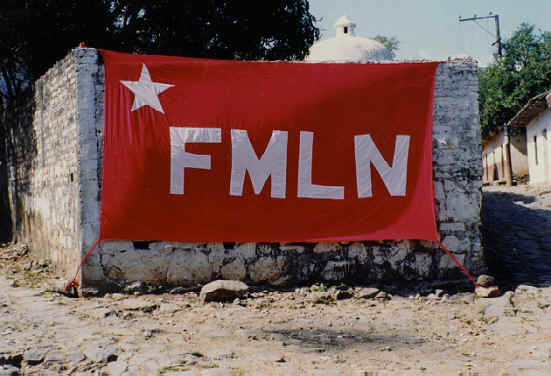
Northern Morazán was the area in which the FMLN had probably most secure hold throughout the war, and is where the so-called guerrilla capital, Perquín, was located. The area's prominence, however, is also due to the fact that it was the stronghold of what was the dominant and probably savviest of all the guerrilla forces that constituted the FMLN, the ERP (Ejército Revolucionario del Pueblo, or Revolutionary People's Army). On the one hand, this makes the region somewhat atypical of FMLN wartime experience and activity; on the other hand, it arguably provides particular insight into guerrilla organization and the likely shape of a post-revolutionary society, should the Revolution have been successful.

Binford's approach combines the concept of hegemony with the concepts of habitus and "field of power," these latter two terms drawn from the work of Pierre Bourdieu. His argument is that the FMLN embarked on "a double process of hegemony construction" (4), first among the civilians within the zone, and second (but at the same time) among their own guerrilla combatants. However, they were doubly constrained: first, by the fact that they were operating within what Binford calls a "military-political field of power" (4) within which the repressive state and its armed forces (literally) called many of the shots; and second, by the durability of pre-existing habitus, which included the machismo endemic among many of the guerrilla's own cadre and also the privileging of "household over collective production and individual over communal activity" among much of the peasantry (30).

In the end, then, Binford sees the FMLN's project as a failure, not simply because the Revolution never took place, but also (and perhaps this was the cause) because they were unable to effect durable change in people's pre-existing dispositions. In short, the "depth of ERP hegemony" (29) was at best shallow:
The motives of many participants remained instrumental, accompanied by only minor changes of consciousness, even if for some persons these practices contributed to the development of the "common meaningful and material framework" that is the sine qua non of hegemony (Roseberry 1994: 360-361). That that emergent framework never consolidated into a new "structure of feeling" (Williams 1977: 132) owed much to the short duration (eight years) and limited scope of the doble cara experiment [combining military and civil organization], which failed to reverse at the regional level well-entrenched cultural systems based on individualism and authoritarian control. (29-30)
There is here significant confusion as to whether or not what's at issue is consciousness, as in a traditional conception of ideology and consciousness-raising, or practice, which would be more in line of Bourdieu's notion of habitus as embodied well beneath the level of ideology. Binford would no doubt suggest that the answer is both: he earlier suggests that ERP strategy was focussed on practice, on the attempt to develop new habits, "reconfiguring practices rather than projecting messages" (17), but that this was intended to ensure that "representations more appropriate to that situation--those promoted by the FMLN--would then stand a better chance of becoming generalized" (18). In what would appear to be a dialectical process, "the representations would reinforce practices and the military's real and symbolic power would suffer continuous erosion" (18).

The entrance to Perquin
The concept of hegemony that Binford adopts, taken solely from William Roseberry's "Hegemony and the Language of Contention" (and essentially from one sentence of Roseberry's at that) brings together these two aspects, of consciousness and practice, in its definition (much cited by Binford) of hegemony as a "common meaningful and material framework." Unfortunately, however, neither in Roseberry nor in Binford are the elements that constitute this phrase properly explored or unpacked. Throwing in then the notion of "structure of feeling," drawn from Raymond Williams, only adds to the murk. Hegemony becomes a catch-all category to designate any and all forms of social inequality, control, dominance, or inertia.

Binford employs these concepts more as totems than as analytical categories. This is most evident in his use of the term "field of power," almost always italicized within his text as if to signify both that it is somehow foreign, untranslated French taken straight from Bourdieu, and that it is special, possessed of some undefined and ineffable aura. Occasionally some specification is added: as well as the "military-political field of power" (4), Binford also writes of Northern Morazán simply as a "field of power" (8) when it is not a "social field of power" (9) or a "field of political-military power" (9), a "regional field of power" within "more encompassing fields of power" (11), or perhaps a "field of military power" (11) (emphases all in original). But it is not at all clear what differentiations, if any, are to be marked by these slight changes. They give the impression of complexity without actually enhancing our understanding.

So it is more generally with Binford's use of the term "hegemony." This is not, in the end, a theoretical concept. Or rather, it is "theory" (Theory?) only in the sense that those who oppose theory imagine: it is the use of a somewhat unfamiliar term to add the gloss of sophistication, but thereby mystifying what is in the end an analysis premised on no more than common sense.

And the problem here is that, shielded beneath this confused pseudo-theoretical armature, what remains most stubbornly resistant to critique is "common sense" itself.

Friday, January 06, 2006

Benito Cereno

The University of Chicago Press's reissue of Carl Schmitt's Political Theology has a new Foreword by Tracy B. Strong. (I guess that's really his name... [and see Jodi's comment on this post]) It's a thoughtful and smart take on Schmitt, aligning him ultimately with Weber as a thinker concerned above all about the bureaucratization and so elimination of politics effected by modern technological rationality. Strong stresses therefore Schmitt's humanism, and suggests that this, however counter-intuitively, is what led him ultimately to Nazism:
Hitler appeared to him as something like the entity God had sent to perform a miracle [. . .] and the miracle was the recovery of a this-world transcendence to sovereignty and thus the human realm of the political. (xxx)
In this context, Strong also notes the connection, for Schmitt, between the exception and the miracle: "The exception in jurisprudence is analogous to the miracle in theology" (Political Theology 36).

Strong's engagement with Schmitt's Nazism is well-handled: neither the occasion for simple denunciation, nor for any kind of exculpation. He frames his analysis with a discussion of Schmitt's identification with the eponymous "hero" of Herman Melville's Benito Cereno. Indeed, Strong reports, "in a letter apparently written on his fiftieth birthday in 1938, Schmitt signed himself as 'Benito Cereno'" (ix). He summarizes the novel's plot as follows:
The title character in Benito Cereno is the captain of a slave ship that has been taken over by the African slaves. The owner of the slaves and most of the white crew have been killed, although Don Benito is left alive and forced by the slaves' leader, Babo, to play the role of captain so as not to arouse suspicion from other ships. Eventually, after a prolonged encounter with the frigate of the American Captain Delano during which the American at first suspects Cereno of malfeasance--he cannot conceive of the possibility that slaves have taken over a ship--the truth comes out: the slaves are recaptured and imprisoned, some executed. (viii-ix)
There's plenty of ambivalence in this story, not least when we try to map it on to Schmitt's own circumstances. As Strong notes, after World War II Schmitt's identification with Cereno could also serve as a metaphor for his relationship with the (now) occupying American powers. There are many ways in which one could read this story of a world turned (almost) upside-down.

Benito CerenoAlmost upside-down, that is, in that a white man continues to perform the role of slaveship captain. And the novel revolves around the question of that performance, of its credibility and its effects. In Strong's words again:
Benito Cereno is about, among other things, what being a sovereign or captain is, how one is to recognize one, and the mistakes that can be made when one doesn't. (x)
It's also therefore about the performativity of power, and what happens when the power to decide is displaced from its ostensible location.

Once more, though, ships on the (colonial, Hispanic) high seas serve as the model of sovereignty. And mutiny, treason, on board ship as instances of the threats that sovereignty faces.

Wednesday, January 04, 2006

mercenaries II

I've now finished Thomson's Mercenaries, Pirates, and Sovereigns. In her concluding pages she addresses some of the issues I raised yesterday about contemporary changes and developments. She writes that:
this study demonstrates the development of norms of nonstate violence that were quite robust in the nineteenth century, but the book has not dealt with certain practices that appear to challenge those norms. Were the Nicaraguan contras mercenaries for the United States? Did the U.S. military sell itself as a mercenary army to Kuwait? What about major instances of nonstate violence such as terrorists, drug smugglers, mafiosi, and pirates in the South China Sea? Do these contemporary practices mean the nineteenth-century norms of sovereignty are obsolete?

In my view, they do not. [. . .] Unlike their nineteenth-century counterparts [. . .] contemporary state leaders must [make use of nonstate violence] in secret. States today cannot shirk responsibility for nonstate violence by simply claiming that the latter is a purely private undertaking. [. . .]

But while each twentieth-century practice may be interpreted as being consistent with nineteenth-century norms of sovereignty, a question meriting further theorizing and more systematic empirical research is: How much can practices change and yet remain consistent with the institution of sovereignty? If this book's arguments are correct, a shift away from sovereignty to heteronomy or something else would require a fundamental change in the identity of the national state. This would entail an end to or at least significant erosion of the state's monopoly on the authority to deploy violence beyond its borders. (152-153)
Indeed.

So much for sovereignty. As for the multitude... there's an interesting hint a little earlier in a reference to Anthony Giddens, who argues, we are told, that
the production and control of violence follows a logic different from the production of wealth because in the former there is no force equivalent to the proletariat. Thus, the production of violence is not a dialectical process. (146)
The reference is to Giddens's A Contemporary Critique of Historical Materialism, volume 2, The Nation-State and Violence. I'm not sure that there isn't some confusion here between violence and power. For Negri's point about the multitude, as I understand it, is that its role in the production of power is equivalent to the proletariat's in the production of wealth. Indeed, that there's an almost exact symmetry between the process by which power is produced and the process by which wealth is produced.

In Thomson's book, power refers to the ability to control the allocation, means, and use of violence. But violence is also, of course, a form of power. Read from the point of view of the multitude, the history that Thomson recounts could precisely (I think) be recast in terms of a contest between different forms of power--heteronomy and sovereignty, if you like, in Thomson's own terms--in which the multitude plays a very similar role to that played by the proletariat in traditional accounts of political economy.

Which is not to say that we are thereby returned to dialectics.

Tuesday, January 03, 2006

mercenaries

Janice Thomson's Mercenaries, Pirates, and Sovereigns (discussed also in the Laboratorium) is about the constitution of sovereignty not (as is customarily stressed) so much by imposition of order within national territories, but by the delegitimation and suppression of extraterritorial violence wielded by non-state actors. In her words, she asks:
How did the state achieve a monopoly on violence beyond its borders that emanates from its territory? What explains the elimination of nonstate violence from global politics? (3; my emphasis)
For, as Thomson recounts at some length, until remarkably recently--the mid nineteenth-century at least--global violence was if anything dominated by non-state rather than state actors. Moreover, this non-state domination of extraterritorial force was for the most part accepted and even sanctioned by states themselves. Why, Thomson asks, should states desire to end this long tradition, especially in so far as it entailed numerous benefits to states both strong and weak?

Thomson provides a categorization of different forms of international non-state violence, from the different modes of mercenarism, to pirates and privateers, and international mercantile companies with sovereign and war-making rights.

Mercenarism, for instance, was endemic within Europe's armies of the eighteenth century: in 1743, 66% of Prussia's army was foreign; in 1701, 54% of Britain's army was non-national; while fully a third of France's pre-revolutionary land forces were foreign-born (29). Moreover,
Foreigners were not confined to service in armies; navies displayed a similar multinational character. In the 1660s, six thousand French sailors were serving abroad. One-third of the Dutch navy was French. About seven hundred Frenchmen served in the Sicilian navy, and more Frenchmen than Italians served in the Genoese fleet. At the same time, Italian volunteers and "slaves--North African 'Turks' . . . Russians, Negroes from West Africa, and a few Iroquois Indians"--worked as rowers in the French navy. (32-33)
Meanwhile, as for mercantile companies such as the English and Dutch East Indian Companies or the Hudson Bay Company, they
were, as a rule, granted full sovereign powers. In addition to their economic privileges of a monopoly on trade with a given region or in a particular commodity and the right to export bullion, they could raise an army or a navy, build forts, make treaties, make war, govern their fellow nationals, and coin their own money. (35)
Thomson notes the survival of some of these traditions, particularly mercenarism both sanctioned and un-sanctioned such as the role of Gurkhas in the British army, the continued role of the French Foreign Legion, and the role of soldiers of fortune in a variety of Africa's colonial and postcolonial wars. But her point is that by 1900 most of these practices had been thoroughly delegitimated: piracy was an international crime, privateering abolished, the mercantile companies disbanded or (in the case of the Hudson Bay Company) transformed into purely economic enterprises, filibustering (of the type exercised by William Walker in Nicaragua) outlawed, and so on.

I do wonder, however, what she would say now, ten years after her book was published, of the situation in Iraq. For is not mercenarism making a comeback, with the outsourcing of both official US warmaking to contractors, and the widespread use of private companies, usually employing ex-army personnel, for the security of everyone from the BBC to the United Nations? As John Robb's Global Guerrillas notes (and read the comments to his post),
PMCs (private military corporations) are central to the US effort in Iraq. With between 15,000 PMC (Update: 20,000) mercenaries in Iraq, they represent the second largest allied military force in theater.
See also Robert Fisk and Severin Carrell's article "Occupiers Spend Millions on Private Army of Security Men" or Global Risk Strategies' self-description as "the Force Protector for the International Zone Baghdad". And does not the role of a company such as Halliburton in Iraq remind us more than a little of the ways in which the East India companies served as proxies for colonial expansion in the seventeenth and eighteenth centuries?

What are the implications of these developments for contemporary discussions of sovereignty and the multitude?

Image from Blackwater USA

Monday, January 02, 2006

mercenaries (anticipation)

I've been reading Janice Thomson's Mercenaries, Pirates, and Sovereigns: State-Building and Extraterritorial Violence in Early Modern Europe, a book that Craig of theoria recommended to me some time ago. The title is somewhat unhelpful, in that it's not really about early-modern Europe, rather about the eighteenth- and nineteenth-century constitution of international order. But the book is certainly interesting, and I'll post some further comments in the next couple of days.

In the meantime, a happy new year to one and all.

Tuesday, December 13, 2005

conviviality

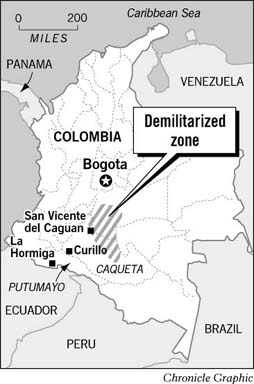
Alma GuillermoprietoWriting in 2000, a period during which the FARC still enjoyed state-sanctioned control of large swathes of South-Central Colombia marked out as a "zona de despeje," a cleared zone, Alma Guillermoprieto notes the grubby normality of everyday life in this safe haven. In San Vicente de Caguán, "there are loud cantinas; fleshy women in too much makeup under the glaring sun; block after block of storefronts selling boom boxes, high-heeled shoes, glitter eye shadow, and telephones shaped like hot dogs" (Looking for History 55).

The guerrilla, as far as Guillermoprieto can see, spend their time mostly lounging about: buying mascara and nail polish; chatting with neighbours; watching TV, their FALs and AK-47s casually propped up in the corner of the room. Of course, the point about a safe haven is that it's a good place for a little R&R; it's not as though there's no war on, and indeed with up to 20,000 people under arms, the FARC are able to carry out significant actions, "waging something very like real war against the Colombian state" (60). (And here's a pretty good round-up of recent accounts of "Latin American's Longest War".) But even this war has become very much a habit among its combatants, some of whom have known little else than life as a guerrilla.

For instance, compañera Nora, "a trim, agreeable woman in charge of the FARC's liaison with the public" (57) has spent well over half of her thirty-three years in the rebel ranks. Meanwhile, the insurgent leader, Manuel Marulanda or "Tirofijo", has been out in the hills in one form or another since the "Violencia" of 1948 to 1958. In Colombia, civil war is very much a way of life, for some almost a lifestyle option: Nora is reported as saying that she joined the FARC, at the age of fifteen, after she had seen a guerrilla column with its "brisk young women, in uniform and carrying guns, and thought they were the most powerful and glamorous creatures she had ever seen" (59).

At the time of Guillermoprieto's visit, the FARC and the Colombian government (under President Andrés Pastrana) were engaged in a "peace process," though these are hardly exactly peace talks: they are rather a "ritual encounter" celebrated "on a regular basis, and call[ed] progress" (64). No real dialogue was underway, and in any case everyone knew that at the margins prowled the military and their comrades in (para)military arms, the so-called "self-defence" units.

DMZ mapBut in any case, such hope as Guillermoprieto entertains is based on the notion that the FARC's experience in this demilitarized zone might bring about a rehabituation. In that they had not been granted sovereignty of this territory that was often misleadingly nicknamed FARClandia, Guillermoprieto notes that ""for the first time, the guerrillas are coexisting with the citizens of a small town, and even having to get along with its mayor" (66). The rebels are forced, in their downtime, at ease, to be "sharing social and political space with the inhabitants of San Vicente" (68).

For Guillermoprieto, then, the experience is a lesson in conviviality, that takes place at a level well below the comandantes non-negotiations with their official counterparts, and even well below the ideology that in any case is hardly the rebels' motive force.

This is not to say, however, that this process of conviviality is not connected in some way with the media--though it may not be mediated in any conventional sense. For Guillermoprieto ends her account with what we are to take as a hopeful sign: a sudden realization that comes to her on her last morning, as she is taking breakfast at a fonda, or small restaurant, abutting the local FARC headquarters. A television is on, as in Latin America one always is. And the programme playing was Xena: Warrior Princess, the TV industry's ironized take on fighting women. But this irony establishes, perhaps, some common ground:
Two waitresses, as young as the guerrillas next door, were glued to the program. And then I realized that the guerrillas were too. The FARC videos were still playing just on the other side of the wall, but the kids were taking turns sneaking out of the headquarters to stand at the doorway of the fonda, watching Xena. (71)
Of course, as a postscript acknowledges, just a couple of months later the US Congress approved "Plan Colombia". And by early 2002, the state withdrew its support for a demilitarized zone, the army returned, and so disappeared any hope for Xena-blessed conviviality.

Xena

Thursday, December 08, 2005

december

[A service announcement...]

What with one thing and another, mostly travel, I probably won't be able to update this blog very often over the rest of December. Normal service will resume in January.

Among my travel destinations, I will be at the MLA in Washington DC at the end of the month. Probably with a fair amount of time on my hands. So I'd be pleased to meet up with any like-minded (or even differently-minded) people who may also have the misfortune to be attending said conference.

I will also be in the UK earlier in December, but with much less time on my hands.

[Here ends the service announcement.]

Wednesday, December 07, 2005

seduction

Giaconda BelliGioconda Belli's The Country Under My Skin documents both the euphoria and the disappointment of the Nicaraguan revolution. It's also a meditation on the relations between power, affect, and knowledge. And it's a seductive tale warning of the dangers of seduction.

Belli is in Costa Rica in the days leading up to Somoza's downfall, frustrated about her distance from the real action. But thanks to her access to radio communications with rebel commanders on the front lines, she is able to follow the action if anything more closely than most of those on the ground: "It was mesmerizing to hear about the progress of the insurrection, to hear what was happening in real time" (234).

The final weeks and months of the Sandinista triumph went by astonishingly rapidly. Rather than leading, the Sandinistas were running to catch up with their impending triumph. Belli captures the "sensation of unreality" as victory finally, unexpectedly, raced up to meet them and the FSLN were thrust, blinking in the light, onto the world stage: "Sometimes it seemed as though they couldn't be talking about my tiny country, abandoned by everyone and beholden to a bloody dictator for half a century, but about a major power, able to make policy decisions that would alter Latin America's future" (236).

And then suddenly, almost anticlimactically, Somoza leaves office. And the Sandinistas, as much as anyone else, are left wondering what happens next: "Nobody spoke. Nobody moved. Everyone's eyes glittered with anticipation" (239).

Then the celebration: "Overcome with joy, we fell into one another's arms. 'Somoza left!' we repeated to each other, as we kissed, danced and hugged." And Belli echoes Neruda's famous "Heights of Macchu Picchu" in her invocation of the dead reborn in triumph: "Multitudes of our beloved dead came to life among us with their empty eyes, their deaf ears, the dust of their bones that could never celebrate with us" (239). It's a mythic time of (re)creation: "The 18th, the 19th of July 1979. [. . .] Two days that felt as though a magical, age-old spell had been cast over us, taking us back to Genesis, to the very site of the creation of the world" (241).

Such is the world-making power of revolutionary violence.

Ernesto Cardenal and multitude
But Belli, closely associated with the cúpula of the FSLN leadership, is soon entrusted with part of the transformation of that constituent power into constituted power: the construction of a nation, reconstruction of the state. Her task is to represent the revolution, to produce the "victory issue" of a new newspaper, to be called Patria Libre. This task can only be completed from the distance that representation requires, the newspaper then imported into the newly liberated country.

Flying into Managua on a plane loaded down with newsprint, Belli finds the airport almost deserted: the action is elsewhere. Only an old school friend has turned up to greet her, but Belli turns her away, judging her guardianship of the papers to be more important. Here, even at arrival, is the first disappointment, the first betrayal, of the revolution: over the "eerie desolation" of the airport terminal "Justine's face would be always superimposed. I managed to shake off my uneasiness. There would be time later on to explain things to Justine, to my parents, I said to myself. They would wait for me, they always did. But history wouldn't" (246).

Belli sets off, with her precious copies of Patria Libre, seeking to track down the history that the newspaper already claimed to represent. Her truck passes jubilant crowds: "their joy had the taste of sweet, red watermelon, its juice dripping down my chin" (247). But when at last they get to the city and reach the central plaza "there was no one left. That was when we realized that the crowds we'd seen on the road had been walking home after the celebration. All that was left in the great, deserted plaza were wrappers, trash" (248).

Henry Ruiz, aka ModestoIn place of this unpredictable, mobile multitude, the Sandinistas establish a militarized state as totem and fetish, positing its institutions and its leaders as the object of revolutionary desire--thus inverting the relationship constitutive of the triumph itself. Belli notes the demobilizing effect of this inversion, describing her lover Modesto and his "bodyguards, who only a month earlier had fearlessly confronted Somoza's tanks, [and now] were docile and obedient in their leader's presence" (266).

She observes the ways in which "military protocol had its grandiose, seductive side. [. . .] Modesto--comandante, member of the Sandinista National Directorate, maximum authority in Nicaragua both during and after the Revolution--would move calmly amid the soldiers hurriedly standing at attention" (266).

It's not long before Belli also realizes that "the dazzling spell of power"--constituted power, we should clarify--also entails self-delusion among those who wield it: "these men had been seduced by the spell of their own self-image [. . .]. They felt eminently astute and capable, a cross between political bright boys and heroic, strapping knights-errant" (275).

The Sandinistas begin to believe their own myth of leadership, rather than learning from their experience of belatedness. The only indication of what has been lost in this transition is the lingering nostalgia that pervades Belli's memoir, a "nostalgia for what we had been" (291) before the rigidity that set in with the state's consolidation, and before the FSLN retrospectively branded everything in sight with their red and black logo.

Tuesday, December 06, 2005

substitution

Le Colonel Chabert offers a fervent defence of populism--or rather, a fervent critique of anti-populism, which the colonel links to the anti-fanaticism of the war against terror. But it's an error to conflate populism and fanaticism, or to think that all enemies of one's enemies are alike. Populism is itself very clearly anti-fanatical. Yes, it mobilizes passions, but only then to demobilize and contain them. Whereas fanaticism seeks immanence, populism re-establishes transcendence.

Populism, especially indeed the neo-populism of someone like Chávez, is the last gasp of the social contract. (What the escuálidos don't realize is that Chávez is the great saviour of puntofijismo, not its downfall.) As such, it's a pre-eminent mode of counter-insurgency.

(Update: and now over on Lenin's tomb we read that "we have to side unflinchingly with populist movements".)

Here, more from Posthegemony, whose first chapter is devoted to populism (and whose second chapter deals with fanaticism)...

The dream of abstracting some radical impulse from populism's anti-authoritarian and rebellious sentiments is shipwrecked on the fact that, under the guise of subversion, populist movements only ever construct and consolidate sovereignty, authorizing a people whose rebelliousness never rises above sentimentality.

Populism, as exemplified by classical political movements such as Peronism and contemporary intellectual tendencies such as cultural studies, and as theorized by Laclau, entails a systematic set of substitutions. It presents us with people instead of classes (or multitude), rhetorical gestures instead of analysis (or struggle), morality instead of politics (or ethics), sentiment instead of affect (or habit) socialized identities instead of social forces (or preindividual singularities), transcendence instead of immanence (or quasi-causes), unity instead of multiplicity (or contingency), the body of the sovereign instead of the power of the state (or constituent force). As Kraniauskas observes, quoting Freud on fetishism, in each case "something else has taken its place, has been appointed its substitute, as it were, and now inherits the interest which was formerly directed to its predecessor" ("Rodolfo Walsh y Eva Perón" 113; emphasis in original). Through these serried substitutions, populism constructs a drastically simplified image of social space. What has been substituted is quickly forgotten, erasing also the process that has constructed this falsely simplified scenario of easy dichotomies, crystal clear antagonisms, and well-worn assumptions. It is true that these disavowals conserve some remainder of what has gone, but analysis must move beyond the mere examination of such symptoms.

Above all, populism presents us with hegemony instead of any other conception of politics, and the state's expansiveness as though it were cultural subversion or a flourishing civility. In the name of a purported counter-hegemony of anti-authoritarian sentiment, populism's self-erasing state logic permeates and coordinates everyday life. In an article tracing Marxist theories of the state, Laclau himself equivocates on this precise point. He notes that state logic has come to organize society as a whole: "the form of the state defines the basic articulations of a society and not solely the limited field of a political superstructure" ("Teorías marxistas del estado" 54); but he immediately disavows this insight by claiming that "political struggle has passed now to extend to the totality of civil society" (54). This only repeats the populist substitution: the state is conflated with civil society, political struggle with sovereign command. So long, therefore, as political analysis remains confined to the theory of hegemony, as is contemporary cultural studies, it will remain confined to a logic of populism unable either to differentiate itself from the populism of the right or even to recognize and so criticize the transformations and substitutions that populism demands and entails. Moreover, it will be anxiously haunted by the remainder that hegemony contains of what has been lost. Rather, then, than fixating on discursive articulations within civil society, we might do better to re-examine the differential inter-imbrication of culture and state. Or rather, we might again see the state as what has to be explained, in its dependence on but distinction from the affective performativity and cultural habit that sustains it.

Saturday, December 03, 2005

party

What's odd about Walter Benjamin's "Critique of Violence," at least from our present context, is how little the essay has to say about power. There is much about violence (of course) and much about the law. But the question of power hardly arises, and when it does its relation to violence and law is unclear.

"Lawmaking is power making," Benjamin tells us, "and, to that extent, an immediate manifestation of violence. Justice is the principle of all divine end making, power the principle of all mythical lawmaking" (295). Here, on the one hand, law and power are intimately related: to make law is to make power. On the other hand, power and justice are counterpoised: justice relates to ends and to divine violence; power relates (presumably) to means, and to mythical violence.

And this comes immediately after the observation that lawmaking, and so mythical violence, "establishes as law not an end unalloyed with violence, but one necessarily and intimately bound to it, under the title of power" (295). Power, here, is the "title" under which law and violence are "necessarily and intimately" bound one to the other.

This relative silence about power is odd in our present context, because for the past thirty years or so, political theory has been concerned above all with the problem of power. It has been the project of, first, Michel Foucault and, then, Antonio Negri to reconceive power, to rethink its origins and its historical vicissitudes. Indeed, at the core of Foucault's and Negri's political philosophy is power's relocation, even dislocation: Foucault with the concepts of disciplinary, capillary, and (most influentially at present) bio power; Negri with the fundamental distinction between constituent and constituted power.

It's not immediately clear how to map Benjamin's essay on to our contemporary concern with power. I'm not convinced by Paul Passavant's suggestion that we can read "violence" as "power." That's a little quick. It's true that Benjamin indicates that "mythical violence is bloody power" and "divine violence[,] pure power" (297). There's surely a nexus between violence and power. And there's no doubt that government without violence, or rather parliaments without "the sense that a lawmaking violence is represented by themselves," also lacks power, and proves unable to "achieve decrees worthy of this violence" (288). Yet the fact remains that Benjamin's is a critique of violence, not a critique of power.

I wonder if this is not because, whatever Benjamin's hesitations towards Bolshevism and the Soviet Union, he is not yet prepared to question the party form. It is not, yet, part of what Althusser would call his "problematic."

After all, the post-1968, perhaps better post-1956, critique of power for which I have provided the ciphers of Foucault and Negri (but one could add Deleuze and Guattari and even the whole tradition of cultural studies) is premised on an unease with if not outright rejection of the party form. This unease provides the problematic of contemporary political theory. It is only very recently indeed, essentially with Zizek's somewhat quixotic revival of Lenin, that anybody has had anything much good to say about the party as a mode of political organization. But this reassessment has entailed also a frontal assault on and so acknowledgement of the dominant problematic.

By contrast, Benjamin, for all that he draws on Sorel, is not yet, at least, post-Leninist. This is what is fundamentally alien about his essay.

Benjamin writes of the "state power" that the "proletarian general strike" is set to destroy (291), but in such a way that the phrase "state power" is almost an unexamined tautology. It is certainly not interrogated alongside the "educative power" that, for Gramsci (writing at about the same time), is the power of hegemony incarnated in the party cadre. Gramsci, of course, happily welcomed the notion that the party and the state wielded the same form of power: both aspired to hegemony, to be Prince, old or modern.

And Benjamin, for all the inkling of something like constituent power that this essay so tantalizingly invokes, is not yet able either to critique the party or to suggest an alternative to hegemony.

(Cross-posted to Long Sunday.)

Friday, December 02, 2005

factory

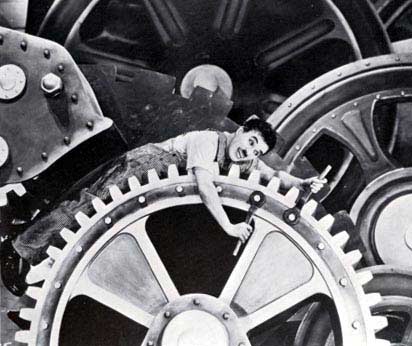
Simone Weil's "Factory Work" is a phenomenological account of the Fordist labour process and its "transmutation of man into workman" (55). Though the experience of the factory assembly line, full of sensation, sound, and movement, could in other contexts be considered "exhilarating" (54), this sensorial wealth goes unappreciated by the labourer: "Those who people the factories do not feel [its joys], except in rare and fleeting moments, for they are not free [. . .] for the vise of their servitude grips them through the senses, their bodies, the thousand and one little details that crowd the minutes of which their lives are constituted" (55).

What's interesting here, in the first place, is the way in which Weil describes Fordism as a mode of subjection through affect: it consists in the immediate capture of the senses that is simultaneously a desensitization, and so also a habituation to the machine. Reason is bypassed. Rather "what is recognized [. . .] is the barracks formula: 'Never mind the reasons!' [. . .] Come what may, the work must go on. It is up to the worker to get on with the job. And he does get on with it" (55).

Chaplin in Modern TimesWeil's account of the factory process is also an astute observation of the way in which subjection through affect and habit involves a detemporalization, or rather the denarrativization of time. The worker is unable to relate means to ends, and so "thought draws back from the future. This perpetual recoil upon the present produces a kind of brutish stupor" (57).

The resulting "mixture of monotony and accident" (58) makes of the labourer little more than an animal, who responds insensately, because so wrapped up the senses, to immediate stimuli and no more. The overall affective tone of the labour process is a "pervasive anxiety--the anxiety of not working fast enough--that is diffused through every working moment" (58).

It's because of its fundamentally non-narrative temporality that the factory experience also resists representation. For representation would entail the imposition of narrative upon an experience whose very essence is the loss of narrative. No wonder then that "workingmen themselves do not find it easy to write, speak, or even reflect on such a subject" (54).

So it is clear that the factory worker's subjugation is fundamentally non-hegemonic. And Weil's response to this predicament is to call for a hegemonization of the labourer within the production process. Weil sketches out a reformed factory system in which, though "nothing might accrue to [the worker's] actual rights" (70), labour could be emplotted within a master narrative of meaningful human activity, so producing a vision to which the worker would be wedded to his work, his consent finally secured:
If a workingman's job is to drop a die punch on a piece of brass destined for some device in a subway, he ought to know it. Moreover he ought to have a clear-cut image of the place and function of that piece of brass on the subway line, what operations it has already undergone and which ones are to follow before being put into place. the plea here is not, of course, for a lecture to each worker at the beginning of each piece of work. What is possible is such things as having each work group occasionally explore the plant by turns for several hours, at the usual wages, all to the accompaniment of appropriate explanations. Even better would be to allow each worker to bring his family along. And why not? [. . .] A workingman truly wedded to his job would be proud and happy to show his place of work to his wife and children. (67)
Here we see the pedagogic project of hegemony outlined. With sufficient education, the worker can enter heart and soul (rather than simply body and sense) into production. What's more, hegemony might also secure the expanded field of social reproduction, securing the consent not simply of the male worker, but also his wife and children. For it is a double wedding that ensues: married to the job as well as to his civil spouse, the worker inducts his family into subjugation to the machine age.

Take your Daughter to Work Day patchEven, then, in envisaging a workplace hegemonized, Weil already anticipates the posthegemonic real subsumption of society by capital achieved in post-Fordism with its "take your daughter to work" days and its language of "stakeholding" and individual proprietorship in the productive process.

The result, however, being that workers are their own masters only in the sense that they are encouraged to coordinate and so embrace their own alienation.

[UPDATE: See Jeremy's response in "factory revisited".]

Thursday, December 01, 2005

economy (stupid!)

I'm very pleased to present the following guest post from my friend Jeremy, on recent events in France...

It’s the Economy, Stupid!

Both in France and in Britain, media coverage and commentary on the recent disturbances in the banlieues has focused on the perceived fundamental differences between the French republican model of “integration” and the so-called “Anglo-Saxon model” of multiculturalism. Commentators on either side of the Channel, or indeed the Atlantic, rarely miss an opportunity to point to problems in the other country as evidence of the inherent failings of the foreign model and the superiority of their own.

Peter Mandelson, formerly the architect of Blairism, currently EC Trade Commissioner, was recently featured on BBC’s Newsnight programme, preparing to meet the French Trade and Agriculture Ministers in advance of the latest round of world trade talks. As Mandelson walked to the meeting, an advisor suggested he should break the ice by expressing his sympathy for the problems the French government was experiencing in quelling the nightly disturbances in the banlieues. “So much for the French social model they’re always telling us must be defended at all costs!” came Mandelson’s audible, acerbic reply.

Such evident Schadenfreude was perhaps understandable given the eagerness of French observers to lecture those in the so-called “Anglo-Saxon world” on the inherent superiority of the “French model.” In their analyses of the riots, several French commentators have been unable to resist comparing race relations in France with the situations in both Britain and the US, predictably concluding that things are far worse “chez les Anglo-Saxons.” For example, in the left-leaning Le Nouvel Observateur, Jacques Juillard and Jean Daniel insisted that where the July bombings in London demonstrate failings inherent to the “Anglo-Saxon model” of multiculturalism, rioting in the banlieues is in no way a symptom of equivalent flaws in French republican universalism; such problems, they assure us, relate to the purely contingent failure to apply republican values properly.

The mistake, when confronted with such patent examples of self-serving chauvinistic myopia, would be to play the French at their own game, by trumpeting the superiority of our own national models or traditions. However tempting, matching nationalistic bad faith with nationalistic bad faith will not advance us far.

What is really significant about the tendency of so many in France to champion the benefits of their own “social model” is that such apparently confident assertions of national superiority merely reveal the deep anxiety at perceived French national decline that in fact lies at their root. Moreover, what lies behind the periodic, largely directionless outbreaks of violent protest in the banlieues is not the failure of one or other model for “integrating” ethnic minorities. Rather, what’s at stake here is the breaking of the link between such differing conceptions of national belonging and the mode of capitalist accumulation that used to underpin them.

It is commonplace in France to claim that earlier immigrant generations were integrated into the Republic relatively unproblematically. Too often forgotten is that such immigrants either arrived as adults or, if children, had a mercifully brief exposure to the French education system, that talismanic site of republican integration. Arriving as adults or leaving school at 15, such immigrants and their offspring were in fact integrated in the Fordist workplace, through both labour and the labour movement, thanks to the ramified political, social, and cultural networks of unions and the Communist Party. The role of republican institutions was limited to equipping such workers with certain linguistic skills and a fairly minimal sense of specifically French cultural values and traditions.

The banlieues were, of course, the necessary adjuncts to Fordism. Inspired, architecturally, by Le Corbusier’s “factories for living,” they were located close to areas of heavy industry to provide housing for workers in France’s booming post-war economy. The decline of the banlieues has thus precisely mirrored the decline of French heavy industry and the shift to a post-Fordist mode of accumulation. As unskilled and semi-skilled factory jobs have dried up, so the young French working class, ethnic minorities and others alike, have been encouraged to spend ever longer in formal education, to be confronted on a daily basis with evidence of the disparity between the republican school’s promises of equality and meritocratic social promotion and the reality it can actually deliver.

As the bases of Fordism as mode of both governmentality and capitalist accumulation disappear, so republican institutions, and the school in particular, are left to take up alone the task of integrating France’s most economically and socially deprived groups. Unsurprisingly, this is a task which such institutions are unable to achieve in isolation. The more such institutions fail, the more politicians and commentators across the political spectrum insist that their founding values must be safeguarded and reasserted. But reasserting the very republican values and institutions whose failings banlieue inhabitants confront on a daily basis can only produce effects opposite to those desired. The thousands of burnt-out cars littering the streets is depressing evidence of such unintended consequences.

French Prime Minister Dominique de Villepin’s response to the rioting, which has included a plan to revive “pre-apprenticeship” schemes for young male immigrants, at least has the merit of moving beyond the traditional exclusive focus on republican institutions and the school. Indeed, his proposals might be interpreted as an attempt, doubtless vain, to suture the fractured link between republicanism and the Fordist mode of accumulation that had previously ensured the “integration” or disciplining of generations of French citizens into the body politic.

Another of De Villepin’s proposals, to introduce a form of “voluntary civil service” to replace the compulsory military service demanded, until a few years ago, of all male French school-leavers, is also telling. As Michael Hardt and Antonio Negri point out in Multitude, the disciplining of bodies under mass conscription paralleled the disciplining of bodies in the Fordist factory. It is this parallel, they argue, that Céline explores in Journey to the End of the Night, as his narrator recounts his experiences on the Western Front and, later, as a worker at the Ford factory in Detroit. What Hardt and Negri neglect to mention is that between these two experiences, Céline’s narrator recounts his encounter with French imperialism, in French West Africa. What Hardt and Negri term Fordist “disciplinary governmentality” did not merely involve a parallel between mass soldier and mass worker: it also rested on Western imperialism.

In France today, the Fordist factory has all but disappeared, mass conscription has been abolished, and the grandchildren of France’s former colonial subjects have arrived in the imperial metropolis to confront residual forms of colonial arrogance and violence; the old mission civilisatrice will no longer be enacted in a primary school in Kabylia, but in one of the newly designated Zones d’éducation prioritaire in the metropolis’s all too proximate periphery, the banlieue – open to all French residents, universally, as long as they leave their Islamic headscarves at the door.

De Villepin’s attempts to return to a more certain age, through a reassertion of republicanism, a dose of national service, and precocious insertion into the workplace, will doubtless prove in vain. Yet this should not be cause for any Mandelsonian Schadenfreude. For it is precisely the failings of the nation state, its institutions and traditions, that is at stake here, so that any analysis that falls back on disparaging comparisons between the failings of “their model” as against the strengths of “ours” paradoxically becomes a symptom of the very malaise it claims to diagnose.

Or rather, what’s at stake is the failed articulation between the nation state and the economy, between national ideology and the contemporary mode of capitalist accumulation. The fact that the London bombers hailed from declining industrial communities of the Midlands and the North should remind us that, contra Juillard and Daniel, what was significant in the UK, too, was not the inherent failings of a so-called “Anglo-Saxon” multiculturalism but the disappearance of Fordist structures of work and socialisation – it’s the economy, stupid!

This has been a guest post from Jeremy.