One of my panels at LASA (the Latin American Studies Association congress) turned once more to discussion of Ernesto Laclau.
I have spent a long time engaging with Laclau (and I deal with his work at length in my book's first chapter). His is an important and influential theory--indeed, I argue that it is the most complete theory of hegemony--but it is also fundamentally flawed and fatally limited.
In essence, what Laclau has done is extrapolate from the discussions among a small number of leftist radicals in Argentina during the early 1970s, when populism seemed the only possible horizon for politics. Their question then was how could they redeem populism for a progressive project, when there seemed to be no alternative available.
It is impressive that Laclau has managed to produce an entire politico-theoretical system from the dilemma that these militants perceived in a particular place at a particular time.
But what is extraordinary, given the subsequent adoption of this system almost wholesale by so much of cultural studies, is that if we return to the Argentine situation we see that left-populism was proved totally mistaken.
For the left was violently expelled from the Peronist coalition almost as soon as Perón arrived back in the country following his long exile. Moreover, the subsequent military coup then (and even more violently) showed that populism itself had run up against its limit when it refused to acknowledge the role of the state.
No doubt pretty much any political philosophy is at root largely an extrapolation from a particular state of affairs. Antonio Negri, for instance, is in his own way also still captivated by his observation of the rapid changes in Italy during the 1950s and 1960s, and then by his part in the resulting struggles of the early 1970s.
But Negri was at least to some extent right: the dismal failure of the Italian Communist Party’s so-called "historic compromise" revealed the political and theoretical poverty of the theory of hegemony upon which Eurocommunism (so lauded by Laclau) depended.
Negri was of course wrong about the imminence of revolution both then and, I'd argue, now, though I still think that there is much to salvage from his work none-the-less. I suppose that followers of Laclau could similarly argue that hegemony theory can likewise be salvaged even after its failure in the context in which it was originally elaborated, and for which it should ideally work best.
But they don't seem to acknowledge that failure in the first place, in part no doubt because Laclau's increasingly abstract systematization serves to obscure that context quite totally for most of his commentators.
Showing posts with label hegemony. Show all posts
Showing posts with label hegemony. Show all posts
Wednesday, June 24, 2009

Tuesday, May 12, 2009
hook
In a strange convergence, it turns out that the disgraced financier Bernie Madoff and the young Somali sea bandit Abdul Wali Muse have both been held in the same New York detention center, prompting the question who is the bigger pirate?
Indeed, where once they were celebrated as wizards, the financial whizzkids of Wall Street, or of corrupt behemoths such as Enron, are increasingly being condemned as pirates. "Make Enron Pirates Answer" demanded the LA Times a few years ago, and now we find that Enron has "gone global" as "hedge fund pirates" stalk the world economy. The comparison with the dangerous seas off the Horn of Africa is made explicit again as we're told that "Like Somali Pirates, Wall Street Holds U.S. to Ransom".
None of this, however, should be any great surprise. As Tom Wolfe reports, financiers have long self-consciously struck a "pirate pose", not least the Hedge Fund that unabashedly goes by the name of Pirate Capital, its website featuring a series of images that switch between wooden-masted sailing boats and computer print-outs of financial accounts. As Wolfe describes the firm:
 And now comes The Invisible Hook by Peter Leeson, who is apparently "Professor for the Study of Capitalism" at George Mason University. His website too is adorned with pirate imagery, and no wonder: his book is a whole-hearted celebration of piracy as a model for free-market economic practice.
Eighteenth-century pirates, Leeson want to argue, were the very model of rational economic actors whose bloodthirsty ways were merely the outcome of a commendable search for profit. Moreover, in balance pirates in fact did more good than harm, precisely thanks to their clear-eyed desire to maximize their personal earnings. Contrary to reputation, they were peace-loving democrats who merely cultivated a violent image as part of an enormously successful brand-management campaign. If we study Golden Age piracy, Leeson suggests, we learn the universal truth of the adage that "greed is good":
Ultimately, this is a superficial and even silly book. It's an exercise in market-choice dogma rather than a real investigation into the economics of piracy. Though it claims to overturn the ways in which we think about sea banditry, the version of piracy that it promotes is on the whole as abstract and idealized as the Disney caricatures that apparently first inspired the author's interest. It's just that these are idealized rational economic actors, rather than barbarous if comic exotic rogues. Either way, we get caricature. Pirates are merely the ruse for a not-so-very hidden agenda: here, a sort of duffer's guide to economic dogma.

In some ways, the failures of Leeson's book are predictable. Piracy has long served as a screen on to which all sorts of prejudices or idées fixes can be projected. As Leeson himself notes almost in passing, pirates have been cast as proto-communists as often as they have been presented as neoliberals avant la lettre; they have claimed for gay rights and queer theory as much as they have been condemned for their barbarous machismo; and they have been cast as forming ideal democratic societies as frequently as they have been represented as savages who care for neither morality nor legality.
But rather than repeating his own simplistic morality tale of greed is good, Leeson might have explored the fundamental ambivalence that enables piracy to serve as a Rorscharh Test for so many distinct political and social positions. If, for instance, the joint stock company incarnates what Marx termed the "communism of capital," perhaps these "sea-going stock compan[ies]" (41) have something to tell us about the capitalism of communism, or about a certain indecideability between a line of flight that seeks to escape all constituted authority and a constituent power that creates ever-new constitutions.
Leeson is really no more interested in politics as such than he is in history; the whole point of the book is show the purported superiority of classical economics to explain any aspect of human behavior. But he has to tangle with politics from time to time. Leeson's manifest libertarian impulses, that lead him to disparage the notion of state regulation at almost every turn, also force him to suggest a fine distinction between state government and private governance. If greed is good, then government is generally bad; but governance is praised as a form of privatized, self-regulating government. And this idealized conception of governance comes to sound remarkably like hegemony: it is voluntary, non-coercive, and contractual. For Leeson, pirate ships are not only exemplary instances of economic rationality; they are also (almost) perfectly functional hegemonies. And perhaps it is this, rather than the economic as such, that explains piracy's strange allure: it offers a counterpart to the pseudo-hegemony of the nation state, a romanticized conjunction of liberty and self-organization.
Indeed, where once they were celebrated as wizards, the financial whizzkids of Wall Street, or of corrupt behemoths such as Enron, are increasingly being condemned as pirates. "Make Enron Pirates Answer" demanded the LA Times a few years ago, and now we find that Enron has "gone global" as "hedge fund pirates" stalk the world economy. The comparison with the dangerous seas off the Horn of Africa is made explicit again as we're told that "Like Somali Pirates, Wall Street Holds U.S. to Ransom".
None of this, however, should be any great surprise. As Tom Wolfe reports, financiers have long self-consciously struck a "pirate pose", not least the Hedge Fund that unabashedly goes by the name of Pirate Capital, its website featuring a series of images that switch between wooden-masted sailing boats and computer print-outs of financial accounts. As Wolfe describes the firm:
The 41-year-old hedge fund founder Tom Hudson [. . .] struck a Blackbeard pose right out in the open—Blackbeard, the pirate who took what he wanted and was accountable to no one. When Hudson launched his company in Norwalk in 2002, he named it Pirate Capital and called its hedge fund the Jolly Roger. Outside the door to his office he installed a life-size wooden figure of a storybook pirate, in full color, wearing all the pirate’s rig: the patch over one eye, the golden hoop earring through one earlobe, the tricornered hat, Captain Hook’s hook instead of a hand on one arm, the pantaloons, the peg leg, and the cutlass. He handed out baseball caps and T-shirts emblazoned SURRENDER YOUR BOOTY!, which was funny but no joke.Of course, those who live by the sword also die by the sword: even before the current downturn, Pirate Capital faced mutiny as it tried to make its own staff walk the plank. But you could never suggest that the firm ever hid its piratical intentions. Rather, it gloried in them.
 And now comes The Invisible Hook by Peter Leeson, who is apparently "Professor for the Study of Capitalism" at George Mason University. His website too is adorned with pirate imagery, and no wonder: his book is a whole-hearted celebration of piracy as a model for free-market economic practice.
Eighteenth-century pirates, Leeson want to argue, were the very model of rational economic actors whose bloodthirsty ways were merely the outcome of a commendable search for profit. Moreover, in balance pirates in fact did more good than harm, precisely thanks to their clear-eyed desire to maximize their personal earnings. Contrary to reputation, they were peace-loving democrats who merely cultivated a violent image as part of an enormously successful brand-management campaign. If we study Golden Age piracy, Leeson suggests, we learn the universal truth of the adage that "greed is good":
Pirate greed is what motivated pirates to pioneer progressive institutions and practices. For example, this greed is responsible for pirates' system of constitutional democracy [. . .]. Pirate greed is also responsible for some sea rogues' superior treatment of blacks. (179)Mind you, Leeson also warns us that we should be careful not to learn too much from pirate self-organization: just because they arguably instituted a form of "workers' democracy" doesn't mean that contemporary corporations should feel constrained to follow suit; after all, workers would tend to support "risky decision making," while external financiers rightly reject such risks as they have "to bear the full costs of failure" (183). Oh, just imagine what a pickle we'd be in now if risk-loving workers held sway over the sensible inclinations of finance capitalists!
Ultimately, this is a superficial and even silly book. It's an exercise in market-choice dogma rather than a real investigation into the economics of piracy. Though it claims to overturn the ways in which we think about sea banditry, the version of piracy that it promotes is on the whole as abstract and idealized as the Disney caricatures that apparently first inspired the author's interest. It's just that these are idealized rational economic actors, rather than barbarous if comic exotic rogues. Either way, we get caricature. Pirates are merely the ruse for a not-so-very hidden agenda: here, a sort of duffer's guide to economic dogma.

In some ways, the failures of Leeson's book are predictable. Piracy has long served as a screen on to which all sorts of prejudices or idées fixes can be projected. As Leeson himself notes almost in passing, pirates have been cast as proto-communists as often as they have been presented as neoliberals avant la lettre; they have claimed for gay rights and queer theory as much as they have been condemned for their barbarous machismo; and they have been cast as forming ideal democratic societies as frequently as they have been represented as savages who care for neither morality nor legality.
But rather than repeating his own simplistic morality tale of greed is good, Leeson might have explored the fundamental ambivalence that enables piracy to serve as a Rorscharh Test for so many distinct political and social positions. If, for instance, the joint stock company incarnates what Marx termed the "communism of capital," perhaps these "sea-going stock compan[ies]" (41) have something to tell us about the capitalism of communism, or about a certain indecideability between a line of flight that seeks to escape all constituted authority and a constituent power that creates ever-new constitutions.
Leeson is really no more interested in politics as such than he is in history; the whole point of the book is show the purported superiority of classical economics to explain any aspect of human behavior. But he has to tangle with politics from time to time. Leeson's manifest libertarian impulses, that lead him to disparage the notion of state regulation at almost every turn, also force him to suggest a fine distinction between state government and private governance. If greed is good, then government is generally bad; but governance is praised as a form of privatized, self-regulating government. And this idealized conception of governance comes to sound remarkably like hegemony: it is voluntary, non-coercive, and contractual. For Leeson, pirate ships are not only exemplary instances of economic rationality; they are also (almost) perfectly functional hegemonies. And perhaps it is this, rather than the economic as such, that explains piracy's strange allure: it offers a counterpart to the pseudo-hegemony of the nation state, a romanticized conjunction of liberty and self-organization.
Saturday, September 13, 2008
imps
 María Amparo Ruiz de Burton’s Who Would Have Thought It? (the first Mexican-American novel in English) is centrally concerned with the notion of “good government”--and its absence from the nineteenth-century USA. Indeed, at some points the problems facing the country seem to be the fault of government per se “If we were to trace our troubles to their veritable source,” the novel’s narrator declares at one point, “we would often reach, more or less directly, their origin in our lawgivers. Not only the dwellers of the frontiers, not only the victims of lawsuits, not only--“ (201).
Here, however, the train of thought is interrupted. The narrator breaks off to declare “But I am no political philosopher. I am wandering away from my humble path” (201). And that path is, ostensibly, a romantic comedy of domesticity and manners.
The narrative opens as the life of the Norvals of New England is transformed when Dr. Norval returns to his family from an expedition to the American Southwest with a young Mexican girl named Lola he has helped to rescue from a band of border Indians. The doughty and upright Mrs Norval is shocked and upset, but the unwelcome arrival is rather sweetened by the fact that the girl brings with her a million dollars’ worth of gold ore and precious stones. Much of this loot has to be kept in trust until Lola comes of age and/or is reunited with her missing father. In the meantime, however, there is plenty that can be appropriated by the family, whose daughters are soon arrayed in the latest fashion and riding out from a New York mansion in the finest carriages. There is even enough money to be spread around family friends and acquaintances, and to outfit entire companies for the Union side when the Civil War breaks out.
The bulk of the novel then charts the ways in which money and warfare expose the frailties and hypocrisies of WASP respectability. The story’s greatest rogue is a lawyer turned preacher turned military man by the name of Mr. Hackwell, who circles the Norvals, their womenfolk, and their money, like a hyena who has sniffed out the stench of moral corruption and is anxious to reap the profits. Hackwell contrives to seduce Mrs Norval into a clandestine marriage once her husband takes off on yet another voyage, while trying to engineer nuptials between her son, Julian, and Hackwell’s own sister, Emma. All the while he lusts after the young Lola, who develops into a striking beauty as she matures, made all the more desirable by the potential dowry that she bears with her.
Rosaura Sánchez and Beatrice Pita point out that money and machinations thereby lead to “the fall of Republican motherhood” (“Introduction” xxviii) and “the violation of the marriage contract” (xxxi). But this is also an allegory of broader social disturbances, just as the arrival of Lola and her wealth points to the US acquisition of over half of Mexico’s mineral-rich territory following the Mexican-American War of 1846 to 1848. As Sánchez and Pita observe, the novel exposes “the degeneration of democratic values and the faltering of the republican ideal” as a whole (xlv). Democracy is a myth, rights are proclaimed only to be abused and ignored, and there is “no informed consent of the governed [. . .] but rather corruption and influence peddling everywhere, even in the highest circles of government” (xlv).
The novel is indeed scathing about the state of the American res publica. Mrs Norval’s sister, Lavinia, travels to Washington to enquire about her brother, Isaac, a prisoner of war in a Southern camp. She discovers, however, that her government is happy to let its citizens languish if it should mean increasing pressure upon the Confederacy’s capacity to feed even its own people. Moreover, Isaac in particular has been removed from any list of prisoners to be exchanged because he once had a run-in with a powerful politician. Private pride (as well as ambition and indifference) is allowed to over-rule any sense of compassion or responsibility.
Lavinia had previously “believed all she had read in printed political speeches” (106); soon, however, she reluctantly comes to share in the cynicism expressed eventually by almost all the novel’s admirable characters. Julian too, for instance, who is threatened with dismissal from the army despite his heroic record, and then studiously ignored when he tries to press his case before the President, soon finds himself learning a “bitter philosophy [. . .] from the leading men of his country” (215).
In short, precisely at the moment at which the United States is forging some of its most potent discourses of self-justification and exceptionalism, from Manifest Destiny to the Empancipation Declaration, Ruiz de Burton reveals their bankruptcy and hypocrisy. Figures such as Mrs Norval may continue to declare that theirs is “the best government on Earth” (67), and to rail against both foreigners and popery; but she is insulated by wealth and blinded by the return of long repressed desires that dance around her, Ruiz de Burton suggests, like “unbottled imps” that have particular and “abundant fun” in Washington (148). As the social contract is revealed to be a sham, any putative hegemony is replaced by the new habits of wealth and the impish antics of misguided desire.
Friday, August 15, 2008
never
There is no hegemony and never has been. We live in cynical, posthegemonic times: nobody is very much persuaded by ideologies that once seemed fundamental to securing social order. Everybody knows, for instance, that work is exploitation or that politics is deceit. But we have always lived in posthegemonic times: social order was never in fact secured through ideology. No amount of belief in the dignity of labor or the selflessness of elected representatives could ever be enough. The fact that people no longer give up their consent in the ways in which they may once have done, and yet everything carries on much the same, only shows that consent was never really at issue. Social order is secured through habit and affect: through turning the constituent power of the multitude back on itself. It follows also that social change is never achieved through any putative counter-hegemony. No amount of adherence to a revolutionary creed or a party line can ever be enough. The fact that people no longer believe in radical change in the ways in which they may once have done does not mean that everything will carry on much the same. Social change, too, is achieved through habit and affect: through affirming the constituent power of the multitude. But change is not a matter of substituting one program for another. The multitude betrays the best-laid plans.
Read more.... (long .pdf file)
Read more.... (long .pdf file)
Thursday, August 14, 2008
over
The fiction of hegemony is more threadbare than ever. The myth of the social contract is over. In place of coercion or consent, both of which depend upon granting transcendence to the state, posthegemony substitutes affect, habit, and an immanent multitude. Politics is biopolitics: in fact, it always has been, but today more clearly than before neither civil society nor the state are sites of struggle or objects of negotiation. At stake is life itself. One the one hand, increasingly corrupt forces of command and control modulate and intervene directly on the bodies of ordinary men and women. On the other hand, everyday insurgencies of constituent power reveal a multitude that betrays and corrodes constituted power from the inside, overflowing and escaping its bounds. The outcome of this confrontation is uncertain: constituent power may still fold back against itself; the line of flight that escapes may become suicidal; the multitude may turn bad and become monstrous; or perhaps, just perhaps, Exodus may lead to what Negri terms “the time of common freedom” (The Porcelain Workshop 161).
Read more.... (long .pdf file)
Read more.... (long .pdf file)
Monday, August 04, 2008
Columbus
Even empires seek validation. No power can subsist on coercion alone. Hence Italian Marxist Antonio Gramsci's famous distinction between "hegemony" and "direct domination." Hegemony is "the 'spontaneous' consent given by the great masses of the population to the general direction imposed on social life by the dominant social group" (Selections from Prison Notebooks 12). Direct domination is exercised by "the apparatus of state coercive power which 'legally' enforces discipline on those groups which do not 'consent' either actively or passively" (12). Hegemony, in fact, is primary: for Gramsci, power is grounded in consent, and force is employed only secondarily, "in moments of crisis and command when spontaneous consent has failed" (12). Coercion supplements consent, rather than vice versa. Hegemony is, in Gramsci's view, the bedrock of social order. It is through the pedagogical activities of intellectuals in civil society that the state maintains its grip over the exploited, and the dominant group cements the "prestige" that it "enjoys because of its position and function in the world of production" (12).
Read more.... (long .pdf file)
Read more.... (long .pdf file)
Friday, July 18, 2008
hegemony
Hegemony theory has become the ubiquitous common sense of cultural studies. This first chapter is a critique of both by means of an examination of their shared populism. After defining and historicizing the field, I embark on a close reading of the Argentine theorist Ernesto Laclau, whose version of hegemony theory is the most fully developed and influential for cultural studies. Laclau’s definition of hegemony is embedded in a series of reflections on populism, especially in his earliest book, Politics and Ideology in Marxist Theory, and in his latest, On Populist Reason. I trace the development of Laclau’s theory, showing how from the start it simply mimics the logic of populism. Laclau sets out to differentiate between a left populism and a populism of the right, a distinction that would be essential for cultural studies to make good on its political pretensions, but ultimately he fails to establish such a difference, even to his own satisfaction. I then move to the relationship between populism and the state, and show, again through a reading of Laclau, how hegemony theory and cultural studies alike repeat the populist sleight of hand in which a purported anti-institutionalism in fact enables the state apparently to disappear. Hegemony stands in for politics, and screens off the ways in which states anchor social order through habituation, under the cover of a fictional social contract. Throughout, in counterpoint, I offer an alternative account of the Argentine Peronism from which Laclau’s theory stems.
Read more.... (long .pdf file)
Read more.... (long .pdf file)
Tuesday, July 15, 2008
authoritarianism
When Latin American modernization projects fail, or when their ideological legitimation falters, authoritarian regimes often step in to complete (or to further) their agenda. Though authoritarianism is defined by its contempt for consensus (for which it substitutes coercion), it does not give up on discursive legitimation altogether; it merely prioritizes efficiency over hegemony. Authoritarianism's legitimation may still take its cue from populism's project of national popular redemption. Authoritarianism comes to be the pursuit of hegemony by other means once populism has defined hegemony as the model for the political--or rather, once populism has defined hegemony as politics by other means. Military rulers seeking justification by appealing to populist understandings of hegemony give an ironic twist to the martial understanding of politics implicit in the Gramscian concept of hegemony. Authoritarianism literalizes what, in cultural studies at least, is the figurative conceit of defining the pursuit of hegemony as a war of position. Thus the Argentine military president Juan Carlos Onganía in 1966 appeals to national unity, arguing that "the cohesion of our institutions [. . .] ought to be our permanent concern because that cohesion is the maximum guarantor of the spirit that gave rise to the republic" (qtd. in Loveman and Davis, The Politics of Antipolitics 195). Equally, handing over to what would become Perón's second administration, "in his farewell address to the Argentine people in 1973, General Alejandro Lanusse felt obliged to thank his fellow citizens for their patience with a government that had not been elected" (Schoultz, The Populist Challenge 20).
Friday, July 14, 2006
philosophy
Following on from my recent posts "tautology" and "radical", here is my draft review of Radical Democracy and Beyond Hegemony: "Radical Philosophy?". As it is a draft, please do not cite without permission.
As a taster, the conclusion:
Schecter's critique of purported post-liberalism, as simply a warmed-over liberalism that conserves the worst rather than the best of what it claims to supercede, is a useful antidote to theories of radical democracy. His analysis of liberalism's paradoxes, while not always novel, is also sharp and to the point. However, he might have considered more the possibility that we are already living in a posthegemonic age. Bush, Blair, and Co. hardly stir themselves much to fabricate consensus these days--indeed, Blair's main argument for the war in Iraq is now that precisely the unpopularity of his policies is a guarantee that he is not merely bowing to the court of legitimate public opinion. Moreover, is not Schecter's dream of a "constant exchange of information between producers [. . .] and consumers" (138) not already with us albeit in the form of questionnaires, focus groups, and the information derived from loyalty cards on the one hand, and advertising and the ideologies of business transparency on the other? We are already beyond hegemony, and whatever else radicalism might be, surely it does not involve rescuing liberalism, whether in its purer, idealist, form or in its corrupt, democratizing, incarnations.
As a taster, the conclusion:
Schecter's critique of purported post-liberalism, as simply a warmed-over liberalism that conserves the worst rather than the best of what it claims to supercede, is a useful antidote to theories of radical democracy. His analysis of liberalism's paradoxes, while not always novel, is also sharp and to the point. However, he might have considered more the possibility that we are already living in a posthegemonic age. Bush, Blair, and Co. hardly stir themselves much to fabricate consensus these days--indeed, Blair's main argument for the war in Iraq is now that precisely the unpopularity of his policies is a guarantee that he is not merely bowing to the court of legitimate public opinion. Moreover, is not Schecter's dream of a "constant exchange of information between producers [. . .] and consumers" (138) not already with us albeit in the form of questionnaires, focus groups, and the information derived from loyalty cards on the one hand, and advertising and the ideologies of business transparency on the other? We are already beyond hegemony, and whatever else radicalism might be, surely it does not involve rescuing liberalism, whether in its purer, idealist, form or in its corrupt, democratizing, incarnations.
Wednesday, July 12, 2006
tautology
More thoughts towards a review of Tønder and Thomassen's Radical Democracy...
In a quirk of sloppy copy-editing, one of the contributions to Lars Tønder and Lasse Thomassen's collection, Radical Democracy, bears the running header "For an Agnostic Public Sphere" instead of the essay's actual title, which is "For an Agonistic Public Sphere."
But this confusion between agnosticism and agonism is perhaps symptomatic of the problems afflicting the very concept of radical democracy. For though its proponents repeatedly invoke notions of political combat and engagement, they all too easily slip into quiescent indecision.
Put it this way: it is far from clear what is "radical" about radical democracy behind the rhetorical display of terms such as agonism, antagonism, pluralism, and the like.
 Is radical democracy a specific form of democracy, comparable to but different from (say) the Athenian, liberal, or neoliberal variants of democratic practice? And if so, is it a democracy still to come, to be fought for as a perhaps utopian horizon of democratic thought and struggle?
Or is it, by contrast, a form of democracy in which some groups (new social movements, say) currently engage, in other words a counter-democratic actuality that has emerged since the end of the Cold War and the bad old days of class politics?
On the other hand, could radical democracy be found less either in the future or the present, but in a return to the founding moment of the so-called "democratic revolutions"? Is radical democracy then a rediscovery of an inherent radicality democracy once provided but has now lost? In slightly different words, is radical democracy simply another name for what Simon Critchley here terms "true" democracy?
Or finally, is democracy always radical? Is radical democracy really a tautology, in that democracy properly understood and described, even as it is played out currently in the real world, is necessarily in some way radical?
In a quirk of sloppy copy-editing, one of the contributions to Lars Tønder and Lasse Thomassen's collection, Radical Democracy, bears the running header "For an Agnostic Public Sphere" instead of the essay's actual title, which is "For an Agonistic Public Sphere."
But this confusion between agnosticism and agonism is perhaps symptomatic of the problems afflicting the very concept of radical democracy. For though its proponents repeatedly invoke notions of political combat and engagement, they all too easily slip into quiescent indecision.
Put it this way: it is far from clear what is "radical" about radical democracy behind the rhetorical display of terms such as agonism, antagonism, pluralism, and the like.
 Is radical democracy a specific form of democracy, comparable to but different from (say) the Athenian, liberal, or neoliberal variants of democratic practice? And if so, is it a democracy still to come, to be fought for as a perhaps utopian horizon of democratic thought and struggle?
 Or is it, by contrast, a form of democracy in which some groups (new social movements, say) currently engage, in other words a counter-democratic actuality that has emerged since the end of the Cold War and the bad old days of class politics?
On the other hand, could radical democracy be found less either in the future or the present, but in a return to the founding moment of the so-called "democratic revolutions"? Is radical democracy then a rediscovery of an inherent radicality democracy once provided but has now lost? In slightly different words, is radical democracy simply another name for what Simon Critchley here terms "true" democracy?
Or finally, is democracy always radical? Is radical democracy really a tautology, in that democracy properly understood and described, even as it is played out currently in the real world, is necessarily in some way radical?
Friday, July 07, 2006
radical
I'm reading a couple of books for a review essay: Darrow Schecter's Beyond Hegemony and Lars Tønder and Lasse Thomassen's Radical Democracy.
Schecter's book is smart but misguided, and essentially involves an attempt to rescue liberalism from itself--or what he sometimes terms "early liberalism" from its historical vicissitudes. He likes, in short, the ways in which Kantianism sets up formal legality over legitimacy, as legitimacy (he argues) always involves a compromise in which particular interests take precedence over the universal, and a forced reconciliation or fabricated consensus (hegemony) results. The problem, Schecter recognizes, is that Kant secured such a distance of legality from interest or need only by assuming a limited suffrage and so by excluding women, wage-earners, etc. from the sphere of politics. Moreover, even within such an attenuated public sphere, actually existing liberal democracy depended upon a covert subject, the white male property-owner, and his particular interests. Still, Schecter wants to maintain the notion that a disinterested (and so legitimate) legality is attainable. For this he turns (rather unconvincingly) to the libertarian or "guild" socialism of G D H Cole.
Still, however wrong, Schecter's book is at least provocative and intelligent.
The same can hardly be said for Tønder and Thomassen's collection. Its premise is to set up a distinction "between abundance and lack," which essentially means playing off Lacanianism and Deleuzianism, all under the sign of radical democracy. The so-called Lacanians (because in fact they are Laclauians through and through) run through the same old moves about hegemony, constitutive outsides, tendentially empty signifiers, non-coincidence of desire, and the like. The so-called Deleuzians are, however, on the whole even worse, as they attempt to shoe-horn Deleuze within the framework of "radical democracy," as bidden by the collection's editors. Paul Patton's piece, for instance, rather bizarrely tries to claim that Deleuze was a paid-up liberal democrat mainly based on the fact that he so seldom discusses liberal democracy. His argument is generally along the lines of admitting "there is no doubt that Deleuze is not a theorist of democracy in the narrow sense of the term," but only to follow up with the thought that "it does not follow from this that Deleuze is hostile to democratic government" (54). Well, but you can't make of a non sequitur a democratic theorist.
Meanwhile, the whole concept of "radical democracy" is a con. The tag "radical" is basically meaningless. And there is much confusion as to what purpose the adjective serves: is the notion that radical democracy is some new kind of democracy, exciting, different, and better than (say) liberal or neoliberal democracy? Or is it that democracy is itself radical, and what's involved is merely a redescription to make democracy seem more exciting, different, and better than it currently appears? This ambivalence, which is never directly confronted, undermines the book's very premises.
Schecter's book is smart but misguided, and essentially involves an attempt to rescue liberalism from itself--or what he sometimes terms "early liberalism" from its historical vicissitudes. He likes, in short, the ways in which Kantianism sets up formal legality over legitimacy, as legitimacy (he argues) always involves a compromise in which particular interests take precedence over the universal, and a forced reconciliation or fabricated consensus (hegemony) results. The problem, Schecter recognizes, is that Kant secured such a distance of legality from interest or need only by assuming a limited suffrage and so by excluding women, wage-earners, etc. from the sphere of politics. Moreover, even within such an attenuated public sphere, actually existing liberal democracy depended upon a covert subject, the white male property-owner, and his particular interests. Still, Schecter wants to maintain the notion that a disinterested (and so legitimate) legality is attainable. For this he turns (rather unconvincingly) to the libertarian or "guild" socialism of G D H Cole.
Still, however wrong, Schecter's book is at least provocative and intelligent.
The same can hardly be said for Tønder and Thomassen's collection. Its premise is to set up a distinction "between abundance and lack," which essentially means playing off Lacanianism and Deleuzianism, all under the sign of radical democracy. The so-called Lacanians (because in fact they are Laclauians through and through) run through the same old moves about hegemony, constitutive outsides, tendentially empty signifiers, non-coincidence of desire, and the like. The so-called Deleuzians are, however, on the whole even worse, as they attempt to shoe-horn Deleuze within the framework of "radical democracy," as bidden by the collection's editors. Paul Patton's piece, for instance, rather bizarrely tries to claim that Deleuze was a paid-up liberal democrat mainly based on the fact that he so seldom discusses liberal democracy. His argument is generally along the lines of admitting "there is no doubt that Deleuze is not a theorist of democracy in the narrow sense of the term," but only to follow up with the thought that "it does not follow from this that Deleuze is hostile to democratic government" (54). Well, but you can't make of a non sequitur a democratic theorist.
Meanwhile, the whole concept of "radical democracy" is a con. The tag "radical" is basically meaningless. And there is much confusion as to what purpose the adjective serves: is the notion that radical democracy is some new kind of democracy, exciting, different, and better than (say) liberal or neoliberal democracy? Or is it that democracy is itself radical, and what's involved is merely a redescription to make democracy seem more exciting, different, and better than it currently appears? This ambivalence, which is never directly confronted, undermines the book's very premises.
Sunday, May 21, 2006
tears
 In Southern California for a conference, I finally got around to seeing Avi Lewis's and Naomi Klein's film The Take (official website here), which champions the Argentine movement to take over and recuperate abandoned factories.
Before the screening, I joked with some friends that the movie would most likely say more about Canada than about Argentina. But so indeed it turned out.
The Take gives us the Canadian dream: young, idealistic do gooders, who tell us they have for years lived with "tear gas by day, theory by night," spreading the word that an alternative is possible. Nothing revolutionary, mind you: merely the small difference of a slightly kinder, slightly more gentle capitalism.
Lewis and KIein are blithely unconcerned by the fact that the justification for the factory takeovers is presented very much in line with neoliberal rationality itself. We are told that worker-run businesses are more "efficient," because their workings are more transparent and because they have been cleansed of the corruption of their former owners. The state is warned not to intervene against the enterprising former workers, who show magnificent entrepreneurship as they lovingly care for and reactivate their sadly abandoned machines.
Obviously, no viewer can resist the banal liberal point that we'd rather see the workers Freddy and Lalo in charge of the plant than the Montgomery Burns style caricature of a former owner. But precisely the irresistability of this point is problematic.
And what's most striking is how much this is a film about affect, motivated by affect. You'd struggle hard to find a movie with more shots of men crying. The camera lingers on the tears rolling down their tough porteño cheeks. The men cry with nostalgia when they tour the ruined factory. They cry with joy when the provincial legislature gives them the legal right to return. They cry with frustration that their sense of self and masculine dignity has been humilliated, now they can no longer provide for their family (the wife's make up, the children's happy meals).
But finally, the film's closing sequence is a long montage of workers smiling, beaming, laughing in their pride and satisfaction as they joyfully invest their labour power into the production of value.
Simone Weil would have been pleased.
For they all worked happily ever after.
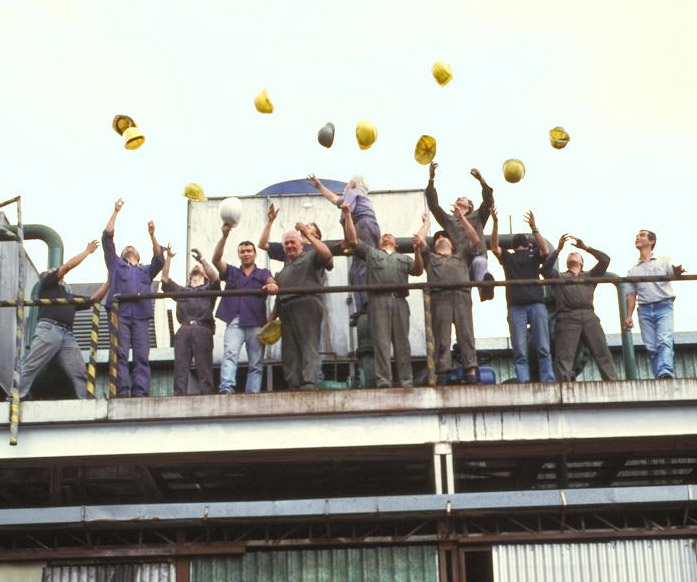
Update: tears revisited.
Saturday, January 07, 2006
more confusion
I have already discussed Leigh Binford's work on El Salvador, in which he argues for the utility of the concept of hegemony as a means to understand guerrilla insurgency.
I had been looking forward to reading his article "Hegemony in the Interior of the Salvadoran Revolution: The ERP in Northern Morazán," not least because I had assumed it would be a more theoretically robust defence of his approach. Unfortunately, it is not.
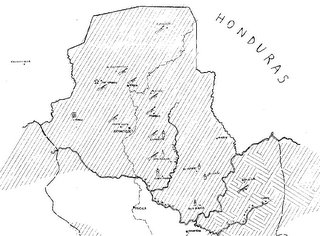
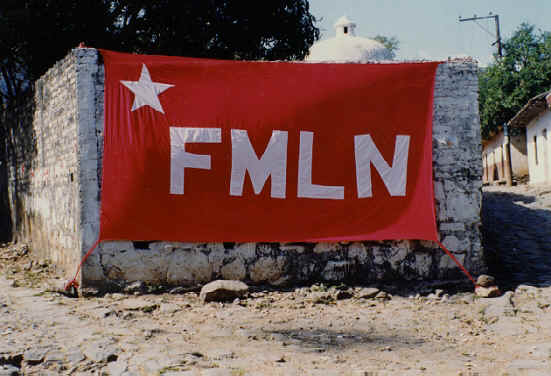
Northern Morazán was the area in which the FMLN had probably most secure hold throughout the war, and is where the so-called guerrilla capital, Perquín, was located. The area's prominence, however, is also due to the fact that it was the stronghold of what was the dominant and probably savviest of all the guerrilla forces that constituted the FMLN, the ERP (Ejército Revolucionario del Pueblo, or Revolutionary People's Army). On the one hand, this makes the region somewhat atypical of FMLN wartime experience and activity; on the other hand, it arguably provides particular insight into guerrilla organization and the likely shape of a post-revolutionary society, should the Revolution have been successful.
Binford's approach combines the concept of hegemony with the concepts of habitus and "field of power," these latter two terms drawn from the work of Pierre Bourdieu. His argument is that the FMLN embarked on "a double process of hegemony construction" (4), first among the civilians within the zone, and second (but at the same time) among their own guerrilla combatants. However, they were doubly constrained: first, by the fact that they were operating within what Binford calls a "military-political field of power" (4) within which the repressive state and its armed forces (literally) called many of the shots; and second, by the durability of pre-existing habitus, which included the machismo endemic among many of the guerrilla's own cadre and also the privileging of "household over collective production and individual over communal activity" among much of the peasantry (30).
In the end, then, Binford sees the FMLN's project as a failure, not simply because the Revolution never took place, but also (and perhaps this was the cause) because they were unable to effect durable change in people's pre-existing dispositions. In short, the "depth of ERP hegemony" (29) was at best shallow:
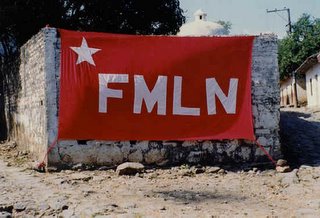
The concept of hegemony that Binford adopts, taken solely from William Roseberry's "Hegemony and the Language of Contention" (and essentially from one sentence of Roseberry's at that) brings together these two aspects, of consciousness and practice, in its definition (much cited by Binford) of hegemony as a "common meaningful and material framework." Unfortunately, however, neither in Roseberry nor in Binford are the elements that constitute this phrase properly explored or unpacked. Throwing in then the notion of "structure of feeling," drawn from Raymond Williams, only adds to the murk. Hegemony becomes a catch-all category to designate any and all forms of social inequality, control, dominance, or inertia.
Binford employs these concepts more as totems than as analytical categories. This is most evident in his use of the term "field of power," almost always italicized within his text as if to signify both that it is somehow foreign, untranslated French taken straight from Bourdieu, and that it is special, possessed of some undefined and ineffable aura. Occasionally some specification is added: as well as the "military-political field of power" (4), Binford also writes of Northern Morazán simply as a "field of power" (8) when it is not a "social field of power" (9) or a "field of political-military power" (9), a "regional field of power" within "more encompassing fields of power" (11), or perhaps a "field of military power" (11) (emphases all in original). But it is not at all clear what differentiations, if any, are to be marked by these slight changes. They give the impression of complexity without actually enhancing our understanding.
So it is more generally with Binford's use of the term "hegemony." This is not, in the end, a theoretical concept. Or rather, it is "theory" (Theory?) only in the sense that those who oppose theory imagine: it is the use of a somewhat unfamiliar term to add the gloss of sophistication, but thereby mystifying what is in the end an analysis premised on no more than common sense.
And the problem here is that, shielded beneath this confused pseudo-theoretical armature, what remains most stubbornly resistant to critique is "common sense" itself.
I had been looking forward to reading his article "Hegemony in the Interior of the Salvadoran Revolution: The ERP in Northern Morazán," not least because I had assumed it would be a more theoretically robust defence of his approach. Unfortunately, it is not.

Northern Morazán was the area in which the FMLN had probably most secure hold throughout the war, and is where the so-called guerrilla capital, Perquín, was located. The area's prominence, however, is also due to the fact that it was the stronghold of what was the dominant and probably savviest of all the guerrilla forces that constituted the FMLN, the ERP (Ejército Revolucionario del Pueblo, or Revolutionary People's Army). On the one hand, this makes the region somewhat atypical of FMLN wartime experience and activity; on the other hand, it arguably provides particular insight into guerrilla organization and the likely shape of a post-revolutionary society, should the Revolution have been successful.
Binford's approach combines the concept of hegemony with the concepts of habitus and "field of power," these latter two terms drawn from the work of Pierre Bourdieu. His argument is that the FMLN embarked on "a double process of hegemony construction" (4), first among the civilians within the zone, and second (but at the same time) among their own guerrilla combatants. However, they were doubly constrained: first, by the fact that they were operating within what Binford calls a "military-political field of power" (4) within which the repressive state and its armed forces (literally) called many of the shots; and second, by the durability of pre-existing habitus, which included the machismo endemic among many of the guerrilla's own cadre and also the privileging of "household over collective production and individual over communal activity" among much of the peasantry (30).
In the end, then, Binford sees the FMLN's project as a failure, not simply because the Revolution never took place, but also (and perhaps this was the cause) because they were unable to effect durable change in people's pre-existing dispositions. In short, the "depth of ERP hegemony" (29) was at best shallow:
The motives of many participants remained instrumental, accompanied by only minor changes of consciousness, even if for some persons these practices contributed to the development of the "common meaningful and material framework" that is the sine qua non of hegemony (Roseberry 1994: 360-361). That that emergent framework never consolidated into a new "structure of feeling" (Williams 1977: 132) owed much to the short duration (eight years) and limited scope of the doble cara experiment [combining military and civil organization], which failed to reverse at the regional level well-entrenched cultural systems based on individualism and authoritarian control. (29-30)There is here significant confusion as to whether or not what's at issue is consciousness, as in a traditional conception of ideology and consciousness-raising, or practice, which would be more in line of Bourdieu's notion of habitus as embodied well beneath the level of ideology. Binford would no doubt suggest that the answer is both: he earlier suggests that ERP strategy was focussed on practice, on the attempt to develop new habits, "reconfiguring practices rather than projecting messages" (17), but that this was intended to ensure that "representations more appropriate to that situation--those promoted by the FMLN--would then stand a better chance of becoming generalized" (18). In what would appear to be a dialectical process, "the representations would reinforce practices and the military's real and symbolic power would suffer continuous erosion" (18).
The concept of hegemony that Binford adopts, taken solely from William Roseberry's "Hegemony and the Language of Contention" (and essentially from one sentence of Roseberry's at that) brings together these two aspects, of consciousness and practice, in its definition (much cited by Binford) of hegemony as a "common meaningful and material framework." Unfortunately, however, neither in Roseberry nor in Binford are the elements that constitute this phrase properly explored or unpacked. Throwing in then the notion of "structure of feeling," drawn from Raymond Williams, only adds to the murk. Hegemony becomes a catch-all category to designate any and all forms of social inequality, control, dominance, or inertia.
Binford employs these concepts more as totems than as analytical categories. This is most evident in his use of the term "field of power," almost always italicized within his text as if to signify both that it is somehow foreign, untranslated French taken straight from Bourdieu, and that it is special, possessed of some undefined and ineffable aura. Occasionally some specification is added: as well as the "military-political field of power" (4), Binford also writes of Northern Morazán simply as a "field of power" (8) when it is not a "social field of power" (9) or a "field of political-military power" (9), a "regional field of power" within "more encompassing fields of power" (11), or perhaps a "field of military power" (11) (emphases all in original). But it is not at all clear what differentiations, if any, are to be marked by these slight changes. They give the impression of complexity without actually enhancing our understanding.
So it is more generally with Binford's use of the term "hegemony." This is not, in the end, a theoretical concept. Or rather, it is "theory" (Theory?) only in the sense that those who oppose theory imagine: it is the use of a somewhat unfamiliar term to add the gloss of sophistication, but thereby mystifying what is in the end an analysis premised on no more than common sense.
And the problem here is that, shielded beneath this confused pseudo-theoretical armature, what remains most stubbornly resistant to critique is "common sense" itself.
Tuesday, December 06, 2005
substitution
Le Colonel Chabert offers a fervent defence of populism--or rather, a fervent critique of anti-populism, which the colonel links to the anti-fanaticism of the war against terror. But it's an error to conflate populism and fanaticism, or to think that all enemies of one's enemies are alike. Populism is itself very clearly anti-fanatical. Yes, it mobilizes passions, but only then to demobilize and contain them. Whereas fanaticism seeks immanence, populism re-establishes transcendence.
Populism, especially indeed the neo-populism of someone like Chávez, is the last gasp of the social contract. (What the escuálidos don't realize is that Chávez is the great saviour of puntofijismo, not its downfall.) As such, it's a pre-eminent mode of counter-insurgency.
(Update: and now over on Lenin's tomb we read that "we have to side unflinchingly with populist movements".)
Here, more from Posthegemony, whose first chapter is devoted to populism (and whose second chapter deals with fanaticism)...
The dream of abstracting some radical impulse from populism's anti-authoritarian and rebellious sentiments is shipwrecked on the fact that, under the guise of subversion, populist movements only ever construct and consolidate sovereignty, authorizing a people whose rebelliousness never rises above sentimentality.
Populism, as exemplified by classical political movements such as Peronism and contemporary intellectual tendencies such as cultural studies, and as theorized by Laclau, entails a systematic set of substitutions. It presents us with people instead of classes (or multitude), rhetorical gestures instead of analysis (or struggle), morality instead of politics (or ethics), sentiment instead of affect (or habit) socialized identities instead of social forces (or preindividual singularities), transcendence instead of immanence (or quasi-causes), unity instead of multiplicity (or contingency), the body of the sovereign instead of the power of the state (or constituent force). As Kraniauskas observes, quoting Freud on fetishism, in each case "something else has taken its place, has been appointed its substitute, as it were, and now inherits the interest which was formerly directed to its predecessor" ("Rodolfo Walsh y Eva Perón" 113; emphasis in original). Through these serried substitutions, populism constructs a drastically simplified image of social space. What has been substituted is quickly forgotten, erasing also the process that has constructed this falsely simplified scenario of easy dichotomies, crystal clear antagonisms, and well-worn assumptions. It is true that these disavowals conserve some remainder of what has gone, but analysis must move beyond the mere examination of such symptoms.
Above all, populism presents us with hegemony instead of any other conception of politics, and the state's expansiveness as though it were cultural subversion or a flourishing civility. In the name of a purported counter-hegemony of anti-authoritarian sentiment, populism's self-erasing state logic permeates and coordinates everyday life. In an article tracing Marxist theories of the state, Laclau himself equivocates on this precise point. He notes that state logic has come to organize society as a whole: "the form of the state defines the basic articulations of a society and not solely the limited field of a political superstructure" ("Teorías marxistas del estado" 54); but he immediately disavows this insight by claiming that "political struggle has passed now to extend to the totality of civil society" (54). This only repeats the populist substitution: the state is conflated with civil society, political struggle with sovereign command. So long, therefore, as political analysis remains confined to the theory of hegemony, as is contemporary cultural studies, it will remain confined to a logic of populism unable either to differentiate itself from the populism of the right or even to recognize and so criticize the transformations and substitutions that populism demands and entails. Moreover, it will be anxiously haunted by the remainder that hegemony contains of what has been lost. Rather, then, than fixating on discursive articulations within civil society, we might do better to re-examine the differential inter-imbrication of culture and state. Or rather, we might again see the state as what has to be explained, in its dependence on but distinction from the affective performativity and cultural habit that sustains it.
Populism, especially indeed the neo-populism of someone like Chávez, is the last gasp of the social contract. (What the escuálidos don't realize is that Chávez is the great saviour of puntofijismo, not its downfall.) As such, it's a pre-eminent mode of counter-insurgency.
(Update: and now over on Lenin's tomb we read that "we have to side unflinchingly with populist movements".)
Here, more from Posthegemony, whose first chapter is devoted to populism (and whose second chapter deals with fanaticism)...
The dream of abstracting some radical impulse from populism's anti-authoritarian and rebellious sentiments is shipwrecked on the fact that, under the guise of subversion, populist movements only ever construct and consolidate sovereignty, authorizing a people whose rebelliousness never rises above sentimentality.
Populism, as exemplified by classical political movements such as Peronism and contemporary intellectual tendencies such as cultural studies, and as theorized by Laclau, entails a systematic set of substitutions. It presents us with people instead of classes (or multitude), rhetorical gestures instead of analysis (or struggle), morality instead of politics (or ethics), sentiment instead of affect (or habit) socialized identities instead of social forces (or preindividual singularities), transcendence instead of immanence (or quasi-causes), unity instead of multiplicity (or contingency), the body of the sovereign instead of the power of the state (or constituent force). As Kraniauskas observes, quoting Freud on fetishism, in each case "something else has taken its place, has been appointed its substitute, as it were, and now inherits the interest which was formerly directed to its predecessor" ("Rodolfo Walsh y Eva Perón" 113; emphasis in original). Through these serried substitutions, populism constructs a drastically simplified image of social space. What has been substituted is quickly forgotten, erasing also the process that has constructed this falsely simplified scenario of easy dichotomies, crystal clear antagonisms, and well-worn assumptions. It is true that these disavowals conserve some remainder of what has gone, but analysis must move beyond the mere examination of such symptoms.
Above all, populism presents us with hegemony instead of any other conception of politics, and the state's expansiveness as though it were cultural subversion or a flourishing civility. In the name of a purported counter-hegemony of anti-authoritarian sentiment, populism's self-erasing state logic permeates and coordinates everyday life. In an article tracing Marxist theories of the state, Laclau himself equivocates on this precise point. He notes that state logic has come to organize society as a whole: "the form of the state defines the basic articulations of a society and not solely the limited field of a political superstructure" ("Teorías marxistas del estado" 54); but he immediately disavows this insight by claiming that "political struggle has passed now to extend to the totality of civil society" (54). This only repeats the populist substitution: the state is conflated with civil society, political struggle with sovereign command. So long, therefore, as political analysis remains confined to the theory of hegemony, as is contemporary cultural studies, it will remain confined to a logic of populism unable either to differentiate itself from the populism of the right or even to recognize and so criticize the transformations and substitutions that populism demands and entails. Moreover, it will be anxiously haunted by the remainder that hegemony contains of what has been lost. Rather, then, than fixating on discursive articulations within civil society, we might do better to re-examine the differential inter-imbrication of culture and state. Or rather, we might again see the state as what has to be explained, in its dependence on but distinction from the affective performativity and cultural habit that sustains it.
Friday, December 02, 2005
factory
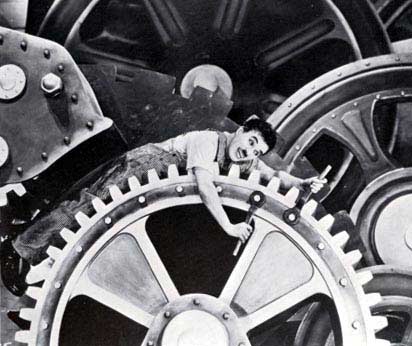
Simone Weil's "Factory Work" is a phenomenological account of the Fordist labour process and its "transmutation of man into workman" (55). Though the experience of the factory assembly line, full of sensation, sound, and movement, could in other contexts be considered "exhilarating" (54), this sensorial wealth goes unappreciated by the labourer: "Those who people the factories do not feel [its joys], except in rare and fleeting moments, for they are not free [. . .] for the vise of their servitude grips them through the senses, their bodies, the thousand and one little details that crowd the minutes of which their lives are constituted" (55).
What's interesting here, in the first place, is the way in which Weil describes Fordism as a mode of subjection through affect: it consists in the immediate capture of the senses that is simultaneously a desensitization, and so also a habituation to the machine. Reason is bypassed. Rather "what is recognized [. . .] is the barracks formula: 'Never mind the reasons!' [. . .] Come what may, the work must go on. It is up to the worker to get on with the job. And he does get on with it" (55).
 Weil's account of the factory process is also an astute observation of the way in which subjection through affect and habit involves a detemporalization, or rather the denarrativization of time. The worker is unable to relate means to ends, and so "thought draws back from the future. This perpetual recoil upon the present produces a kind of brutish stupor" (57).
The resulting "mixture of monotony and accident" (58) makes of the labourer little more than an animal, who responds insensately, because so wrapped up the senses, to immediate stimuli and no more. The overall affective tone of the labour process is a "pervasive anxiety--the anxiety of not working fast enough--that is diffused through every working moment" (58).
It's because of its fundamentally non-narrative temporality that the factory experience also resists representation. For representation would entail the imposition of narrative upon an experience whose very essence is the loss of narrative. No wonder then that "workingmen themselves do not find it easy to write, speak, or even reflect on such a subject" (54).
So it is clear that the factory worker's subjugation is fundamentally non-hegemonic. And Weil's response to this predicament is to call for a hegemonization of the labourer within the production process. Weil sketches out a reformed factory system in which, though "nothing might accrue to [the worker's] actual rights" (70), labour could be emplotted within a master narrative of meaningful human activity, so producing a vision to which the worker would be wedded to his work, his consent finally secured:
 Even, then, in envisaging a workplace hegemonized, Weil already anticipates the posthegemonic real subsumption of society by capital achieved in post-Fordism with its "take your daughter to work" days and its language of "stakeholding" and individual proprietorship in the productive process.
The result, however, being that workers are their own masters only in the sense that they are encouraged to coordinate and so embrace their own alienation.
[UPDATE: See Jeremy's response in "factory revisited".]
What's interesting here, in the first place, is the way in which Weil describes Fordism as a mode of subjection through affect: it consists in the immediate capture of the senses that is simultaneously a desensitization, and so also a habituation to the machine. Reason is bypassed. Rather "what is recognized [. . .] is the barracks formula: 'Never mind the reasons!' [. . .] Come what may, the work must go on. It is up to the worker to get on with the job. And he does get on with it" (55).
 Weil's account of the factory process is also an astute observation of the way in which subjection through affect and habit involves a detemporalization, or rather the denarrativization of time. The worker is unable to relate means to ends, and so "thought draws back from the future. This perpetual recoil upon the present produces a kind of brutish stupor" (57).
 The resulting "mixture of monotony and accident" (58) makes of the labourer little more than an animal, who responds insensately, because so wrapped up the senses, to immediate stimuli and no more. The overall affective tone of the labour process is a "pervasive anxiety--the anxiety of not working fast enough--that is diffused through every working moment" (58).
It's because of its fundamentally non-narrative temporality that the factory experience also resists representation. For representation would entail the imposition of narrative upon an experience whose very essence is the loss of narrative. No wonder then that "workingmen themselves do not find it easy to write, speak, or even reflect on such a subject" (54).
So it is clear that the factory worker's subjugation is fundamentally non-hegemonic. And Weil's response to this predicament is to call for a hegemonization of the labourer within the production process. Weil sketches out a reformed factory system in which, though "nothing might accrue to [the worker's] actual rights" (70), labour could be emplotted within a master narrative of meaningful human activity, so producing a vision to which the worker would be wedded to his work, his consent finally secured:
If a workingman's job is to drop a die punch on a piece of brass destined for some device in a subway, he ought to know it. Moreover he ought to have a clear-cut image of the place and function of that piece of brass on the subway line, what operations it has already undergone and which ones are to follow before being put into place. the plea here is not, of course, for a lecture to each worker at the beginning of each piece of work. What is possible is such things as having each work group occasionally explore the plant by turns for several hours, at the usual wages, all to the accompaniment of appropriate explanations. Even better would be to allow each worker to bring his family along. And why not? [. . .] A workingman truly wedded to his job would be proud and happy to show his place of work to his wife and children. (67)Here we see the pedagogic project of hegemony outlined. With sufficient education, the worker can enter heart and soul (rather than simply body and sense) into production. What's more, hegemony might also secure the expanded field of social reproduction, securing the consent not simply of the male worker, but also his wife and children. For it is a double wedding that ensues: married to the job as well as to his civil spouse, the worker inducts his family into subjugation to the machine age.
 Even, then, in envisaging a workplace hegemonized, Weil already anticipates the posthegemonic real subsumption of society by capital achieved in post-Fordism with its "take your daughter to work" days and its language of "stakeholding" and individual proprietorship in the productive process.
 The result, however, being that workers are their own masters only in the sense that they are encouraged to coordinate and so embrace their own alienation.
[UPDATE: See Jeremy's response in "factory revisited".]
Sunday, November 27, 2005
affinity
Both the title and the subtitle of Richard Day's Gramsci is Dead are misleading. The title because, though Day has much to say about hegemony, his version of the concept is sufficiently broad that he traces it back to (at least) Hegel, and he hardly discusses Gramsci's contribution. (I suppose, however, that Hegel is Dead would have been a marginally less alluring title.)
The subtitle, "Anarchist Currents in the Newest Social Movements" is also something of a misnomer, mostly because Day is less concerned to establish influences than to point to resonances between social movements and the anarchist tradition. Even then, he is interested primarily in the ways in which recent theory as well as recent practice might help release anarchism (as well as Marxism) from what he terms "the hegemony of hegemony."
Day establishes an opposition between the "logic of hegemony" and the "logic of affinity." Hegemony, he tells us, is totalizing and state-centered. It operates, equally in either what he likes to term its "(neo)liberal" or its "(post)marxist" variants, by means of demand, representation, recognition, and integration. From the very moment that politics is predicated on the demand, it implies and invokes the existence of a state before which the individual or group constituted in the demand seeks to be represented, and by which it hopes to be first recognized and then integrated. Affinity, on the other hand, begins with Exodus and establishes self-generated (and self-valorizing) communities predicated on a "groundless solidarity" and "infinite responsibility" that are always open to the new and the other.
Though inspired by, and driven in part by an attempt to revindicate, the historical tradition of anarchist thought from William Godwin to Gustav Landauer, Day also stresses the contribution of poststructuralist and postmodern theorists such as Foucault and (above all) Deleuze and Guattari. He is particularly interested in the figure of the "smith" found in A Thousand Plateaus: the smith, located somewhere between nomad and citizen, opens up and inhabits the "holey space" that is neither fully smooth nor fully striated. The smith, Day argues, is "the autonomous subject of the coming communities" (128).
Day puts his case forcefully and in large part convincingly. There is no doubt that we should leave the dead carcass of hegemony and hegemonic thought well behind us. Yet the final few pages of Gramsci is Dead indicate some gnawing problems with his grand narrative pitting hegemony against affinity. Here he acknowledges that states are no longer sovereign as they once were, and that this is in part because "corporations [are] working to undermine" them (217). "Decentralization," Day admits, "just as easily, and much more likely under current conditions, means a shift from modern discipline to postmodern control" (216). Distinguishing between "radicle and radical forms of rhizomatic organization," he notes that "maintaining this differentiation will become an ever-more pressing task" (216).
For indeed, the notion of a grand struggle between hegemony and affinity no longer makes much sense (if it ever did). We live in posthegemonic times, in which control is exerted directly and immediately by affective and habitual means. And on the other hand, for all the fine examples of social movements that Day puts forward, from the Zapatistas to No One is Illegal, from Participatory Economics to People's Global Action, I am not sure that we can be quite so sanguine these days about Temporary Autonomous Zones, or that "clearly, an experiment carried out as part of a mass movement is much more dangerous than the same experiment undertaken by one or more packs" (176). What, after all, about the pack that carried out its experimentation on September 11th 2001, a day that cannot be so glibly despatched as "the Day of the Great Excuse for Oppression" (32).
In short, beyond attention-grabbing and unenlightening exclamations (Gramsci is Dead!), rather more work is required to construct a theory of posthegemony.
(Cross-posted to an ungrammatical multitude.)
The subtitle, "Anarchist Currents in the Newest Social Movements" is also something of a misnomer, mostly because Day is less concerned to establish influences than to point to resonances between social movements and the anarchist tradition. Even then, he is interested primarily in the ways in which recent theory as well as recent practice might help release anarchism (as well as Marxism) from what he terms "the hegemony of hegemony."
Day establishes an opposition between the "logic of hegemony" and the "logic of affinity." Hegemony, he tells us, is totalizing and state-centered. It operates, equally in either what he likes to term its "(neo)liberal" or its "(post)marxist" variants, by means of demand, representation, recognition, and integration. From the very moment that politics is predicated on the demand, it implies and invokes the existence of a state before which the individual or group constituted in the demand seeks to be represented, and by which it hopes to be first recognized and then integrated. Affinity, on the other hand, begins with Exodus and establishes self-generated (and self-valorizing) communities predicated on a "groundless solidarity" and "infinite responsibility" that are always open to the new and the other.
Though inspired by, and driven in part by an attempt to revindicate, the historical tradition of anarchist thought from William Godwin to Gustav Landauer, Day also stresses the contribution of poststructuralist and postmodern theorists such as Foucault and (above all) Deleuze and Guattari. He is particularly interested in the figure of the "smith" found in A Thousand Plateaus: the smith, located somewhere between nomad and citizen, opens up and inhabits the "holey space" that is neither fully smooth nor fully striated. The smith, Day argues, is "the autonomous subject of the coming communities" (128).
Day puts his case forcefully and in large part convincingly. There is no doubt that we should leave the dead carcass of hegemony and hegemonic thought well behind us. Yet the final few pages of Gramsci is Dead indicate some gnawing problems with his grand narrative pitting hegemony against affinity. Here he acknowledges that states are no longer sovereign as they once were, and that this is in part because "corporations [are] working to undermine" them (217). "Decentralization," Day admits, "just as easily, and much more likely under current conditions, means a shift from modern discipline to postmodern control" (216). Distinguishing between "radicle and radical forms of rhizomatic organization," he notes that "maintaining this differentiation will become an ever-more pressing task" (216).
For indeed, the notion of a grand struggle between hegemony and affinity no longer makes much sense (if it ever did). We live in posthegemonic times, in which control is exerted directly and immediately by affective and habitual means. And on the other hand, for all the fine examples of social movements that Day puts forward, from the Zapatistas to No One is Illegal, from Participatory Economics to People's Global Action, I am not sure that we can be quite so sanguine these days about Temporary Autonomous Zones, or that "clearly, an experiment carried out as part of a mass movement is much more dangerous than the same experiment undertaken by one or more packs" (176). What, after all, about the pack that carried out its experimentation on September 11th 2001, a day that cannot be so glibly despatched as "the Day of the Great Excuse for Oppression" (32).
In short, beyond attention-grabbing and unenlightening exclamations (Gramsci is Dead!), rather more work is required to construct a theory of posthegemony.
(Cross-posted to an ungrammatical multitude.)
Monday, November 21, 2005
solidarity
Over on home cooked theory, with an entry entitled "Post Solidarity (?)" Mel Gregg is, I feel, a mite defensive about Cultural Studies. Admittedly, judging by this news about state funding of research in Australia (and the ensuing discussion), academics there have some cause to be touchy these days. On the other hand, she links my recent post on anti-politics to this same encroachment of state regulation upon academic production. To which I take, well, mild umbrage.
It's true that, contra John McGowan, I would rather bury than celebrate Cultural Studies. But I see the main point of what I am trying to elaborate as "posthegemony theory" as the attempt to outline some kind of coherent alternative to the concept of hegemony that Cultural Studies wields so readily and so loosely.
The concept of hegemony serves as stand-in for political analysis, a deus ex machina that explains little and achieves even less. But it's up to those of us dissatisfied with this approach to come up with something better.
In so far as people like Mel (or John McGowan, or, say, Larry Grossberg, or whomever else) also see their work as an attempt to come up with "something better," then of course what I'm trying to do is in solidarity with their efforts.
The mistake is to assume that solidarity is premissed on agreement or consensus. But then that is a classic problem of hegemony theory itself...
Solidarity is a much more difficult and unrewarding relation than Cultural Studies typically imagines. As I've said before, "you cannot pick and choose: true solidarity has to contend with the physicality and materiality of the most unpleasant of affects and habits." Cultural Studies consistently sets itself up for a fall by imagining that the people that it invokes will somehow spontaneously agree with the analyses and directions that it puts forward.
But if we learn anything from Subaltern Studies, for instance, it is that the characteristic gesture of the multitude is treason, betrayal.
Cultural Studies should therefore prepare itself to be unpopular (in all senses of that word: unliked and unpopulist). What would an unpopular cultural studies look like? Here's how I've tried to answer that question in the past...
The first task of an unpopular cultural studies might be to return to those phenomena, such as testimonio, that (our current, populist) cultural studies has abandoned, to examine what flees or escapes from populism. We might understand the various failures of hegemonic movements less as, simply (and banally), failures always to be blamed upon some exterior force distorting the course of hegemonic politics, than as the sites of betrayals that may also be expressions of the multitude’s power. The second task of an unpopular cultural studies might be to return to examples of apparently successful hegemonic movements, such as Peronism, to examine the ways in which hegemony follows and overcodes the multitude’s inconstant and unpredictable movements. In either case, we may start with an investigation of "popular culture," but only with the aim of uncovering traces of multitudinous unpopularity. And if the raison d’être of cultural studies has been the claim that hegemony is always provisional and incomplete--and that there is therefore room for counter-hegemonic projects--the watchword for unpopular cultural studies might be a radicalisation of this claim: there is no hegemony and never has been.
It's true that, contra John McGowan, I would rather bury than celebrate Cultural Studies. But I see the main point of what I am trying to elaborate as "posthegemony theory" as the attempt to outline some kind of coherent alternative to the concept of hegemony that Cultural Studies wields so readily and so loosely.
The concept of hegemony serves as stand-in for political analysis, a deus ex machina that explains little and achieves even less. But it's up to those of us dissatisfied with this approach to come up with something better.
In so far as people like Mel (or John McGowan, or, say, Larry Grossberg, or whomever else) also see their work as an attempt to come up with "something better," then of course what I'm trying to do is in solidarity with their efforts.
The mistake is to assume that solidarity is premissed on agreement or consensus. But then that is a classic problem of hegemony theory itself...
Solidarity is a much more difficult and unrewarding relation than Cultural Studies typically imagines. As I've said before, "you cannot pick and choose: true solidarity has to contend with the physicality and materiality of the most unpleasant of affects and habits." Cultural Studies consistently sets itself up for a fall by imagining that the people that it invokes will somehow spontaneously agree with the analyses and directions that it puts forward.
But if we learn anything from Subaltern Studies, for instance, it is that the characteristic gesture of the multitude is treason, betrayal.
Cultural Studies should therefore prepare itself to be unpopular (in all senses of that word: unliked and unpopulist). What would an unpopular cultural studies look like? Here's how I've tried to answer that question in the past...
The first task of an unpopular cultural studies might be to return to those phenomena, such as testimonio, that (our current, populist) cultural studies has abandoned, to examine what flees or escapes from populism. We might understand the various failures of hegemonic movements less as, simply (and banally), failures always to be blamed upon some exterior force distorting the course of hegemonic politics, than as the sites of betrayals that may also be expressions of the multitude’s power. The second task of an unpopular cultural studies might be to return to examples of apparently successful hegemonic movements, such as Peronism, to examine the ways in which hegemony follows and overcodes the multitude’s inconstant and unpredictable movements. In either case, we may start with an investigation of "popular culture," but only with the aim of uncovering traces of multitudinous unpopularity. And if the raison d’être of cultural studies has been the claim that hegemony is always provisional and incomplete--and that there is therefore room for counter-hegemonic projects--the watchword for unpopular cultural studies might be a radicalisation of this claim: there is no hegemony and never has been.
Monday, August 29, 2005
ideas
Over at Long Sunday, there's an interesting post on Benevolent Global Hegemony, about the "power of ideas":
There remains, however, the question of what additional work ideas do. In what ways do ideas overdetermine political and historical processes?
The power of ideas has little to do with the extent to which they convince those to whom they are addressed, though this would be what hegemony theory suggests: that people consent to their own domination on the basis of the ideological discourse to which they are subjected. Rather, it's a matter of the conviction with which those ideas are held, the sense of confidence or presumption that they convey.
Brian Massumi writes about the confidence projected by Ronald Reagan. The coherence (or, more often, otherwise) of his pronouncements was unimportant. And people happily voted for Reagan even though they were aware that they disagreed with him. But Reaganism secured power through affect, not through ideology. Or, as Massumi says, he produced ideological effects by non-ideological means. Hence the Zizekian formula of posthegemony: "I know, but still I do."
Much of what Massumi writes about Reagan applies a fortiori to Bush the Younger. Liberals who pillory so-called "Bushisms" miss the point. The power of Bush's ideas resides not in their logic or coherence, but in the ways in which they are held: as folk wisdom, from time immemorial, imperfectly remembered in the present, but unassailable for that very reason.
The work that these ideas perform is, to poach a phrase from Hardt and Negri, a form of affective labour.
I am amazed (and horrified) that in the mainstream it is conservatives who talk about "ideas" and "liberals" talk about "solving problems."But it's no surprise that conservatives should be "idealist," i.e. that they should erase or elide the importance of material (economic or political) factors in their own success. It's worth returning to The German Ideology:
The production of ideas, of conceptions, of consciousness, is at first directly interwoven with the material activity and the material intercourse of men, the language of real life. Conceiving, thinking, the mental intercourse of men, appear at this stage as the direct efflux of their material behaviour. (47)Marx's account has of course to be added to and complicated, but it's a decent start.
There remains, however, the question of what additional work ideas do. In what ways do ideas overdetermine political and historical processes?
The power of ideas has little to do with the extent to which they convince those to whom they are addressed, though this would be what hegemony theory suggests: that people consent to their own domination on the basis of the ideological discourse to which they are subjected. Rather, it's a matter of the conviction with which those ideas are held, the sense of confidence or presumption that they convey.
Brian Massumi writes about the confidence projected by Ronald Reagan. The coherence (or, more often, otherwise) of his pronouncements was unimportant. And people happily voted for Reagan even though they were aware that they disagreed with him. But Reaganism secured power through affect, not through ideology. Or, as Massumi says, he produced ideological effects by non-ideological means. Hence the Zizekian formula of posthegemony: "I know, but still I do."
Much of what Massumi writes about Reagan applies a fortiori to Bush the Younger. Liberals who pillory so-called "Bushisms" miss the point. The power of Bush's ideas resides not in their logic or coherence, but in the ways in which they are held: as folk wisdom, from time immemorial, imperfectly remembered in the present, but unassailable for that very reason.
There's an old saying in Tennessee—I know it's in Texas, probably in Tennessee—that says, fool me once, shame on—shame on you. Fool me—you can't get fooled again.What's important here is the flexibility and mutability ("I know it's in Texas, probably in Tennessee") of ideas that are never meant to convince, to cohere, to secure consent.
The work that these ideas perform is, to poach a phrase from Hardt and Negri, a form of affective labour.
Thursday, August 25, 2005
confusion
I've been leafing through Aldo Lauria-Santiago and Leigh Binford's collection Landscapes of Struggle: Politics, Society, and Community in El Salvador. It was Binford who organized a session at last year's Latin American Studies Association, in Vegas, entitled "Disputing the Post hegemony Thesis."
Part of what's at issue in the debate, such as it is, over posthegemony is a matter of differing definitions. Thus Binford et. al. draw on Raymond Williams and (especially) William Roseberry, whereas I prefer to read hegemony theory through Gramsci and Laclau. It became clear in the Vegas session itself that those declaring themselves against posthegemony were equally opposed to Laclau's reformulation of hegemony itself.
In many ways that's fair enough, but the signal service provided by Laclau is to provide a real theorization of the concept of hegemony. Binford and friends, by contrast, fall back on "hegemony" as a catch-all notion that sounds sophisticated but ends up merely confused.
 Here's an example, from Binford's own otherwise very interesting essay "Peasants, Catechists, Revolutionaries," on the role of the Catholic church in Northern Morazán, which would come to be the heartland of FMLN territory during the civil war, and site of the FMLN's unofficial "capital," Perquín. Describing the conservative theology and pastoral practice of the region's only pre-war priest, Binford states that:
On the one hand, this sentence is so banal as to be unarguable. Of course, Catholicism (or rather, the orthodox, pietistic Catholicism that preceded the changes initiated by Vatican II) played an important part in securing regional order. On the other hand, in so far as Binford purports to be explaining the mechanisms by which this order was secured, his statement here is opaque in the extreme.
For instance, what exactly is the relation between "hegemony" and "hegemonic order"? And why not, say, talk of the hegemonic underpinning of regional order? In other words, what is the relation between the Church and this "regional order" of which Binford writes? In what ways did Catholicism "underpin" this order rather than being itself part of it? What is meant by seeing beliefs and practices as "frames that shape people's lived experience," so apparently distinguishing them from experience? What is this metaphor of framing, and what does it actually mean?
In short, why does Binford wish to separate out hegemony from the other components of the society he is describing, putting it on another level (underpinning) or transcending (framing) that society? I think it's because he's trying to make the concept do some analytic work, to present it as some (semi-)external mechanism or cause to explain apparent peasant docility. Because peasants are themselves, of course, naturally rebellious, somehow in themselves endlessly "struggl[ing] against oppression." But even the very language that Binford uses ("beliefs and practices") gets hegemony entangled again within the experience and behavior that the concept allegedly explains.
Far from an explanatory concept, hegemony becomes "hegemonic order" and so little more than a redescription of the phenomena that Binford sets out to analyze. The terminological shift from "regional order" to "hegemony" to "regional hegemonic order" in fact explains nothing, adds nothing to our understanding of the relations between Catholicism, subalterns, and elites. It leads only to confusion masking as sophistication, bereft of any foundation beyond the gestural.
Part of what's at issue in the debate, such as it is, over posthegemony is a matter of differing definitions. Thus Binford et. al. draw on Raymond Williams and (especially) William Roseberry, whereas I prefer to read hegemony theory through Gramsci and Laclau. It became clear in the Vegas session itself that those declaring themselves against posthegemony were equally opposed to Laclau's reformulation of hegemony itself.
In many ways that's fair enough, but the signal service provided by Laclau is to provide a real theorization of the concept of hegemony. Binford and friends, by contrast, fall back on "hegemony" as a catch-all notion that sounds sophisticated but ends up merely confused.
 Here's an example, from Binford's own otherwise very interesting essay "Peasants, Catechists, Revolutionaries," on the role of the Catholic church in Northern Morazán, which would come to be the heartland of FMLN territory during the civil war, and site of the FMLN's unofficial "capital," Perquín. Describing the conservative theology and pastoral practice of the region's only pre-war priest, Binford states that:
These beliefs established Catholicism as an important underpinning of the regional hegemonic order, defining hegemony here as a system of beliefs and practices that favor dominant groups and that serve as frames that shape people's lived experience, even their experience of struggle against oppression. (108; emphasis in original)There follows a footnote that refers to Williams's Marxism and Literature and to Roseberry's "Hegemony and the Language of Contention," but to no particular passages from either work.
On the one hand, this sentence is so banal as to be unarguable. Of course, Catholicism (or rather, the orthodox, pietistic Catholicism that preceded the changes initiated by Vatican II) played an important part in securing regional order. On the other hand, in so far as Binford purports to be explaining the mechanisms by which this order was secured, his statement here is opaque in the extreme.
For instance, what exactly is the relation between "hegemony" and "hegemonic order"? And why not, say, talk of the hegemonic underpinning of regional order? In other words, what is the relation between the Church and this "regional order" of which Binford writes? In what ways did Catholicism "underpin" this order rather than being itself part of it? What is meant by seeing beliefs and practices as "frames that shape people's lived experience," so apparently distinguishing them from experience? What is this metaphor of framing, and what does it actually mean?
In short, why does Binford wish to separate out hegemony from the other components of the society he is describing, putting it on another level (underpinning) or transcending (framing) that society? I think it's because he's trying to make the concept do some analytic work, to present it as some (semi-)external mechanism or cause to explain apparent peasant docility. Because peasants are themselves, of course, naturally rebellious, somehow in themselves endlessly "struggl[ing] against oppression." But even the very language that Binford uses ("beliefs and practices") gets hegemony entangled again within the experience and behavior that the concept allegedly explains.
Far from an explanatory concept, hegemony becomes "hegemonic order" and so little more than a redescription of the phenomena that Binford sets out to analyze. The terminological shift from "regional order" to "hegemony" to "regional hegemonic order" in fact explains nothing, adds nothing to our understanding of the relations between Catholicism, subalterns, and elites. It leads only to confusion masking as sophistication, bereft of any foundation beyond the gestural.
Monday, August 15, 2005
sovereignty
The following reading is only partly against the grain, I think...
The state is the unacknowledged center of Laclau's theory of hegemony. In On Populist Reason, he declares that "social demands" are the "smallest unit" of political analysis (73). But these demands are addressed to an institution or authority, an "institutional system" (73), "the dominant system" (89), or an "institutional order" (116), that is presupposed in and through their articulation. These "democratic demands" are "formulated to the system by an underdog of sorts" (125; emphasis in original). Laclau's examples of such institutional systems include small-scale state structures such as the "local authorities" from which people might seek a resolution to housing problems (73) or, elsewhere, the "city hall" that could improve transport networks ("Populism" 36); his historical case studies, however, all involve nation states. If "a demand is always addressed to someone" (On Populist Reason 86), that "someone" is always, for Laclau, an institution already in a position to satisfy such demands. Indeed, the demand itself recognizes the pre-constituted power of the system that is addressed: "the very fact that a request takes place shows that the decisory power of the higher instance is not put into question" ("Populism" 36). The power of the state as "higher instance" is never questioned either by Laclau, who insists that social demands can be satisfied, and satisfied fully.
When a demand is satisfied, it disappears: it "ceases to be a demand" (On Populist Reason 127). When it is not, it gains "discursive presence" (128). Unsatisfied demands give rise to the people and power bloc as partners in an antagonistic relation: if demands addressed to the state remain unfulfilled, they accumulate and an equivalential relationship is established between them; "they start, at a very incipient level, to constitute the 'people' as a potential historical actor" (74). Thus emerges "an internal antagonistic frontier separating the 'people' from power" (74). But this antagonism also displaces the object of its address. When "an extensive series of social demands" remain unfulfilled, these "popular demands are less and less sustained by a pre-existing differential framework: they have, to a large extent, to construct a new one." Hence, "the identity of the enemy also depends increasingly on a process of political construction" (86). That enemy may be given any of a number of names, such as "the 'regime,' the 'oligarchy,' the 'dominant groups,' and so on" (87). And as Laclau points out, names retrospectively constitute their referents: "the name becomes the ground of the thing" (105). But what is important is the displacement, by which a discursive antagonism replaces an institutional relation. An enemy constituted through populist discourse stands in for the state itself.
At the same time, the populist leader, or rather the tendentially empty signifier that is populist articulation's nodal point, comes to incarnate the sovereign. First the leader is identified with the group: "the equivalential logic leads to singularity, and singularity to identification of the unity of the group with the name of the leader" (On Populist Reason 100). The more successful this process, the more that the populist leader can claim to represent the social whole, the "populus." Of course, in that a populist movement emerges in opposition to the state, this constitution of a "signifying totality" has to be distinguished from "actual ruling" (100): the latter would require institutional power, the power to satisfy or deny social demands. But in so far as a hegemonic project can legitimately claim to represent a "people," its leader can then argue that he embodies the popular sovereignty denied by the illegitimate rule of the "enemy." Indeed, for Laclau, it is by means of its characteristic production of an empty signifier that the logic of populism constructs sovereignty itself, as the "void [that] points to the absent fullness of the community" (170). The principle of populism's transcendent "empty universality" is also the principle that grounds sovereign power. And on this basis, the populist leader demands that his sovereignty is recognized, that he should assume the mantle of the state.
These, then, are populism's characteristic moves. First, it displaces the state through the construction of a discursive antagonist. In the process, institutional power, the power to grant or deny demands, is replaced by an image of power, projected onto an illegitimate enemy. In other words, the stakes of the political game become representational legitimacy, rather than the satisfaction of demands. Second, then, the populist leader assumes representational transcendence, and demands the right to be named sovereign. All this is accomplished by means of a sleight of hand that substitutes hegemony for other forms of politics, and sovereignty for any other conceptions of power. Hence populism can gain institutional power while still maintaining an anti-institutional critique directed at the displaced objects of its antagonistic discourse. But rather than offering a critique of this process, Laclau mirrors it, accepting as we have seen that hegemony is indeed politics tout court. This is true even in Politics and Ideology, ostensibly a work for which Marxism and anti-statism remain fundamental.
The state is the unacknowledged center of Laclau's theory of hegemony. In On Populist Reason, he declares that "social demands" are the "smallest unit" of political analysis (73). But these demands are addressed to an institution or authority, an "institutional system" (73), "the dominant system" (89), or an "institutional order" (116), that is presupposed in and through their articulation. These "democratic demands" are "formulated to the system by an underdog of sorts" (125; emphasis in original). Laclau's examples of such institutional systems include small-scale state structures such as the "local authorities" from which people might seek a resolution to housing problems (73) or, elsewhere, the "city hall" that could improve transport networks ("Populism" 36); his historical case studies, however, all involve nation states. If "a demand is always addressed to someone" (On Populist Reason 86), that "someone" is always, for Laclau, an institution already in a position to satisfy such demands. Indeed, the demand itself recognizes the pre-constituted power of the system that is addressed: "the very fact that a request takes place shows that the decisory power of the higher instance is not put into question" ("Populism" 36). The power of the state as "higher instance" is never questioned either by Laclau, who insists that social demands can be satisfied, and satisfied fully.
When a demand is satisfied, it disappears: it "ceases to be a demand" (On Populist Reason 127). When it is not, it gains "discursive presence" (128). Unsatisfied demands give rise to the people and power bloc as partners in an antagonistic relation: if demands addressed to the state remain unfulfilled, they accumulate and an equivalential relationship is established between them; "they start, at a very incipient level, to constitute the 'people' as a potential historical actor" (74). Thus emerges "an internal antagonistic frontier separating the 'people' from power" (74). But this antagonism also displaces the object of its address. When "an extensive series of social demands" remain unfulfilled, these "popular demands are less and less sustained by a pre-existing differential framework: they have, to a large extent, to construct a new one." Hence, "the identity of the enemy also depends increasingly on a process of political construction" (86). That enemy may be given any of a number of names, such as "the 'regime,' the 'oligarchy,' the 'dominant groups,' and so on" (87). And as Laclau points out, names retrospectively constitute their referents: "the name becomes the ground of the thing" (105). But what is important is the displacement, by which a discursive antagonism replaces an institutional relation. An enemy constituted through populist discourse stands in for the state itself.
At the same time, the populist leader, or rather the tendentially empty signifier that is populist articulation's nodal point, comes to incarnate the sovereign. First the leader is identified with the group: "the equivalential logic leads to singularity, and singularity to identification of the unity of the group with the name of the leader" (On Populist Reason 100). The more successful this process, the more that the populist leader can claim to represent the social whole, the "populus." Of course, in that a populist movement emerges in opposition to the state, this constitution of a "signifying totality" has to be distinguished from "actual ruling" (100): the latter would require institutional power, the power to satisfy or deny social demands. But in so far as a hegemonic project can legitimately claim to represent a "people," its leader can then argue that he embodies the popular sovereignty denied by the illegitimate rule of the "enemy." Indeed, for Laclau, it is by means of its characteristic production of an empty signifier that the logic of populism constructs sovereignty itself, as the "void [that] points to the absent fullness of the community" (170). The principle of populism's transcendent "empty universality" is also the principle that grounds sovereign power. And on this basis, the populist leader demands that his sovereignty is recognized, that he should assume the mantle of the state.
These, then, are populism's characteristic moves. First, it displaces the state through the construction of a discursive antagonist. In the process, institutional power, the power to grant or deny demands, is replaced by an image of power, projected onto an illegitimate enemy. In other words, the stakes of the political game become representational legitimacy, rather than the satisfaction of demands. Second, then, the populist leader assumes representational transcendence, and demands the right to be named sovereign. All this is accomplished by means of a sleight of hand that substitutes hegemony for other forms of politics, and sovereignty for any other conceptions of power. Hence populism can gain institutional power while still maintaining an anti-institutional critique directed at the displaced objects of its antagonistic discourse. But rather than offering a critique of this process, Laclau mirrors it, accepting as we have seen that hegemony is indeed politics tout court. This is true even in Politics and Ideology, ostensibly a work for which Marxism and anti-statism remain fundamental.
Subscribe to:
Posts (Atom)