Showing posts with label power. Show all posts

Saturday, February 19, 2011

visible

The Saturday photo, part XIV: Alcatraz with its various clearly visible overlapping inscriptions, from the strident disciplinary to the militant indigenous to (below, rather more subdued) the museal sanctification as National Park:

Alcatraz is definitely a ruin that bears the multiple traces of its repeated reinscriptions. Even what might otherwise have been a rather sober audio tour has to take note repeatedly of the way in which the rock and its prison have been figured by Hollywood. Much is made of the escape attempts, which threatened drama but ultimately failed to disturb the penitentiary regime. In the end, it was a combination of banal economics (the place was too expensive to run) and the slow 1960s move towards different philosophies of incarceration that did for the showpiece of America's disciplinary regime.

The prison's internal architecture does not follow the panopticon model: it has but a single cellblock, with the cells laid out in parallel thoroughfares rather than radiating from a central core. But the rock itself, in full view from the shores of the bay, offers a literally spectacular fable of the price of criminality. Much is made of the fact that prisoners could see the city, and occasionally hear (for instance) the sounds of New Year's festivities at the Yacht Club. But nothing was said about the effect that having a prison in such plain view must have had on the psychic life of San Francisco itself.

Tuesday, November 30, 2010

questions

Interrogative Mood coverPadgett Powell's The Interrogative Mood is many things, but probably not a novel. Still, it asks us to consider the question of what makes a novel. Not that this is the only question it asks.

For the book is composed solely of questions. Every single sentence it contains ends with a question mark. So, more fundamentally, it asks us to consider what makes a question--and if some questions are more questioning or more questionable than others.

Powell tells us that the motivation for exercise was the fact that he continually received, as director of a university program, a series of email messages phrased as questions:
Is it time for the director to have a chat with the provost? Do we recall what the dean promised us last spring? Would it be prudent to assume that history will not repeat itself?
Whatever else these missives were--gentle cajoling, injunctions that feared to reveal their disciplinary status, the sign of a boss who had drunk the management-speak kool-aid--they were surely not really questions.

And so it is with The Interrogative Mood, which interrogates the very act of interrogation, without of course (as in the best interrogations) ever giving up any easy answers.

There are sentences that are open-ended investigations of a theme, attempts to resolve some kind of mystery: "Is there charity? Can there be reason?" (112); "Is semaphore still used at sea or has it been displaced by the digital age?" (113); "Could Oswald have done it alone?" (148). But these are very much in the minority.

Very many more of the text's questions are more like the prompts found in an examination or interview: "Do you know what the longest military siege in history was?" (57); "How fast do the fastest birds fly?" (123); "Have you read much philosophy?" (26); "Can you read music?" (66). And of course: "Is there anything you'd like to ask me?" (69), a question that usually expects no reply.

But the questions soon take on the tone of an examination gone wild: "Is it correct to say that an orange is eponymous? Why is a banana yellow and not banana?" (67); "Is life better or not better now that for the most part we live it without a daily concern with ramparts?" (70). They frequently indulge in wordplay and logical games: "What color is your crowbar?" (92); "Are you more at ease in a veneer of civilization or a true hardwood of barbary?" (114); "At what point is a gosling a goose?" (133)

Sometimes, moreover, the questions seem to reveal more about the questioner than they ask of the person questioned: "Isn't wool a marvel?" (9); "Are you as fond as I of cobalt glass?" (59).

Above all, what the questioning reveals is that a pronounced nostalgia suffuses this interrogative mood. We're often asked about the past, and about memory: "Do you recall, and did you ever try to use, all-metal roller skates that strapped on over your shoes?" (25); "Doesn't it seem as if the boardgame called Chinese Checkers was once popular and has now disappeared?" (116). One of the book's longest sentences concerns the long-vanished roller skates and laments that childhood toys now involve "some Kevlar/Teflon-ey wheels, a microchip gyroscope, a laser level, a GPS, a twenty-four-hour customer-service hotline" and so on (65).

No wonder that it goes strangely unquestioned that there must be some "kernel" to "the demise of the world as we knew it" (117).

It is as though this book, so full of questions that turn out not to be questions, ultimately despaired of the very grammatical or linguistic shift on which its existence depends. It is as though it rebelled against its very condition of possibility.

I sympathize with the disquiet that Padgett evinces with the new voice in which bureaucracy speaks: all apparent concern and solicitousness, questioning and asking us to question ourselves, encouraging self-correction as though denying the very existence of a power that could impose resolution from above. But I'm not sure that there is anything very new here.

Language has always been both a means by which power simultaneously operates and disguises its operation. But it has also always provided the possibilities for excess and contradiction that, as this book wryly exemplifies, subvert power's presumptions and show how precarious is its grip on language. Don't you think?

Wednesday, April 14, 2010

ceremonies

The Wednesday quotation, part XIV: Wu Ming on the "anti-globalization" protests:
Although it was inspiring and effective, the metaphor [of empire . . . as a castle besieged by a manifold army of peasants] was a misrepresentation. There was no real siege going on, as you can’t besiege a power that’s everywhere and whose main manifestation is a constant flow of electrons from stock exchange to stock exchange.

That misrepresentation would prove fatal in Genoa.

We were mistaking the power’s formal ceremonies for the power itself. ("Spectres of Müntzer at Sunrise")
This seems right to me. I do still wonder about the effect (if any) of "power's formal ceremonies," and so likewise the effect (if any) of disrupting those ceremonies. Is there such a thing as a power that is absolutely non-ceremonial, that doesn't at all rely on such ceremonies? Or on the other hand, is there a ceremony that is truly empty of power?

Meanwhile, I find it rather amusing that Wu Ming took such inspiration from Slap Shot, of all films.

Tuesday, October 13, 2009

ignorant

Jacques Rancière's The Ignorant Schoolmaster may be egalitarian, but it is far from anti-authoritarian. Indeed, what's curious is the way in which the book implicitly argues for the superiority of traditional forms of authority, against the illegitimacy of modern expertise.

Rancière's book elaborates on the theory of intellectual emancipation propounded by the Frenchman Joseph Jacotot in the early nineteenth-century. Exiled from France after the conservative restoration, Jacotot found himself in Belgium where he was charged with teaching French to native Flemish-speakers. Knowing no Flemish himself, Jacotot was forced to rely on his students' abilities to glean the basics of French grammar from the bilingual edition of a French novel. This they did, with remarkable results. Thus Jacotot propounded a novel pedagogic theory whose basic principle was that "one can teach what one doesn't know" (15).

On this foundation, the observation that teaching is not a matter of communicating expertise from master to pupil, Jacotot develops an entire philosophy, which Rancière in turn seems to affirm. (It is hard to disentangle Rancière's voice from that of Jacotot.) The practice of explication, instruction, and interpretation is denounced. The true pedagogue enables the student to discover his or her own intelligence, rather than to be illuminated by the professor's. Or rather, it is suggested that all teaching is a matter of harnessing and guiding the student's will to learn; "explication is the myth of pedagogy," whose function is not to communicate knowledge but to produce "a world divided into knowing minds and ignorant ones, ripe minds and immature ones, the capable and the incapable, the intelligent and the stupid" (6). For in fact, all intelligences are equal, or of equal capacity--this at least is the hypothesis or opinion that an emancipatory pedagogy sets out to verify.

Hence the radical egalitarianism: all intelligences are of the same kind and "any human work of art is the practice of the same intellectual potential" (36); it is just that sometimes that potential is developed, and sometimes it is constrained. Moreover, one of the foremost forces to constrain the development of natural intelligence is the very educational system that claims that this is its object. The school doesn't educate; it stultifies.

But hence therefore the strange reversion to traditional authority: the business of education has to be taken from the educational system and returned to the family. Intellectual emancipation cannot be systematized; "universal teaching belongs to families, and the best that an enlightened ruler can do for its propagation is to use his authority to protect the free circulation of its service" (103).

For it is not that Jacotot (or, implicitly, Rancière) would be done with authority: his students "had learned without a master explicator, but not for all that, without a master" (12). If anything, the new master is more demanding than the old one in forever insisting that the student pay attention and direct his or her will to achieving their own potential: "Is this insignificant? Think about everything the demand implies for the student in the way of an endless task" (31).

So it is perhaps unsurprising, if unfortunate, that the family is chosen as the sole legitimate sphere for universal education on the basis that (and here Rancière is directly quoting Jacotot) it "was the sanctuary where the father was the supreme arbiter" (105). The "natural method of the human mind" (105) appeals to the supposed naturalness of patriarchal authority for its implementation.

All this is strangely anti-social in every sense of the term, and it's not clear how much it jives with Rancière's later concern with precisely the institution of the social (however precarious and necessarily incomplete). But it ain't necessarily so. For surely this strong division between natural families and un-natural social institutions itself merely replicates the false dichotomy between pedagogy and instruction.

After all, explicators and instructors are in fact pedagogues, though they are (ironically) ignorant of the fact: "learning also takes place at the stultifiers' school; a professor is a thing, less easily handled than a book, undoubtedly, but he can be learned" (102). As such, rather than legitimating the authority of the patriarchal family, surely another route towards emancipatory pedagogy would be the further objectification of the professoriat?

Monday, April 27, 2009

merchants

Haiti coverMichel-Rolph Trouillot's Haiti: State Against Nation. The Origins and Legacy of Duvalierism is a comprehensive account of Haiti from independence in 1804 to the downfall of Jean-Claude ("Baby Doc") Duvalier in 1986. Precisely the fact that Trouillot feels the need to go back to the early nineteenth century in order to explain Duvalierism demonstrates how deep-rooted he feels the problems that plague the country to be. And though the book concludes with the end of the Duvaliers, it hardly evidences much optimism for what would follow. As Trouillot confesses, "If wishes alone sufficed, I would have ended on a more cheerful note" (228). He is as scathing about intellectuals and others who opposed Duvalierism as he is of the sycophants who enabled it to survive so long: "For if the Duvalierists are understandably among the villains of the story, there is nevertheless no clear champion of the popular cause" (228).

One wonders what Trouillot made of the rise of Aristide and Lavalas. Unfortunately, as far as I can see he has published nothing on the topic--and my understanding is that sadly he has been quite seriously ill for some time, so is unlikely to write anything on Haiti again in the near future. He argues here, however, that "any solution to the Haitian crisis must face the peasant question" and "it must find its roots in the resources of that peasantry" (229). Perhaps, for Trouillot, Lavalas may have offered the possibility of some kind of "solution" to the deeply-entrenched crisis that he analyzes as having afflicted the country almost from the moment of its birth.

It's important to note, however, that the role that Trouillot argues for the Haitian peasantry is quite different from that taken by peasants in just about any other Latin American country. Indeed, though it is to be welcomed that Haiti is now (finally) being studied as part of Latin America, and not utterly ignored as has been the predominant tradition, Trouillot's book does also demonstrate the significant ways in which Haiti's history and social and political structure have long been very different from the Latin American mainland, or indeed the rest of the Caribbean. Above all, it seems clear that social struggles in Haiti have not primarily revolved around the ownership of land.

Whereas in most of Latin America throughout the nineteenth century and up until fairly recently, the prime source of social conflict has been the disparity between large (often absentee) landholders and subsistence farmers, this does not appear to have been the case in Haiti. Here, in Trouillot's account, the Revolution decisively destroyed the power of the landlords. Against even the desires of the so-called leaders of the Revolution, who "all agreed on the need to maintain largescale export-oriented plantations," the former slaves utterly refused such an arrangement: "they knew that the plantation system was close to slavery and they rejected it" (49). Hence very early on land was redistributed to the peasants, although this did not of course necessarily mean an end to economic or social inequity: the elites "surrendered land in order to win control of the state" (48). In so far as landlords became rulers, however, they did so as "often nothing but rulers" (76).

What resulted, then, was what Trouillot terms a "republic for the merchants" in which the state gained a high degree of autonomy (and hence separation from civil society), its relations with the peasantry mediated through the merchant class, and its exploitation exercised through taxes, particularly export taxes levied at the custom houses. "It is thus fair to say," Trouillot concludes, "that the landlords have remained, since the 1840s, in the shadow of the alliance of rulers and merchants, never again becoming an autonomous social force" (78).

In a subsequent post I will look at the conclusions that Trouillot draws from this anomalous social structure, which enables the face-off between state and nation that he sees coming to a head under the Duvaliers. I will also examine how this relates to the concept of hegemony that Trouillot employs, and particularly to Laclau (who provides the book with one of its blurbs, but I will argue singularly inappropriately).

Tuesday, July 15, 2008

authoritarianism

When Latin American modernization projects fail, or when their ideological legitimation falters, authoritarian regimes often step in to complete (or to further) their agenda. Though authoritarianism is defined by its contempt for consensus (for which it substitutes coercion), it does not give up on discursive legitimation altogether; it merely prioritizes efficiency over hegemony. Authoritarianism's legitimation may still take its cue from populism's project of national popular redemption. Authoritarianism comes to be the pursuit of hegemony by other means once populism has defined hegemony as the model for the political--or rather, once populism has defined hegemony as politics by other means. Military rulers seeking justification by appealing to populist understandings of hegemony give an ironic twist to the martial understanding of politics implicit in the Gramscian concept of hegemony. Authoritarianism literalizes what, in cultural studies at least, is the figurative conceit of defining the pursuit of hegemony as a war of position. Thus the Argentine military president Juan Carlos Onganía in 1966 appeals to national unity, arguing that "the cohesion of our institutions [. . .] ought to be our permanent concern because that cohesion is the maximum guarantor of the spirit that gave rise to the republic" (qtd. in Loveman and Davis, The Politics of Antipolitics 195). Equally, handing over to what would become Perón's second administration, "in his farewell address to the Argentine people in 1973, General Alejandro Lanusse felt obliged to thank his fellow citizens for their patience with a government that had not been elected" (Schoultz, The Populist Challenge 20).

Wednesday, February 27, 2008

supreme

Some old notes on Augusto Roa Bastos's Yo el supremo, which follow on from a previous post on dictation, which dealt with language in the novel:

Power

Dr Francia"Here the generality of the people is embodied in the State. Here I can affirm with perfect reason: I-am-the-State, since the people have made me their supreme potestate" (166)

In the first and last instance, I the Supreme is a novel about power. As we have seen, the title itself is a declaration of power and authority: power is here made to speak, performatively. The first person declares himself to be first among the equals that constitute the republic in a relation of apposition that is to go without saying, for "I, the Supreme" presupposes the initial foundation "I am the Supreme." This foundation is to be taken for granted; the Supreme insists that he (and only he) has the right to speak as supreme authority. He is the state.

But as we have seen, the novel also revolves around the fact that the parody found pinned to the cathedral door threatens to undermine this assumption of supreme power. It would seem that somebody is attempting to usurp the Supreme's right to absolute authority by forging his authorship of state decrees. Hence the book threatens to undo the assumption contained within its title, and the Supreme finds himself forced to justify and so (re)legitimate his place as head of state. The novel unfolds as an anatomy not only of power but also of (potential) counter-powers.

The dictator reasserts his right to supreme authority not only through repression but also by narratively re-enacting the history of the state's coming into being, its struggle for independence first from Spanish rule and second from the threat posed by the neighboring states of Argentina and Brazil. Thus the Supreme re-tells the story not only of the battles but also (more importantly from his standpoint) of the negotiations in which he played a key part in maintaining Paraguay's autonomy as the various parts of what was previously the Spanish Empire reconstituted themselves as sovereign nations. The establishment of Paraguayan sovereignty is represented as a process that is both material and discursive, a question of force and persuasion. Even the most absolute of dictatorial powers feels the need for discursive legitimation.

We should note particularly that the discourse to which the dictator has recourse establishes Paraguay as a distinctively modern state, and thus the Supreme's power as a specifically modern power, in so far as his narrative is one that invokes the people as the source of legitimate power. Rather than the divine right that was invoked to justify monarchical power, the Supreme appeals to the notion of a social contract as elaborated by the French philosopher Jean-Jacques Rousseau. Indeed, he signals that he is more modern than the Argentina delegation who come to Asunción with their talk of power politics and pragmatics. He is frustrated that there is not more opportunity to talk further about the principles of political philosophy and their adaptability to the nascent American republics: "I would have liked to discuss at that moment the principles of the Social Contract as applied to our countries" (205). Paraguay was, after all, the first Latin American republic, and the Supreme's concern is in part how to found this new type of regime from the ashes of a discredited Empire.

Rousseau's notion of the Social Contract is an attempt to legitimate the State through reason and consent, rather than tradition (or theology). A newly independent Paraguay has no republican tradition on which it can draw (and has turned its back on the church). All that remains is reason, and it is important to recognize therefore that the Supreme is a profoundly rational man in so far as his power is founded upon reason's dictates. This is so even as and when we see his reason dissolving or becoming unreasonable. We should still see that his attempts to consolidate his power have also to be presented at attempts to ward off the irrational. And after all, in so far as his power is undercut, it is never by reasoned argument, but rather by parody, multiplicity, or material decay (of either his body or his text).

What we have, therefore, is a hyper-politicized version of Borges's concern with the limits of reason. In the person of the Supreme, the Borgesian preoccupation with reason and order is immediately also a concern with the legitimation of the social. The crisis that afflicts the dictator (and if this is a novel about power, it is also a novel about power in crisis) concerns the extent to which not only his will but also rationality itself can be imposed upon a recalcitrant world. There is an echo of Hamlet, here quoted in the dictator's conversation with the Robertsons--"There's a Divinity that shapes our ends, / Rough-hew them how we will!" (129). The Supreme's wager is that he can invoke a republican power that supersedes the things of heaven and earth: "I am the final judge. I can decide how things will go. Contrive the facts. Invent the events" (196).

In a sense, then, dictatorship is presented not so much as the power of the individual counterposed against that of the people, for the people, the State, and the individual are a single entity incarnated in the body of the people's supreme representative; rather dictatorship here involves the attempt to assert the power of reason over that of history.

Wednesday, July 11, 2007

war

The Wednesday quotation, Part III: the war on culture.
We have to redefine government based on conservative principles, we have to win the war against our culture, and we have to win the war on terror. (Tom DeLay, qtd. in Jeffrey Goldberg, "Party Unfaithful." The New Yorker [June 4, 2007]: 45; my emphasis)

Tuesday, July 03, 2007

chiliasm

The multitude is a collective subject that gathers on affect’s line of flight, coalesces in habit, and expresses itself through constituent power. But the multitude, too, is ambivalent. After all, constituent power does lead to constituted power. Though the multitude makes its presence felt in revolution, all too soon something goes wrong. What begins as immanence and liberation, as cultural innovation and creativity, ends up as transcendence and normalization, as the state form and its repressive apparatuses. Constituent power makes and remakes the world, but that world is the one we see around us, characterized by oppression and exploitation. In Antonio Negri’s words, constituted power “feeds on this strength: without this strength it could not exist” (Insurgencies 325). For Negri, though the multitude resists constituted power, “this resistance is dissolved in the dialectic, over and over again.” From being a subject, the prime subject of the social, “the multitude is always objectified. Its name is reduced to a curse: vulgus, or worse, Pöbel. Its strength is expropriated. [. . .] Modernity is therefore the negation of any possibility that the multitude may express itself as subjectivity” (325). The multitude is like the proletarian: creator of the social world, but alienated within it. Negri argues that the conditions are now finally ripe for autonomy, for a liberation of constituent power in and for itself. But what guarantee is there that the multitude will not, as ever hitherto, simply call forth a new state form, perhaps all the more repressive and insidious? Can what Negri and Michael Hardt term “Empire” be so easily separated from the multitude? Finally, even were it actualizable, Negri’s utopia of a self-realized multitude, “the most extreme deterritorialization” and “the revolution of the eternal” (Time for Revolution 260, 261), is perhaps too invested in a theological chiliasm whose vision of eternal life is scarcely distinguishable from eternal death.

Wednesday, June 20, 2007

supranational

A new feature: the Wednesday quotation. Part 1: Celebrity colonalism and the end of the nation state.
Bono, Bob Geldof, and Kofi Annan
Bono has become a one-man state; more than that, he’s a one-man cross-border supranational institution. He presumes to speak for millions, not on the basis of a democratic mandate but on the basis that he – mystically, magically, and because Africans are apparently too poor and destitute to speak for themselves – really, really knows what Africans want. Thus we have the utterly bizarre spectacle of a rock star putting pressure on leaders who were elected by millions of people to do what ‘I WANT’ in Africa. British newspaper columnist Rod Liddle refers to him as "the People’s Republic of Bono," and wonders how long it will be before he is given "a seat on the United Nations security council" or makes an announcement that "he is developing nuclear weapons". (Brendan O'Neill, "Welcome to the People's Republic of Bono", from spiked)

Sunday, November 05, 2006

coup

Reading Stephen Schlesinger and Stephen Kinzer's now classic account of the 1954 Guatemalan coup, Bitter Fruit, comparisons with the United States' more recent adventures in regime change and nation-building are inevitable.

anti-Arbenz rebelsAs in Iraq, toppling the Guatemalan government proved easier than many expected. Indeed, in 1954, and despite some nervous moments, US provision of air power to its small proxy army meant that the overthrow of reforming (and democratically elected) president Jacobo Arbenz was almost too easy. On being debriefed by the CIA operatives who orchestrated the coup, and hearing that the rebel force had suffered only one fatality in the whole process, "Eisenhower shook his head, perhaps thinking of the mass slaughter he had seen in World War II, and muttered 'Incredible!'" (218).

What's striking, in fact, is how modern were the methods used to bring down Arbenz. Beyond buzzing the capital and strafing a few provincial towns, the CIA relied for the most part on PR and psychological warfare. In short, their aim was to sow fear--or better, terror--within the country, and to ensure complacency outside. Precisely in its paucity of casualties (and loyalist forces themselves only lost "a total of fifteen soldiers, with another twenty-five wounded" [194]), the coup was very much a media event, complete with the US ambassador feeding the foreign press (dis)information over drinks at Guatemala City's American Club (186).

Together with the covert operation to topple Iran's Mohammed Mossadegh in 1953, the coup against Arbenz marked a departure for the CIA, which under Truman had since its foundation in 1947 mainly confined itself to passive intelligence gathering: but with John Foster Dulles as head of the State Department, the Agency had "embarked on an activist course" (100). One might speculate that had the outcomes of these two operations been different, the US might have thought twice in subsequent years about such aggressive intervention in overseas jurisdictions. As it was, however, "the CIA as an institution got a renewed lease of life" thanks to its apparently almost effortless success (228).

But that success was short lived. Schlesinger and Kinzer quote "the 'official' historian of the coup, Ronald Schneider," as saying that "in the light of subsequent events it might reasonably be considered little short of disaster" (227). They also cite a former advisor in the US Embassy to Guatemala: "Having a revolution is a little like releasing a wheel at the top of a hill. You don't know where it's going to bounce or where it's going to go" (227).

For, in the first place, the US had installed a military class that was almost comically divided and fractious. Though they, in conjunction with the influential United Fruit Company, had set up Colonel Castillo Armas to be the country's putative "liberator," soon a rather squalid power struggle erupted. Castillo Armas, chosen in part "because he was a stupid man" was in fact the Americans' third choice, and he soon had to face the contending claims of various other army leaders, not least General Miguel Ydígoras Fuentes, who eventually came to power upon Castillo Armas's assassination in 1957.

Second, and in part because of the precarious legitimacy of the regimes subsequent to the coup, the history of Guatemala since 1954 has been remarkably violent and bloody. The country holds the dubious distinction of being the first place to see the practice of "disappearing" political opponents, a fact that Greg Grandin underscores in The Last Colonial Massacre (which I review here) and also in an interview on the University of Chicago Press website:
In March of 1966 [. . .] over thirty leftists were captured, interrogated, tortured, and executed between March 3 and March 5. Their bodies were placed in sacks and dropped into the Pacific from US-supplied helicopters. Although some of their remains washed back to shore, and despite pleas from Guatemala’s archbishop and over five hundred petitions of habeas corpus filed by relatives, the government and the American embassy remained silent about the fate of the executed.
More generally, though the 1980s genocide in the Guatemalan highlands is relatively well known, as Bitter Fruit (as also The Last Colonial Massacre) makes evident, this was merely the culmination of years of slaughter: more than 30,000 people "abducted, tortured, and assassinated" in the 1960s and 1970s (247); already by 1976 René de León Shlotter can speak of "a spectacular form of violence" over the previous two decades, notable for its "intensity--the high number of victims and the cruelty of the methods used" (qtd. 250).

Third, however, Grandin also argues that the coup was
perhaps the single most important event in twentieth-century US-Latin American relations [. . . leading] to a radicalization of hemispheric politics. [. . .]

The overthrow of Arbenz convinced many Latin American reformers, democrats, and nationalists that the United States was less a model to be emulated than a danger to be feared. Che Guevara, for example, was in Guatemala working as a doctor and witnessed firsthand the effects of US intervention. He fled to Mexico, where he would meet Fidel Castro and go on to lead the Cuban Revolution. He taunted the United States repeatedly in his speeches by saying that "Cuba will not be Guatemala." For its part, the United States promised to turn Guatemala into a "showcase for democracy" but instead created a laboratory of repression. Practices institutionalized there—such as death squad killings conducted by professionalized intelligence agencies—spread throughout Latin America in the coming decades.
In some ways, the whole cycle of violence that will later lead to such concern for human rights in the region starts here, in 1954. In other ways, it's in Guatemala more than anywhere else that we see the clearest continuity with the kinds of practices documented by Bartolomé de las Casas as early as the 1530s.

But again, if only the US had taken to heart at the time the lesson that regime change is easy; yet political legitimacy and stability cannot be assured thereafter.

Sunday, October 08, 2006

quotation

I half-followed the brouhaha over various weeks in the Letters pages of the London Review of Books about John Mearsheimer and Stephen Walt's article, “The Israel Lobby”. (Links to the correspondence that the article provoked can be found on the LRB site, at the end of Mearsheimer and Walt's article.)

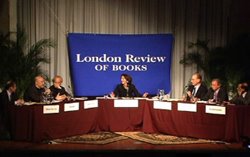
LRB debateAnyhow, in response, the LRB organized a debate at Cooper Union, entitled "The Israeli Lobby: Does it Have Too Much Influence on US Foreign Policy?" Thanks to ScribeMedia, the entire debate can now be viewed online. I recommend it.

Panelists at the debate were John Mearsheimer, Shlomo Ben-Ami, Martin Indyk, Tony Judt, Rashid Khalidi, and Dennis Ross, with Anne-Marie Slaughter as moderator.

Just one small thing I noted, which could perhaps be added to Charlotte Street's Notes on Rhetoric, is that Mearsheimer and Walt are repeatedly accused of "selective quotation."

While I guess I understand what is meant by this accusation, in fact it is nonsense, a tautology. Of course quotation is selective. Even when an entire article or speech or discourse is quoted, that too is a selection. We may not like or may disagree about the principles of selection, but the charge of selectivity is itself bogus.

Saturday, March 25, 2006

communiqués

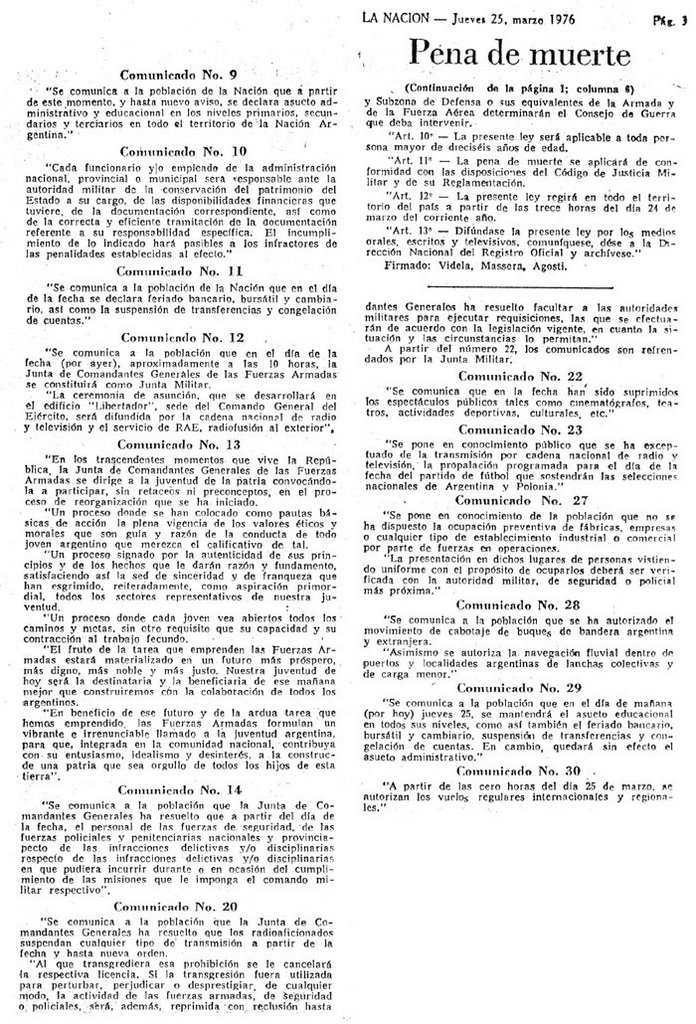
Thanks to Isis who, in the comments to my last post, provided a link to the Argentine government's website 24 de Marzo 1976-2006, detailing the coup, the military regime, and the various post-dictatorial governments.

There's a lot of material there. But, following on from my discussion of communiqué 23, I was particularly interested to see the details of all the communiqués issued by the Junta. They detail, after all, the refoundation of the state as a state of exception. And interestingly, in fact they are not all prohibitions: they also outline a program, and attempt already to interpellate the citizen body.

Communiqué 1:
The population are informed that as of today the country is under the operational control of a Junta of the General Command of the Armed Forces. Everyone is recommended to defer strictly to the orders and directives put out by the military, security, or police authorities, and to exercise caution so that they avoid individual or group actions or attitudes that might provoke drastic intervention from operational personnel.
Communiqué 2:
To preserve order and tranquility, the population are reminded of the ongoing state of exception [estado de sitio]. Everyone is to refrain from organizing meetings in public and from passing on alarmist news. Those that do so will be detained by the military, security, or police authorities. Likewise you are warned that any demonstration in favour of the guerrilla will be severely repressed.

Communiqués
Communiqué 7:
The national government reminds you that the obligatory intervention of the Armed Forces has been effected so as to benefit the whole country, and is not directed against any particular social groups. The process of reorganization that is now underway, and which will bring about the rapid recovery of the country and the welfare of its inhabitants, requires the collaboration of everyone. So the population are called upon to reflect, and workers and bosses alike are urged to work together and ensure that labour relations remain governed by an atmosphere of liberty and mutual respect.

You are advised that as all labour regulations [for medidas de fuerza?] are suspended, as likewise are all those that could affect productivity, any differences should be resolved peacefully, by means of the intervention of the relevant authority.

Workers are recommended to ignore any incitation to either violence or the refusal to undertake their obligations, given that such an attitude definitely goes against their own interests.

And bosses are warned to refrain from inflicting arbitrary measures against their workforce, which the authorities have the obligation to curtail.

Communiqués
Communiqué 13:
In this momentous period that the Republic is going through, the Junta of the General Command of the Armed Forces turns to the young people of the fatherland, calling on them to participate, without grudge or preconception, in the process of reorganization now underway.

This is a process that has established as a preliminary step forward the full application of the ethical and moral values that are the guide and reason for the conduct of ever young Argentine deserving of that name.

This is a process marked by the authenticity of its principles and of the facts that give it reason and foundation, so satisfying the thirst for sincerity and frankness repeatedly brandished, as a basic demand, by all sectors representative of our young people.

This is a process in which each young person should have every possible pathway and goal open to him, without any other requirement than his capacity and his application to productive labour [contracción al trabajo fecundo].

The fruit of the task undertaken by the Armed Forces will be the materialization of a future that is more prosperous, more worthy, more noble, and more just. Our youth of today will be the recipients and beneficiaries of this brighter tomorrow that we will build in collaboration with all the Argentine people.

It is for the benefit of this future, and the arduous task that we have taken on, that the Armed Forces make this lively and unignorable appeal to the young people, that, as an integral part of the national community, they contribute their enthusiasm, idealism, and selflessness to the construction of a fatherland that could be the pride of all this land's sons and daughters.
And finally, yes, Communiqué 23:
We inform the public that an exception has been made to the rules governing national radio and television transmission, enabling the broadcast programmed for today of the football game to be played between the national teams of Argentina and Poland.
(NB, for some reason communiqués 24-26 aren't on this list.)

Wednesday, January 04, 2006

mercenaries II

I've now finished Thomson's Mercenaries, Pirates, and Sovereigns. In her concluding pages she addresses some of the issues I raised yesterday about contemporary changes and developments. She writes that:
this study demonstrates the development of norms of nonstate violence that were quite robust in the nineteenth century, but the book has not dealt with certain practices that appear to challenge those norms. Were the Nicaraguan contras mercenaries for the United States? Did the U.S. military sell itself as a mercenary army to Kuwait? What about major instances of nonstate violence such as terrorists, drug smugglers, mafiosi, and pirates in the South China Sea? Do these contemporary practices mean the nineteenth-century norms of sovereignty are obsolete?

In my view, they do not. [. . .] Unlike their nineteenth-century counterparts [. . .] contemporary state leaders must [make use of nonstate violence] in secret. States today cannot shirk responsibility for nonstate violence by simply claiming that the latter is a purely private undertaking. [. . .]

But while each twentieth-century practice may be interpreted as being consistent with nineteenth-century norms of sovereignty, a question meriting further theorizing and more systematic empirical research is: How much can practices change and yet remain consistent with the institution of sovereignty? If this book's arguments are correct, a shift away from sovereignty to heteronomy or something else would require a fundamental change in the identity of the national state. This would entail an end to or at least significant erosion of the state's monopoly on the authority to deploy violence beyond its borders. (152-153)
Indeed.

So much for sovereignty. As for the multitude... there's an interesting hint a little earlier in a reference to Anthony Giddens, who argues, we are told, that
the production and control of violence follows a logic different from the production of wealth because in the former there is no force equivalent to the proletariat. Thus, the production of violence is not a dialectical process. (146)
The reference is to Giddens's A Contemporary Critique of Historical Materialism, volume 2, The Nation-State and Violence. I'm not sure that there isn't some confusion here between violence and power. For Negri's point about the multitude, as I understand it, is that its role in the production of power is equivalent to the proletariat's in the production of wealth. Indeed, that there's an almost exact symmetry between the process by which power is produced and the process by which wealth is produced.

In Thomson's book, power refers to the ability to control the allocation, means, and use of violence. But violence is also, of course, a form of power. Read from the point of view of the multitude, the history that Thomson recounts could precisely (I think) be recast in terms of a contest between different forms of power--heteronomy and sovereignty, if you like, in Thomson's own terms--in which the multitude plays a very similar role to that played by the proletariat in traditional accounts of political economy.

Which is not to say that we are thereby returned to dialectics.

Tuesday, January 03, 2006

mercenaries

Janice Thomson's Mercenaries, Pirates, and Sovereigns (discussed also in the Laboratorium) is about the constitution of sovereignty not (as is customarily stressed) so much by imposition of order within national territories, but by the delegitimation and suppression of extraterritorial violence wielded by non-state actors. In her words, she asks:
How did the state achieve a monopoly on violence beyond its borders that emanates from its territory? What explains the elimination of nonstate violence from global politics? (3; my emphasis)
For, as Thomson recounts at some length, until remarkably recently--the mid nineteenth-century at least--global violence was if anything dominated by non-state rather than state actors. Moreover, this non-state domination of extraterritorial force was for the most part accepted and even sanctioned by states themselves. Why, Thomson asks, should states desire to end this long tradition, especially in so far as it entailed numerous benefits to states both strong and weak?

Thomson provides a categorization of different forms of international non-state violence, from the different modes of mercenarism, to pirates and privateers, and international mercantile companies with sovereign and war-making rights.

Mercenarism, for instance, was endemic within Europe's armies of the eighteenth century: in 1743, 66% of Prussia's army was foreign; in 1701, 54% of Britain's army was non-national; while fully a third of France's pre-revolutionary land forces were foreign-born (29). Moreover,
Foreigners were not confined to service in armies; navies displayed a similar multinational character. In the 1660s, six thousand French sailors were serving abroad. One-third of the Dutch navy was French. About seven hundred Frenchmen served in the Sicilian navy, and more Frenchmen than Italians served in the Genoese fleet. At the same time, Italian volunteers and "slaves--North African 'Turks' . . . Russians, Negroes from West Africa, and a few Iroquois Indians"--worked as rowers in the French navy. (32-33)
Meanwhile, as for mercantile companies such as the English and Dutch East Indian Companies or the Hudson Bay Company, they
were, as a rule, granted full sovereign powers. In addition to their economic privileges of a monopoly on trade with a given region or in a particular commodity and the right to export bullion, they could raise an army or a navy, build forts, make treaties, make war, govern their fellow nationals, and coin their own money. (35)
Thomson notes the survival of some of these traditions, particularly mercenarism both sanctioned and un-sanctioned such as the role of Gurkhas in the British army, the continued role of the French Foreign Legion, and the role of soldiers of fortune in a variety of Africa's colonial and postcolonial wars. But her point is that by 1900 most of these practices had been thoroughly delegitimated: piracy was an international crime, privateering abolished, the mercantile companies disbanded or (in the case of the Hudson Bay Company) transformed into purely economic enterprises, filibustering (of the type exercised by William Walker in Nicaragua) outlawed, and so on.

I do wonder, however, what she would say now, ten years after her book was published, of the situation in Iraq. For is not mercenarism making a comeback, with the outsourcing of both official US warmaking to contractors, and the widespread use of private companies, usually employing ex-army personnel, for the security of everyone from the BBC to the United Nations? As John Robb's Global Guerrillas notes (and read the comments to his post),
PMCs (private military corporations) are central to the US effort in Iraq. With between 15,000 PMC (Update: 20,000) mercenaries in Iraq, they represent the second largest allied military force in theater.
See also Robert Fisk and Severin Carrell's article "Occupiers Spend Millions on Private Army of Security Men" or Global Risk Strategies' self-description as "the Force Protector for the International Zone Baghdad". And does not the role of a company such as Halliburton in Iraq remind us more than a little of the ways in which the East India companies served as proxies for colonial expansion in the seventeenth and eighteenth centuries?

What are the implications of these developments for contemporary discussions of sovereignty and the multitude?

Image from Blackwater USA

Wednesday, December 07, 2005

seduction

Giaconda BelliGioconda Belli's The Country Under My Skin documents both the euphoria and the disappointment of the Nicaraguan revolution. It's also a meditation on the relations between power, affect, and knowledge. And it's a seductive tale warning of the dangers of seduction.

Belli is in Costa Rica in the days leading up to Somoza's downfall, frustrated about her distance from the real action. But thanks to her access to radio communications with rebel commanders on the front lines, she is able to follow the action if anything more closely than most of those on the ground: "It was mesmerizing to hear about the progress of the insurrection, to hear what was happening in real time" (234).

The final weeks and months of the Sandinista triumph went by astonishingly rapidly. Rather than leading, the Sandinistas were running to catch up with their impending triumph. Belli captures the "sensation of unreality" as victory finally, unexpectedly, raced up to meet them and the FSLN were thrust, blinking in the light, onto the world stage: "Sometimes it seemed as though they couldn't be talking about my tiny country, abandoned by everyone and beholden to a bloody dictator for half a century, but about a major power, able to make policy decisions that would alter Latin America's future" (236).

And then suddenly, almost anticlimactically, Somoza leaves office. And the Sandinistas, as much as anyone else, are left wondering what happens next: "Nobody spoke. Nobody moved. Everyone's eyes glittered with anticipation" (239).

Then the celebration: "Overcome with joy, we fell into one another's arms. 'Somoza left!' we repeated to each other, as we kissed, danced and hugged." And Belli echoes Neruda's famous "Heights of Macchu Picchu" in her invocation of the dead reborn in triumph: "Multitudes of our beloved dead came to life among us with their empty eyes, their deaf ears, the dust of their bones that could never celebrate with us" (239). It's a mythic time of (re)creation: "The 18th, the 19th of July 1979. [. . .] Two days that felt as though a magical, age-old spell had been cast over us, taking us back to Genesis, to the very site of the creation of the world" (241).

Such is the world-making power of revolutionary violence.

Ernesto Cardenal and multitude
But Belli, closely associated with the cúpula of the FSLN leadership, is soon entrusted with part of the transformation of that constituent power into constituted power: the construction of a nation, reconstruction of the state. Her task is to represent the revolution, to produce the "victory issue" of a new newspaper, to be called Patria Libre. This task can only be completed from the distance that representation requires, the newspaper then imported into the newly liberated country.

Flying into Managua on a plane loaded down with newsprint, Belli finds the airport almost deserted: the action is elsewhere. Only an old school friend has turned up to greet her, but Belli turns her away, judging her guardianship of the papers to be more important. Here, even at arrival, is the first disappointment, the first betrayal, of the revolution: over the "eerie desolation" of the airport terminal "Justine's face would be always superimposed. I managed to shake off my uneasiness. There would be time later on to explain things to Justine, to my parents, I said to myself. They would wait for me, they always did. But history wouldn't" (246).

Belli sets off, with her precious copies of Patria Libre, seeking to track down the history that the newspaper already claimed to represent. Her truck passes jubilant crowds: "their joy had the taste of sweet, red watermelon, its juice dripping down my chin" (247). But when at last they get to the city and reach the central plaza "there was no one left. That was when we realized that the crowds we'd seen on the road had been walking home after the celebration. All that was left in the great, deserted plaza were wrappers, trash" (248).

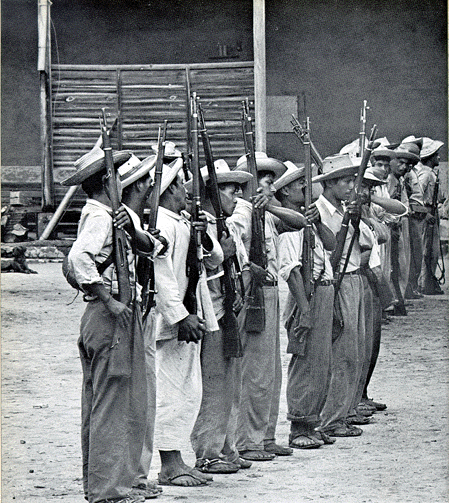
Henry Ruiz, aka ModestoIn place of this unpredictable, mobile multitude, the Sandinistas establish a militarized state as totem and fetish, positing its institutions and its leaders as the object of revolutionary desire--thus inverting the relationship constitutive of the triumph itself. Belli notes the demobilizing effect of this inversion, describing her lover Modesto and his "bodyguards, who only a month earlier had fearlessly confronted Somoza's tanks, [and now] were docile and obedient in their leader's presence" (266).

She observes the ways in which "military protocol had its grandiose, seductive side. [. . .] Modesto--comandante, member of the Sandinista National Directorate, maximum authority in Nicaragua both during and after the Revolution--would move calmly amid the soldiers hurriedly standing at attention" (266).

It's not long before Belli also realizes that "the dazzling spell of power"--constituted power, we should clarify--also entails self-delusion among those who wield it: "these men had been seduced by the spell of their own self-image [. . .]. They felt eminently astute and capable, a cross between political bright boys and heroic, strapping knights-errant" (275).

The Sandinistas begin to believe their own myth of leadership, rather than learning from their experience of belatedness. The only indication of what has been lost in this transition is the lingering nostalgia that pervades Belli's memoir, a "nostalgia for what we had been" (291) before the rigidity that set in with the state's consolidation, and before the FSLN retrospectively branded everything in sight with their red and black logo.

Friday, November 18, 2005

farce

Apparently unaware of Marx's maxim that history repeats only "the first time as tragedy, the second as farce" (The Eighteenth Brumaire 300), Latin American ex-presidents have a strange propensity to return and seek power again, long after their disgrace, and despite usually having accumulated plenty of money in the bank to see them through to a comfortable retirement.

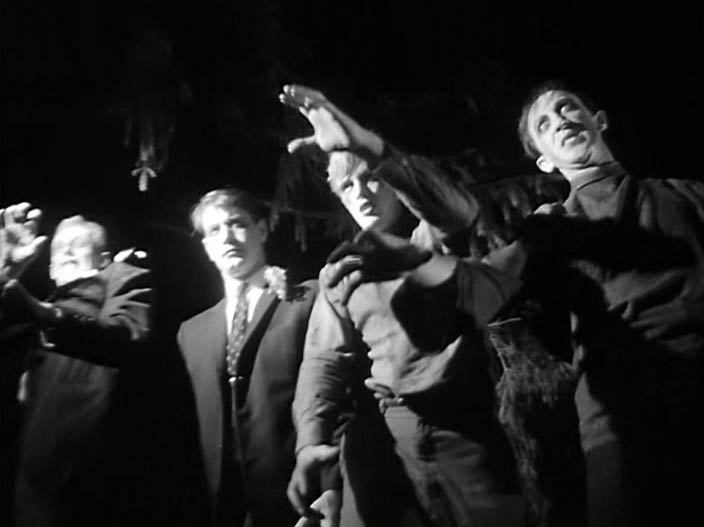
Menem and wifeCarlos Menem in Argentina, Daniel Ortega in Nicaragua, Alan García in Peru, Gonzalo Sánchez de Losada in Bolivia... These are just some of the political undead who have stalked the region's politics in the past few years, often somewhere in the penumbra living a colourful highlife of exile while charges or even convictions mount up in absentia. But as soon as there is word of an upcoming ballot, back they come sniffing around like dogs returning to their vomit, to make many a presidential poll a rerun of Night of the Living Dead.

(Javier Corrales points out that the only countervailing tendency is the election of complete newcomers to political power: he shows that of 29 presidential elections in 17 countries since 1996, "eleven featured former presidents who obtained a third place or higher" while twelve "featured complete newcomers" who likewise "obtained a third place or higher.")

Himself once one of the surprise neophyte winners, the latest of these former presidents who really should know better is Peru's Alberto Fujimori. President from 1990 until 2000 (a decent potted biography is available here), when he scarpered to Japan in November of that year, his regime in crisis with daily revelations of corruption and the lurid misadventures of his spy chief and advisor Vladimiro Montesinos. When, in rather undignified fashion, Fujimori attempted to submit his resignation from Japan by fax (rather like dumping someone by text message), the Peruvian Congress finally took sufficient umbrage instead to sack him themselves, for being "morally unfit" to govern.

girlfriend Satomi KataokaFor the past five years, Fujimori has been hanging out in Tokyo, most recently living in his new girlfriend's hotel, spending up to 12 hours a day on the internet and taking advantage of the fact that there is no extradition treaty between Peru and Japan.

But too much time online can warp the mind... He has been making noises suggesting he wanted to return to Peru. Not, needless to say, to face the various charges brought against him; rather, to contest the 2006 elections and (one presumes) resume power where he had so abruptly left off in 2000.

To this purpose, he has been broadcasting radio shows for diffusion within Peru, setting up some kind of transpacific political infrastructure, and maintaining a trilingual website from which he can rebut attacks and denounce his attackers. At the bottom of every page is a little Flash gizmo that first shows us former Sendero head Abimael Guzmán, crossed out in red ink, and the words "Defeat of Terrorism"; then the acronyms APEC, IFM (IMF), World Bank, and the message "Re-insertion into the International Financial Community." This is, one takes it, what he would like us to remember of his presidency. Not, for instance, the suspension of Congress and civil rights, the massacres, the personalist control through bribery...

Fujimori arrives in SantiagoAlong with two others, my friend and colleague Max Cameron has started up a blog on the 2006 Peruvian elections, a blog which of necessity, and especially given Fujimori's surprise arrival in Chile and subsequent arrest there, has become increasingly a blog about the former president, his ambitions, and the rumours and responses to his activities.

Though much of the blog is a clearing house of information culled from the Peruvian press and NGOs (usually, but not always, in Spanish), Max himself has contributed some analysis on "Return of Fujimori" and "The Trouble with Alberto". Go read it.

For what it's worth, Fujimori's own political project is a more or less standard neoliberalism, and his style is very much the neoliberal anti-politics of all things to all men (and women). He's a shapeshifter: arriving on the political scene in 1990 as an unknown agronomist facing off against the flamboyant novelist Mario Vargas Llosa he seemed to be an empty, characterless vessel into which the electorate could pour their own hopes and desires. Precisely because he can seem so unassuming, his Spanish relatively slow and apparently devoid of fluency or rhetoric, and also because of the stereotype that saw "el chino" as inscrutably and demurely Asiatic, for a long time what Max terms his "immoderate ambition" and "the depth of his indifference toward the rule of law" could be overlooked.

Even so, the return of this zombie even to the margins of political respectability rather boggles the mind. It's surely not that he seeks redemption--for which contrition would be a pre-requisite.

It is, however, another sign that despite the obvious (political, moral, and often enough also literally economic) bankruptcy of neoliberalism in Latin America, no real alternative has yet emerged to replace it. Individual countries and regimes have come up with more or less patchwork post-neoliberal orders, from Kirchner's social democracy in Argentina to Chávez's telepopulism in Venezuela (and Lula's rebranding of the same old policies with Workers Party tags in Brazil), but they each have a rather rickety and ramshackle air.

We're in the interregnum. And to steal a quotation from More Better Analysis:
The crisis consists precisely in the fact that the old is dying and the new cannot be born: in this interregnum, morbid phenomena of the most varied kind come to pass.
So while the crisis persists, we'll continue to be haunted by these undead ghouls from the past. But there are also some specters of a possible future around, not least in Peru's neighbour, Bolivia. In the meantime, though, we might want to keep a sharp eye around us in the dark nights and grey days of Lima's coastal fog.

Night of the Living Dead

Sunday, November 13, 2005

diagram

Instead of transcendence, immanence; instead of determination by the economic base, the abstract machine; instead of hegemony, the diagram.

"The diagram," Deleuze argues in his book on Foucault, "acts as a non-unifying immanent cause that is coextensive with the whole social field: the abstract machine is like the cause of the concrete assemblages that execute its relations; and these relations between forces take place 'not above' but within the very tissue of the assemblages they produce" (Foucault 37).

"Of course," then, "this has nothing to do with a transcendent idea or with an ideological superstructure, or even with an economic infrastructure, which is already qualified by its substance and defined by its form and use" (36-37).

The diagram is abstract (an "abstract machine") because it precedes the distinction between form and substance, "between content and expression, between a discursive formation and a non-discursive formation" (34). Such distinctions are only a consequence of the abstract machine's realization (though surely what's meant is "actualization"?) in concrete social orders: "it is here that two forms of realization diverge or become differentiated: a form of expression and a form of content, a discursive and a non-discursive form, the form of the visible and the form of the articulable" (38; emphasis in original).

One cannot hope to explain one element of this bifurcation by the other--to explain discursive formations by resorting to some material ground, or to explain the material by reference to discursive strategies. It is the cause of the bifurcation itself, and its distinctive delineation in any given society, that has first to be explained.

For there is nothing ahistorical about the abstract machine. "The history of forms, the archive, is doubled by an evolution of forces, the diagram" (43). Hence Deleuze can argue that "there are as many diagrams as there are social fields in history" (34) and "every society has its diagram(s)" (35): the diagram of "modern disciplinarian societies" differs from that of "the ancient sovereign societies" (34); the society of control (not named as such here) corresponds to yet another diagram. From theatre to factory to...

Then there are also "intermediary diagrams, in which we shift from one society to another [. . .]. This is because the diagram is highly unstable or fluid, continually churning up matter and functions in a way likely to create change" (35).

It's not entirely clear here how Deleuze envisages the process of change. There's something rather functionalist about his account. Here, at least, there's no conception of agency or constituent power. But he does describe the notion of a gap within which change might be engineered.

For it's precisely because institutions do not determine statements (though "any institution implies the existence of statements" [9]) and statements do not determine institutions (though, reciprocally, "statements refer back to an institutional milieu" [9]), in other words it's precisely because we can throw out the concepts of either determination or even overdetermination, that we can attend to the non-coincidence between discourse and the non-discursive as a site of possibility or potential.

For every society will be defined by the "gap or disjunction" that opens up "between the visible and the articulable," the "'non-place' [. . .] where the informal diagram is swallowed up and becomes embodied instead in two different directions that are necessarily divergent and irreducible" (38). Every society, in short, is defined by the "crack" that traverses it and "that determines how the abstract machine performs" (38). And this crack enables us to see that "there is no diagram that does not also include, besides the points which it connects up, certain relatively free points, points of creativity, change and resistance" (44).

But again, a posthegemonic understanding of social order must first grapple with the "common, immanent cause which works informally" and analyze the ways in which "every mechanism is a mushy measure of the visible and the articulable" (38) before then explaining how the two come to appear so radically separated, one determining the other, to conjure up (inter alia) the deus ex machina of hegemony.


[Meanwhile, I wonder about the "Diagram Poems" of Douglas Oliver.]

Sunday, October 23, 2005

auctoritas

The final chapter of Giorgio Agamben's State of Exception adds a third term for power to the couplet of constituent and constituted power: to potentia and potestas is added auctoritas, "authority." I suspect that this concept is a useful corrective or addition to Negri's theory of power, and that it might clarify some of what remains obscure or contradictory in his and Hardt's theory of Empire.

Auctoritas is a figure of sovereign power, and yet it "has nothing to do with the potestas or the imperium of the magistrates or the people" (78). Auctoritas supplements and legitimates potestas: "the auctoritas patrum intervenes to ratify the decisions of the popular comitia and make them fully valid" (78).

At the same time, it is auctoritas that has the power to suspend potestas, to announce the state of exception, and it is auctoritas that is the force of suspended law ("force of law," as Agamben calls it) that holds sway in the absence of constituted power. Agamben therefore concludes that
auctoritas and potestas are clearly distinct, and yet together they form a binary system. [. . .] auctoritas seems to act as a force that suspends potestas where it took place and reactivates it where it was no longer in force. It is a power that suspends or reactivates law, but is not formally in force as law. (78, 79)
The "essence" of auctoritas is that it is a "power that can at once 'grant legitimacy' and suspend law [. . .]. It is what remains of law if law is wholly suspended." It is, adds Agamben, in this sense "not law but life--law that blurs at every point with life" (80).

Auctoritas is the very figure of biopolitics, the sovereign pole to be set against Agamben's other paradigmatic image of the biopolitical, the "bare life" of the camps, of Guantánamo. Agamben can therefore contrast "the biopolitical tradition of auctoritas" to "the legal tradition of potestas" (84). Auctoritas is the biopolitical anchor for constituted power.
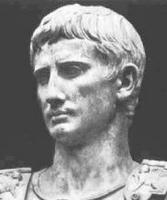
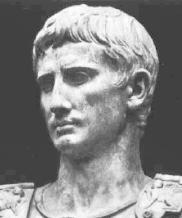
Caesar AugustusImmanent to life, auctoritas is fully embodied, incarnate in the collective body of the Senate or in the person of the Emperor. It is auctoritas that the Emperor embodies, not power as such:
The Roman principate [. . .] is not a magistracy, but an extreme form of auctoritas. [Richard] Heinze has described this contrast perfectly: "Every magistracy is a preestablished form, which the individual enters into and which constitutes the source of his power; auctoritas, on the other hand, springs from the person, as something that is constituted through him, lives only in him, and disappears with him." (82)
Auctoritas is therefore an affective form of power, comparable to what Weber termed "charisma," which also "coincides with the neutralization of law and not with a more originary figure of power" (89).

Incarnate in the leader, in the Führer, in the President, auctoritas is something like the shadowy mirror image of potentia, of the constituent power embodied in the multitude. It is as though, with the figure of auctoritas, sovereignty offered a biopolitical double for potentia, in order to ground its (un)constitutional order.

Auctoritas might also be the figure for what elsewhere goes by the name of hegemony: some kind of explanation to the question as to why constituent power so often ends up, alienated and inverted, as constituted power. (A question that Negri never answers.) It is in and through auctoritas that potentia is harnessed to potestas: auctoritas is the transmission mechanism that simultaneously gives constituted power its (borrowed) life and deadens, blocks, constituent power.

Auctoritas, then, would be the fundamental articulation, "effective though fictional" (87), between multitude and state, "the fiction that governs the arcanum imperii [secret of power] par excellence of our time" (86).

But something has gone awry with this mechanism, in these posthegemonic times. Rather than articulating constituent to constituted power, auctoritas now stands revealed as the sole principle of power in the permanent state of exception whose roots Agamben traces in the period immediately following World War I. All that remains is the fictive embodiment of charisma, of affect, in individuals: Bush, Cheney, Blair (Saddam, Osama, Fidel?).

This is a mechanism that has "today reached its maximum worldwide deployment" (86), but only because it is simultaneously in crisis:
The ancient dwelling of law is fragile and, in straining to maintain its own order, is always already in the process of ruin and decay. The state of exception is the device that must ultimately articulate and hold together the two elements of the juridico-political machine by instituting a threshold of undecidability between anomie and nomos, between life and law, between auctoritas and potestas. (86)
But here Agamben has too quickly assimilated auctoritas back into potentia: for surely auctoritas is the fictive link itself, rather than one element in what it articulates.

And that articulating mechanism (perhaps, following Deleuze and Guattari, we would do better to think of it as a machinic synthesis) is predominant in the age of Empire, preserving only the remnants of transcendence in its immanent capture of potentia, found now in displaced form as charismatic gift of leadership, aura of self-confidence, but also corruption incarnate.

Saturday, September 24, 2005

Popol Vuh

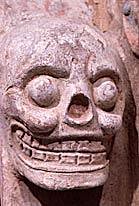
Mayan skullThe Popol Vuh, "Mayan Book of the Dawn of Life," is also a book of death. For it is at best the record of an absence. Its anonymous authors tell us at the outset that they are writing the history and myth of the Quiché people precisely because
there is no longer

a place to see it, a Council Book,
a place to see "The Light that Came from Beside the Sea,"
the account of "Our Place in the Shadows,"
a place to see "The Dawn of Life." (63)
They conclude in similar vein:
This is enough about the Being of Quiché, given that there is no longer a place to see it. There is the original book and ancient writing owned by the lords, now lost. (198)
The Popol Vuh itself, then, can only supplement or stand in for a lost or inaccessible text, a missing plenitude irrecoverable in the wake of Spanish conquest. Hence the ambivalence of the book's final lines, which assert either that this substitution has been successful in recapturing the lost history that it retells, or that the supplement can be no more than an epitaph to an independent existence now irredeemably extinguished: "everything has been completed here concerning Quiché, which is now named Santa Cruz" (198).

Something of this impossibility inheres in all subaltern texts: they recognize that the power of naming (a power continually underscored within the pages of the Popol Vuh) escapes their grasp. At best, the subaltern can hope to insinuate him or herself within the codes established by the dominant, perhaps to upset or relativize that discourse of power, at least slightly. At best, the subaltern aims at a precarious reinscription within or between the terms structuring the new doxa.

Mayan Death GodAt the same time, with the Popol Vuh--and the same goes for the Incas with both Garcilaso de la Vega's Comentarios reales and Guaman Poma's Primer Nueva Corónica--there are very definite limits to the sympathy such a text can incite. For what it laments is not the fact of domination per se, but simply its relocation. These books lament the destitution of indigenous sovereignty, but above all they also mourn the fate of a native aristocracy usurped.

The Popol Vuh is a genealogy of the Quiché state, a record of its noble houses and lordships, and a celebration of its (former) power to exact tribute from surrounding tribes:
What they did was no small feat, and the tribes they conquered were not few in number. The tribute of Quiché came from many tribal divisions.
And the lords had undergone pain and withstood it; their rise to splendor had not been sudden. Actually it was Plumed Serpent who was the root of the greatness of the lordship.
Such was the beginning of the rise and growth of Quiché.
And now we shall list the generations of lords, and we shall also name the names of all these lords. (194)
The last lords in the list have Spanish names: Don Juan de Rojas and Don Juan Cortés. They themselves now pay tribute to the Spanish, rather than receiving it from their fellow indigenous people. Like many native aristocrats, however, Juan de Rojas and Juan Cortés sought accommodation with the Spaniards, hoping to maintain their rights to local domination under the aegis of European imperialism. And, as translator and editor Dennis Tedlock notes, the Popol Vuh itself may well have been a crucial implement in the case that the local lords made as they tried to establish dialogue with their new masters:
Juan Cortés, whose duties as Keeper of the Reception House Mat would have included tribute collection had he served before the coming of [conquistador] Alvarado, worked constantly to restore tribute rights to the lordly lineages of the town of Quiché. In 1557 he went all the way to Spain to press his case, and it could be that he took a copy of the alphabetic Popol Vuh with him. (56)
Interestingly, the subjugated tribes are described twice as a multitude, at least as they are ventriloquized by the scribal aristocrats of their subjugators: "Don't we constitute a multitude of people?" (166); "Aren't we a multitude?" (169).

The real absence, then, is surely not the defeated state nobility whose destruction these texts bemoan; it is rather the constituent power that they themselves repress, in a form of anticipatory counter-insurgency.

But what can we say of constituent power in pre-Columbian societies, when constituted power has so thoroughly mystified its origins in the few texts that are available to us?