“We will never ask what a book means, as signified or signifier: we will not look for anything to understand in it. We will ask what it functions with, in connection with what other things it does or does not transmit intensities, in which other multiplicities its own are inserted and metamorphosed” (Deleuze and Guattari, A Thousand Plateaus 4).
Showing posts with label deleuze. Show all posts
Showing posts with label deleuze. Show all posts
Monday, July 23, 2012
reading

Wednesday, July 18, 2012
virtual
A blast from the past. Here I am speaking at Virtual Futures, Warwick, 1995:
Virtual Futures 1995 - Jon Beasley-Murray from Virtual Futures on Vimeo.
But you know what: some of this made its way eventually into the book, Posthegemony.
Tuesday, July 17, 2012
Also

Gilles Deleuze and Félix Guattari’s Anti-Oedipus surely has some of the most remarkable opening lines of any work of philosophy or cultural critique. First published in France in 1972, just a few years after the demonstrations of May 1968, its stylish bravado immediately reminds us of the attitudes struck by student agitators, and proclaims that their radical energies persist: “It is at work everywhere, functioning smoothly at times, as other times in fits and starts. It breathes, it heats, it eats. It shits and fucks. What a mistake to have ever said the id.” The original French is even more striking, playing on the fact that “id” and “it” are both “ça” (“Ça fonctionne partout . . . Quelle erreur d'avoir dit le ça.”). “It” is a machinic unconscious that is defined not by what it represents, but by what it produces: “Everywhere it is machines--real ones, not figurative ones: machines driving other machines, machines being driven by other machines, with all the necessary couplings and connections” (Anti-Oedipus 1). The question “what does it mean?” gives way to “how does it work?” As Deleuze and Guattari go on to declare in their second enquiry into “Capitalism and Schizophrenia,” A Thousand Plateaus: “We will never ask what a book means, as signified or signifier: we will not look for anything to understand in it. We will ask what it functions with, in connection with what other things it does or does not transmit intensities, in which other multiplicities its own are inserted and metamorphosed” (A Thousand Plateaus 4). They therefore refuse any attempt to derive meaning from biography, to reduce the work to its author(s). Indeed, they disclaim authorship as anything but a matter of arbitrary convenience and custom: “Why have we kept our own names? Out of habit, purely out of habit. To make ourselves unrecognizable in turn. [. . .] We are no longer ourselves. Each will know his own. We have been aided, inspired, multiplied” (A Thousand Plateaus 3-4).
Read more... (.pdf file)
Wednesday, May 25, 2011
bliss
The Wednesday quotation, part XV: Gilles Deleuze on immanence:

Very small children all resemble one another and have hardly any individuality, but they have singularities: a smile, a gesture, a funny face--not subjective qualities. Small children, through all their sufferings and weaknesses, are infused with an immanent life that is pure power and even bliss. (Immancence: A Life, 30)
Wednesday, February 23, 2011
Deus
 Alexandr Zholkovkii's short essay "Deus ex Machina" does not, rather fortunately, succumb so swiftly to the strange (and strikingly out of place) Romanticism that characterizes so many of the other texts that outline what he terms a "poetics of expressiveness". Here, instead of praise for the accomplished and inspired author and his or her techniques for better self-expression, his focus is on the literary machine itself and its autonomic tendencies.
Zholkovkii's thesis, he tells us, is that "any artistic text is a machine working on the reader: a 'machine' not only in the figurative sense, but in the strictly cybernetic sense as well--as a transforming device" (53). Soon enough, however, this definition has to be extended: there is no special privilege to the artistic text; all cultural productions and practices obey a machinic logic that amplifies, distorts, modulates, or transforms a whole series of inputs, often in unpredictable ways. Social and legal conventions, for instance, ensure that a contract is fulfilled (in one example that Zhlkovskii provides) even when one of the parties to the contract has, unknown to the other, suddenly died. Events have a logic of their own, that goes beyond individual agents. Plot consists in precisely such machinic logic that overtakes and determines the fate of individual characters.
In Zholkovskii's vision, every instance of a literary, artistic, or social machine still requires some kind of external input: the machines do not run by themselves. This is the residual trace of the notion of "expressiveness": the machinery is ultimately a form of expression. But the mechanism that enables such expression tends to become so dominant that individuals are soon subjected to the machine rather than its subject: Zolkovskii mentions the famous scene, for instance, in Modern Times in which Charlie Chaplin is physically "dragged into an assembly line" (57). "One is, of course, tempted" he therefore observes, "to think of a machine that would alone do all the plot work" (59).
A machine without some kind of prior input, however, is unimaginable: the whole formula of expressiveness would disappear and "such a machine would [. . .] completely replace and thus cancel the plot" (59); such a perpetual motion machine, that strictly followed its own logic and no other, would be the end of art and culture. The machine needs an external God, a supplement of some kind, to ensures that there is indeed God also in the machine itself. Zholkovkii's Romanticism never quite disappears, though here we see its limit point.
But what if there were nothing but machines? Or at least, other inputs that were not themselves already human. This, of course, is the provocative opening of Deleuze and Guattari's Anti-Oedipus:
It is at work everywhere, functioning smoothly at times, at other times in fits and starts. It breathes, it heats, it eats. It shits and fucks. What a mistake to have ever said the id. Everywhere it is machines--real ones, not figurative ones: machines driving other machines, machines being driven by other machines, with all the necessary couplings and connections. (1)This would be a machine that, like Athusser's "hailing machine," produced subjects (rather than being driven by them), though also so much else. Indeed, the subject might be perhaps the least interesting of its many products. And if a God remained in the mechanism, it would be immanent, fully part of the machine rather than the mere trace of some transcendent vision.
Meanwhile, I've written elsewhere on the machinic unconscious of literary texts: "Arguedasmachine".
Saturday, April 21, 2007
field
The key to the difference between Bourdieu and Deleuze, and so to the specificity of the concept of habitus, consists in Bourdieu’s introduction of the related concepts of “field” and “symbolic capital.” For Bourdieu, habitus is always embedded in a prior social field, which itself is structured by symbolic power. In some ways Bourdieu takes more seriously than Deleuze, then, the notion encapsulated in Deleuze and Guattari’s affirmation that “politics precedes being” (A Thousand Plateaus 203). For if habitus is a set of “structured structures predisposed to function as structuring structures” (The Logic of Practice 53), it is not only generative but also generated. It is the product of a given state of power relations: the social field as a whole, and also distinct subfields (such as the artistic field, the journalistic field, the academic field). Hence, in Loïc Wacquant’s words, the relation between habitus, field, and capital is that “a field consists of a set of objective, historical relations between positions anchored in certain forms of power (or capital), while habitus consists of a set of historical relations ‘deposited’ within individual bodies” (Bourdieu and Wacquant, An Invitation to Reflexive Sociology 16). Hence the dispositions of habitus are also depositions, both in the sense that they constitute a record of the state of the field that formed them and (to use now more Deleuzian terminology) that they are the sediments or deposits that form within a particular landscape of power. They are “conditionings associated with a particular class of conditions of existence” (The Logic of Practice 53). And what they therefore generate or structure in turn tends therefore to reproduce the structures that constituted them, in that they generate practices that seem to call those structures into being, that take them for granted without the need of words or discourse.
Each field is structured by a competition for domination and capital. “The structure of the field,” Bourdieu argues, “is determined by the structure of the distribution of the distinct forms of capital that are active in it” (An Introduction to Reflexive Sociology 108). For there are different forms of capital, each of which has a different weight depending upon the field in question. Broadly, for instance, the field of culture is structured in terms of its differential distribution of cultural capital, while it is financial capital that counts in the market for economic goods. Yet Bourdieu downplays the direct influence of financial capital, and is interested above all in the distinct forms of symbolic capital that are subject to struggle in different subfields, and the ways in which the definition of capital (or what is to be accorded value) is at stake in these struggles, as well as the mechanisms by which one form of capital is converted into another. In the end, the most effective power is symbolic: “symbolic” here does not imply either representation or a power that is “merely” symbolic, but refers a mode of domination that achieves legitimacy in that its arbitrariness is misrecognized, so much so that it goes without saying. Bourdieu and Passeron present this as the fundamental axiom grounding their analysis of social reproduction: “every power which manages to impose meanings and to impose them as legitimate by concealing the power relations which are the basis of its force, adds its own specifically symbolic force to those power relations” (Reproduction 4; emphasis in original). What is reproduced through habitus, habitually, is our corporeal assent to the legitimacy of these power relations, and to the unequal distribution of capital that they secure.
Habitus is reflex and relay, product and producer, assuring social continuity by literally incarnating the principles of social order. In Bourdieu’s words, “it ensures the active presence of past experiences, which, deposited in each organism in the form of schemes and perception, thought and action, tend to guarantee the ‘correctness’ of practices and their constancy over time” (The Logic of Practice 54). It ensures that social agents are attuned to their circumstances. It fosters the self-confidence of the “inheritor” who, rich in cultural capital, exhibits a confidence and flair that is rewarded with further social and cultural capital; and it also ensures that those dispossessed of cultural capital assent to their dispossession by rejecting what is culturally consecrated (be it higher education or high art) with the sentiment that it is not for them. Privilege is naturalized as though it were simply a “gift”; and subordination is taken for granted as though social difference were a question of talent or taste. The dispossessed are often the first to admit that they have only themselves to blame. And all this is legitimated and arbitrated by institutions and officials who have no need to be aware of what they are doing, who can be committed or even (increasingly) entirely cynical about the ideals they are upholding. For ideals are not at stake. Academic diplomas, for instance, attest to “gifts” and “merits,” and can do so objectively with no hint of bias, because the real work has been done in the conversion and so dissimulation of privilege as attitude. The source of these dispositions is concealed, all the more effectively in that the habits they generate are second nature. Hence, Bourdieu and Passeron argue, “the supreme privilege” of the privileged is “not seeing themselves as privileged,” which in turn “manages the more easily to convince the disinherited that they owe their scholastic and social destiny to their lack of gifts and merits, because in matters of culture absolute dispossession excludes awareness of being dispossessed” (Reproduction 210). There is no conspiracy because there is no hidden knowledge: the game’s winners as much as the game’s losers, as well as its arbitrators, can all act in perfectly good faith. The judgments that lead to social promotion or exclusion, such as the feeling that “he’s a good chap” or “she’s not one of us,” can be justified by transcendent principles whose legitimacy is assured by the fact that they resonate with immanent habits.
Each field is structured by a competition for domination and capital. “The structure of the field,” Bourdieu argues, “is determined by the structure of the distribution of the distinct forms of capital that are active in it” (An Introduction to Reflexive Sociology 108). For there are different forms of capital, each of which has a different weight depending upon the field in question. Broadly, for instance, the field of culture is structured in terms of its differential distribution of cultural capital, while it is financial capital that counts in the market for economic goods. Yet Bourdieu downplays the direct influence of financial capital, and is interested above all in the distinct forms of symbolic capital that are subject to struggle in different subfields, and the ways in which the definition of capital (or what is to be accorded value) is at stake in these struggles, as well as the mechanisms by which one form of capital is converted into another. In the end, the most effective power is symbolic: “symbolic” here does not imply either representation or a power that is “merely” symbolic, but refers a mode of domination that achieves legitimacy in that its arbitrariness is misrecognized, so much so that it goes without saying. Bourdieu and Passeron present this as the fundamental axiom grounding their analysis of social reproduction: “every power which manages to impose meanings and to impose them as legitimate by concealing the power relations which are the basis of its force, adds its own specifically symbolic force to those power relations” (Reproduction 4; emphasis in original). What is reproduced through habitus, habitually, is our corporeal assent to the legitimacy of these power relations, and to the unequal distribution of capital that they secure.
Habitus is reflex and relay, product and producer, assuring social continuity by literally incarnating the principles of social order. In Bourdieu’s words, “it ensures the active presence of past experiences, which, deposited in each organism in the form of schemes and perception, thought and action, tend to guarantee the ‘correctness’ of practices and their constancy over time” (The Logic of Practice 54). It ensures that social agents are attuned to their circumstances. It fosters the self-confidence of the “inheritor” who, rich in cultural capital, exhibits a confidence and flair that is rewarded with further social and cultural capital; and it also ensures that those dispossessed of cultural capital assent to their dispossession by rejecting what is culturally consecrated (be it higher education or high art) with the sentiment that it is not for them. Privilege is naturalized as though it were simply a “gift”; and subordination is taken for granted as though social difference were a question of talent or taste. The dispossessed are often the first to admit that they have only themselves to blame. And all this is legitimated and arbitrated by institutions and officials who have no need to be aware of what they are doing, who can be committed or even (increasingly) entirely cynical about the ideals they are upholding. For ideals are not at stake. Academic diplomas, for instance, attest to “gifts” and “merits,” and can do so objectively with no hint of bias, because the real work has been done in the conversion and so dissimulation of privilege as attitude. The source of these dispositions is concealed, all the more effectively in that the habits they generate are second nature. Hence, Bourdieu and Passeron argue, “the supreme privilege” of the privileged is “not seeing themselves as privileged,” which in turn “manages the more easily to convince the disinherited that they owe their scholastic and social destiny to their lack of gifts and merits, because in matters of culture absolute dispossession excludes awareness of being dispossessed” (Reproduction 210). There is no conspiracy because there is no hidden knowledge: the game’s winners as much as the game’s losers, as well as its arbitrators, can all act in perfectly good faith. The judgments that lead to social promotion or exclusion, such as the feeling that “he’s a good chap” or “she’s not one of us,” can be justified by transcendent principles whose legitimacy is assured by the fact that they resonate with immanent habits.
Wednesday, April 18, 2007
habitus
Something I'm working on, and I thought I'd put it up to see what the various Bourdieusians and Deleuzians make of it...
Bourdieu’s concept of “habitus” is, in the first place, central to his intervention into the ongoing debate about structure and agency, “one of the key faultlines that runs through social theory” (Korczynski, Hodson, and Edwards, “Introduction” 12). On the one hand, there are theorists who stress the ways in which social structures constrain and determine individual or social agency. Marxism and psychoanalysis, for instance, in different ways tend to emphasize the ways in which agency is constrained by structures that are, respectively, material and psychic. On the other hand, other theorists stress the fact that agents can resist or overcome these structural determinants. The tendency of cultural studies, for example, is to point to the slippages by which (say) consumers determine their own responses and eke out a measure of agency even within contemporary capitalism. Or as Anthony Giddens (whose theory of structuration is an alternative bid to resolve the debate) puts it, those for whom “structure (in the divergent senses attributed to that concept) has primacy over action, and the constraining qualities of structure are strongly accentuated” are arrayed against those for whom “action and meaning are accorded primacy in the explication of human conduct; structural concepts are not notably prominent, and there is not much talk of constraint” (The Constitution of Society 2). Giddens goes on to characterize this difference as an “imperialism of the social object” facing “an imperialism of the object” (2). In short, these are two competing claims to transcendence; what is at stake, Giddens argues, is as much ontological as it is epistemological, as much about our models of what society is as about conflicting perspectives regarding the same model (2).
Bourdieu’s intervention is therefore also ontological, substituting immanence for the dueling imperial transcendences of structure and agency. He refuses both “mechanism” (an emphasis on structure) and “finalism” (a stress on agency), arguing that the debate between the two is “a false dilemma” (Outline of a Theory of Practice 72). If “it is necessary to abandon all theories which explicitly or implicitly treat practice as a mechanical reaction” shaped by rules or structures alone, equally “rejection of mechanistic theories in no way implies that [. . .] we should reduce the objective intentions and constituted significations of actions and works to the conscious and deliberate intentions of their authors” (73). Mechanism and finalism, structure and agency, are each as reductionist as the other, seeking causes always elsewhere, in some other dimension, either the “transcendent, permanent existence” of objective social constraints and regulations or the “transcendence of the ego” equipped to make its own rules (27, 75). So Bourdieu turns to habit, or “habitus,” an embodied set of dispositions immanent to practice itself. Habitus is a system “of durable, transposable dispositions, structured structures predisposed to function as structuring structures, that is, as principles which generate and organize practices and representations” (The Logic of Practice 53). These dispositions are “objectively ‘regulated’ and ‘regular’ without in any way being the product of obedience to rules, objectively adapted to their goals without presupposing a conscious aiming at ends” (Outline 72). Habit, our everyday activity, is therefore the product of a “scheme (or principle) immanent in practice, which [. . .] exists in a practical state in agents’ practice and not in their consciousness, or rather, their discourse” (27; emphasis in original). Regulation and practice are immanent to each other, rather than mediated either by consciousness or by external structures. Habitus is an attitude of the body. It is the unspoken, unspeakable, feel for the social game that generates the positions and actions that agents adopt in given situations, in regular if not fully predictable ways. In short, because it is immanent, habitus is both embedded, and so structured; and it is also generative, an immediate rather than external motor of action.
There are many overlaps between Bourdieu’s habitus and Deleuze’s conception of the “virtual.” Both are immanent and productive, intensive and affective, corporeal and immediate. The relation between habitus and practice is not unlike that between the virtual and the actual: an unfolding or differentiation that takes place in the event of an encounter with other bodies. Habitus and the virtual alike describe an ontology that underlies but is of a different order from the realm of representation, discourse, and ideology. Habitus, Bourdieu tells us, is like the work of art in that it “always contains something ineffable, not by excess [. . .] but by default, something which communicates, so to speak, from body to body, i.e. on the hither side of words and concepts” (Outline 2; emphasis in original), while the virtual, Brian Massumi explains, is “the unsaid of the statement, the unthought of thought” (A User’s Guide 46; emphasis in original). Hence both theorists’ distaste for ideology: for Deleuze and Guattari, “there is no ideology and never has been” (A Thousand Plateaus 4); for Bourdieu, more measured, “I have little by little come to shun the use of the word ‘ideology’” (Pascalian Meditations 181). And yet, despite these manifold similarities, the tenor of Bourdieu’s work differs markedly from Deleuze’s. Where Deleuze emphasizes escape, and a flight towards the immanent virtuality of affect as an empowering realization of what the body can do, for Bourdieu the immanence of habitus is characterized above all by inertia. Bourdieu shows how habit enables social reproduction and works against radical social change, so much so that (as Bourdieu and Wacquant note) some even accuse him of “a politically sterile hyperfunctionalism” (An Invitation to Reflexive Sociology 52). Though his “functionalist tenor” (Lane, Bourdieu’s Politics 116) does not exhaust Bourdieu’s account of habit, the contrast with the voluntarist tenor of Deleuze’s theorization of affect is dramatic. Yet the difference is not, as Massumi claims, that habitus is an “ideological notion” whereas Deleuze’s account “emphasizes that [habit] belongs as much to the organic stratum, to the productive, physiological capacities of the flesh” (“Introduction” xxxvii). Bourdieu’s habitus is fully as corporeal as Deleuze’s affect. Rather, we might almost say that the structure and agency debate is replicated in the difference between Deleuze and Bourdieu, but now as a contest between two immanences.
Bourdieu’s concept of “habitus” is, in the first place, central to his intervention into the ongoing debate about structure and agency, “one of the key faultlines that runs through social theory” (Korczynski, Hodson, and Edwards, “Introduction” 12). On the one hand, there are theorists who stress the ways in which social structures constrain and determine individual or social agency. Marxism and psychoanalysis, for instance, in different ways tend to emphasize the ways in which agency is constrained by structures that are, respectively, material and psychic. On the other hand, other theorists stress the fact that agents can resist or overcome these structural determinants. The tendency of cultural studies, for example, is to point to the slippages by which (say) consumers determine their own responses and eke out a measure of agency even within contemporary capitalism. Or as Anthony Giddens (whose theory of structuration is an alternative bid to resolve the debate) puts it, those for whom “structure (in the divergent senses attributed to that concept) has primacy over action, and the constraining qualities of structure are strongly accentuated” are arrayed against those for whom “action and meaning are accorded primacy in the explication of human conduct; structural concepts are not notably prominent, and there is not much talk of constraint” (The Constitution of Society 2). Giddens goes on to characterize this difference as an “imperialism of the social object” facing “an imperialism of the object” (2). In short, these are two competing claims to transcendence; what is at stake, Giddens argues, is as much ontological as it is epistemological, as much about our models of what society is as about conflicting perspectives regarding the same model (2).
Bourdieu’s intervention is therefore also ontological, substituting immanence for the dueling imperial transcendences of structure and agency. He refuses both “mechanism” (an emphasis on structure) and “finalism” (a stress on agency), arguing that the debate between the two is “a false dilemma” (Outline of a Theory of Practice 72). If “it is necessary to abandon all theories which explicitly or implicitly treat practice as a mechanical reaction” shaped by rules or structures alone, equally “rejection of mechanistic theories in no way implies that [. . .] we should reduce the objective intentions and constituted significations of actions and works to the conscious and deliberate intentions of their authors” (73). Mechanism and finalism, structure and agency, are each as reductionist as the other, seeking causes always elsewhere, in some other dimension, either the “transcendent, permanent existence” of objective social constraints and regulations or the “transcendence of the ego” equipped to make its own rules (27, 75). So Bourdieu turns to habit, or “habitus,” an embodied set of dispositions immanent to practice itself. Habitus is a system “of durable, transposable dispositions, structured structures predisposed to function as structuring structures, that is, as principles which generate and organize practices and representations” (The Logic of Practice 53). These dispositions are “objectively ‘regulated’ and ‘regular’ without in any way being the product of obedience to rules, objectively adapted to their goals without presupposing a conscious aiming at ends” (Outline 72). Habit, our everyday activity, is therefore the product of a “scheme (or principle) immanent in practice, which [. . .] exists in a practical state in agents’ practice and not in their consciousness, or rather, their discourse” (27; emphasis in original). Regulation and practice are immanent to each other, rather than mediated either by consciousness or by external structures. Habitus is an attitude of the body. It is the unspoken, unspeakable, feel for the social game that generates the positions and actions that agents adopt in given situations, in regular if not fully predictable ways. In short, because it is immanent, habitus is both embedded, and so structured; and it is also generative, an immediate rather than external motor of action.
There are many overlaps between Bourdieu’s habitus and Deleuze’s conception of the “virtual.” Both are immanent and productive, intensive and affective, corporeal and immediate. The relation between habitus and practice is not unlike that between the virtual and the actual: an unfolding or differentiation that takes place in the event of an encounter with other bodies. Habitus and the virtual alike describe an ontology that underlies but is of a different order from the realm of representation, discourse, and ideology. Habitus, Bourdieu tells us, is like the work of art in that it “always contains something ineffable, not by excess [. . .] but by default, something which communicates, so to speak, from body to body, i.e. on the hither side of words and concepts” (Outline 2; emphasis in original), while the virtual, Brian Massumi explains, is “the unsaid of the statement, the unthought of thought” (A User’s Guide 46; emphasis in original). Hence both theorists’ distaste for ideology: for Deleuze and Guattari, “there is no ideology and never has been” (A Thousand Plateaus 4); for Bourdieu, more measured, “I have little by little come to shun the use of the word ‘ideology’” (Pascalian Meditations 181). And yet, despite these manifold similarities, the tenor of Bourdieu’s work differs markedly from Deleuze’s. Where Deleuze emphasizes escape, and a flight towards the immanent virtuality of affect as an empowering realization of what the body can do, for Bourdieu the immanence of habitus is characterized above all by inertia. Bourdieu shows how habit enables social reproduction and works against radical social change, so much so that (as Bourdieu and Wacquant note) some even accuse him of “a politically sterile hyperfunctionalism” (An Invitation to Reflexive Sociology 52). Though his “functionalist tenor” (Lane, Bourdieu’s Politics 116) does not exhaust Bourdieu’s account of habit, the contrast with the voluntarist tenor of Deleuze’s theorization of affect is dramatic. Yet the difference is not, as Massumi claims, that habitus is an “ideological notion” whereas Deleuze’s account “emphasizes that [habit] belongs as much to the organic stratum, to the productive, physiological capacities of the flesh” (“Introduction” xxxvii). Bourdieu’s habitus is fully as corporeal as Deleuze’s affect. Rather, we might almost say that the structure and agency debate is replicated in the difference between Deleuze and Bourdieu, but now as a contest between two immanences.
Monday, November 06, 2006
inscription
To return to my first post in this series... There I suggested that rights could be seen as "surfaces of inscription, sites within which the current balance of forces in a given struggle is marked." I suppose I mean by this that rights discourse produces a series of texts within which can be read (albeit in coded form, perhaps) a history of struggle and repression. Those texts would include both rights declarations (the UN Declaration and so on) and also the reports produced by rights organizations (such as Amnesty).
Two issues therefore arise:
First, the mechanisms of encoding. These are perhaps successive. For instance, what happens as pain is expressed or transmitted first affectively (paradigmatically, in the scream; see John Holloway on this), then narratively (say, in testimonio), and then as a legal plaint (taking rights discourse to be a version of juridical deliberation)? How, in other words, is the discourse of rights produced? Looking at this would involve understanding the ways in which struggle and repression become encoded, enter into various types of representation. I think it's out of a concern with this process that Deleuze argues for the importance of jurisprudence:
One would also consider all the various groups, institutions, and (in short) agencies in all senses of that word that contribute to the mechanics of rights discourse: the role of human rights groups, for instance; or the relays between international bodies such as the OAS or the UN; or the part played by truth commissions and the like.
Second, however, why think of rights discourse as the final text, as an end product? Indeed, though rights as often presented as goal as they are assumed as origin--hence the notion of "fighting for" or seeking to gain rights--it's surely best to see them as an instrument, as one more cog or chain in a much broader arrangement. After all, does anybody really care about the right to (say) shelter, privacy, or free speech? No, they care for the achievement of those goals. In rights discourse, this is finessed as the distinction between an exercised and an unexercised right; but an unexercised right is dead, useless.
What then (and here I'm inspired by some discussion at Serena's blog) of rights discourse as one part of a broader mechanism of social justice? Rights here (as Peggy implies) would be the abstract moment bridging two concrete practices: crime and its punishment.
A few concerns:
First, all this sounds worryingly dialectical, as the abstract universal mediates concrete particulars.
Second, would the above not also apply to law tout court? (What difference is there between rights and law? Are rights not just a (fictitious) model for an entire legal constitution?)
Third, such talk of mechanisms seems to obscure the importance of interpretation.
Fourth, we shouldn't forget the sovereign instance (state or divinity, or even the idea of the human) that ultimately guarantees the possibility of any such mediation.
OK, for a moment there I thought I might be on the road towards salvaging rights, now as mechanism rather than discourse. Perhaps not.
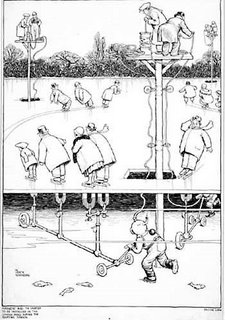 But it might be worth figuring out how the machine of rights discourse functions, and how it compares with the machine of state power or sovereignty.
Reading about the 1954 Guatemalan coup, I'm struck by how much what the CIA cobbled together was a Heath Robinson contraption (Rube Goldberg machine for North Americans) constantly in danger of breaking down, but finally anchored by US President Eisenhower's say so.
How different is that from (what would be more charitably described as) the network by means of which human rights abuses are charted, publicized, and acted against? I'm thinking here for instance of Amnesty's decentralized collection of letter writers, assiduously (as I imagine them) sending postcards off to jailors and generals throughout the Third World. But again, does this network not also depend upon a sovereign instance as anchor?
Two issues therefore arise:
First, the mechanisms of encoding. These are perhaps successive. For instance, what happens as pain is expressed or transmitted first affectively (paradigmatically, in the scream; see John Holloway on this), then narratively (say, in testimonio), and then as a legal plaint (taking rights discourse to be a version of juridical deliberation)? How, in other words, is the discourse of rights produced? Looking at this would involve understanding the ways in which struggle and repression become encoded, enter into various types of representation. I think it's out of a concern with this process that Deleuze argues for the importance of jurisprudence:
Creation, in law, is jurisprudence, and that's the only thing there is. So: fighting for jurisprudence. That's what being on the left is about. It's creating the right.One would have therefore also to think further about the theory of representation at work here. Deleuze argues in terms of "creation" rather than a perhaps more customary emphasis on the dislocation between referent and sign.
One would also consider all the various groups, institutions, and (in short) agencies in all senses of that word that contribute to the mechanics of rights discourse: the role of human rights groups, for instance; or the relays between international bodies such as the OAS or the UN; or the part played by truth commissions and the like.
Second, however, why think of rights discourse as the final text, as an end product? Indeed, though rights as often presented as goal as they are assumed as origin--hence the notion of "fighting for" or seeking to gain rights--it's surely best to see them as an instrument, as one more cog or chain in a much broader arrangement. After all, does anybody really care about the right to (say) shelter, privacy, or free speech? No, they care for the achievement of those goals. In rights discourse, this is finessed as the distinction between an exercised and an unexercised right; but an unexercised right is dead, useless.
What then (and here I'm inspired by some discussion at Serena's blog) of rights discourse as one part of a broader mechanism of social justice? Rights here (as Peggy implies) would be the abstract moment bridging two concrete practices: crime and its punishment.
A few concerns:
First, all this sounds worryingly dialectical, as the abstract universal mediates concrete particulars.
Second, would the above not also apply to law tout court? (What difference is there between rights and law? Are rights not just a (fictitious) model for an entire legal constitution?)
Third, such talk of mechanisms seems to obscure the importance of interpretation.
Fourth, we shouldn't forget the sovereign instance (state or divinity, or even the idea of the human) that ultimately guarantees the possibility of any such mediation.
OK, for a moment there I thought I might be on the road towards salvaging rights, now as mechanism rather than discourse. Perhaps not.
 But it might be worth figuring out how the machine of rights discourse functions, and how it compares with the machine of state power or sovereignty.
 Reading about the 1954 Guatemalan coup, I'm struck by how much what the CIA cobbled together was a Heath Robinson contraption (Rube Goldberg machine for North Americans) constantly in danger of breaking down, but finally anchored by US President Eisenhower's say so.
How different is that from (what would be more charitably described as) the network by means of which human rights abuses are charted, publicized, and acted against? I'm thinking here for instance of Amnesty's decentralized collection of letter writers, assiduously (as I imagine them) sending postcards off to jailors and generals throughout the Third World. But again, does this network not also depend upon a sovereign instance as anchor?
Friday, September 01, 2006
rights
[The first in a series...]
 Are, then, rights--that cherished shibboleth of progressive liberalism--beyond redemption? Gilles Deleuze seems to think so, calling rights "softheaded thinking" and "a party line for intellectuals, and for odious intellectuals, and for intellectuals without any ideas of their own" ("On Human Rights").
If we were to salvage rights, then on what grounds? The most frequently cited might be the tactical use of rights discourse, perhaps particularly as a mode of appealing beyond given territorial boundaries. So (say) a beseiged minority in a third world state (though why not also a first world one?) appeals to the UN charter of rights as a tactic within a local, punctual struggle. Rights then as a line of flight?
Perhaps more interestingly, surely we should also see rights, or the various declarations within which rights are defined and announced (however "self-evident[ly]," as with the US Constitution), as surfaces of inscription, sites within which the current balance of forces in a given struggle is marked? As such, though the danger is that the state of play is thereby reified and miscrecognized (always a temptation with rights: to see them as immutable and transhistorical), at the same time it might be worth considering how that act of inscription functions to complicate and feed back upon the struggle itself.
Are, then, rights--that cherished shibboleth of progressive liberalism--beyond redemption? Gilles Deleuze seems to think so, calling rights "softheaded thinking" and "a party line for intellectuals, and for odious intellectuals, and for intellectuals without any ideas of their own" ("On Human Rights").If we were to salvage rights, then on what grounds? The most frequently cited might be the tactical use of rights discourse, perhaps particularly as a mode of appealing beyond given territorial boundaries. So (say) a beseiged minority in a third world state (though why not also a first world one?) appeals to the UN charter of rights as a tactic within a local, punctual struggle. Rights then as a line of flight?
Perhaps more interestingly, surely we should also see rights, or the various declarations within which rights are defined and announced (however "self-evident[ly]," as with the US Constitution), as surfaces of inscription, sites within which the current balance of forces in a given struggle is marked? As such, though the danger is that the state of play is thereby reified and miscrecognized (always a temptation with rights: to see them as immutable and transhistorical), at the same time it might be worth considering how that act of inscription functions to complicate and feed back upon the struggle itself.
Thursday, June 01, 2006
frayed
The "Pirate Studies" panel the other day, organized by Craig of theoria, was fun and generated some useful discussion. It was also good to hang out afterwards with Craig, Weblog denizen Doug Johnson, and others.
 Here's the last section of my paper, on "piracy, nomadism, and the state." The first two sections were on "why pirates matter" and "the political economy of piracy." The paper as a whole is more or less an outline, sketching out some possible positions within pirate studies. But it brings together some thoughts I've been mulling over for a little while...
piracy, nomadism, and the state
The complexity and confusion regarding piracy’s political economy leads to, is amplified in, and exacerbates a similar set of confusions regarding piracy’s relation to the state. Moreover, an added complication here concerns first, the range of piratical activities and the nomenclature used to describe them, and second the historical vicissitudes of piracy from at least the sixteenth to the nineteenth centuries, in other words precisely during the period of the European state’s consolidation, and imperial expansion. Take the issue of nomenclature. Though sometimes all non-state maritime violence is considered under the label of piracy, the series of differing terms employed at other times indicates multiple attempts (often finally frustrated) to distinguish between different forms of violence, or more strictly its different degrees of legitimacy. Pirate, buccaneer, privateer, private man-of-war, corsair, filibuster, freebooter, coastal raider. . . all these terms indicate subtle differentiations, of which by far the most important is that between privateer and pirate.
Strictly speaking, a privateer is a private merchantman who has been provided with a “letter of marque” from a national state, permitting him to engage with, board, and take goods from merchantmen from other nations, within boundaries more or less precisely delineated by national and international law. As such, privateers (and the closely related private men-of war) were extensions of the state’s juridical and military apparatus in those areas of the world beyond its formal control, or its ability for direct regulation. Privateers and private men-of-war were essentially mercenaries, enabling state expansion without the state having to invest in the expense of fixed capital, and the set-up costs of recruitment, construction, outfitting, and so on. Privateers were particularly a feature of the sixteenth-century Caribbean, when private seamen such as Drake and Hawkins, though viewed as common criminals by the Spanish, in fact did the work of English state foreign policy more effectively and efficiently than the English navy itself was capable of doing. No wonder Elizabeth I would term Drake “my pirate.” Given, however, this close relation between state and private forces, there was significant attempts at regulation and normalization of the relationship. So, for instance, normally, as David Starkey notes, the “authority [of letters of marque] was valid only in wartime and against enemy property” (69). Yet, as Starkey goes on to explain, the boundaries of legality were often disputed, and evidence as to the propriety of specific acts hard to ascertain when they had taken place on the high seas many thousands of miles from any court of law. The British High Court of the Admiralty was charged with determining justice in such cases, with the “issue of letters of marque and privateer commissions and the condemnation of prizes” (73). But the process could be cumbersome, especially as in the case of dispute “either party could appeal against the decision to a superior court, the Court of Prize Appeals, which could delay the final pronouncement for months or even years” (76).
The system was therefore prone to abuses, to privateers going beyond their bounds and misreporting or not reporting the extent or circumstances of their engagements. Increasingly, the regulation of privateering had to take place closer to the spheres in which it actually took place, and so to be monitored more directly by the Royal Navy. As such, however, and with the (in part, consequent) growth in the power and extent of the Navy, the raison d’être for privateering began to wane. After all, if the Navy could now take on the role of monitoring privateering on the high seas, it would be even more efficient for it to perform directly the self-same functions for which privateering was invented. In other words, once the state no longer needed private supplements to enable its foreign adventures, it could dispense with the requirement for privateers, and even take a moral high ground within the international juridical order, by seeking to abolish privateering altogether. And this was precisely what happened over the course of the seventeenth century, until by the beginning of the eighteenth what was supposedly piracy’s “golden age” was in fact the period of its precipitate decline, at least in the Atlantic, as it was the point at which European state collectively turned against the forces that they themselves had historically authorized and nurtured, turning now to outlaw private force, and so to secure their rather tardy achievement of a monopoly over the legitimate use of force, beyond as well as within their territorial borders.
Hence, the relation between piracy and the state is complex and historically variable. And here, to conclude, we can venture some theoretical observations regarding the Deleuzoguattarian conception of nomadism. At times, to be sure, pirates do and have functioned as a kind of absolute outside, a war machine opposed to and in contradistinction to a state which only arises (if perhaps not “all at once”) later. At other times, however, pirates were if anything the advance guard of the state, heralds of its imperial expansion. In a further irony, piracy equally called forth the state as a mode of regulation. This is perhaps most clearly obvious in the case of Spain and its construction of the first modern state bureaucracy, centered in Seville’s “Casa de Contratación,” in direct response to the threat of a continuity of illegal activities, from private commerce to fraud to mutiny to outright piracy. Finally, there is the case of piracy sponsored and originated by the state, instances of groups organized and financed under its care, but which outgrew it, to become semi-autonomous, dangerously out of control. The American filibusters such as William Walker and his Nicaraguan expeditionaries in the nineteenth century, are perhaps a particularly good example of this. In other words, the question of nomadism may not simply be that of the state taking over the war machine (as Deleuze and Guattari suggest) but also the ways in which the state itself becomes immanent, at the frayed edges of its territorial power, at the liminal margins of Empire: the ways in which, in short, the state itself generates its own nomads.
 Here's the last section of my paper, on "piracy, nomadism, and the state." The first two sections were on "why pirates matter" and "the political economy of piracy." The paper as a whole is more or less an outline, sketching out some possible positions within pirate studies. But it brings together some thoughts I've been mulling over for a little while...
piracy, nomadism, and the state
The complexity and confusion regarding piracy’s political economy leads to, is amplified in, and exacerbates a similar set of confusions regarding piracy’s relation to the state. Moreover, an added complication here concerns first, the range of piratical activities and the nomenclature used to describe them, and second the historical vicissitudes of piracy from at least the sixteenth to the nineteenth centuries, in other words precisely during the period of the European state’s consolidation, and imperial expansion. Take the issue of nomenclature. Though sometimes all non-state maritime violence is considered under the label of piracy, the series of differing terms employed at other times indicates multiple attempts (often finally frustrated) to distinguish between different forms of violence, or more strictly its different degrees of legitimacy. Pirate, buccaneer, privateer, private man-of-war, corsair, filibuster, freebooter, coastal raider. . . all these terms indicate subtle differentiations, of which by far the most important is that between privateer and pirate.
Strictly speaking, a privateer is a private merchantman who has been provided with a “letter of marque” from a national state, permitting him to engage with, board, and take goods from merchantmen from other nations, within boundaries more or less precisely delineated by national and international law. As such, privateers (and the closely related private men-of war) were extensions of the state’s juridical and military apparatus in those areas of the world beyond its formal control, or its ability for direct regulation. Privateers and private men-of-war were essentially mercenaries, enabling state expansion without the state having to invest in the expense of fixed capital, and the set-up costs of recruitment, construction, outfitting, and so on. Privateers were particularly a feature of the sixteenth-century Caribbean, when private seamen such as Drake and Hawkins, though viewed as common criminals by the Spanish, in fact did the work of English state foreign policy more effectively and efficiently than the English navy itself was capable of doing. No wonder Elizabeth I would term Drake “my pirate.” Given, however, this close relation between state and private forces, there was significant attempts at regulation and normalization of the relationship. So, for instance, normally, as David Starkey notes, the “authority [of letters of marque] was valid only in wartime and against enemy property” (69). Yet, as Starkey goes on to explain, the boundaries of legality were often disputed, and evidence as to the propriety of specific acts hard to ascertain when they had taken place on the high seas many thousands of miles from any court of law. The British High Court of the Admiralty was charged with determining justice in such cases, with the “issue of letters of marque and privateer commissions and the condemnation of prizes” (73). But the process could be cumbersome, especially as in the case of dispute “either party could appeal against the decision to a superior court, the Court of Prize Appeals, which could delay the final pronouncement for months or even years” (76).
The system was therefore prone to abuses, to privateers going beyond their bounds and misreporting or not reporting the extent or circumstances of their engagements. Increasingly, the regulation of privateering had to take place closer to the spheres in which it actually took place, and so to be monitored more directly by the Royal Navy. As such, however, and with the (in part, consequent) growth in the power and extent of the Navy, the raison d’être for privateering began to wane. After all, if the Navy could now take on the role of monitoring privateering on the high seas, it would be even more efficient for it to perform directly the self-same functions for which privateering was invented. In other words, once the state no longer needed private supplements to enable its foreign adventures, it could dispense with the requirement for privateers, and even take a moral high ground within the international juridical order, by seeking to abolish privateering altogether. And this was precisely what happened over the course of the seventeenth century, until by the beginning of the eighteenth what was supposedly piracy’s “golden age” was in fact the period of its precipitate decline, at least in the Atlantic, as it was the point at which European state collectively turned against the forces that they themselves had historically authorized and nurtured, turning now to outlaw private force, and so to secure their rather tardy achievement of a monopoly over the legitimate use of force, beyond as well as within their territorial borders.
Hence, the relation between piracy and the state is complex and historically variable. And here, to conclude, we can venture some theoretical observations regarding the Deleuzoguattarian conception of nomadism. At times, to be sure, pirates do and have functioned as a kind of absolute outside, a war machine opposed to and in contradistinction to a state which only arises (if perhaps not “all at once”) later. At other times, however, pirates were if anything the advance guard of the state, heralds of its imperial expansion. In a further irony, piracy equally called forth the state as a mode of regulation. This is perhaps most clearly obvious in the case of Spain and its construction of the first modern state bureaucracy, centered in Seville’s “Casa de Contratación,” in direct response to the threat of a continuity of illegal activities, from private commerce to fraud to mutiny to outright piracy. Finally, there is the case of piracy sponsored and originated by the state, instances of groups organized and financed under its care, but which outgrew it, to become semi-autonomous, dangerously out of control. The American filibusters such as William Walker and his Nicaraguan expeditionaries in the nineteenth century, are perhaps a particularly good example of this. In other words, the question of nomadism may not simply be that of the state taking over the war machine (as Deleuze and Guattari suggest) but also the ways in which the state itself becomes immanent, at the frayed edges of its territorial power, at the liminal margins of Empire: the ways in which, in short, the state itself generates its own nomads.
Monday, May 22, 2006
dialectic
An interesting post from Steve Shaviro over at The Pinocchio Theory, on "Pluralism and Antagonism". The nub of his argument is that a Deleuzian anti-dialecticism might re-invigorate Marxist categories.
My question is whether we should assume that the dialectic ever functioned as it claimed to do. For Deleuze, surely not.
Or to put it another way. At Brock, Negri repeatedly insisted that the dialectic of labour and capital was at an end. But a more thorough-going Deleuzianism would insist that there never was such a dialectic.
We have moved, in other words, from a period in which the concept of the dialectic was at best well-rooted only in appearances (and so thoroughly ideological), to a period in which its prior bankruptcy is clearer now than ever.
I'm interested in thinking through the nature of that transition, which is not (cannot be) as far as I can see an transition in the functioning of politics and economics themselves. Rather, what has changed is only a certain regime of visibility or of epistemology. Which is not to say that an epistomological change has no effects. But collapsing one transition into the other too quickly is rather problematic.
Meanwhile, I know I've featured this image before, but even so...
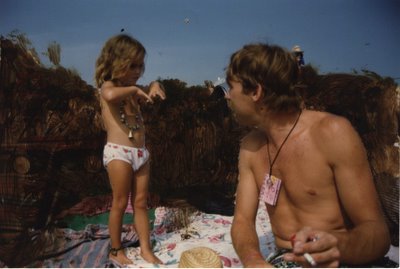
"Girl Refuting Hegel's Dialectic Model of History," by Michael Laster
In this situation, contradiction and negativity have become rather sterile resources for change, I think. Deleuze’s notion of the virtual allows for a wider range of resources. Instead of a dialectic, Deleuze (and Guattari) propose a vision of how capitalism simultaneously unleashes and regulates fluxes of energy and matter, of desires and subjects and objects.But my question concerns the opening phrase, "in this situation." Shaviro refers to the post-1960s stagnation of the Left and radical theory itself. This is the period that I'd describe in terms of posthegemony.
My question is whether we should assume that the dialectic ever functioned as it claimed to do. For Deleuze, surely not.
Or to put it another way. At Brock, Negri repeatedly insisted that the dialectic of labour and capital was at an end. But a more thorough-going Deleuzianism would insist that there never was such a dialectic.
We have moved, in other words, from a period in which the concept of the dialectic was at best well-rooted only in appearances (and so thoroughly ideological), to a period in which its prior bankruptcy is clearer now than ever.
I'm interested in thinking through the nature of that transition, which is not (cannot be) as far as I can see an transition in the functioning of politics and economics themselves. Rather, what has changed is only a certain regime of visibility or of epistemology. Which is not to say that an epistomological change has no effects. But collapsing one transition into the other too quickly is rather problematic.
Meanwhile, I know I've featured this image before, but even so...

Thursday, April 27, 2006
eclecticism
Somewhat late in the day, there's been a minor dust-up in the Spivak event over the concept of a "higher eclecticism." See Scott Kaufman's post at the Valve, "Arguments about Higher Eclecticism, as Illustrated by Two Paintings with One Name".
 (Oh, and let me say that I have never liked Mark Tansey's work. I remember seeing him speak once, and asking a question suggesting he was just a highbrow Peter Blake.)
I felt myself rather misrepresented in that post (as I try to clarify in the subsequent comments). But the fact that my name was invoked arises in part from my suggestions at various times that it'd be worth formulating some kind of defence of eclecticism, if not necessarily a "higher eclecticism."
As a place-holder for such a defence, let me rescue and elaborate slightly upon a comment I made elsewhere, in the discussion that originally led up to the Spivak symposium...
I have no real idea what John Holbo means by "higher eclecticism," but in many ways I'd happily admit that my own work is concerned with, and operates though, a form of (perhaps lowdown and dirty) eclecticism.
Put it this way: I enjoy and find productive the activity of bringing together apparently divergent traditions of thought and cultural enquiry, and seeing what emerges from the ensuing collision.
I do that both with theorists (Deleuze and Bourdieu, for instance, who are certainly unlikely bedmates), but also more generally with Area Studies and Theory, and/or with Latin American reflections on culture and Anglo-American approaches to culture.
I wouldn't want to argue that there's some natural affinity between these traditions, nor that their contradictions or differences can be resolved. It's not an attempt to totalize or homogenize. Far from it, in fact; I'd rather preserve their heterogeneity. But I do think that the sparks that fly off in the encounters or clashes between divergent series is indeed illuminating. I'm thinking here in part of Deleuze's reflections on the series, and the "strange attractor" that communicates between them like a lightning flash.
Anyhow, I'm not necessarily advocating this as some kind of transferable master plan. (There might after all be some self-contradiction were I to do so...) But it works well enough for me.
And if that's "higher eclecticism," then so be it.
Though if I were to be suitably self-regarding and self-conscious, I'd probably turn to concepts within the traditions I work with--such as "mestizaje" or "transculturation" or "hybridity," say--as my own personal descriptors. After all, these terms (hybridity and so on) are crucial to the way in which we've understood Latin American (and more generally, postcolonial) culture. Why not work with them? Even if we have to differentiate between different modes of eclecticism (higher vs. lower, dirty vs. clean, I don't know), just as Alberto Moreiras distinguishes a "savage" hybridity.
But if the alternative to eclecticism is disciplinarity, purity, respect for lineage... then I'll choose eclecticism every time.
 (Oh, and let me say that I have never liked Mark Tansey's work. I remember seeing him speak once, and asking a question suggesting he was just a highbrow Peter Blake.)
I felt myself rather misrepresented in that post (as I try to clarify in the subsequent comments). But the fact that my name was invoked arises in part from my suggestions at various times that it'd be worth formulating some kind of defence of eclecticism, if not necessarily a "higher eclecticism."
As a place-holder for such a defence, let me rescue and elaborate slightly upon a comment I made elsewhere, in the discussion that originally led up to the Spivak symposium...
I have no real idea what John Holbo means by "higher eclecticism," but in many ways I'd happily admit that my own work is concerned with, and operates though, a form of (perhaps lowdown and dirty) eclecticism.
Put it this way: I enjoy and find productive the activity of bringing together apparently divergent traditions of thought and cultural enquiry, and seeing what emerges from the ensuing collision.
I do that both with theorists (Deleuze and Bourdieu, for instance, who are certainly unlikely bedmates), but also more generally with Area Studies and Theory, and/or with Latin American reflections on culture and Anglo-American approaches to culture.
I wouldn't want to argue that there's some natural affinity between these traditions, nor that their contradictions or differences can be resolved. It's not an attempt to totalize or homogenize. Far from it, in fact; I'd rather preserve their heterogeneity. But I do think that the sparks that fly off in the encounters or clashes between divergent series is indeed illuminating. I'm thinking here in part of Deleuze's reflections on the series, and the "strange attractor" that communicates between them like a lightning flash.
Anyhow, I'm not necessarily advocating this as some kind of transferable master plan. (There might after all be some self-contradiction were I to do so...) But it works well enough for me.
And if that's "higher eclecticism," then so be it.
Though if I were to be suitably self-regarding and self-conscious, I'd probably turn to concepts within the traditions I work with--such as "mestizaje" or "transculturation" or "hybridity," say--as my own personal descriptors. After all, these terms (hybridity and so on) are crucial to the way in which we've understood Latin American (and more generally, postcolonial) culture. Why not work with them? Even if we have to differentiate between different modes of eclecticism (higher vs. lower, dirty vs. clean, I don't know), just as Alberto Moreiras distinguishes a "savage" hybridity.
But if the alternative to eclecticism is disciplinarity, purity, respect for lineage... then I'll choose eclecticism every time.
Saturday, April 08, 2006
blocks
Posthegemony is on something of a diagram spree right now. I have more of Douglas Oliver's diagrams to post shortly--next week, most likely. Meanwhile, however, two from the last couple of books I've read.
First, Arguedas's El zorro de arriba y el zorro de abajo includes, as one element of its decidedly messy mixed-genre text, a diagram.
This comes in the same section that I've discussed already: as the factory manager, Don Angel, is showing his visitor, Diego, around the bowels of the machinic apparatus. Diego asks Don Angel "And the panorama? How do you see the panorama, the conjunction of things?" Angel replies:
But if Diego is indeed "watch[ing his] hand and listen[ing] to [his] words" at the same time, as Don Angel encourages him to do, perhaps it might occur to him that the two are not necessarily consonant. Where does the factory manager come up with these seven blocks, for instance? And where are "we," the elite subject that he first invokes? Part of the Peruvian government, or part of the Peruvian people? What is the logic of the lines' criss-crossing and semi-convergence, also at times semi-divergence? Do these lines construct the face we see, or does that pre-exist the diagram? Is it indeed a face, or a mask, a fetish, set at a distance from all the elements of Peruvian society that are, after all, separated out at the top of the picture?
In other words, for all the narrative verve and confidence that Don Angel brings to his analysis of the social panorama, there's a sense in which the diagram betrays him. The lines of force that he traces take flight, obeying their own logic, suggesting their own conclusions--perhaps a more open future than the inevitable permanence of capitalist rule the manager himself so confidently predicts.
Meanwhile, there's at least a topological similarity between the diagram to be found in Arguedas's book and the two architectures of power outlined in Deleuze and Guattari's Kafka: Toward a Minor Literature.
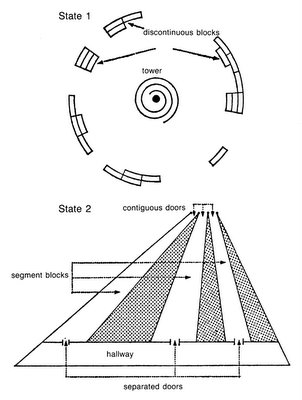
These two diagrams designate two states of social architectonics, which are both distinct and commingling. The first of these is the image of transcendence, or the quasi-cause: rather than eggs we have blocks, set at a distance from a central tower in which power purports to reside. (There is of course something here of Foucault's analysis of the panopticon, though that's not directly referenced.)
This first state is governed by a logic of
The second architectural state, on the other hand, is governed by a logic of the
To return to Arguedas, then, the task would be to seek out the other diagram, the rhizomatic diagram of the faraway and the contiguous that would start to undo and counter Don Angel's faith in the distant and the close.
As a first approximation, as I have suggested, we may find traces of that other diagram even in the map drawn by the factory manager himself. For is not the shape of his diagram closer to the second of Deleuze and Guattari's diagram (the posthegemonic assemblage) than the first: another triangle, another set of disjunctive convergences, albeit inverted? One step might then be to invert the industrialist's diagram, to put his account of Peruvian society, in which capital is necessarily in the driving seat, back on its feet.
And a second approximation would be to seek that other, missing diagram elsewhere in Arguedas's work. To open up the Arguedas-machine to the immanence of affective contiguity and intensity in the faraway highlands, to follow the set of procedures for achieving the plane of immanence that have governed his writing from the very start.
First, Arguedas's El zorro de arriba y el zorro de abajo includes, as one element of its decidedly messy mixed-genre text, a diagram.
This comes in the same section that I've discussed already: as the factory manager, Don Angel, is showing his visitor, Diego, around the bowels of the machinic apparatus. Diego asks Don Angel "And the panorama? How do you see the panorama, the conjunction of things?" Angel replies:
Yes, Diego my friend; yes I see the panorama more clearly. Wait a moment. This is the way the conjunction is. That's it! Take a good look at this map or diagram, complete with names, that I'll trace and write down; I'll be drawing it. This is how it starts. Watch my hand and listen to my words. I think that something will come out of this; yes, something objective. Look...So we have ten eggs, and ten lines, which converge and cross over a face, a mask, that is the face of Peru. This is a diagram of power (is there any other kind?), a balance of forces, in which the industrialist expresses his confidence in the eternal omnipotence of capital.
Seven white eggs against three red ones. There's us, and industry, and the USA, the Peruvian government, the Peruvian people's ignorance, and the ignorance of the Cardozos [the liberation theology priests] about the Peruvian people, together we all make up the white forces. On the other hand, John XXIII, Communism, and the rage, whether lucid or cock-eyed, of a small section of the Peruvian people against the USA, industry, and the government, all these make up the red forces. Take a look: that's the face of Peru, that's it with its three little red lines. [. . .] In short, Diego my friend, we are seven white eggs against three red ones. And one of the red ones, Communism that is, has maggots infesting its dying body. I know what I'm talking about. And this map won't change ever at all against capital, only in its favour. It's a sure thing! There are just a few people in power through the whole universe, heaven and earth, water and sea. (92-93)
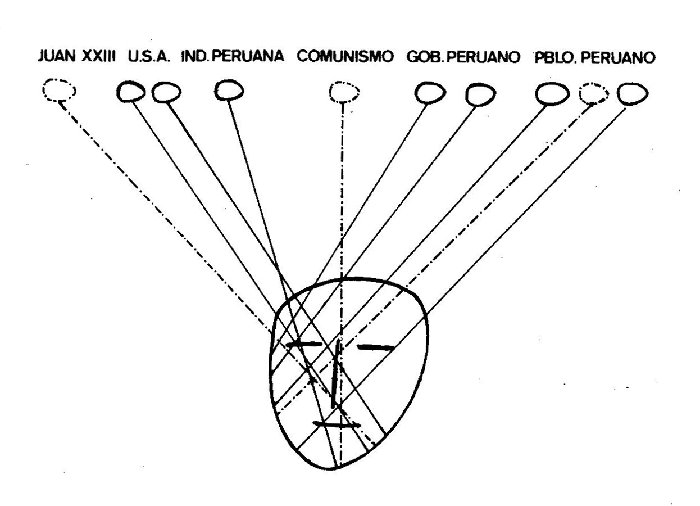
But if Diego is indeed "watch[ing his] hand and listen[ing] to [his] words" at the same time, as Don Angel encourages him to do, perhaps it might occur to him that the two are not necessarily consonant. Where does the factory manager come up with these seven blocks, for instance? And where are "we," the elite subject that he first invokes? Part of the Peruvian government, or part of the Peruvian people? What is the logic of the lines' criss-crossing and semi-convergence, also at times semi-divergence? Do these lines construct the face we see, or does that pre-exist the diagram? Is it indeed a face, or a mask, a fetish, set at a distance from all the elements of Peruvian society that are, after all, separated out at the top of the picture?
In other words, for all the narrative verve and confidence that Don Angel brings to his analysis of the social panorama, there's a sense in which the diagram betrays him. The lines of force that he traces take flight, obeying their own logic, suggesting their own conclusions--perhaps a more open future than the inevitable permanence of capitalist rule the manager himself so confidently predicts.
Meanwhile, there's at least a topological similarity between the diagram to be found in Arguedas's book and the two architectures of power outlined in Deleuze and Guattari's Kafka: Toward a Minor Literature.
These two diagrams designate two states of social architectonics, which are both distinct and commingling. The first of these is the image of transcendence, or the quasi-cause: rather than eggs we have blocks, set at a distance from a central tower in which power purports to reside. (There is of course something here of Foucault's analysis of the panopticon, though that's not directly referenced.)
This first state is governed by a logic of
the distant and the close [. . .] the blocks that form arches of the circle are close to each other--they join up by forming couples. It is also true that they remain distant from each other, since gaps that will never be filled remain between them. Furthermore, the transcendental law, the infinite tower, is infinitely distant from each block; and, at the same time, it is always very close and never ceases to send its messager to each block, bringing one near the other when it moves away from the other, and so on. The infinitely distant law emits hypostases, sends emanations that always come closer and closer. (76-77)

The second architectural state, on the other hand, is governed by a logic of the
faraway and the contiguous. Faraway is opposed to close, contiguous is opposed to distant. But in the grouping of the experiences and concepts, faraway is equally opposed to distant, contiguous opposed to close. In fact, the offices are very far away from each other because of the length of the hallway that separates them (they aren't very close), but they are contiguous because of the back doors that connect them along the same line (they aren't very distant). (77)Rhizome versus arborescence, in short--but also bureaucratic machine versus (myth of) sovereignty. And posthegemony versus hegemony.
To return to Arguedas, then, the task would be to seek out the other diagram, the rhizomatic diagram of the faraway and the contiguous that would start to undo and counter Don Angel's faith in the distant and the close.
As a first approximation, as I have suggested, we may find traces of that other diagram even in the map drawn by the factory manager himself. For is not the shape of his diagram closer to the second of Deleuze and Guattari's diagram (the posthegemonic assemblage) than the first: another triangle, another set of disjunctive convergences, albeit inverted? One step might then be to invert the industrialist's diagram, to put his account of Peruvian society, in which capital is necessarily in the driving seat, back on its feet.
And a second approximation would be to seek that other, missing diagram elsewhere in Arguedas's work. To open up the Arguedas-machine to the immanence of affective contiguity and intensity in the faraway highlands, to follow the set of procedures for achieving the plane of immanence that have governed his writing from the very start.
Saturday, February 18, 2006
coexistence
Deleuze articulates the core of Difference and Repetition, and perhaps of his work as a whole, with the following declaration:
Immediately thereafter, Deleuze forestalls those who suggest that dispensing with negation would also mean doing away with critique, those who worry that giving up on the dialectic implies an acceptance, say, of the end of history. No, Deleuze states, the negative was never intrinsic to Marxism. Deleuze stands by an anti-dialectical Marxism, in tune with Althusserianism:
It's worth noting en passant that Deleuze's Marxism in Difference and Repetition is surprisingly orthodox, at least in so far as he holds to the base/superstructure model:
For the point is that overturning Platonism and rejecting Hegelianism are insufficient. Representation, the One, negation, etc. are false problems. Once their insubstantiality is shown, the real problems persist. And is "the name of Marx" really enough to save us from a functionalist celebration of the immanent? It certainly hasn't stopped Manual de Landa, for instance, from employing Deleuzianism for an apologia for the market.
To put this another way, the end of hegemony is scarcely a liberation. It is only the beginning of the task facing posthegemony.
"Girl Refuting Hegel's Dialectic Model of History," by Michael Laster
In short, the negative is always derived and represented, never original or present: the process of difference and differenciation is primary in relation to that of the negative and opposition. (207)Here, succinctly, is both Platonism overturned and Hegelianism rejected.
Immediately thereafter, Deleuze forestalls those who suggest that dispensing with negation would also mean doing away with critique, those who worry that giving up on the dialectic implies an acceptance, say, of the end of history. No, Deleuze states, the negative was never intrinsic to Marxism. Deleuze stands by an anti-dialectical Marxism, in tune with Althusserianism:
Those commentators on Marx who insist upon the fundamental difference between Marx and Hegel rightly point out that in Capital the category of differenciation (the differenciation at the heart of a social multiplicity: the division of labour) is substituted for the Hegelian concepts of opposition, contradiction, and alienation. (207)A footnote to Reading Capital follows.
It's worth noting en passant that Deleuze's Marxism in Difference and Repetition is surprisingly orthodox, at least in so far as he holds to the base/superstructure model:
In all rigour, there are only economic social problems, even though the solutions may be juridical, political, or ideological, and the problems may be expressed in these fields of resolvability. (186)But in what is almost an aside, Deleuze then notes:
Clearly, at this point the philosophy of difference must be wary of turning into the discourse of beautiful souls: differences, nothing but differences, in a peaceful coexistence in the Idea of social places and functions . . . but the name of Marx is sufficient to save it from this danger. (207)This is an odd but crucial clarification. It also contains a significant ellipsis. Not the only one in the book, but no doubt the most symptomatic. (Compare xx, 26, 63, 72, 75, 85, 117, 155, 163, 187, 188, 191, 223, 228, 246, where in most cases the ellipsis is fairly trivially associated with a list.)
For the point is that overturning Platonism and rejecting Hegelianism are insufficient. Representation, the One, negation, etc. are false problems. Once their insubstantiality is shown, the real problems persist. And is "the name of Marx" really enough to save us from a functionalist celebration of the immanent? It certainly hasn't stopped Manual de Landa, for instance, from employing Deleuzianism for an apologia for the market.
To put this another way, the end of hegemony is scarcely a liberation. It is only the beginning of the task facing posthegemony.
Wednesday, February 15, 2006
larval
I suspect that most people who read Deleuze's Difference and Repetition--and there can't be many of them--are reading the book through the lens provided by his and Guattari's later Capitalism and Schizophrenia. And indeed, many of the elements of the later work are already in place here, not least the affirmation of difference and multiplicity, and the refusal of negation and representation.
The productivist ethos of Anti-Oedipus is on display: "In every respect," Deleuze tells us, "truth is a matter of production, not of adequation" (154). As is the refusal of lack, and so implicitly an incipient anti-Lacanianism: "The unconscious is neither an unconscious of degradation nor an unconscious of contradiction; it involves neither limitation nor opposition [. . .]. The celebrated phrase 'the unconscious knows no negative' must be taken literally" (108).
Moreover, surely the syntheses of the later work (connective, disjunctive, and conjunctive) are anticipated in the discussion of Habitus, Eros, and Thanatos, the "three syntheses which must be understood as constitutive of the unconscious" (114). This triad reoccurs in a number of variations in the first half of the book: as present, past, and future (but also as different modalities of the past, and of time itself); and as "coupling," "resonance," and "forced movement" (117).
And although Deleuze's concerns are not (yet) fully social, fully political, there are indications of both possible and actual connections with social critique. For example:
And I had forgotten that Deleuze attends so much to "the mystery of habit" (73), which he even discusses under the rubric of Habitus. There is something primary about habit in Deleuze: it constitutes the first synthesis, of connection or "contraction" (73). (Could one imagine a counter-contractarian tradition, then?)
 Habit establishes the "larval self," or the larval selves that inhabit us, "the primary habits that we are; the thousands of passive syntheses of which we are organically composed. [. . .] We speak of our 'self' only in virtue of these thousands of little witnesses which contemplate within us" (74). Habit is always already multitudinous. Or, again:
As such, an alternative tradition opens up, a fissure that runs through even the most canonical of philosophers. And it is tracing that fissure, and the larvae that spill from it, that is the object of so much of Deleuze's other philosophical work.
The productivist ethos of Anti-Oedipus is on display: "In every respect," Deleuze tells us, "truth is a matter of production, not of adequation" (154). As is the refusal of lack, and so implicitly an incipient anti-Lacanianism: "The unconscious is neither an unconscious of degradation nor an unconscious of contradiction; it involves neither limitation nor opposition [. . .]. The celebrated phrase 'the unconscious knows no negative' must be taken literally" (108).
Moreover, surely the syntheses of the later work (connective, disjunctive, and conjunctive) are anticipated in the discussion of Habitus, Eros, and Thanatos, the "three syntheses which must be understood as constitutive of the unconscious" (114). This triad reoccurs in a number of variations in the first half of the book: as present, past, and future (but also as different modalities of the past, and of time itself); and as "coupling," "resonance," and "forced movement" (117).
And although Deleuze's concerns are not (yet) fully social, fully political, there are indications of both possible and actual connections with social critique. For example:
What is a thought which harms no one, neither thinkers nor anyone else? Recognition is a sign of the celebration of monstrous nuptials, in which thought "rediscovers" the State, rediscovers "the Church," and rediscovers the current values that it subtly presented in the pure form of an eternally blessed unspecified eternal object. (135-136)Indeed, and this is another of those subterranean connections to Bourdieu that interest me, the struggle against Philosophy's "image of thought" is also a struggle against doxa, a posthegemonic analysis of a common sense that lies beneath or beyond ideology: "The image of thought is only the figure in which doxa is universalised by being elevated to the rational level" (134).
And I had forgotten that Deleuze attends so much to "the mystery of habit" (73), which he even discusses under the rubric of Habitus. There is something primary about habit in Deleuze: it constitutes the first synthesis, of connection or "contraction" (73). (Could one imagine a counter-contractarian tradition, then?)
 Habit establishes the "larval self," or the larval selves that inhabit us, "the primary habits that we are; the thousands of passive syntheses of which we are organically composed. [. . .] We speak of our 'self' only in virtue of these thousands of little witnesses which contemplate within us" (74). Habit is always already multitudinous. Or, again:
This living present, and with it the whole of organic and psychic life, rests upon habit. [. . .] We must regard habit as the foundation from which all other psychic phenomena derive. [. . .] These thousands of habits of which we are composed--these contractions, contemplations, pretensions, presumptions, satisfactions, fatigues; these variable presents--thus form the basic domain of passive syntheses. [. . .] Selves are larval subjects; the world of passive syntheses constitutes the system of the self, under conditions yet to be determined, but it is the system of a dissolved self. (78)The issue, then, is how the Self, the Subject, is composed as an abstraction from and imposition on this teeming world. Whence the One, now all too recognizable, that stands in for this multiplicity? Deleuze here asks this question of Philosophy. And it is Plato who is the villain of the piece, though this is complicated by the fact both that Platonism has subsequently been compounded by (particularly) Descartes, Kant, and Hegel, and also that Plato at least is ascribed the virtue of having in some way failed to secure the victory of the Idea over the copy: "Was it not inevitable that Plato should be the first to overturn Platonism, or at least to show the direction such an overturning should take?" (68).
As such, an alternative tradition opens up, a fissure that runs through even the most canonical of philosophers. And it is tracing that fissure, and the larvae that spill from it, that is the object of so much of Deleuze's other philosophical work.
Sunday, November 13, 2005
diagram
Instead of transcendence, immanence; instead of determination by the economic base, the abstract machine; instead of hegemony, the diagram.
"The diagram," Deleuze argues in his book on Foucault, "acts as a non-unifying immanent cause that is coextensive with the whole social field: the abstract machine is like the cause of the concrete assemblages that execute its relations; and these relations between forces take place 'not above' but within the very tissue of the assemblages they produce" (Foucault 37).
"Of course," then, "this has nothing to do with a transcendent idea or with an ideological superstructure, or even with an economic infrastructure, which is already qualified by its substance and defined by its form and use" (36-37).
The diagram is abstract (an "abstract machine") because it precedes the distinction between form and substance, "between content and expression, between a discursive formation and a non-discursive formation" (34). Such distinctions are only a consequence of the abstract machine's realization (though surely what's meant is "actualization"?) in concrete social orders: "it is here that two forms of realization diverge or become differentiated: a form of expression and a form of content, a discursive and a non-discursive form, the form of the visible and the form of the articulable" (38; emphasis in original).
One cannot hope to explain one element of this bifurcation by the other--to explain discursive formations by resorting to some material ground, or to explain the material by reference to discursive strategies. It is the cause of the bifurcation itself, and its distinctive delineation in any given society, that has first to be explained.
For there is nothing ahistorical about the abstract machine. "The history of forms, the archive, is doubled by an evolution of forces, the diagram" (43). Hence Deleuze can argue that "there are as many diagrams as there are social fields in history" (34) and "every society has its diagram(s)" (35): the diagram of "modern disciplinarian societies" differs from that of "the ancient sovereign societies" (34); the society of control (not named as such here) corresponds to yet another diagram. From theatre to factory to...
Then there are also "intermediary diagrams, in which we shift from one society to another [. . .]. This is because the diagram is highly unstable or fluid, continually churning up matter and functions in a way likely to create change" (35).
It's not entirely clear here how Deleuze envisages the process of change. There's something rather functionalist about his account. Here, at least, there's no conception of agency or constituent power. But he does describe the notion of a gap within which change might be engineered.
For it's precisely because institutions do not determine statements (though "any institution implies the existence of statements" [9]) and statements do not determine institutions (though, reciprocally, "statements refer back to an institutional milieu" [9]), in other words it's precisely because we can throw out the concepts of either determination or even overdetermination, that we can attend to the non-coincidence between discourse and the non-discursive as a site of possibility or potential.
For every society will be defined by the "gap or disjunction" that opens up "between the visible and the articulable," the "'non-place' [. . .] where the informal diagram is swallowed up and becomes embodied instead in two different directions that are necessarily divergent and irreducible" (38). Every society, in short, is defined by the "crack" that traverses it and "that determines how the abstract machine performs" (38). And this crack enables us to see that "there is no diagram that does not also include, besides the points which it connects up, certain relatively free points, points of creativity, change and resistance" (44).
But again, a posthegemonic understanding of social order must first grapple with the "common, immanent cause which works informally" and analyze the ways in which "every mechanism is a mushy measure of the visible and the articulable" (38) before then explaining how the two come to appear so radically separated, one determining the other, to conjure up (inter alia) the deus ex machina of hegemony.
[Meanwhile, I wonder about the "Diagram Poems" of Douglas Oliver.]
"The diagram," Deleuze argues in his book on Foucault, "acts as a non-unifying immanent cause that is coextensive with the whole social field: the abstract machine is like the cause of the concrete assemblages that execute its relations; and these relations between forces take place 'not above' but within the very tissue of the assemblages they produce" (Foucault 37).
"Of course," then, "this has nothing to do with a transcendent idea or with an ideological superstructure, or even with an economic infrastructure, which is already qualified by its substance and defined by its form and use" (36-37).
The diagram is abstract (an "abstract machine") because it precedes the distinction between form and substance, "between content and expression, between a discursive formation and a non-discursive formation" (34). Such distinctions are only a consequence of the abstract machine's realization (though surely what's meant is "actualization"?) in concrete social orders: "it is here that two forms of realization diverge or become differentiated: a form of expression and a form of content, a discursive and a non-discursive form, the form of the visible and the form of the articulable" (38; emphasis in original).
One cannot hope to explain one element of this bifurcation by the other--to explain discursive formations by resorting to some material ground, or to explain the material by reference to discursive strategies. It is the cause of the bifurcation itself, and its distinctive delineation in any given society, that has first to be explained.
For there is nothing ahistorical about the abstract machine. "The history of forms, the archive, is doubled by an evolution of forces, the diagram" (43). Hence Deleuze can argue that "there are as many diagrams as there are social fields in history" (34) and "every society has its diagram(s)" (35): the diagram of "modern disciplinarian societies" differs from that of "the ancient sovereign societies" (34); the society of control (not named as such here) corresponds to yet another diagram. From theatre to factory to...
Then there are also "intermediary diagrams, in which we shift from one society to another [. . .]. This is because the diagram is highly unstable or fluid, continually churning up matter and functions in a way likely to create change" (35).
It's not entirely clear here how Deleuze envisages the process of change. There's something rather functionalist about his account. Here, at least, there's no conception of agency or constituent power. But he does describe the notion of a gap within which change might be engineered.
For it's precisely because institutions do not determine statements (though "any institution implies the existence of statements" [9]) and statements do not determine institutions (though, reciprocally, "statements refer back to an institutional milieu" [9]), in other words it's precisely because we can throw out the concepts of either determination or even overdetermination, that we can attend to the non-coincidence between discourse and the non-discursive as a site of possibility or potential.
For every society will be defined by the "gap or disjunction" that opens up "between the visible and the articulable," the "'non-place' [. . .] where the informal diagram is swallowed up and becomes embodied instead in two different directions that are necessarily divergent and irreducible" (38). Every society, in short, is defined by the "crack" that traverses it and "that determines how the abstract machine performs" (38). And this crack enables us to see that "there is no diagram that does not also include, besides the points which it connects up, certain relatively free points, points of creativity, change and resistance" (44).
But again, a posthegemonic understanding of social order must first grapple with the "common, immanent cause which works informally" and analyze the ways in which "every mechanism is a mushy measure of the visible and the articulable" (38) before then explaining how the two come to appear so radically separated, one determining the other, to conjure up (inter alia) the deus ex machina of hegemony.
[Meanwhile, I wonder about the "Diagram Poems" of Douglas Oliver.]
Monday, October 10, 2005
habituation (Seigworth)
Greg Seigworth is a reader of this blog, and in response to my recent entry on Lyotard and Deleuze he generously sent me a couple of his own essays on things Deleuzian and affective, one of which discusses precisely the same passage from Lyotard that I cited the other day.
I recommend both pieces: "From Affection to Soul," published last year in Charles Stivale's collection Gilles Deleuze: Key Concepts; and "Fashioning a Stave, or, Singing Life," from Jennifer Daryl Slack's Animations (of Deleuze and Guattari).
Seigworth locates a concern with affect at the centre of Deleuze's work: "It is an implicit (and sometimes explicit) movement through the vicissitudes of affect that continually guides Deleuze's thought" ("From Affection to Soul" 166). He continues by usefully distinguishing between three facets of affect as Deleuze takes them from Spinoza: affectio, that is, "an affection of a body by or upon another" or "affect turned 'effect'"; affectus, "affect as a line of continuous variation in the passage of intensities or forces of existence" or "affect as 'becoming'"; and affect "as entirely active or as absolute survey," i.e. "pure immanence at its most concrete abstraction from all becomings and states of things" (166-167).
These three aspects also outline a methodology, a mode of both investigation and praxis: from a materialist conception of social interaction in terms of the power and effect of bodies in resonance or collision, to the discovery of lines of flight and processes of becoming, to the plane of immanence and "the attempt to grasp power positively not only as an effect or in its effects" (168). The development implicit here is a "series of beyondings":
Classical, oedipalizing, psychoanalysis presents a paradigmatic example of affect's arrest, its limitation by representation. "Here," Seigworth observes of Freud's famous account of a child's game of "fort/da," "the motility of affect, with regard to the materiality of unconscious processes, is brought to a standstill" (n.p.). Freud conjures up the signifier "fort" from the child's refrain "o-o-o-o," interested less in the resonances of vocalization than in the establishment of a symbolic order. And where Freud maintains some ambivalence about this manoeuvre, Seigworth shows how Lacan takes it a step further, banishing affect altogether as a "term one must completely expunge from our papers."
But its interruption by signification is not the only fate that can befall affect. It can also become the basis of a habituation. This is the reverse of the development described above: rather than taking us from affectio to affectus, here "affect (affectus) turns to affections (affectio) while affections, as the anticipation of interbody foldings, produce habits." Seigworth emphasizes the way in which habit feeds back into becoming, the way in which "habits come to serve as the ground, the scrap of familiar territory, that then provides a motor [. . .] for all future becomings." But one might equally point out that habits can stand in for becoming, can forestall becoming as surely as does representation (but now immanently, without ever rising to the level of signification or ideology).
This is the point at which I turn to Bourdieu, for his understanding of habitus as a mechanism that ensures social reproduction at a level well beneath the ideological. Which is not say, as I've mentioned before, that one couldn't or shouldn't imagine other habits, habits befitting new forms of liberating, multitudinous, subjectivity.
On the other hand, as I've just tried to point out in a rather different context, there's no necessary value to be attached to affective intensity.
Habituation and affectation: these are the conjoined processes that posthegemony theory should study, not to valorize one over the other, but to chart how they combine to produce varieties of subjectification, sometimes constricting, sometimes empowering.
[Update: I have fixed the typo that I introduced to one of Greg's article titles; thanks to Greg for pointing out the error, perhaps symptomatic on my part. I had put "affectation" for "affection." Maybe more on this anon, but despite the poor connotations that the word carries with it, I like the idea of "affectation" to indicate (in parallel with "habituation") the process by which affects are produced, or by which other processes become "affected," reveal their resonance or grounding in affect.]
I recommend both pieces: "From Affection to Soul," published last year in Charles Stivale's collection Gilles Deleuze: Key Concepts; and "Fashioning a Stave, or, Singing Life," from Jennifer Daryl Slack's Animations (of Deleuze and Guattari).
Seigworth locates a concern with affect at the centre of Deleuze's work: "It is an implicit (and sometimes explicit) movement through the vicissitudes of affect that continually guides Deleuze's thought" ("From Affection to Soul" 166). He continues by usefully distinguishing between three facets of affect as Deleuze takes them from Spinoza: affectio, that is, "an affection of a body by or upon another" or "affect turned 'effect'"; affectus, "affect as a line of continuous variation in the passage of intensities or forces of existence" or "affect as 'becoming'"; and affect "as entirely active or as absolute survey," i.e. "pure immanence at its most concrete abstraction from all becomings and states of things" (166-167).
These three aspects also outline a methodology, a mode of both investigation and praxis: from a materialist conception of social interaction in terms of the power and effect of bodies in resonance or collision, to the discovery of lines of flight and processes of becoming, to the plane of immanence and "the attempt to grasp power positively not only as an effect or in its effects" (168). The development implicit here is a "series of beyondings":
an increasing expansion or widening out: from the affective capacity of bodies (corporeal or incorporeal) to interval (as place of passage between intensive states or continuous variation) and, finally, to plane of immanence: as "the absolute ground of philosophy." (168; the quoted phrase is from What is Philosophy? 41)But Seigworth's "Fashioning a Stave" complicates what would otherwise be some kind of teleology, by showing how at any point along this line affect can either be interrupted, by signification, or fold back in upon itself, to become habit.
Classical, oedipalizing, psychoanalysis presents a paradigmatic example of affect's arrest, its limitation by representation. "Here," Seigworth observes of Freud's famous account of a child's game of "fort/da," "the motility of affect, with regard to the materiality of unconscious processes, is brought to a standstill" (n.p.). Freud conjures up the signifier "fort" from the child's refrain "o-o-o-o," interested less in the resonances of vocalization than in the establishment of a symbolic order. And where Freud maintains some ambivalence about this manoeuvre, Seigworth shows how Lacan takes it a step further, banishing affect altogether as a "term one must completely expunge from our papers."
But its interruption by signification is not the only fate that can befall affect. It can also become the basis of a habituation. This is the reverse of the development described above: rather than taking us from affectio to affectus, here "affect (affectus) turns to affections (affectio) while affections, as the anticipation of interbody foldings, produce habits." Seigworth emphasizes the way in which habit feeds back into becoming, the way in which "habits come to serve as the ground, the scrap of familiar territory, that then provides a motor [. . .] for all future becomings." But one might equally point out that habits can stand in for becoming, can forestall becoming as surely as does representation (but now immanently, without ever rising to the level of signification or ideology).
This is the point at which I turn to Bourdieu, for his understanding of habitus as a mechanism that ensures social reproduction at a level well beneath the ideological. Which is not say, as I've mentioned before, that one couldn't or shouldn't imagine other habits, habits befitting new forms of liberating, multitudinous, subjectivity.
On the other hand, as I've just tried to point out in a rather different context, there's no necessary value to be attached to affective intensity.
Habituation and affectation: these are the conjoined processes that posthegemony theory should study, not to valorize one over the other, but to chart how they combine to produce varieties of subjectification, sometimes constricting, sometimes empowering.
[Update: I have fixed the typo that I introduced to one of Greg's article titles; thanks to Greg for pointing out the error, perhaps symptomatic on my part. I had put "affectation" for "affection." Maybe more on this anon, but despite the poor connotations that the word carries with it, I like the idea of "affectation" to indicate (in parallel with "habituation") the process by which affects are produced, or by which other processes become "affected," reveal their resonance or grounding in affect.]
Subscribe to:
Posts (Atom)