Showing posts with label state. Show all posts

Tuesday, August 24, 2010

Zeitoun

America can be a maddening and frustrating place. Indeed, what is best about America--its boundless optimism and energy, its refusal to listen to naysayers--is also precisely what is so maddening. Moreover, this is as true (perhaps more so) of those who are not-quite Americans, who are in the process of becoming American. After all, nobody believes more in the American Dream than those who have yet to face up to the American Reality.

But the point of the American Dream is also that it is so often unfazed by its encounter with reality. Dave Eggers's Zeitoun is a tale of one immigrant's experience in America: a man who sees the very worst of that country, but who (we are told by the author recounting the story) still stubbornly continues to believe. Indeed, is this not why Eggers, a writer otherwise notable for his sense of nuance and irony, not least about the fashionable overuse of the term "irony," has chosen Abdulrahman Zeitoun as the subject of his latest book?

The concluding words of Zeitoun, which are the last part of the "Author's Thanks," are dedicated to Zeitoun and his wife Kathy, who by this point we know have been through an appalling experience in New Orleans at the hands of Hurricane Katrina and (more horrifying still) the security services' ferocious over-reaction in the aftermath of the hurricane. Eggers rightly praises the couple's courage, which "knows no bounds," but then concludes by upholding "their faith in family and country [that] renews the faith of us all" (337).

Yet this is a story that, by rights, should destroy any faith in country, even as it does very much remind us of the virtues of family--in this case what is very much a translnational and transcultural family whose shared passion is more the water that divide (and link) different countries, rather than any one homeland in particular.

The Zeitouns are Syrians who, we are told, repeatedly try to turn their backs on the sea, but to no avail. Abdulrahman's father, Mahmoud, was born on Arward, "the only island off Syria" where "most boys grew up to be shipbuilders or fishermen" (23). Mahmoud himself worked on cargo boats criss-crossing the Eastern Mediterranean until one day he fell off a schooner's main mast and found himself at sea for two days, clinging to a barrel, until he washed up ashore again in northern Syria. From that day he moved to the mainland, searching for a house as far inland as possible, and pronounced an edict that none of his children would go to sea. But in the end he settled on a home not fifty feet from the shore, and his sons were soon following his wake in their fascination for the water.

An older son, Mohammed, became a long-distance swimmer. Another, Ahmad, became a sea captain until he settled down in Malaga, Spain. Other Zeitouns found their way to Saudi Arabia. Abdulrahman himself spent ten years serving on multinational crews from Greece to Japan, Lagos to London, until eventually finding himself in the USA where he settled on dry land, met and married Kathy, an American convert to Islam, and had three children. In New Orleans, he became a successful businessman as owner of a company of painting contractors and manager of a collection of rental properties. But his attempt, too, to turn his back on the sea failed when Katrina swept through, broke the flimsy levees, and let the waters flood in.

As Kathy and the kids, along with most of the city's population, seek safety and shelter elsewhere, Zeitoun stays. With the stubborn optimism of a hard-working immigrant, and as someone with no great fear of the elements, he felt he could do better weathering the storm and looking after his property. In the eerie silence that followed the hurricane, he paddled through the flooded streets in an old canoe, giving help where he could to its stranded inhabitants. He rescues people from their houses and feeds abandoned dogs, all the time bemused and angered by the failures of the police and other authorities who speed around in fast and noisy fan-powered boats. In his canoe, slowly and quietly navigating the waterlogged streets, Zeitoun is more attuned to the faint sounds of trapped home-owners and pets. But even when he does pass information on to the police, they seemed peculiarly uninterested in humanitarian rescue. Born out of paranoid fears of a city out of control, the official mandate, it seems, is security.

Here Zeitoun is caught up in a decidedly un-natural tragedy. Along with a couple of other fellow-survivors, he is forcibly apprehended by a posse of armed law-enforcement agents and taken to a secure facility that has been swiftly constructed in the downtown bus terminal. Known as "Camp Greyhound", with its open, wire-fenced cells, its prisoners' orange jumpsuits, and its guards' callous insensitivity, the place bears more than a passing resemblance to other sites of extraordinary force and discipline such as Guantánamo Bay and Abu Ghraib.

Indeed, Zeitoun soon finds himself an exemplary subject of the current US state of exception. His detention, at the hands of a Federal Emergency Management Agency that has been folded into the post-9/11 Department of Homeland Security, abrogates all the conventional safeguards of a liberal judicial system. Zeitoun is not registered, not read his rights, not given access to a lawyer or a telephone. For all the world--and for his wife who has taken refuge in Arizona as much as for his brothers and sisters in Syria or Spain--he has simply disappeared. He has become a non-person. This is Kathy's worst fear: as the Moslem wife of an American born in the Middle East, "she had not wanted their family to become collateral damage in a war that had no discernible fronts, no real shape, and no rules" (252).

Zeitoun spends almost a month incommunicado but unarraigned, uncharged, in Camp Greyhound and then the nearby Elayn Hunt Correctional Center. His companions, less lucky still (and with less property as security to secure bail when they are eventually charged), spend up to eight months incarcerated. When he finally managed to reunite with his family and return to the devastated city, at least the worst he has to face is mere incompetence: FEMA give them a trailer to live in, but no keys to access it. But there is never any attempt to compensate him for his experience. A lawsuit seems pointless: "Zeitoun's ordeal was caused [. . .] by systemic ignorance and malfunction. [. . .] This wasn't a case of a bad apple or two in the barrel. The barrel itself was rotten" (307).

With the suspension of all the usual guarantees, with the conversion of the state into a rogue force unconstrained by liberal niceties, "anything could happen. Anything had happened" (314). Or as Zeitoun reflects during his imprisonment, "there was something broken in the country, this was certain" (262).

Eggers tells us that Zeitoun's conclusion is that "New Orleans, his home, needs no speeches, no squabbling, and no politics. It needs new flooring, new roofing, and new roofing, new windows and doors and stairs" (323). Perhaps we can take this two ways. If politics is simply equated with speeches and squabbling, then fair enough; and yet that means that New Orleans (and the USA as a whole) needs as much as anything a new politics. A new political constitution has to be built, even if it is never finished, just as a city is never ultimately completed but always in a process of (re)constitution.

Eggers, however, reads this anti-politics as an affirmation of "the faith of us all" in America. For Eggers, the system merely requires supplementing with charity--and the book's profits are to go to a mixture of good causes under the umbrella of a "Zeitoun Foundation." We need to go back to work, he suggests, with our faith in America renewed, ultimately unquestioned. And he uses this tale of a Syrian American immigrant and his family, a people of waters and the trade routes that are global rather than national, to articulate his decidedly conservative patriotism. Moreover, it is a patriotism that the story of Zeitoun--and that of so many others who have been caught up in a state of exception that itself knows no borders--should by rights decisively negate.

Thursday, July 31, 2008

civil

Civil society theory has flourished in the social sciences in recent decades, and enjoys great influence with non-governmental organizations, social democratic think-tanks, and the like. This second chapter is a critique of that theory and the practices it fosters, arguing that it assumes a liberal compact that is too easily overtaken by its neoliberal radicalization. I first discuss the various definitions of civil society, and the reasons for the concept’s popularity: it names a sphere of mediation between state and market, private and public, and also brings with it an aura of normativity. Who would not want a more “civil” society? I go on, however, to criticize the term’s deployment, through a close reading of political theorists Jean Cohen and Andrew Arato. Their theorization of civil society reveals the concept’s profound ambivalence: it is presented as a moderating, mediating force, but depends upon what they call the “democratic fundamentalism” that drives the social movements that constitute civil society itself. For all that these movements are championed as the expression of democratic rejuvenation, they also are to be policed and curtailed to protect both state and market in the name of political and economic efficiency. I argue that the neoliberal state outflanks civil society theory with its cult of transparency that bypasses mediating institutions and breaks down the boundary between society and state. Neoliberalism and its diffuse sovereignty herald a revolution in reverse, a fundamentalism purged of affect. But that repressed affect always returns, and in counterpoint I offer an account of the Peruvian Maoists Sendero Luminoso and their relations with the neoliberal regime of Alberto Fujimori. Sendero’s baffling ferocity challenges any theory of civil society, and provide a foretaste of the global war on terror that we are all living through now.

Read more.... (long .pdf file)

Saturday, December 08, 2007

successful

In "The Failure of Political Theology", a review essay for Mute of Forrest Hylton's Evil Hour in Colombia and Achille Mbembe's On the Postcolony, Angela Mitropoulos (aka s0metim3s of the archive) skewers the assumptions of "failed state" theory.

She points out, on the one hand, that the notion of "failed states" presupposes the norm of the "successful" state as a more or less harmonious instance of the social contract at work. This is a presupposition shared by liberalism and by Gramscian hegemony theory alike. And obviously enough I thoroughly agree with her assessment of hegemony theory as no more than "a variant of social contract theory with Marxian pretensions." Indeed, as Mitropoulos's reading of Hylton's book shows, if anything so-called progressives are more wedded to the social contract (and so to the repression of the state's founding and ongoing violences) than are liberals. The (populist) demand to refound the state by means of an organic representation of subaltern classes is a ruse of the state's feigned self-cancellation.

And on the other hand, I also appreciate her critique of Mbembe's book, in which she argues first that he falls into replicating the line drawn between European normativity and Third World (in this case, African) exceptionality. We are all postcolonial, and perhaps always have been: the subaltern excess and territorial failure so evident in the South can equally be found everywhere in the North. Second, Mitropoulos also insists that such failure should be taken less as a cause for lament than as a whole new set of possibilities for thinking a new (suitably posthegemonic) politics, no longer tied to the nation, to representation, or to the contract.

It's also worth pointing out that the maps of "failed states" that accompanies the article are in turns laughable and bizarre, demonstrating the manifest bankruptcy of the concept. Or perhaps, the tension (as well as the collusion) between its two variants: the military and geopolitical definition that measures strength in terms of robustness, versus the social democratic definition that demands legitimacy through representability, responsiveness, and welfare.

map of failed states
After all, Colombia (Hylton's focus) is by no means a failed state in terms of the first definition: a couple of years ago it overtook Venezuela as the South American country with the longest unbroken democratic tradition. If anything, the supposed weakness of the Colombian state is a function of its dispersion: in some ways it comes very close to the Gramscian ideal of a fully organic state formation. The state is both everywhere and (so, apparently) nowhere, its functions dispersed through a complex network of para-state organizations both formal and informal.

So the recent spat between Uribe and Chávez is little more than sibling rivalry, as of course is fitting for two neighboring heads of state of countries that in many ways (geographic, demographic, and even historical) are peas in a pod. No wonder that the dispute should have centered around protocol rather than ideology, the chain of command rather than command itself. To describe the differences between the two in terms of "left" and "right," however much this is what the discourse of "left turns" implies, is to miss the fact that sovereigns are inevitably on the same side when it comes to safeguarding the image of a social contract and thus the fact of constituted power.

Cross-posted to Long Sunday and Left Turns?.

Wednesday, November 21, 2007

doppelgänger

Police and crime dramas are popular genres in Peruvian cinema (see for instance Alias "La gringa" or Bajo la piel) and also in Latin America more generally (Plata quemada or El chacal de Nahueltoro, say). There are various reasons for this. Among them, first, that crime is consistently an issue in contexts where the state is relatively weak and so either rural banditry or urban delinquency rife. Second, even when the state is present it is often the object of distrust; a sense that official corruption is tolerated and the poor unnecessarily targeted often turns criminals into folk heroes.

Django posterDjango: La otra cara purports to show this "other face" of criminality and to humanize the conflict between cop and robber, but frankly it's all too predictable and far from credible. This despite the fact that allegedly it's based on a true story, of one Oswaldo Gonzales, alias Django, a notorious Peruvian bank robber during the 1970s and 1980s, who may even have started his own blog devoted to detailing his subsequent conversion to Christianity.

In the film, however, what we are shown are Django's final days at large, as his criminal career starts to unravel thanks to a botched hold-up in which a partner and friend is killed, and thanks also to the single-minded pursuit of a police captain by the name of Manuel. It turns out that Django and Manuel were once friends, way back when they were young men in the provincial town of Trujillo. What's more, Django's wife, Tania, was once Manuel's girlfriend. So the policeman's investigation is also a personal matter, which leads to a measure of respect and consideration on the one hand, but also all the more determination in the quest for justice on the other.

Meanwhile, on the run, Django hooks up with his dead buddy's woman, and together they go on a desperate rampage with shades of Bonnie and Clyde while poor Tania is left literally holding the baby. So Django is hardly the gentleman, despite his debonair ways and the fact he repeatedly examines an old black-and-white photo of his family for some kind of inspiration and/or succor. There's also the suggestion of yet another backstory, in which our hero villain may have been the lone survivor of a car crash in which his parents and brothers were killed, but nothing is made of this over the course of the film.

The stress is on the different paths followed by the two old friends. One has sided with the forces of law and order, the other has become intoxicated by the thrills of crime and ill-begotten money. Constant flashbacks continually ram the point home. But these nostalgic scenes of bygone days don't in fact clarify either of the two characters: in fact their destinies already seem to be set from the outset.

Django would probably like to suggest that the problem of law and outlaw, of criminality as both menace and popular myth, and of the state as both moral guardian and broken promise, is a question of a singular entity with multiple faces, some kind of social doppelgänger. But the movie never succeeds in charting such ambivalences. The paths of lawman and villain only touch tangentially; they never actually cross. Django seldom deviates from being headstrong and self-centered, while Manuel is almost always scrupulous and considerate. The final scene hints at some ultimate betrayal, in which some rough code of honour between the two at last comes to an end, but by this time we really no longer care.

YouTube Link: Django's prison break.

Monday, November 19, 2007

pedagogical

El huerfanito posterEl huerfanito ("The Little Orphan") is another instance of a film from Peru's regions. Set and shot in Puno, by the shores of Lake Titicaca, it tells what are essentially three interconnecting stories.

In the first, a young boy from the countryside, Juanito, sees his mother die in childbirth and his father get sick. Sent to the city to sell the family produce and buy provisions and medicine, he is taken in by a card shark and gambles away all his money plus loses his donkey. Then he's given a job selling ices on the street, but is too shy to hawk his wares and so his merchandise gets ruined and melts. A couple of times he runs into a young boy from the city, Luchito, who is the protagonist of the second story. Luchito's father is a drunk who abuses his wife and children and puts little effort into his carpentry business, drinking away the pittance that he earns. As the mother is therefore forced to work on the streets, selling juice from a pair of plastic containers, Luchito is left mostly to his own devices. Then the third and least-developed story concerns an ex-con who returns to his old haunts and re-unites with his gang. They steal a car, get drunk, and carelessly run over a woman who turns out to be Luchito's mother.

El huerfanito stillThe stories come together in the film's finale as, in a bid to ensure that the mother dies rather than survives to inform on them, the gang recruits Juanito to make an exploratory foray into the hospital. There he meets up with Luchito and in tandem with both Luchito's father and the police they ensure that justice is done to the delinquents. But the outcome for each boy could not be more different: while Luchito's mother recovers and his father is shocked into being a good husband and father once again, Juanito returns to his rural community only to find out that his own father has died of a stroke in his absence.

The film's determinedly pedagogical aims could not be clearer. But just in case we miss them, the two young friends are shown conversing about the state of Peruvian society. Juanito declares: "A teacher at school used to tell me that 'You are the future of Peru.' But if they treat us as badly as they do, what future do we have?" Luchito responds: "How I wish that that we were happy, that life were different, that I were with my parents, with my father, my mother, my little sister, all of us happy... that they'd take us out to play, that we could laugh toegher, hug each other," responds Luchito. "How I wish that people would treat children well," continues Juanito. It is surely then rather superfluous for the director, Fernando Quispe, to tell us in interview that he believes that Peruvian society is "orphaned, its authorities absent."

One striking stylistic feature of the movie is the frequent use of point of view shots that place us directly in the position of characters as they either abuse or are abused by each other. The actors are constantly shown in close up speaking straight to the camera, and so straight to the spectator. The film's verbal and visual discourse alike seek therefore to interpellate its audience directly. And in this sense, rather strangely, unlike Sangre y tradición, El huerfanito does aspire to be a national, rather than simply a regional, film. It's no great surprise, then, that its director should complain also that the film industry has been "orphaned" by the state. Quispe wants to speak as a state, with the state, to a public that he imagines has to be educated, improved, and reformed. For "the people are bad," Luchito and Juanito agree. But they are not quite so bad that they cannot be redeemed, by a fully national cinema.

But this account loses sight of a more interesting subplot concerning two star-crossed lovers, one of whom is Juanito's elder sister Margarita. They make a break from authority, first on horseback then rowing away across the lake. Little more is seen of them until the very end of the movie, when the film-makers' logic requires that they be dragged back to serve as surrogate parents for young Juanito now that he is truly a "little orphan." But what if the film had lingered longer on their escape, rather than reterritorializing them, too, within the bounds of a renovated familial power structure?

YouTube Link: the movie's trailer.

Saturday, November 17, 2007

local

Though Francisco Lombardi is undoubtedly Peru's most important director, Nilo Inga can legitimately claim to be the most important cineaste of Huáchac, indeed probably of the entire Junín region. Not, of course, that he faces all that much competition.

The growth of regional cinema in Peru is noteworthy, and is attracting some interest. Last month there was a colloquium on Cine cholo, and this month sees the first festival of independent cinema in the country. And Nilo Inga's Sange y tradición ("Blood and Tradition") features in both.

Inga's film provides what it promises, although there is more tradition than there is blood. Naturally enough, the special effects budget can hardly have been generous. But this is essentially a monster movie, about the Pishtaco, traditional bogeyman of the highlands. At the film's outset we meet Liz and Ramiro on a clandestine (but very chaste) encounter in the countryside. They are in love with each other, but perhaps even more with the place that they live: "Our town is marvelous," they breathlessly declare. But along with beauty there is also danger in the provinces. Before we know it, the pishtaco, a shadowy figure on horseback, has snatched and dismembered young Liz, and so Ramiro hides out with a friend in fear that the blame will attach to him.

Some time passes and so, remarkably, does the trauma. Ramiro soon finds himself a new girlfriend, who has been away from the town (presumably in Lima) but has returned briefly to catch up on old friends. All is going well enough, apart from the brooding presence of a guy called Julio who tries to hit on Ramiro's girl, leading to a scrap outside. But in general Ramiro seems to have got over Liz and her grisly demise. Which is presumably why her ghost decides to return to him, jog his memory, and demand vengeance.

So Ramiro organizes his friends, who are all part of the same local folk dance troupe, makes up with Julio who it turns out is surly only because he too has a traumatic past to avenge, and they set out to catch the pishtaco. Much running around later, the pishtaco is done in but so unfortunately is Ramiro. Before expiring, however, Ramiro urges his friends not to forget their traditions, for the sake of all the blood that has been shed in the community. The boys, tears running down their cheeks, promise solemnly to do what Ramiro says, and the next we see they're dancing to celebrate the arrival of the New Year, while the ghosts of Liz and Ramiro, hand in hand, look on approvingly.

In short, the film is more a curiosity than an aesthetic or narrative achievement, though the cinematography and editing are surprisingly competent. If you are were resident of Huáchac, or indeed anywhere else in Junín, you'd have reason to be very proud. And Inga himself shows no sign of letting his camera rest: he's just come up with another traditional monster tale, El tunche.

The upsurge in regional cinema is a correlative to the long-standing phenomenon, on another scale, of international co-productions. Big budget "name" directors like Lombardi are forced to rely on funds secured abroad; micro-budget enthusiasts such as Inga count on the new affordability of digital cameras and computer editing. Neither can expect the state to pick up the bill. Any strictly national cinema disappears. But we see from Sangre y tradición that Inga makes a virtue of his situation, and deliberately turns from Lima to Junín.

And in the end, to be killed by a Pishtaco is not the worst thing that can happen to you: the film's resolution is a happy one for Liz, as she is reconciled with Ramiro yet they both can still enjoy the spectacle of rural traditions from their ethereal perches neither completely of this world nor completely absent. No, the worst thing you can do is to abandon your hometown for the capital. Of Ramiro's new girlfriend we never get a second glimpse. She's discarded utterly from the plot, and the true revenge of the local is that her fate no longer interests us at all.

Video Link: the film's trailer.
Bonus Link: interview with the director.

Thursday, June 01, 2006

frayed

The "Pirate Studies" panel the other day, organized by Craig of theoria, was fun and generated some useful discussion. It was also good to hang out afterwards with Craig, Weblog denizen Doug Johnson, and others.

Johnny Depp, pirateHere's the last section of my paper, on "piracy, nomadism, and the state." The first two sections were on "why pirates matter" and "the political economy of piracy." The paper as a whole is more or less an outline, sketching out some possible positions within pirate studies. But it brings together some thoughts I've been mulling over for a little while...

piracy, nomadism, and the state

The complexity and confusion regarding piracy’s political economy leads to, is amplified in, and exacerbates a similar set of confusions regarding piracy’s relation to the state. Moreover, an added complication here concerns first, the range of piratical activities and the nomenclature used to describe them, and second the historical vicissitudes of piracy from at least the sixteenth to the nineteenth centuries, in other words precisely during the period of the European state’s consolidation, and imperial expansion. Take the issue of nomenclature. Though sometimes all non-state maritime violence is considered under the label of piracy, the series of differing terms employed at other times indicates multiple attempts (often finally frustrated) to distinguish between different forms of violence, or more strictly its different degrees of legitimacy. Pirate, buccaneer, privateer, private man-of-war, corsair, filibuster, freebooter, coastal raider. . . all these terms indicate subtle differentiations, of which by far the most important is that between privateer and pirate.

Strictly speaking, a privateer is a private merchantman who has been provided with a “letter of marque” from a national state, permitting him to engage with, board, and take goods from merchantmen from other nations, within boundaries more or less precisely delineated by national and international law. As such, privateers (and the closely related private men-of war) were extensions of the state’s juridical and military apparatus in those areas of the world beyond its formal control, or its ability for direct regulation. Privateers and private men-of-war were essentially mercenaries, enabling state expansion without the state having to invest in the expense of fixed capital, and the set-up costs of recruitment, construction, outfitting, and so on. Privateers were particularly a feature of the sixteenth-century Caribbean, when private seamen such as Drake and Hawkins, though viewed as common criminals by the Spanish, in fact did the work of English state foreign policy more effectively and efficiently than the English navy itself was capable of doing. No wonder Elizabeth I would term Drake “my pirate.” Given, however, this close relation between state and private forces, there was significant attempts at regulation and normalization of the relationship. So, for instance, normally, as David Starkey notes, the “authority [of letters of marque] was valid only in wartime and against enemy property” (69). Yet, as Starkey goes on to explain, the boundaries of legality were often disputed, and evidence as to the propriety of specific acts hard to ascertain when they had taken place on the high seas many thousands of miles from any court of law. The British High Court of the Admiralty was charged with determining justice in such cases, with the “issue of letters of marque and privateer commissions and the condemnation of prizes” (73). But the process could be cumbersome, especially as in the case of dispute “either party could appeal against the decision to a superior court, the Court of Prize Appeals, which could delay the final pronouncement for months or even years” (76).

The system was therefore prone to abuses, to privateers going beyond their bounds and misreporting or not reporting the extent or circumstances of their engagements. Increasingly, the regulation of privateering had to take place closer to the spheres in which it actually took place, and so to be monitored more directly by the Royal Navy. As such, however, and with the (in part, consequent) growth in the power and extent of the Navy, the raison d’être for privateering began to wane. After all, if the Navy could now take on the role of monitoring privateering on the high seas, it would be even more efficient for it to perform directly the self-same functions for which privateering was invented. In other words, once the state no longer needed private supplements to enable its foreign adventures, it could dispense with the requirement for privateers, and even take a moral high ground within the international juridical order, by seeking to abolish privateering altogether. And this was precisely what happened over the course of the seventeenth century, until by the beginning of the eighteenth what was supposedly piracy’s “golden age” was in fact the period of its precipitate decline, at least in the Atlantic, as it was the point at which European state collectively turned against the forces that they themselves had historically authorized and nurtured, turning now to outlaw private force, and so to secure their rather tardy achievement of a monopoly over the legitimate use of force, beyond as well as within their territorial borders.

Hence, the relation between piracy and the state is complex and historically variable. And here, to conclude, we can venture some theoretical observations regarding the Deleuzoguattarian conception of nomadism. At times, to be sure, pirates do and have functioned as a kind of absolute outside, a war machine opposed to and in contradistinction to a state which only arises (if perhaps not “all at once”) later. At other times, however, pirates were if anything the advance guard of the state, heralds of its imperial expansion. In a further irony, piracy equally called forth the state as a mode of regulation. This is perhaps most clearly obvious in the case of Spain and its construction of the first modern state bureaucracy, centered in Seville’s “Casa de Contratación,” in direct response to the threat of a continuity of illegal activities, from private commerce to fraud to mutiny to outright piracy. Finally, there is the case of piracy sponsored and originated by the state, instances of groups organized and financed under its care, but which outgrew it, to become semi-autonomous, dangerously out of control. The American filibusters such as William Walker and his Nicaraguan expeditionaries in the nineteenth century, are perhaps a particularly good example of this. In other words, the question of nomadism may not simply be that of the state taking over the war machine (as Deleuze and Guattari suggest) but also the ways in which the state itself becomes immanent, at the frayed edges of its territorial power, at the liminal margins of Empire: the ways in which, in short, the state itself generates its own nomads.

Saturday, March 25, 2006

communiqués

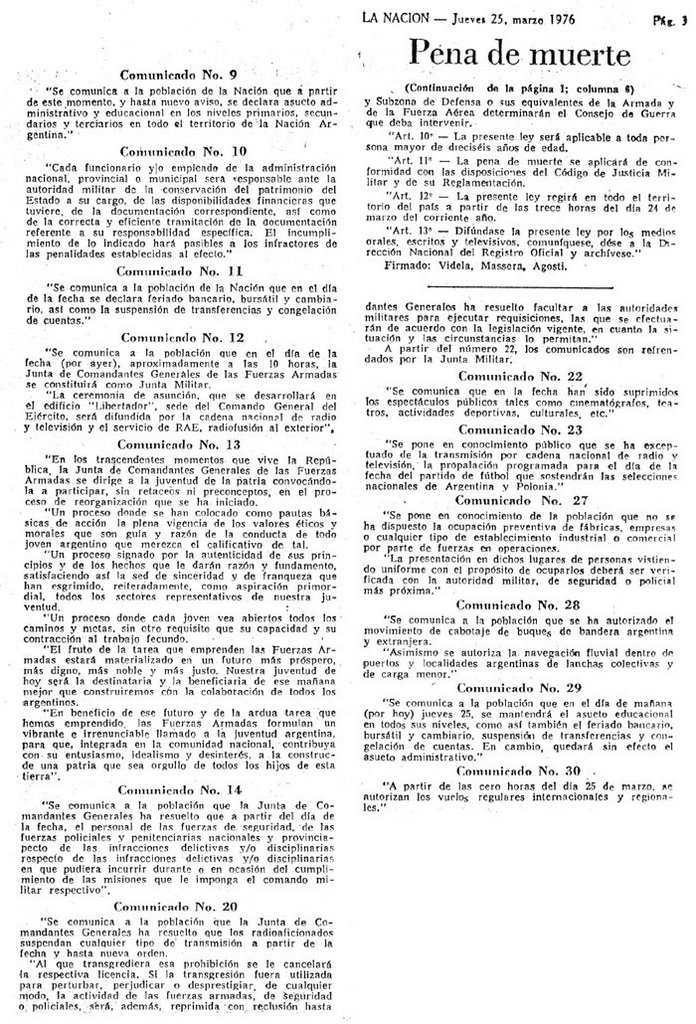
Thanks to Isis who, in the comments to my last post, provided a link to the Argentine government's website 24 de Marzo 1976-2006, detailing the coup, the military regime, and the various post-dictatorial governments.

There's a lot of material there. But, following on from my discussion of communiqué 23, I was particularly interested to see the details of all the communiqués issued by the Junta. They detail, after all, the refoundation of the state as a state of exception. And interestingly, in fact they are not all prohibitions: they also outline a program, and attempt already to interpellate the citizen body.

Communiqué 1:
The population are informed that as of today the country is under the operational control of a Junta of the General Command of the Armed Forces. Everyone is recommended to defer strictly to the orders and directives put out by the military, security, or police authorities, and to exercise caution so that they avoid individual or group actions or attitudes that might provoke drastic intervention from operational personnel.
Communiqué 2:
To preserve order and tranquility, the population are reminded of the ongoing state of exception [estado de sitio]. Everyone is to refrain from organizing meetings in public and from passing on alarmist news. Those that do so will be detained by the military, security, or police authorities. Likewise you are warned that any demonstration in favour of the guerrilla will be severely repressed.

Communiqués
Communiqué 7:
The national government reminds you that the obligatory intervention of the Armed Forces has been effected so as to benefit the whole country, and is not directed against any particular social groups. The process of reorganization that is now underway, and which will bring about the rapid recovery of the country and the welfare of its inhabitants, requires the collaboration of everyone. So the population are called upon to reflect, and workers and bosses alike are urged to work together and ensure that labour relations remain governed by an atmosphere of liberty and mutual respect.

You are advised that as all labour regulations [for medidas de fuerza?] are suspended, as likewise are all those that could affect productivity, any differences should be resolved peacefully, by means of the intervention of the relevant authority.

Workers are recommended to ignore any incitation to either violence or the refusal to undertake their obligations, given that such an attitude definitely goes against their own interests.

And bosses are warned to refrain from inflicting arbitrary measures against their workforce, which the authorities have the obligation to curtail.

Communiqués
Communiqué 13:
In this momentous period that the Republic is going through, the Junta of the General Command of the Armed Forces turns to the young people of the fatherland, calling on them to participate, without grudge or preconception, in the process of reorganization now underway.

This is a process that has established as a preliminary step forward the full application of the ethical and moral values that are the guide and reason for the conduct of ever young Argentine deserving of that name.

This is a process marked by the authenticity of its principles and of the facts that give it reason and foundation, so satisfying the thirst for sincerity and frankness repeatedly brandished, as a basic demand, by all sectors representative of our young people.

This is a process in which each young person should have every possible pathway and goal open to him, without any other requirement than his capacity and his application to productive labour [contracción al trabajo fecundo].

The fruit of the task undertaken by the Armed Forces will be the materialization of a future that is more prosperous, more worthy, more noble, and more just. Our youth of today will be the recipients and beneficiaries of this brighter tomorrow that we will build in collaboration with all the Argentine people.

It is for the benefit of this future, and the arduous task that we have taken on, that the Armed Forces make this lively and unignorable appeal to the young people, that, as an integral part of the national community, they contribute their enthusiasm, idealism, and selflessness to the construction of a fatherland that could be the pride of all this land's sons and daughters.
And finally, yes, Communiqué 23:
We inform the public that an exception has been made to the rules governing national radio and television transmission, enabling the broadcast programmed for today of the football game to be played between the national teams of Argentina and Poland.
(NB, for some reason communiqués 24-26 aren't on this list.)

Saturday, August 27, 2005

security

From The Independent:
"This is the path to victory: integration between the security secretariat, the police and citizens," said the state security secretary, Marcelo Itagiba.
So much, then, for any separation between civil society and state.

Sunday, August 21, 2005

peace

Over the summer I read the (inaptly named) David Peace's "Red Riding Quartet". I am now reading his most recent book, GB84.

Peace is a compelling if rather over-stylized writer. Moreover, aspects of his style become tics, overused and so less effective the more you read of him. But he is worth reading.

My friend John Kraniauskas argues that his books are in fact treatises on the British state. In so far as the Red Riding Quartet is crime fiction, then they are clearly about the state in the ways that all such fiction is: detailing the state apparatus's attempts to reimpose order and rationality after criminality has upset the social order. Like many post-Chandler crime writers, Peace is also concerned to demonstrate that the order imposed by the state is, however, not so easily separable from the disorder against which it is apparently arrayed. The state, too, is delinquent.

Don McPhee photo of miner and policemanGB84 is interesting because it takes the style and motifs of crime fiction, and applies them to a situation that is more readily read as straightforwardly political, the 1984 miners' strike. The state here is faced with political protest, or rather a labour protest with strong political overtones, and its response is in part to criminalize protest and in part to become itself criminal. (Meanwhile, the union also takes on aspects of the state, as registered in the parody recorded by Don McPhee's photograph, and also in semi-jocular references to the "Socialist Republic of South Yorkshire.")

Of course, the interesting question is why most people generally accept a firm distinction between police and prey, rather than questioning the state's legitimacy. Peace, like other crime writers, resorts to what are ultimately rather unsatisfactory responses: corruption, cover-up, manipulation of the press, ignorance, and so on. Like, say, James Ellroy (whose extraordinary American Tabloid and The Cold Six Thousand take the same approach to an epic sweep of mid-century US history), the important demarcation for Peace is less that between civil and criminal, law and outlaw, than that between insiders and outsiders, those in the know and those outside the loop.

The severest punishments, imposed by the state and the anti-state alike, are reserved for informers, those who threaten to break the code of silence and reveal the true mechanisms of power. Yet when word does get out, it can too often easily be dismissed as the fantasies of cranks, the ramblings of conspiracy theorists, or the delusions of paranoids. The greatest tragedy is always that of those who, Cassandra-like, are condemned to have their denunciations treated as another round of resentful crying wolf.

Or is it that the tremendous popularity of crime fiction in the twentieth century reveals that we do in fact know that the state is just another mafia, whose power is maintained by corruption rather than consent? But our silence, our complicity, is the open secret that finally binds society.

Meanwhile, here is a great review of Ellroy. I've yet to see such a good one of Peace.

[UPDATE: I see that k-punk has also been reading GB84.]

Friday, August 12, 2005

state

Over at I cite, Jodi Dean has posted an essay on "Political Theory and Cultural Studies".

She's rather positive about British Cultural Studies, though only really discusses Stuart Hall's work on Thatcherism, and nothing that Hall wrote while he was at the Centre, for instance. She says of Cultural Studies that "in a context of struggle with Marxism, and as an effort to understand and contest a newly emerging right wing alliance that had come to power in the wake of widespread social, economic, and political disruption—'authoritarian populism,'" it achieved "analytical power and political purchase, indeed, truth" (17). Less mention is made, therefore, of the fact that for Hall it was Thatcherism that showed up Cultural Studies' (or at least the Centre's) manifest failure: Thatcherism's success as a hegemonic project was a rebuke to the Left's inability to do more than watch, appalled, from the sidelines.

She then argues that as some of the ideas and approaches of British Cultural Studies crossed the Atlantic and become influential within (at least some parts of) US Political Theory, "a sense of the dominance of cultural politics (as opposed to the marginality of a venture called cultural studies), on the one hand, with the demands of political science, on the other, formatted political theory’s cultural turn so as to distance it from the state" (17). In the culture wars, everything, and so nothing, became political. Rather, however, than lambaste either US political theory or US Cultural Studies, she argues that this mutation is itself determined by a new phase of sovereignty: "Despite the depoliticization the claim perversely effects, the notion that everything is political marks a change in the political situation of late-capitalism, namely, the decentering or changed role of the state" (21).

I'd argue, by contrast, that Cultural Studies had lost sight of the state long before its 1980s or 1990s expansion to North America. Where, after all, is the state in Culture and Society? Pretty marginal. If there was a flurry of attention to state processes at the Centre in the mid 1970s, for which the best example is probably Policing the Crisis, this was above all thanks to the influence of Althusser (whom Dean never mentions). Once Althusser was sloughed off, in large part thanks to Hall's appropriation of Gramsci via Laclau's endorsement of populism as politics, Cultural Studies (British as well as American) could return to its populist impulses, and leave the state behind with hardly a glance in its direction thereafter.

What's most interesting is the slippage or sleight of hand at the heart of a movement such as Cultural Studies, and indeed at the heart of all populisms: a movement that claims to have the state in its sights, as it champions popular expression against domination from above, but which at almost the last moment loses sight of the state, putting a fetishized conception of culture in its place. And it is, of course, the concept of hegemony that enables this depoliticizing substitution.