Showing posts with label el salvador. Show all posts

Tuesday, December 08, 2009

partisan

I've long been fascinated by the FMLN's November 1989 "Final Offensive" (click here for a sequence of photos) and particularly by the incident in the Sheraton Hotel (for which see this image, by Jeremy Bigwood, which will be included in the book).

Here, a small band of guerrillas made their way into Escalón, San Salvador's most exclusive neighborhood, took over what was then (with the Camino Real) one of the city's two top luxury hotels, and so also effectively took hostage a group of US green berets, "dressed in pajamas and bulletproof vests", who so happened to be staying there at the time. (The Secretary General of the OAS, João Baena Soares, was also caught up in the action.)

I remember following events in the British papers at the time, as it caught the eye of the international press much more than the guerrillas' control of the working-class barrios where the insurrection had started. See Time's contemporaneous account, which focuses on the possibility that for the first time the US military would be directly involved in the civil war. And as Time also points out, there was something carnivalesque about the whole affair:
Despite the tension, the scene became like something from a TV situation comedy, with the rebels enjoying a feast of hotel food and the U.S. soldiers resolutely glowering from behind their barricades.
But it always seemed to me that there was more to the incident than its value as some kind of spectacular publicity stunt in the middle of an uprising that eventually ended in stalemate. It was a digression, but an important one.

I've discussed the Sheraton incident before, and also recounted something of a visit two years ago in which I stayed in a Sheraton, if not (it turned out) "the" Sheraton.

In Posthegemony, I deal with the Salvadoran civil war, and particularly the capture of the Sheraton, at some length. I try, among other things, to argue that this brief episode is in fact significant in broader world-historical terms. As I put it there:
The Salvadoran civil war was part of a broader, global transition. [. . .] As the guerrilla forces quietly slipped away from the scene, and as the fighting across the country began to subside, on the other side of the world the Cold War was ending. The FMLN offensive had taken place in the brief interlude between the fall of the Berlin wall on November 9, and the first Eastern European Communist regime to collapse (in Czechoslovakia) on November 24. The November offensive ("in all probability, the biggest guerrilla offensive ever mounted against a Latin American government"), and particularly the incident in the Sheraton with which it ended, was a hinge: both the last confrontation of the Cold War era, and the first post-Cold War conflict, a premonition of future actions against tall buildings. [. . .] Perhaps, then, San Salvador provided a better indication then Berlin or Prague of how the world would soon look. For all the euphoria of the border-breaching and deterritorialization in Eastern and Central Europe, Central America offered a clearer index of the low-intensity fear and control societies emerging from the shell of Cold War ideological tussles.
In the book's overall argument, however, this is something of a digression. It is part of my general intuition that in some sense (almost) all of modern history starts in Latin America. This is my rejoinder to the self-confidence of someone like Henry Kissinger who, in 1969, declared to the Chilean foreign minister of the time:
Nothing important can come from the South. History has never been produced in the South. The axis of history starts in Moscow, goes to Bonn, crosses over to Washington, and then goes to Tokyo. What happens in the South is of no importance. You're wasting your time.
By contrast, I like to say that everything of importance comes from the South: modernity, the industrial revolution, nationalism, neoliberalism... and so on and so forth. The only exception is liberal democracy, but then how important is that, anyway?

Of course, in many ways this argument is simply intended as a provocation. It's a useful corrective to unthinking Eurocentrism, modeled on and extending some of the provocations initially put forward for instance by dependency theory, but the very idea of an "axis of history" is itself rather dubious. Rather, in almost every case phenomena such as modernity or neoliberalism arise in a complex series of interactions, complicities, encounters, and struggles that involve both North and South. And more dependency theory itself, while emphasizing the importance of (say) the mines of Potosí for the development of industrial capitalism, also shows that it is the interaction of (what it calls) "center" and "periphery" that counts. Indeed, in the end the very distinction between center and periphery, North and South, becomes ultimately tenuous.

Hence my suggestion that the Final Offensive is a "hinge" and a "premonition of future actions against tall buildings" is a digression: perhaps (again) an important one, but ultimately not crucial to the main argument. I want rather to establish resonances between the Central American guerrilla and contemporary terrorism, mostly through a phenomenology of terrorist affect, and the ways in which it undermines both liberal and conservative conceptions of the state. Any sense of historical causality or origin is by the by. After all, there were plenty of other things going on in Latin America in that fateful year, not least for instance the Venezuelan Caracazo.

And yet... I continue to have the sense that there is something particularly interesting about the Final Offensive. And now, reading Carl Schmitt's Theory of the Partisan, I feel I have more of an idea as to why that might be. In short, November 1989 demonstrated the final crisis of the figure (or, in Schitt's terms, the "theory") of the partisan. It is here that we see definitively the arrival of "unexpected new forms of the new partisan" with all the implications that has for "the concept of the political, [. . .] the question of the real enemy and of a new nomos of the earth" (Schmitt, 95).

But enough for today. More on this, probably, tomorrow.

Monday, January 19, 2009

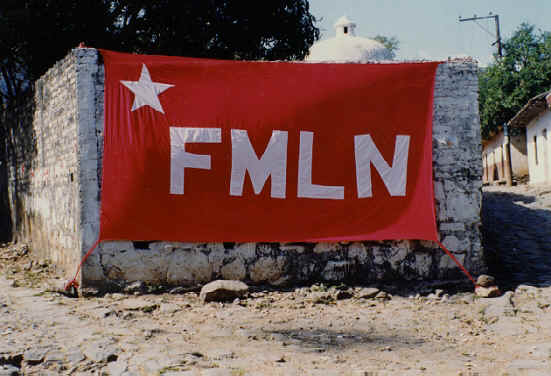
fmln '09

Click here for all your Salvadoran election news. In short, the FMLN have won a plurality in the Legislative Assembly, but not an absolute majority, and indeed have not done as well as predicted. They also lost the mayoralty of San Salvador.

And see here for a helpful analysis of why the Salvadorans will be going to the polls again in a few weeks' time. (Via.)

Saturday, November 03, 2007

dawn

Now I have a digital camera, a new feature on this blog, sporadic no doubt like any other...

The Saturday photo, part I: dawn in El Cuco, El Salvador.

Friday, November 02, 2007

passions

Half the places I tried to go in San Salvador were closed. It was Monday and the Museum of Popular Art didn’t open until Tuesday. A café I’d been recommended was shut until Wednesday. And when I arrived at the Museum of the Word and Image, there too I was faced with a locked door. I’d got there in the middle of a two-hour lunchbreak. So I stopped a the little cantina next door. Even to call it a cantina was to say too much. It had a concrete floor, corrugated iron roof, and chicken wire walls. The kitchen was an open wood fire and a couple of sinks. But the corn tortillas were excellent: soft, tasty. They took me back. There was a time when I’d eaten nothing but beans and tortillas, occasionally spiced up with a bit of chile pepper, for almost a month. That got old, soon. But for now I welcomed a proper hand-made tortilla, nothing like the thin and flavorless factory products found in Mexico and Mexican restaurants throughout the world.

But Salvador’s national food is the pupusa: a tortilla stuffed with cheese or beans. You can buy them hot off the grill at any market or street corner in provincial towns. A few days later, amid the bustle of a place called San Francisco Gotera in which the central plaza was over-run by market stalls, I sat down for some pupusas. Hot, greasy, overloaded with melted cheese, they were delicious. They came with assorted pickled vegetables that I scooped up with the tortilla and my fingers. I downed the sweet, tepid coffee that was also on offer. And asked to pay. I didn’t quite understand reply, but I knew it was three something. I proffered three dollars, only to receive a laugh and two dollars twenty-five in change. It turns out that the Salvadorans, who abandoned colones for their currency and now rely on US greenbacks and coins, talk in terms of “coras” or “quarters.” The meal had been three quarters. Seventy-five cents, and no thought of taking advantage of my confusion.

Back at the museum, I decided to try my luck and ring the bell to see if they’d let me in anyway. A woman answered and after a brief consultation welcomed me inside. But it wasn’t quite what I’d expected. I’d thought that this would be a monument to the war experience. I was somewhat chastened to discover instead an emphasis first on the indigenous culture of the West, and second an exhibition in preparation on the noted painter Salarrué. I was a fairly unabashed war tourist, but here I was brought up short. But in one room was a doorway covered by a rough mat curtain, on which was pinned a note saying “You can open this curtain at your own risk... Reconstruction of the ‘Cave of Passions,” in La Guacamaya, Morazán, 1982.”

Cave of the Passions curtain
I took the risk and moved the cloth aside, to find a darkened room with a couple of chairs and a bank of aged radio equipment. This was the small homage to Radio Venceremos, the guerrilla radio, in the museum run by its most famous representative, a man who still went by his nom de guerre of "Santiago.".

Cave of Passions
But it was as though hiding the “cave of passions” were both a rebuke to the over-nostalgic seeking to relive some kind of war experience, and also a reminder to others of passions that still lay just a twitch of a curtain away. It was a gesture of showing and not showing, insisting either way that there was more to the country than you might have thought.

Thursday, November 01, 2007

Sheraton

I arrived in El Salvador to be greeted by a tropical downpour. Even in the airport, in front of the customs and immigration agents, the rain was dripping through the roof into buckets arrayed on the floor. If the country wanted to give international visitors the sense of modernity and that it could cope with the elements, it hadn’t made a great start of things.

When I was traveling through Central America in the 1980s, Salvadoran border posts were always the site of a rather anxious lottery. How much would they look through your luggage and what exactly would they find suspicious? How many days would they allow you to stay in the country? I used to stuff anything vaguely incriminating way down at the bottom of my backpack, and try to make sure I was among the very first travelers of the day, in the belief that the guards would be too sleepy or perhaps still with some morning goodwill to bother with all the formalities. With luck, the would let me through without too much hassle, hopefully stamping my passport with at least fifteen days, ideally thirty.

So I still felt a residual sense of tension as I confronted the immigration official, hardly much helped by the sense of some disorder as the rain continued to come down beside me. He asked me if this was my first visit to the country. No, I truthfully said. I was last here a few years ago. When? He asked. Four, five years ago, I said vaguely. He looked for the stamps, but I explained I’d renewed my passport since then. And how long are you planning to stay? Five days, I replied, adding forty eight hours just in case, to give me some leeway. OK, he said. And he stamped, returned my passport, and told me with a smile he’d given me three months. I thanked him and said I if I enjoyed my stay I’d think perhaps of hanging around a little longer.

Central America has a distinctive smell. The Canadian singer Bruce Cockburn described it as “dust and diesel” that “rise like incense from the road.” There’s also the woodsmoke on the breeze, and the special sense of how tropical rain cleanses everything, making it that little bit less grubby. I left the airport terminal and took my time before looking for a trustworthy taxi-driver. I breathed in El Salvador.

I wanted to stay in the Sheraton. For the sake of it, and because of the incident during the 1989 Offensive in which the FMLN guerrilla, during what was perhaps the turning point of the decade-long civil war, took control of the hotel, in the heart of the capital’s exclusive Escalón district. No matter that a night there now would cost me about the same sum as I used to live on for a month way back when. I was a different kind of traveler now. I felt able to indulge myself, and petty sense of symbolism. And no matter really either that the Sheraton now was in a different building altogether, and that what used to be the Sheraton was now a Radisson. I decided that it was the name that counted anyway.

Wednesday, February 22, 2006

assembly

As I seem to have a sideline on Latin American elections (Bachelet, Morales), and with all the talk of Latin America's "leftward drift"...

Salvador flagIt's worth noting then that according to Tim's El Salvador Blog the FMLN are leading the polls in advance of Salvador's upcoming National Assembly and mayoral elections.

The country's Presidential election took place two years ago, and was won by Tony Saca of ARENA, the party that was, notoriously, the party of the death squads during the 1980s civil war.

The FMLN's candidate in 2004 was their veteran leader, Schafik Handal, who died in January at the airport, returning from Evo Morales's inauguration. It seems likely that the party's current standing in the polls owes not a little to the sentimental affection expressed for Handal after his death, whereas in life the Communist leader was much vilified.

(For another example of a Communist leader whose recent death has done much to boost her public acceptability, see Chile's Gladys Marín.)

At the same time, Schafik's departure may enable some renovation within the FMLN. See again Tim's discussion of the party's internal debates. Splits within the FMLN--always at best a loose coalition, but united in the 1980s in line with the necessities of insurgency--have long meant that the left have failed to capitalize in peacetime on their strength and definite popularity as a rebel force. The party has never really recovered from the defection of Joaquín Villalobos, wartime strategist, who decided to ally with ARENA in 1994. Michael Zielinski summarizes the situation in the mid-1990s here. And Margaret Swedish comments on further divisions here.

Still, the former guerrillas have more recently performed well in Assembly elections and in local politics alike. In 2003, with 34% of the vote, they won a qualified majority in the Assembly. But they remained the opposition, facing a right of centre coalition dominated by ARENA. And the current mayor of San Salvador was elected as a member of the FMLN, even though he quit the party last year. Perhaps this year will see an electoral breakthrough. Which will irritate the US, if nothing else. But let us hope it achieves more than that.

For more news on Salvador, in addition to Tim's fine blog, see the UCA's Proceso, extracts of which are available in both English and Spanish.

Saturday, January 07, 2006

more confusion

I have already discussed Leigh Binford's work on El Salvador, in which he argues for the utility of the concept of hegemony as a means to understand guerrilla insurgency.

I had been looking forward to reading his article "Hegemony in the Interior of the Salvadoran Revolution: The ERP in Northern Morazán," not least because I had assumed it would be a more theoretically robust defence of his approach. Unfortunately, it is not.

Northern Morazan
Northern Morazán was the area in which the FMLN had probably most secure hold throughout the war, and is where the so-called guerrilla capital, Perquín, was located. The area's prominence, however, is also due to the fact that it was the stronghold of what was the dominant and probably savviest of all the guerrilla forces that constituted the FMLN, the ERP (Ejército Revolucionario del Pueblo, or Revolutionary People's Army). On the one hand, this makes the region somewhat atypical of FMLN wartime experience and activity; on the other hand, it arguably provides particular insight into guerrilla organization and the likely shape of a post-revolutionary society, should the Revolution have been successful.

Binford's approach combines the concept of hegemony with the concepts of habitus and "field of power," these latter two terms drawn from the work of Pierre Bourdieu. His argument is that the FMLN embarked on "a double process of hegemony construction" (4), first among the civilians within the zone, and second (but at the same time) among their own guerrilla combatants. However, they were doubly constrained: first, by the fact that they were operating within what Binford calls a "military-political field of power" (4) within which the repressive state and its armed forces (literally) called many of the shots; and second, by the durability of pre-existing habitus, which included the machismo endemic among many of the guerrilla's own cadre and also the privileging of "household over collective production and individual over communal activity" among much of the peasantry (30).

In the end, then, Binford sees the FMLN's project as a failure, not simply because the Revolution never took place, but also (and perhaps this was the cause) because they were unable to effect durable change in people's pre-existing dispositions. In short, the "depth of ERP hegemony" (29) was at best shallow:
The motives of many participants remained instrumental, accompanied by only minor changes of consciousness, even if for some persons these practices contributed to the development of the "common meaningful and material framework" that is the sine qua non of hegemony (Roseberry 1994: 360-361). That that emergent framework never consolidated into a new "structure of feeling" (Williams 1977: 132) owed much to the short duration (eight years) and limited scope of the doble cara experiment [combining military and civil organization], which failed to reverse at the regional level well-entrenched cultural systems based on individualism and authoritarian control. (29-30)
There is here significant confusion as to whether or not what's at issue is consciousness, as in a traditional conception of ideology and consciousness-raising, or practice, which would be more in line of Bourdieu's notion of habitus as embodied well beneath the level of ideology. Binford would no doubt suggest that the answer is both: he earlier suggests that ERP strategy was focussed on practice, on the attempt to develop new habits, "reconfiguring practices rather than projecting messages" (17), but that this was intended to ensure that "representations more appropriate to that situation--those promoted by the FMLN--would then stand a better chance of becoming generalized" (18). In what would appear to be a dialectical process, "the representations would reinforce practices and the military's real and symbolic power would suffer continuous erosion" (18).

The entrance to Perquin
The concept of hegemony that Binford adopts, taken solely from William Roseberry's "Hegemony and the Language of Contention" (and essentially from one sentence of Roseberry's at that) brings together these two aspects, of consciousness and practice, in its definition (much cited by Binford) of hegemony as a "common meaningful and material framework." Unfortunately, however, neither in Roseberry nor in Binford are the elements that constitute this phrase properly explored or unpacked. Throwing in then the notion of "structure of feeling," drawn from Raymond Williams, only adds to the murk. Hegemony becomes a catch-all category to designate any and all forms of social inequality, control, dominance, or inertia.

Binford employs these concepts more as totems than as analytical categories. This is most evident in his use of the term "field of power," almost always italicized within his text as if to signify both that it is somehow foreign, untranslated French taken straight from Bourdieu, and that it is special, possessed of some undefined and ineffable aura. Occasionally some specification is added: as well as the "military-political field of power" (4), Binford also writes of Northern Morazán simply as a "field of power" (8) when it is not a "social field of power" (9) or a "field of political-military power" (9), a "regional field of power" within "more encompassing fields of power" (11), or perhaps a "field of military power" (11) (emphases all in original). But it is not at all clear what differentiations, if any, are to be marked by these slight changes. They give the impression of complexity without actually enhancing our understanding.

So it is more generally with Binford's use of the term "hegemony." This is not, in the end, a theoretical concept. Or rather, it is "theory" (Theory?) only in the sense that those who oppose theory imagine: it is the use of a somewhat unfamiliar term to add the gloss of sophistication, but thereby mystifying what is in the end an analysis premised on no more than common sense.

And the problem here is that, shielded beneath this confused pseudo-theoretical armature, what remains most stubbornly resistant to critique is "common sense" itself.

Thursday, November 17, 2005

becoming-guerrilla

There's a certain fascination with why and how people join armed movements. All the more so when what's at issue is apparently "assimilated" Western Moslems turning to terror. Obviously, this process engenders a great deal of anxiety, which is no doubt why it also has to be retraced and narrativized over and over.

This is one context for what I'm trying to understand in writing about the Salvadoran FMLN...

It soon became apparent that the Salvadoran revolution would prove a "long war" (to use Dunkerley's phrase) in more ways than one: not only could it trace its inspiration back to the 1932 Communist uprising, bloodily repressed by the oligarchic state; it would also become one of the most sustained guerrilla insurgencies ever seen in the Americas. And by the mid-1980s the unsuitability of the FMLN's strategy for such a long war had become apparent. Hugh Byrne records that by the end of 1983, "the guerrillas were winning the war. However, the FMLN had military weaknesses. Its concentration of forces made the insurgents vulnerable to the assets of the armed forces, particularly helicopters, aircraft, and artillery" (104). Byrne goes on to observe that "a quasi-regular war played to one of the strengths of the ESAF [El Salvadoran Armed Forces]: its access to sophisticated equipment and extensive funds to wage a high-technology war (104). The FMLN therefore had to resort to flexibility, mobility, and nomadism to maintain its challenge to the Salvadoran state, abandoning ideological as well as military rigidity, even to a large extent abandoning ideology tout court. For Bracamonte and Spencer, it was this "lack of ideological trappings [that] allowed the FMLN to continually develop successful tactics that worked to near perfection" (8).

In place of ideology, affect. Joining the FMLN involved not the adoption of any specific set of beliefs, but a change in affective state, indeed a shift from the individualized subjectivity associated with emotion to the depersonalized commonality characteristic of affect. Almost all guerrilla testimonios testify to the trauma and the intense affective charge of the transition to clandestinity. For instance, Ana María Castillo ("Comandante Eugenia") is quoted to explain how becoming guerrilla is a form of social death: "You [. . .] will leave your family and friends, people dear to you will die. Members of your family, perhaps, will be captured to see if they can give you up. You won't be able to do a thing about it" (Alegría and Flakoll, No me agarran viva 55). Dialogue and discourse with the rest of the world, or the world left behind, become impossible: "You will even see people in the street who know you and your whole heart will be turned inside out with desires to say 'hi' at least, but you won't be able to. You'll have to keep on past them [. . .] and it'll hurt" (55). Clandestinity produces a separation for which the guerrilla returns apparently as specter: she can see and (here, at least) be seen, but cannot look back and cannot speak. She is suffused with desire (as well as hurt), but also helpless, desubjectivized, strangely passive: "you won't be able to do a thing about it." Her motives will have to go unrecognized, taken to be snobbery ("perhaps they'll think 'How stuck up that Eugenia is'" [55]) or, Eugenia later suggests, treachery: "All the comrades among the workers may even believe that I've betrayed them. That I've gone who knows where" (55). She has gone, and if she is brought back, it will only be as a corpse: "no me agarran viva" ("they won't take me alive").

At the same time, if the transition to clandestinity is a scission, and a desubstantialization, a becoming spectral, for the guerrilla it is also a bodily passage to union. Going underground is an immersion in the material that desubjectifies the guerrilla as he or she becomes immanent to the struggle and to the revolutionary movement. Charles Clements, a pacifist US doctor who spent a year with the FMLN around the Guazapa volcano, notes this emphasis on the corporeal in a conversation with the guide leading him to the war zone. Faced with the question "¿Porqué un gringo se incorporó?" Clements notes "the question puzzled me. I didn't understand the verb. '¿Qué quieres decir por incorporarse?' (What do you mean by 'incorporate'?) I asked. He explained to me that when you join the struggle, you 'incorporate' with the guerrillas--literally, I suppose, to join their body" (Witness to War 30). When Clements later himself realizes that he, too, despite himself and his sense of difference as gringo, as doctor, and as pacifist, has incorporated, has joined the social body and lost his sense of individuality ("I had altogether ceased to be Charlie Clements" [221]), he feels this as a crisis. His aim had been to keep neutral, to keep his distance. But in the Front, the "Zone" that the FMLN traverses, desubjectification is inevitable. And for the fighters, incorporation is also the fulfillment of a desire to be subsumed in the collectivity: while there is hurt and perhaps terror in the inhabitation of spectral excess, in the end there is the joy of commitment, of being fully enfolded within the struggle.

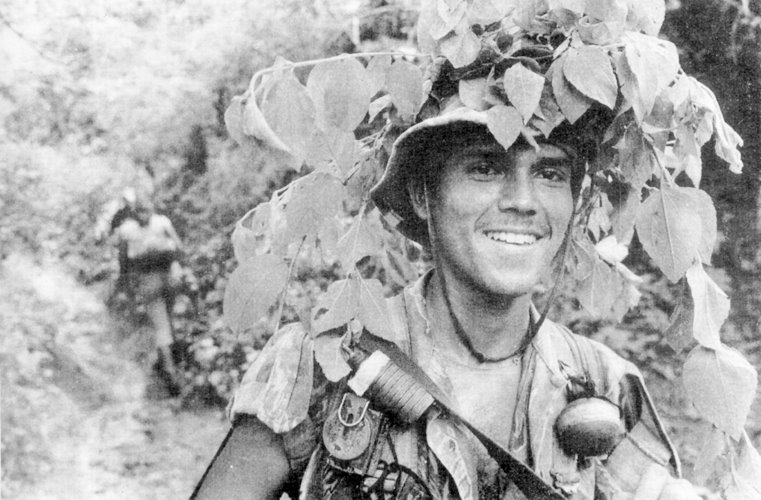
smiling guerrilla
For incorporation is experienced less as excess than as plenitude. This is the source of guerrilla joy. In No me agarran viva, Eugenia's husband Javier, also a guerrilla, says of her death: "In my view Eugenia died complete. Completely happy. Her death simply crowned with heroism a life profoundly given over, without any remainder" (147; my emphasis). Becoming-guerrilla is social death, but asocial rebirth. According to Edwin Ayala, "Here in the Front you are born again, everything is new, you learn everything, you start on your first steps" (El tope y más allá 60). So returning to social order could be quite as traumatic as becoming clandestine. Concluding his testimonio with an account of his 1992 demobilization, Ayala lists everything he will miss about guerrilla life, from singing to making tea on an open fire or constructing air-raid shelters, and the collective affect of "feeling everyone's happiness at the moment of a victory." He contemplates a future of "boredom what with all the hassle and navigating the world of 'civilization' again" (277). At the threshold between what is implicitly "barbarism" and his reinsertion into "civilization," he meets the mother of a fallen comrade: "I left the multitude to go up to a person; at first I hesitated, but up I went, it was Leo's mother. Standing before her, I couldn't find anything to say. She was sitting down. So I crouched down and asked, 'Are you really Leo's mother?'" (276). For Ayala the shock of re-entering civilian life is a transition from the multitude back to the individual, from silence to a speech that names family ties and social position. From affect, to an affectless boredom and emptiness.

Thursday, August 25, 2005

Rumsfeld

(Via The Square Circuit...)

Well, further to my earlier entry about the "Salvador Option", it turns out that just a couple of days thereafter Donald Rumsfeld did indeed compare Iraq to Salvador.

Setting everything else aside, I can't but believe that such comparisons will backfire. Comparing Iraq to Salvador in the 1980s can only further taint rather than boost the public image of the Iraqi regime now in (rather tenuous) power. Especially given what is commonly accepted about massacres and death squads in the Salvadoran civil war.

confusion

I've been leafing through Aldo Lauria-Santiago and Leigh Binford's collection Landscapes of Struggle: Politics, Society, and Community in El Salvador. It was Binford who organized a session at last year's Latin American Studies Association, in Vegas, entitled "Disputing the Post hegemony Thesis."

Part of what's at issue in the debate, such as it is, over posthegemony is a matter of differing definitions. Thus Binford et. al. draw on Raymond Williams and (especially) William Roseberry, whereas I prefer to read hegemony theory through Gramsci and Laclau. It became clear in the Vegas session itself that those declaring themselves against posthegemony were equally opposed to Laclau's reformulation of hegemony itself.

In many ways that's fair enough, but the signal service provided by Laclau is to provide a real theorization of the concept of hegemony. Binford and friends, by contrast, fall back on "hegemony" as a catch-all notion that sounds sophisticated but ends up merely confused.

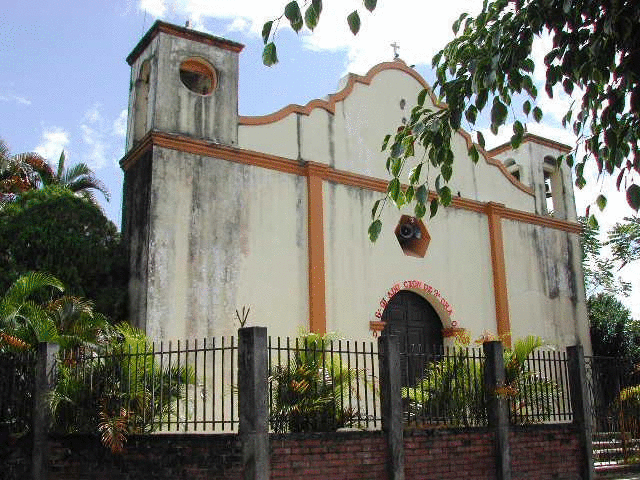
church in Jocoaitique, MorazanHere's an example, from Binford's own otherwise very interesting essay "Peasants, Catechists, Revolutionaries," on the role of the Catholic church in Northern Morazán, which would come to be the heartland of FMLN territory during the civil war, and site of the FMLN's unofficial "capital," Perquín. Describing the conservative theology and pastoral practice of the region's only pre-war priest, Binford states that:
These beliefs established Catholicism as an important underpinning of the regional hegemonic order, defining hegemony here as a system of beliefs and practices that favor dominant groups and that serve as frames that shape people's lived experience, even their experience of struggle against oppression. (108; emphasis in original)
There follows a footnote that refers to Williams's Marxism and Literature and to Roseberry's "Hegemony and the Language of Contention," but to no particular passages from either work.

On the one hand, this sentence is so banal as to be unarguable. Of course, Catholicism (or rather, the orthodox, pietistic Catholicism that preceded the changes initiated by Vatican II) played an important part in securing regional order. On the other hand, in so far as Binford purports to be explaining the mechanisms by which this order was secured, his statement here is opaque in the extreme.

For instance, what exactly is the relation between "hegemony" and "hegemonic order"? And why not, say, talk of the hegemonic underpinning of regional order? In other words, what is the relation between the Church and this "regional order" of which Binford writes? In what ways did Catholicism "underpin" this order rather than being itself part of it? What is meant by seeing beliefs and practices as "frames that shape people's lived experience," so apparently distinguishing them from experience? What is this metaphor of framing, and what does it actually mean?

In short, why does Binford wish to separate out hegemony from the other components of the society he is describing, putting it on another level (underpinning) or transcending (framing) that society? I think it's because he's trying to make the concept do some analytic work, to present it as some (semi-)external mechanism or cause to explain apparent peasant docility. Because peasants are themselves, of course, naturally rebellious, somehow in themselves endlessly "struggl[ing] against oppression." But even the very language that Binford uses ("beliefs and practices") gets hegemony entangled again within the experience and behavior that the concept allegedly explains.

Far from an explanatory concept, hegemony becomes "hegemonic order" and so little more than a redescription of the phenomena that Binford sets out to analyze. The terminological shift from "regional order" to "hegemony" to "regional hegemonic order" in fact explains nothing, adds nothing to our understanding of the relations between Catholicism, subalterns, and elites. It leads only to confusion masking as sophistication, bereft of any foundation beyond the gestural.

Wednesday, August 17, 2005

Salvador

Some days ago, Organic Warfare drew my attention to an entry on the so-called "Salvador Option". Unfortunately, his blog has all comments disabled, but you can see some of our subsequent discussion here.

More recently, I read a long article by Mark Fuller entitled "For Iraq, 'The Salvador Option' Becomes Reality", which draws on a whole number of sources, not least a January Newsweek article on "The Salvador Option" that summarizes this "option" as follows:
The Pentagon is intensively debating an option that dates back to a still-secret strategy in the Reagan administration’s battle against the leftist guerrilla insurgency in El Salvador in the early 1980s. Then, faced with a losing war against Salvadoran rebels, the U.S. government funded or supported "nationalist" forces that allegedly included so-called death squads directed to hunt down and kill rebel leaders and sympathizers. Eventually the insurgency was quelled, and many U.S. conservatives consider the policy to have been a success—despite the deaths of innocent civilians and the subsequent Iran-Contra arms-for-hostages scandal. [. . .]

Following that model, one Pentagon proposal would send Special Forces teams to advise, support and possibly train Iraqi squads, most likely hand-picked Kurdish Peshmerga fighters and Shiite militiamen, to target Sunni insurgents and their sympathizers, even across the border into Syria
See also the follow-up article, "Death Squad Diplomacy", by Christopher Dickey, who was a long-time correspondent in Salvador during the 1980s.

Now, I think that it is worth comparing Salvador and Iraq, though not necessarily in the ways that the above articles suggest. Indeed, I agree with Fuller that there are many ways in which Colombia is probably a better direct comparison. Panama might be another, as one of the US's first experiments in "regime change" in the modern style, and so successfully so (from the US perspective) that it might have given false confidence to those who plotted the Iraq War. Panama's president Noriega had, after all, like Hussein been a strategic ally in a strategically important location--in Noriega's case because he was sitting on the canal. But the US turned against their former strong man in the region, bringing him down in a full scale invasion (ordered by Bush père) on the flimsiest of excuses, with the minimum of US casualties. More details can be found from The Panama Deception, a film that was the Fahrenheit 911 of its day, a controversial 1992 Oscar winner. See also John Weeks and Phil Gunson's Panama: Made in the USA.

At the same time, there are many differences between Iraq and Salvador, Colombia, or Panama. None of the three turned into "failed states" in quite the spectacularly implosive and dangerous manner that Iraq has done so. None of these Latin American conflicts had ethnic or religious components. None were about exploitable resources. (Though Colombia does of course have an export crop that has found a fertile market in the USA, there are as yet no multinationals poised to take over its production and distribution.) None was ever more than briefly the focus of world attention. Still here are some snippets of thoughts about Salvador...

What is it about tall buildings? They seem to provoke a kind of fatal attraction among those that, following Deleuze and Félix Guattari, we could call nomads--those homeless, mobile, components of the war machine for whom "weapons are affects and affects weapons" (A Thousand Plateaus 400). New York's twin towers had, after all, been attacked before, while the height of success for El Salvador's Farabundo Martí National Liberation Front (FMLN) and perhaps the single most important moment of that country's ten-year civil war, was the guerrilla group's capture of the San Salvador Sheraton, one of the city's tallest buildings, in November 1989. As José Ignacio López Vigil puts it: "We attacked the big hotel because it was the highest point in the neighbourhood" (Rebel Radio 229).

Beyond strategic concerns, perhaps it is also that building upwards has been a defining mark of homogenizing unification from Babel to Taipei 101. Babel still epitomizes the dream of unimpeded and transparent communication, but it was also merely the first such project (and the first such tower) to fall. One may hesitate to call Babel "modern," but like the Pyramids (the world's highest manmade structures in the ancient era) its height required a kind of cooperation that ultimately only modernity would enable. It's no coincidence that Kuala Lumpur's city center, with the Petronas towers site of among the world's tallest buildings today, is an "intelligent precinct" set at one end of the world's most ambitious communications project, Malaysia's "Multimedia Super Corridor" (MSC), an area of land the size of Singapore that will be fully "wired" and will be site of two new "smart cities." Tall buildings epitomize the desire for transcendence, whether religious, state, or corporate; they enable surveillance and the dream of transparency; it is from the symbolic and material vantage point that height provides that social life can be stratified and ordered.

In El Salvador, the Sheraton proved to be the locus of far more than simply symbolic power. Attracted to its height, and so to its commanding position within the fashionable neighborhood of Escalón in which they were launching a counter-attack during the November 1989 offensive, the FMLN "had no idea who was inside: none other than the secretary general of the Organisation of American States, João Baena Soares, who was in El Salvador to learn about the war and ended up seeing it up close" (López Vigil, Rebel Radio 229). Still more significantly, also staying at the hotel, on the top floor, were twelve US green berets, who suddenly became in effect prisoners of the FMLN. The US president at the time (another George Bush) sent down an elite Delta Force special operations team from Fort Bragg, ready to intervene directly in the Salvadoran civil war for the first time. But after twenty-eight hours the guerrillas left the hotel of their own volition; as far as the press were concerned, they simply vanished: "Reporters who approached the hotel just after dawn [...] said there was no sign of the rebels who took over part of the hotel in the exclusive Escalon district of the capital" (Simon Tisdall, "Green Berets walk free from Salvador Siege," The Guardian [23 November 1989]: 10). Another report again emphasizes the sudden disappearance of the guerrillas ("the rebels were nowhere to be seen") and contrasts it with the US soldiers' territorial immobility and reliance upon direction from above: "The Green Berets, however, were still behind their barricades. 'We've had no orders so we're staying here,' one of them said to a large crowd of journalists" (Tom Gibb, "Sheraton siege ends as rebels withdraw," The Times [23 November 1989]: 10).

Across the country the offensive was now over. The FMLN had shown that they could mount and sustain an engagement at the very heart of middle class Salvadoran society--while, elsewhere, the government had shown that it had no qualms about bombing working class suburbs from the air, or about murdering some of the country's leading intellectuals, six Jesuit priests who worked and lived in the Universidad Centroamericana. State terror more than matched any "outrageous act of terrorism" (in the words of a US State Department spokesman [quoted in Tom Gibb, "US alert as rebels hold four in hotel," The Times (22 November 1989): 1]) that may have been committed by the insurgents. A realization on both sides of the resulting impasse led to the peace accords that ended the war.

Simultaneously, across the world the Cold War was now ending. The FMLN offensive (November 11th to 23rd) had taken place in the brief interlude between the fall of the Berlin wall (on November 9th) and the fall of the first East European communist regime--the Czech president quit and Dubcek returned to Prague on November 24th. The November offensive ("in all probability, the biggest guerrilla offensive ever mounted against a Latin American government" [McClintock, Revolutionary Movements in Latin America 84]), and particularly the incident in the Sheraton with which it ended, was then a hinge: both the last confrontation of the Cold War era and the first post-Cold War conflict, a premonition of future actions against tall buildings. In the incident at the Sheraton, the FMLN crossed the boundary that separates subaltern from hegemonic project, without for that entering into the space of hegemony itself. Rather, they provided a foretaste and example of posthegemony.