Showing posts with label economics. Show all posts

Tuesday, September 04, 2012

hen

Guy de Maupassant's "Toine" is (much like "The Little Cask") something of a parable of economic theory.

Toine, the eponymous innkeeper, is the very model of productive consumption. He is the biggest fan of his own product: the cognac that he calls "extra-special," which he declares to be "the best in France." His zealous praise of his own produce gives him his nickname, "Toine-My-Extra-Special," and his loquacity and cheeriness draw customers from miles around, "for fat Toine would make a tombstone laugh."

But what makes him special (and presumably what makes him cheery) is also his prodigious appetite, which is itself a marvel for visitors to this out-of-the-way hamlet, sheltered in a ravine from the ocean winds: "merely to see him drink was a curiosity. He drank everything that was offered him."

This consumption, however, is not simply wasteful or a drain on his resources. It is in fact what makes his business profitable. Consumption and acquisition are happily mixed in Toine's gregarious nature: "His was a double pleasure: first, that of drinking; and second, that of piling up the cash."

Toine is a poster boy for profitable sybaritism. He is a living rejoinder to miserliness on the one hand, and the Protestant work ethic on the other.

And this is surely what irks his wife. She is angered by the fact that her husband "earned his money without working." The story's narrative, then, is devoted to her efforts to turn him into something more like a laborer: to reap profit not from his consumption but from a more stringent (and more morally acceptable) program of regimentation and discipline.

So she makes Toine into a broody hen.

Laid up after an apoplectic fit (the fruit of his excessive enjoyment, though it hardly slows him down: he sets up a regular domino game by his bedside and he would still "have made the devil himself laugh"), Toine is forced to keep his wife's chickens' eggs warm. For the long, anxious gestation season, his movements are even more radically restricted: he can no longer turn to left or right, for fear of "plunging him[self] into the midst of an omelette."

As time goes by, Toine, whom his wife has long regarded as more beast than man ("You'd be better in the sty with along with the pigs!") comes more and more to identify with the animal kingdom. There's something almost Kafkaesque about his gradual metamorphosis, if not into a pestilent cockroach but into a mother hen. His arms become like wings, under which his precious charges shelter.

And becoming animal is also (here at least) a becoming feminine: he manifests "the anguish of a woman who is about to become a mother." No wonder that his is an "unusual sort of paternity" as he is transformed into "a remarkable specimen of humanity."

But the story is not so much about Toine's gradual animalization, and more about simply his increasing recognition of his animal status. For Maupassant treats all his characters as, frankly, beasts: Toine's wife "walked with long steps like a stork, and had a head resembling that of a screech-owl"; his friend Prosper, whose idea the entire stratagem is, has "a ferret nose" and is "cunning as a fox." Another friend is if anything less human still: he is "somewhat gnarled, like the trunk of an apple-tree."

So perhaps Maupassant's final word is that, whichever economic regime they favour, and whether they choose the moral virtue of restraint or the sybaritic pleasures of unlicensed consumption, in the end all of his characters are animals. Either way, what you have are simply various modalities of affective labor. It's just that some are more in tune with this realization than others.

Wednesday, January 18, 2012

cardigan

This afternoon to the Presentation House Gallery in North Vancouver, which as I have mentioned before is one of my favourite galleries in the Lower Mainland, with a great little bookstore specializing in photography.

But right now the gallery is between exhibitions, so we had to content ourselves with the North Vancouver museum downstairs. The woman there commented that she hadn't expected anyone to come in today, what with the snow and all. She turned the lights on specially for us.


The permanent exhibit is small but interesting, charting North Vancouver's history from its establishment as a logging camp called Moodyville in the 1880s, though to its industrial heyday as port and home to shipyards in the mid twentieth-century, and now its post-industrial stress on tourism as gateway to Grouse Mountain and Mount Seymour ski resorts, as well as the rather tacky Capilano Suspension Bridge which bills itself as "Vancouver's top attraction."

The museum always has a temporary exhibit, too, which is often very thoughtfully put together and curated. Right now the show is "Made in B.C.: Home-grown Design," a survey of British Columbia's products from (predictably) the staples of timber and shipping to graphic design, architecture, transport vehicles, school yearbooks, stamps, and goodness knows what else. Still, it's rather obvious that in fact British Columbia has never been a place in which very much got produced: its economy has been based on the extraction or cultivation of raw materials (strangely, though, I saw no mention of the current top export, BC Bud) or on the movement of goods.

Now, if anything, the province's major product is the image of Vancouver itself, built up and burnished through international extravaganzas such as Expo 86 and the 2010 Winter Olympics. No wonder Vancouverites were so embarrassed when a bit of street disorder seemed to sully the city's supposedly good name. We worry about our city's sparkling image the same way residents of Detroit care about the car industry or Venezuelans keep half an eye on the price of oil.

For better or worse, Vancouverites have always aspired to be good citizens, or to seem so at least. One of the most striking objects in the "Made in B.C." exhibition, and just about the first thing you see as you enter the room, is a cardigan knitted by a (male) worker employed by the Pacific Great Eastern Railway sometime at the turn of the twentieth century. As part of the design he had stitched the names of the various towns at which the railway stopped. It's not quite a tattoo, but it's close: a gesture of bearing witness to his employer's achievements on his own body. This may look like hegemony, but of course to call it that only begs the unanswerable question: "What was he thinking?"

Friday, January 07, 2011

risk

Guy de Maupassant's "The Little Cask" ("Le Petit Fût") is a short, cautionary narrative of unequal exchange at the border between two economic systems.

In brief, an innkeeper has his eye on his neighbor's farm. But the owner, an old woman who has spent her entire life there, stubbornly refuses to sell: "I was born here, and here I mean to die," as she puts it. But the two eventually come to an agreement, that the innkeeper will pay the old woman an annuity of fifty crowns a month (which she, on the advice of a lawyer, has bargained up from a mere thirty) and he will inherit the property on her death. With the transaction agreed, life continues as before, and the innkeeper notes despairingly that as the years pass the old woman remains as hale and hearty as ever. He then invites her over to dinner and discovers her weak spot: a preference for fine brandy. So in an outpouring of generosity he arranges for her to receive a constant supply of the fine liquor. Soon enough, she begins to decline, people start talking, and she dies a reviled drunk. When her neighbor comes by to take possession of her farm, in accordance with their agreement, he intones the tale's sad moral: " It was very stupid of her; if she had not taken to drink she might very well have lived for ten years longer."

The joke is the disconnect between the moral and the tale itself, even if the conclusion that the innkeeper draws is literally true. For what is stupid is the old woman's trust in her neighbor's generosity, not realizing the economic motives that underlie it.

But in some ways the joke is also on the innkeeper, though he doesn't notice it and indeed presumably wouldn't even mind. For if, as I say, the crux here is the clash between a relationship to land and property based on habit and affect on the one hand, and the introduction of rational calculation of profit, loss, and risk on the other, we see how the dispassionate logic of capital in fact has to be supplemented by an appeal to the senses. The innkeeper's despair arises from the apparent failure of his actuarial calculations: he is forced to intervene by calling on the rather more traditional gestures of hospitality, neighborliness, conviviality, and the gift economy. It just so happens that his gift is (almost literally) a poisoned chalice.

So the hypocrisy of the final judgment rebounds on the innkeeper (again, however little he might ultimately care about the fact). It is as though everything could indeed be explained by the old woman's unwise choices, her failure to make a rational account of her situation and to act prudently to ensure her continued health and so continued enjoyment of the property and annuity alike. But in fact the story tells us that in origin it is the innkeeper's risk assessment that fails, and that his reputation as a "very knowing customer" or "smart business man" depends on his acceptance of other modes of dealing that are not, in the end, entirely businesslike.

Thus ideology: everything can happen as though the tale's moral were correct, because of course it can't be denied. (The old woman may indeed have lived much longer had she not taken to drink!) One is reminded of the many justifications for the recent bank bail-outs, each of which is on its own terms incontrovertible. But this occludes the continued effectivity of another economy, which apparently rational accounts of profit, risk, and loss can never fully escape.

Tuesday, May 12, 2009

hook

In a strange convergence, it turns out that the disgraced financier Bernie Madoff and the young Somali sea bandit Abdul Wali Muse have both been held in the same New York detention center, prompting the question who is the bigger pirate?

Indeed, where once they were celebrated as wizards, the financial whizzkids of Wall Street, or of corrupt behemoths such as Enron, are increasingly being condemned as pirates. "Make Enron Pirates Answer" demanded the LA Times a few years ago, and now we find that Enron has "gone global" as "hedge fund pirates" stalk the world economy. The comparison with the dangerous seas off the Horn of Africa is made explicit again as we're told that "Like Somali Pirates, Wall Street Holds U.S. to Ransom".

None of this, however, should be any great surprise. As Tom Wolfe reports, financiers have long self-consciously struck a "pirate pose", not least the Hedge Fund that unabashedly goes by the name of Pirate Capital, its website featuring a series of images that switch between wooden-masted sailing boats and computer print-outs of financial accounts. As Wolfe describes the firm:
The 41-year-old hedge fund founder Tom Hudson [. . .] struck a Blackbeard pose right out in the open—Blackbeard, the pirate who took what he wanted and was accountable to no one. When Hudson launched his company in Norwalk in 2002, he named it Pirate Capital and called its hedge fund the Jolly Roger. Outside the door to his office he installed a life-size wooden figure of a storybook pirate, in full color, wearing all the pirate’s rig: the patch over one eye, the golden hoop earring through one earlobe, the tricornered hat, Captain Hook’s hook instead of a hand on one arm, the pantaloons, the peg leg, and the cutlass. He handed out baseball caps and T-shirts emblazoned SURRENDER YOUR BOOTY!, which was funny but no joke.
Of course, those who live by the sword also die by the sword: even before the current downturn, Pirate Capital faced mutiny as it tried to make its own staff walk the plank. But you could never suggest that the firm ever hid its piratical intentions. Rather, it gloried in them.

And now comes The Invisible Hook by Peter Leeson, who is apparently "Professor for the Study of Capitalism" at George Mason University. His website too is adorned with pirate imagery, and no wonder: his book is a whole-hearted celebration of piracy as a model for free-market economic practice.

Eighteenth-century pirates, Leeson want to argue, were the very model of rational economic actors whose bloodthirsty ways were merely the outcome of a commendable search for profit. Moreover, in balance pirates in fact did more good than harm, precisely thanks to their clear-eyed desire to maximize their personal earnings. Contrary to reputation, they were peace-loving democrats who merely cultivated a violent image as part of an enormously successful brand-management campaign. If we study Golden Age piracy, Leeson suggests, we learn the universal truth of the adage that "greed is good":
Pirate greed is what motivated pirates to pioneer progressive institutions and practices. For example, this greed is responsible for pirates' system of constitutional democracy [. . .]. Pirate greed is also responsible for some sea rogues' superior treatment of blacks. (179)
Mind you, Leeson also warns us that we should be careful not to learn too much from pirate self-organization: just because they arguably instituted a form of "workers' democracy" doesn't mean that contemporary corporations should feel constrained to follow suit; after all, workers would tend to support "risky decision making," while external financiers rightly reject such risks as they have "to bear the full costs of failure" (183). Oh, just imagine what a pickle we'd be in now if risk-loving workers held sway over the sensible inclinations of finance capitalists!

Ultimately, this is a superficial and even silly book. It's an exercise in market-choice dogma rather than a real investigation into the economics of piracy. Though it claims to overturn the ways in which we think about sea banditry, the version of piracy that it promotes is on the whole as abstract and idealized as the Disney caricatures that apparently first inspired the author's interest. It's just that these are idealized rational economic actors, rather than barbarous if comic exotic rogues. Either way, we get caricature. Pirates are merely the ruse for a not-so-very hidden agenda: here, a sort of duffer's guide to economic dogma.


In some ways, the failures of Leeson's book are predictable. Piracy has long served as a screen on to which all sorts of prejudices or idées fixes can be projected. As Leeson himself notes almost in passing, pirates have been cast as proto-communists as often as they have been presented as neoliberals avant la lettre; they have claimed for gay rights and queer theory as much as they have been condemned for their barbarous machismo; and they have been cast as forming ideal democratic societies as frequently as they have been represented as savages who care for neither morality nor legality.

But rather than repeating his own simplistic morality tale of greed is good, Leeson might have explored the fundamental ambivalence that enables piracy to serve as a Rorscharh Test for so many distinct political and social positions. If, for instance, the joint stock company incarnates what Marx termed the "communism of capital," perhaps these "sea-going stock compan[ies]" (41) have something to tell us about the capitalism of communism, or about a certain indecideability between a line of flight that seeks to escape all constituted authority and a constituent power that creates ever-new constitutions.

Leeson is really no more interested in politics as such than he is in history; the whole point of the book is show the purported superiority of classical economics to explain any aspect of human behavior. But he has to tangle with politics from time to time. Leeson's manifest libertarian impulses, that lead him to disparage the notion of state regulation at almost every turn, also force him to suggest a fine distinction between state government and private governance. If greed is good, then government is generally bad; but governance is praised as a form of privatized, self-regulating government. And this idealized conception of governance comes to sound remarkably like hegemony: it is voluntary, non-coercive, and contractual. For Leeson, pirate ships are not only exemplary instances of economic rationality; they are also (almost) perfectly functional hegemonies. And perhaps it is this, rather than the economic as such, that explains piracy's strange allure: it offers a counterpart to the pseudo-hegemony of the nation state, a romanticized conjunction of liberty and self-organization.

Friday, July 20, 2007

potty

I'm wondering about this extraordinary event that is the publication of the final Harry Potter book. There's something strange here about the manipulation of time and the perversity of the market. I find it mind-boggling that practically each and every copy of the book will be sold at a loss. Also the ridiculous efforts to which Bloomsbury has gone to attempt to ensure secrecy.

But even I know that Ron dies. For what I care.

More on this, later.

Thursday, February 16, 2006

addicted

Kate MossJust as Latin America has long supplied raw material to feed the global economy, so the region has also been exploited for its affective potential. Gold, silver, copper, guano, rubber, chocolate, sugar, tobacco, coffee, coca: these have all sustained peripheral monocultures whose product has been refined and consumed in the metropolis.

And parallel to and intertwined with this consumer goods economy is a no less material affective economy, also often structured by a distinction between the raw and the refined. After all, several of these commodities are mood enhancers, and are confected into forms (rum, cigarettes, cocaine) that further distill their mood-enhancing potential. Others have inspired their own deliria: gold fever, rubber booms.

But there has always been a more direct appropriation and accumulation of affective energy, from the circulation of fearful travelers' tales of cannibals and savages, to the dissemination of "magic realism" or salsa, or the packaging of sexuality for Hollywood or package tourism. Latin America marks the Western imagination with a particular intensity.

And the figures who come to stand in for the region are therefore distinguished by their affective intensity.

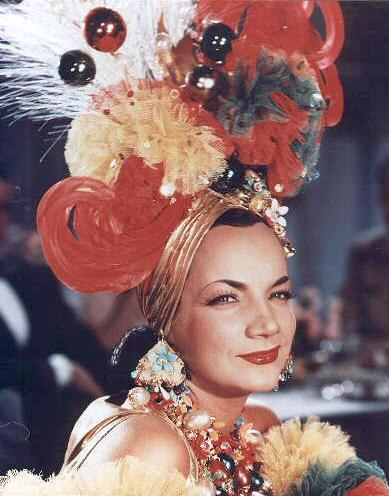
Carmen MirandaCarmen Miranda, for instance, who not only bore the signs of economic exchange (her headdresses loaded with bananas and other fruit provided by tropical bounty), but also served as a fetishized conduit for the exuberance and sexiness that Hollywood captured and distilled as "Latin spirit."

At the same time, and despite the elaborate orchestration that typified a Carmen Miranda number, some disturbing excess remained, not least in the ways in which Miranda's patter upset linguistic convention.

She blurred English and Portuguese and dissolved both, (re)converting language into sounds that were no longer meaningful, only affectively resonant. In Ana López's words, "Miranda's excessive manipulation of accents [. . .] inflates the fetish, cracking its surface while simultaneously aggrandizing it" ("Are All Latins from Manhattan?" 77).

So there has long been a complex relation between Latin affect and Western reason: both reinforcement and subversion. Fernando Ortiz suggests that at stake is a colonial pact with the devil. Of the appearance of tobacco and chocolate from the Americas, as well as Arabian coffee and tea from the Far East, "these four exotic products [. . .] all of them stimulants of the senses as well as of the spirit," he writes that "it is as though they had been sent to Europe from the four corners of the earth by the devil to revive Europe 'when the time came,' when that continent was ready to save the spirituality of reason from burning itself out and give the senses their due once more" (Cuban Counterpoint 206).

An economy of the senses saves reason, gives it a shot in the arm, but also demonstrates reason's addicted dependence upon sensual as well as spiritual stimulation.

Tuesday, July 26, 2005

piracy

Just a quick note or two after reading the BBC story "Microsoft Steps up Piracy Fight".

First, on the political economy of digital production. Pace declarations that "a third of software worldwide is fake" or "counterfeit," in that these are digitally exact replicas of the "original" software, charges of "fakery" are ungrounded. This is not a product that is constructed to resemble what Microsoft sells. This is what Microsoft sells. I take it that the rhetoric of the "counterfeit" is invoked to suggest that "pirated" software is in some way inferior to the "real" thing. But this goes against the whole logic of the digital mode of production.

Second, on the political economy of piracy. I find it interesting that over the past thirty years or so there has been an almost exact reversal of the relation of pirates to the process of production. Classical piracy involved the disruption of distribution networks. Indeed, a common charge against sixteenth and seventeenth-century buccaneers was that they were parasitic and unproductive. Today's software (and CD and DVD) piracy, however, is stigmatized because these pirates, freed from the start-up costs of R&D, from the requirement to invest in the fixed capital of the recording studio, from the obligation to pay wages (royalties) to the artists and designers, and from taxation and other levies imposed by the state, etc. etc., are producers who enjoy unfair comparative advantage because of their overall lower unit costs.

Of course, the political economy of piracy is complicated by the political economy of digital reproduction: most people would probably suggest that pirates copy, rather than produce. But copying is an essential part of the digital production process, in a manner quite distinct from traditional production processes. In Fordist industrial production, for instance, it is not that you first produce one car and then copy that car; rather you produce moulds for the various car components, which are then assembled to construct a car. (Here a counterfeiter would produce his or her own moulds, perhaps relying on inferior technology or materials to construct a product that resembles or is a replica of the original product.) Digital production, however, involves exact duplication. It is as though the "pirates" now have the exact same moulds as the "legitimate" producers (and, as I said, their product is indistinguishable from the legitimate product). They are therefore producers no more and no less than Microsoft (or Time Warner or whoever), albeit that they have abbreviated (rationalized?) the production process.

At the same time, the political economy of classical piracy is also more complex than appears at first sight. There are two main, apparently dichotomous, approaches:

1) Pirates disrupted trade routes, forced extra costs (above all protection costs) on capitalist producers, and also often destroyed the goods that they seized. When this is taken into account along with their prevalent ideologies of freedom from state and other authority, they should be regarded as essentially anti-capitalist, perhaps even proto-communist.

2) Pirates forced open trade routes, introduced competition in the face of monopolized distribution networks, and also often sold on much needed goods to make up for the inefficiencies of over-restricted markets. When this is taken into account along with their prevalent ideologies of freedom from state and other authority, they should be regarded as essentially capitalist, perhaps even proto-neoliberal.