Wednesday, September 20, 2006

modest

Princess Diana in AfricaI had the good fortune this week to read a wonderful book proposal about development work, and more specifically the "desire for development," particularly among white women in the North.

The focus is on Canadian aid workers in sub-Saharan Africa, and the ways in which their investment in their work (and even their resistance) enables their self-constitution as moral subjects. The manuscript includes the following marvellous quotation about the ways in which the assumption of global difference constructs and confirms a sense of moral purpose in Canada above all:
A Canadian today knows herself or himself as someone who comes from the nicest place on earth, as someone from a peacekeeping nation, and as a modest, self-deprecating individual who is able to gently teach Third World Others about civility. (Sherene Razack, Dark Threats and White Knights 9)
This is another approach to the problems I've mentioned before inherent in the self-proclaimed mission to teach "global citizenship".

The manuscript also notes something that surprised me, but probably shouldn't have, that "there are likely more expatriate development workers operating in Africa at this point than there were ever colonialists in the era of empire" (cf R L Stirrat, "Cultures of Consultancy," Critique of Anthropology 20.1 [2000]: 31-46).

Saturday, September 16, 2006

last301 links

Some internet resources on rights and Latin America. I'll be adding to this as time goes by.

s0metim3s has an extraordinarily useful collection of links, mostly theoretical, on rights. See also her essay "The Barbed End of Human Rights".

All the major human rights organizations have websites: such as Amnesty International (who have their own collection of links) and Human Rights Watch (see their page on the Americas). See also for instance the European Human Rights Centre.

Some Declarations of Rights...

On Latin America in general, a good starting point is the Latin American Network Information Center; they also have a page on Human Rights in Latin America.

The OAS has an Inter-American Commission on Human Rights.

On the sidebar I have links to two blogs that, together, do a pretty good job of covering news on the region as it's reported week by week: Latin America News Review and The Latin Americanist.

I also have a few country-specific blogs there: Blog from Bolivia, Tim's El Salvador blog, and Look for me in the Whirlwind (this last, from Venezuela). But there are lots of other blogs from or about particular countries. You can use Technorati to look for, say, blogs about Argentina or Mexico.

(Technorati also lists many blogs that claim to be concerned with human rights; it'd be nice if you could search for blogs that are tagged both human rights and Latin America, but that doesn't seem to be possible.)

From Georgetown University, an excellent project on Comparative Constitutional Studies, with the text of all the various Constitutions of the Americas.

Many of the Latin American truth commissions have published their work online. Argentina's Nunca más is a particularly useful site, with lots of testimonios. (The testimonios are in Spanish, but the published report is also available in English.) Check out too Guatemala's Report of the Commission for Historical Clarification, whose conclusions and recommendations are available. Then for instance there's Peru's Comisión de la Verdad y Reconciliación.

Saturday, September 02, 2006

bridges

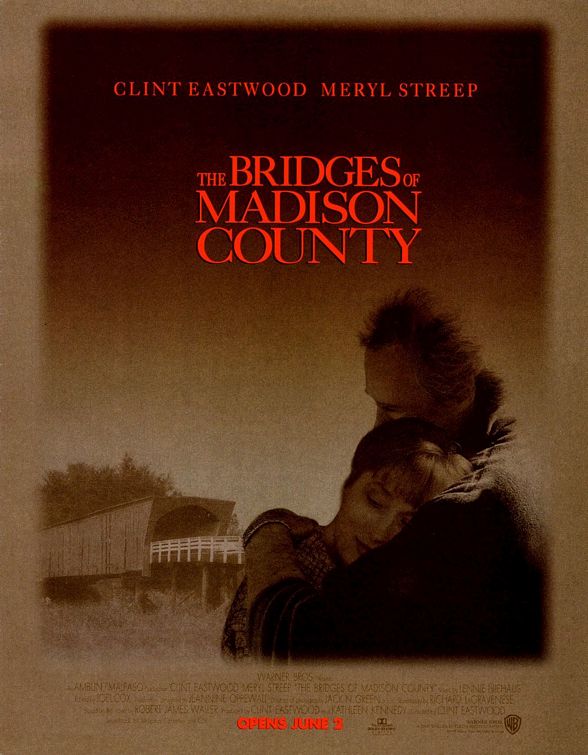
Bridges of Madison County posterOn the face of it, The Bridges of Madison County is a study in psychology: an Iowa housewife, Francesca, dies; among her effects her children discover the key to a closely-held secret, a brief but passionate love affair several decades previously.

Her secret is presented as the key to understanding this woman. Her diaries open up to her children another side to their mother, revealing her to be more than the mere inhabitant of a social role. Yet, within the logic of the secret itself (told in flashback) there is the question as to why she didn't take the chance to escape, to wander the world with the exotic National Geographic photographer who has entered her life and showed how everything might have been otherwise.

So, first: why? And then: why not?

The notion that the film is psychological is emphasized by its format: almost a chamber piece with the bulk of the screen time taken up by the two characters of Francesca (brilliantly portrayed by Meryl Streep) and the photographer, Robert (Clint Eastwood). We are brought to these two subjectivities, one perhaps still only just burgeoning, at a moment of intensity.

But precisely this extreme focus, on these two people over just four days, already starts to give the lie to any psychological realism. We never get any sense, for instance, as to why the episode should have held such importance for Robert, whose character remains a cipher: he stands, rather abstractly, for exoticism and transience; otherwise, there is almost nothing to him. Nor, in the end, do we really see any deeper into Francesca's motivations: yes, we can understand that she might feel isolated and adrift in rural Iowa, but why really is she there in the first place? What holds her to her husband?

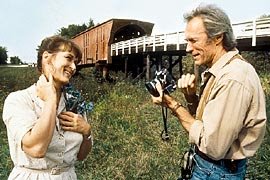
Streep and EastwoodStreep give Francesca an interesting gesture, repeated so often it becomes a tic, a habit: she is endlessly putting her hand to her face, usually to half turn away. It is as though hiding behind her raised hand are inner depths that constantly elude us--and also Francesca herself, so deeply has she repressed her passions. But why insist on some depth beneath the gesture? Why not see the gesture itself as part of an affective mechanism, fully imbued with Francesca's desire.

The gesture of hand to face is complicated by a further gesture that Francesca (almost) makes near the film's end: rather than hand to face, now hand to (car door handle) as, in a crucial moment, she faces the choice of leaving her husband, his car, his life, and joining Robert who is in the truck up front, stopped at traffic lights in the rain. Hand to handle. Hand to handle. It starts to turn. But then the lights change and, after a pause, Robert heads off; Francesca stays, now putting hand to face again.

Hand - face - hand - handle: this minimal mechanism constitutes the film.

We might add, though, various lines of movement and change, along and beside which the mechanism operates: above all, the road leading to Francesca's isolated farmhouse, a road full of ups and downs, twists and turns, such that (as Robert finds when he first turns up on it), it's easy to get lost on it. The road brings Robert to her; it also takes her husband and children away, though then brings them back, while Francesca gazes again up the track hoping that Robert will reappear.

The road also leads (eventually) to a bridge, or rather a series of bridges, the eponymous covered bridges of Madison Country. Points of transition where the mechanism of transition (the crossing itself) is hidden: a black box in which what's to be found at the other side, or even whether one emerges out the other side at all, remains something of a surprise; these are sites of situations, of (possible) events. Will she cross? Won't she cross?

And yet the bridges hide nothing: there's no secret heart, (again) no psychological depth. Just a minimal series of gestures, a diagram with serried bifurcations, which may or may not prompt one body to take flight with another.

Friday, September 01, 2006

rights

[The first in a series...]

Are, then, rights--that cherished shibboleth of progressive liberalism--beyond redemption? Gilles Deleuze seems to think so, calling rights "softheaded thinking" and "a party line for intellectuals, and for odious intellectuals, and for intellectuals without any ideas of their own" ("On Human Rights").

If we were to salvage rights, then on what grounds? The most frequently cited might be the tactical use of rights discourse, perhaps particularly as a mode of appealing beyond given territorial boundaries. So (say) a beseiged minority in a third world state (though why not also a first world one?) appeals to the UN charter of rights as a tactic within a local, punctual struggle. Rights then as a line of flight?

Perhaps more interestingly, surely we should also see rights, or the various declarations within which rights are defined and announced (however "self-evident[ly]," as with the US Constitution), as surfaces of inscription, sites within which the current balance of forces in a given struggle is marked? As such, though the danger is that the state of play is thereby reified and miscrecognized (always a temptation with rights: to see them as immutable and transhistorical), at the same time it might be worth considering how that act of inscription functions to complicate and feed back upon the struggle itself.

Tuesday, July 18, 2006

one

birthday cakeToday this blog is a year old.

Over the past twelve months, there have been 217 posts, including two fine guest posts, courtesy of Jeremy Lane.

Posthegemony has received more than 25,000 visits, which over the past few months has meant around 100 a day, with visitors from Argentina to Zambia, and many places in between.

(And I know there are plenty of more frequented blogs around; but surprisingly Technorati suggests that not only should this be your first port of call for all things Deleuze, Bourdieu, and Negri, as well as affect, habit, and multitude, plus of course both hegemony and posthegemony; it's also the number one place for cultural theory and social theory and a remarkably good resource for cultural studies and Latin America. For what that's worth.)

Many thanks to everyone who has stopped by, and especially to those who have commented, offered encouragement, and generated a series of interesting and productive conversations.

Monday, July 17, 2006

escape

I've been reading a couple of things sent me by my friend Susana Draper. They're mostly about the Punta Carretas mall in Montevideo.

Punta Carretas mallPunta Carretas is interesting not least because what is now a mall was once a prison, notorious for the incarceration and torture of political prisoners during the 1970s and 1980s. One could hardly wish for a better image of neoliberal transition: a marketplace founded on the site (and in the very building) of what was once an institution of state discipline.

Recycled in this way, the building is a place both of (perhaps unwelcome) memory, especially for its former prisoners, and also of collective amnesia, for the busy shopper. It presents a somewhat uneasy combination of these two temporalities--neoliberal present and dictatorial past--which are also two ways of thinking temporality, the scars of political memory or the eternal "now" of the commodity.

Susana is particularly interested in a famous escape from Punta Carretas prison when, in September 1971, over a hundred imprisoned Tupamaro guerrillas tunneled their way to freedom. Moreover, the escape unfolded another temporal doubling, as those burrowing their way out suddenly came across the tunnel that had been dug in the 1930s by anarchist prisoners, also seeking escape. Here, however, this resonance (or "dejà vu" as Susana observes, following Paolo Virno) between two different historical moments is felt as an empowerment, a potentialization, rather than a cancelling out.

There is much more than can be said here about lines of flight, immanence, exodus, creativity, the search for freedom, and so on--and Susana says much of it.

The fact, however, that much of her account is based on a reading of Eleuterio Fernández Huidobro's book La fuga de Punta Carretas made me realize that the prison escape memoir constitutes an entire sub-genre of Latin American testimonial literature.

For instance, there is also Claribel Alegría and DJ Flakoll's Tunnel to Canto Grande, about an MRTA escape from a Peruvian prison, and Ricardo Palma Salamanca's El gran rescate, about a helicopter rescue undertaken by Chile's FPMR.

(Meanwhile, the 1997 "Chavín de Huantar" operation, in which Peruvian special forces tunnelled in to the MRTA-held Japanese ambassador's residence, offers a kind of inverse movement.)

The only English-language comparison that immediately comes to mind would be the wealth of narratives about WWII escapes from German prisoner-of-war camps--such as Eric Williams's The Wooden Horse or the Steve McQueen vehicle The Great Escape. These stories are very different: they are mostly about stiff-upper-lip Englishness and fair play, though of course the "Great Escape" has now been adopted by England football fans.

But it might be worth doing a fuller survey of such escape literature to think further through the theme and the different possible modalities of flight, tunnelling, going underground. Or even jumping fences...

Steve McQueen in The Great Escape

Sunday, July 16, 2006

politics

The question regarding democracy is whether or not we can imagine an anti-democratic, or better non-democratic, politics. In other words, is politics tied to democracy, or can it be imagined beyond democracy?

(A supplmentary question might then be whether or not we can and should imagine a beyond to politics itself: a post-politics.)

The prevailing consensus would seem to be that politics is unimaginable without democracy, that it is only democracy that opens up the possibility for politics. Without democracy, all we are left with is (variously, or perhaps in combination) power, administration, fanaticism, hatred.

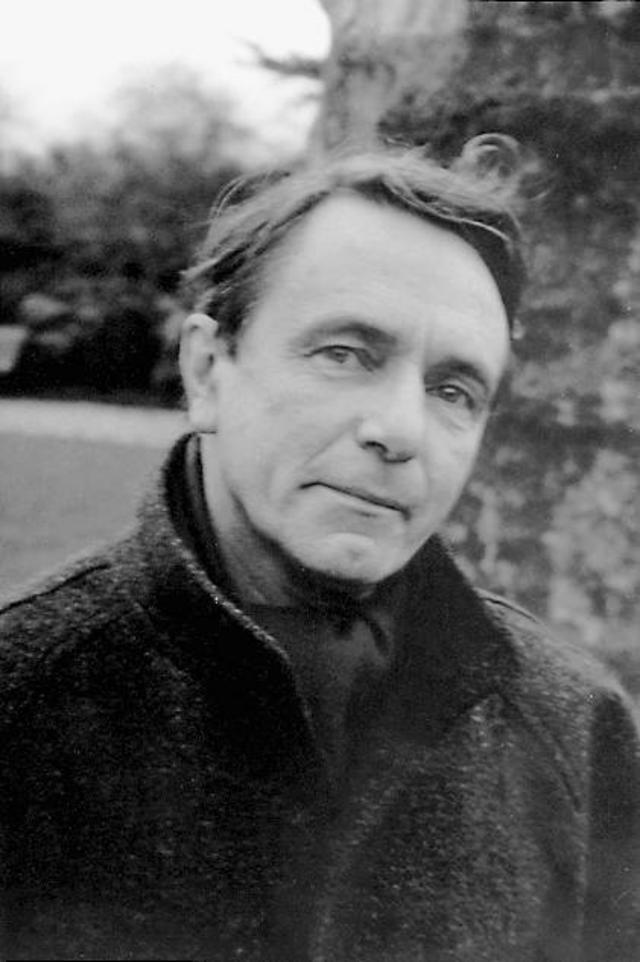
Jacques RanciereSuch is the view of Ernesto Laclau, but also, for instance, Jacques Rancière, who writes:
There is politics, the art and science of politics, because there is democracy. Politics is encountered as already present in the factuality of democracy, in the very strangeness of the combination of words which joins the unassignable quantity of the demos to the indefinable action of kratein. (On the Shores of Politics 94)
Rancière traces the mixed fortunes of both politics and democracy from its invention in Athens to the current "end of politics."

For Rancière, democracy (and so politics) is characterized by three conditions, which together constitute a split and antagonistic subject:
Politics is a function of the fact of democracy, of the way in which democracy's factuality presents itself in three forms: the appearance deployed by the name of the people, the imparity of the people when counted and the grievance connected with the antagonism between rich and poor. (96)
In our post-political, post-democratic age, all three of these conditions are now undermined, ironically for the sake of democracy's correction or perfection, in other words to erase the split that (for Rancière) characterizes the democratic subject:
Exhibition in place of appearance, exhaustive counting in place of imparity, consensus in place of grievance--such are the commanding features of the current correction of democracy, a correction which thinks of itself as the end of politics but which might better be called post-democracy. (98)
There is, however, a tension in this formulation: first, the declaration that this correction only "thinks of itself as the end of politics" implies that in fact politics continues; and second, the admission that this correction of democracy is itself in the name of democracy implies that it is less post-democratic than, in fact, a limit internal to democracy.

Meanwhile, the threat of post-democracy, as Rancière sees it, is that it summons up "the spectre of the great all-devouring Whole" (65), "the rule of the principle of unification of the multitude under the common law of the One" (88), an "ochlocracy" (33), that is, the "turbulent unification of individual turbulences" (31). And what is most monstrous about this threat, we are told, is that its unity is impossible, fantasmatic, and depends only on the violent, passionate exclusion of the racialized other; it conjures up therefore a world of "fear and hate" (36), "the return of the animalistic aspect of politics" rather than "the democratic virtue of trust" that inheres in democracy's "polemical space of shared meaning" (60).

So democracy has to be split, has to depend on inequality and grievance, so as to ward off the threat of radical difference incarnated in the multitude and its purported others.

We have here, therefore, something like a mirror image of Negri's conception of the multitude--with, of course, the difference that for Negri the multitude's passion is not hatred but love.

Moreover, Hardt and Negri's wager is that the (self-)rule of the multitude might still be termed democracy; indeed, that in that it escapes the entire problematic of (in)equality and identity that (as Rancière points out) bedevils democratic theory and practice, replacing it with the combination of commonality and singularity, multitudinous immanence is now a better bearer of the name democracy than are actually existing political regimes. "Post-democracy" therefore invokes this new, more democratic, democracy of pure immanence.

Angela Mitropoulos and Brett Neilson condemn this move as at best a form of "diplomacy" (and "diplomacy is already a technique of statecraft"), but more importantly because it thereby "fails to confront the politics of the demos and the kratos that invocations of democracy set to work" ("Cutting Democracy's Knot"). I'm not so sure; refusing to confront democracy's entanglements might also be seen as a strategic evasion, another mode of cutting the knot.

More importantly, however, it would be worth taking seriously the notion that the multitude might equally be characterized by hatred as by love; I see no obvious reason for simply assuming that the multitude's passion is the latter rather than the former. Certainly not if we look at groups that are otherwise organized very much along the lines that Negri argues are characteristic of the multitude: Sendero Luminoso or al Qaida, for instance. We need, at the least, to distinguish between multitudes good and bad--though that distinction may turn on ethics, rather than on politics.

Or take the image that provides Rancière with his book's title, of maritime flows and desires that have to be domesticated by shepherds on shore. Rancière writes that
The great beast of the populace, the democratic assembly of the imperialist city, can be represented as a trireme of drunken sailors. In order to save politics it must be pulled aground among the shepherds. (1)
But without romanticizing shipboard life and lusts, and while recognizing that it was maritime power that built terrestial empires, can we not rescue a politics of perhaps something like democracy from the interstitial, unbounded spaces of the high seas?

Crossposted to Long Sunday.

Saturday, July 15, 2006

groove

Emperor's New Groove posterThe Emperor's New Groove is not the first Disney film to feature animated llamas: in an extended sequence in Saludos Amigos Donald Duck attempts to ride a llama, with predictably chaotic results. But the differences between the two llamas, and the two films, are salutory, and demonstrate perhaps the changing nature of Disney's relationship with its audience in recent years.

More...

The Emperor's New Groove works to express, as only cartoons can, the purity of given characters' grooves, and to chart the inertia that prevents any easy deviations. (This is a constant theme in cartoons, where a change of state is always somehow delayed, always lags behind, archetypically when a character runs off a cliff and then hangs in mid-air before gravity suddenly, and belatedly, takes hold.) And it's in this displaced, cartoon version of pre-Columbian Latin America, with its vibrant colours and exaggerated imagery (green palm fronds, parrots, endless staircases, complex architectural patterns) that it can both express a groove and also imagine ways in which a groove can be changed.

Friday, July 14, 2006

philosophy

Following on from my recent posts "tautology" and "radical", here is my draft review of Radical Democracy and Beyond Hegemony: "Radical Philosophy?". As it is a draft, please do not cite without permission.

As a taster, the conclusion:

Schecter's critique of purported post-liberalism, as simply a warmed-over liberalism that conserves the worst rather than the best of what it claims to supercede, is a useful antidote to theories of radical democracy. His analysis of liberalism's paradoxes, while not always novel, is also sharp and to the point. However, he might have considered more the possibility that we are already living in a posthegemonic age. Bush, Blair, and Co. hardly stir themselves much to fabricate consensus these days--indeed, Blair's main argument for the war in Iraq is now that precisely the unpopularity of his policies is a guarantee that he is not merely bowing to the court of legitimate public opinion. Moreover, is not Schecter's dream of a "constant exchange of information between producers [. . .] and consumers" (138) not already with us albeit in the form of questionnaires, focus groups, and the information derived from loyalty cards on the one hand, and advertising and the ideologies of business transparency on the other? We are already beyond hegemony, and whatever else radicalism might be, surely it does not involve rescuing liberalism, whether in its purer, idealist, form or in its corrupt, democratizing, incarnations.

Thursday, July 13, 2006

experimentation

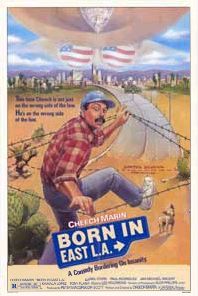
Born in East LA posterCheech Marin's Born in East L. A. is a Chicano take on "Latin America on Screen." Marin takes the questions of border permeability, national security, and identity's performativity, ironizes them, and attempts to milk what comedy results.

Marin plays Rudy, a fairly thoroughly deracinated Los Angelino (who speaks no Spanish and is completely ignorant of Latino music, for instance), who by one of those strange mix-ups finds himself taken to be an illegal and deported to Mexico. He then spends most of the film attempting to cross back over the border, hustling for money with which to pay a coyote, and falling in love with a beautiful young Salvadoran woman, Dolores.

More...

And just as Rudy plays a German folk song (picked up as a GI in Europe) to seduce appreciative European tourists to part with their money, so he teaches a band of Mexican buskers to play rock and roll. Though Mexico may still (just) be a cradle of authenticity, it can also be a site for the experimentation in multiple identities and identifications, preparing the intrepid for the risky step of crossing the border and claiming all the same rights and benefits as those actually "born in East LA."

Wednesday, July 12, 2006

tautology

More thoughts towards a review of Tønder and Thomassen's Radical Democracy...

In a quirk of sloppy copy-editing, one of the contributions to Lars Tønder and Lasse Thomassen's collection, Radical Democracy, bears the running header "For an Agnostic Public Sphere" instead of the essay's actual title, which is "For an Agonistic Public Sphere."

But this confusion between agnosticism and agonism is perhaps symptomatic of the problems afflicting the very concept of radical democracy. For though its proponents repeatedly invoke notions of political combat and engagement, they all too easily slip into quiescent indecision.

Put it this way: it is far from clear what is "radical" about radical democracy behind the rhetorical display of terms such as agonism, antagonism, pluralism, and the like.

ballot boxIs radical democracy a specific form of democracy, comparable to but different from (say) the Athenian, liberal, or neoliberal variants of democratic practice? And if so, is it a democracy still to come, to be fought for as a perhaps utopian horizon of democratic thought and struggle?

Or is it, by contrast, a form of democracy in which some groups (new social movements, say) currently engage, in other words a counter-democratic actuality that has emerged since the end of the Cold War and the bad old days of class politics?

On the other hand, could radical democracy be found less either in the future or the present, but in a return to the founding moment of the so-called "democratic revolutions"? Is radical democracy then a rediscovery of an inherent radicality democracy once provided but has now lost? In slightly different words, is radical democracy simply another name for what Simon Critchley here terms "true" democracy?

Or finally, is democracy always radical? Is radical democracy really a tautology, in that democracy properly understood and described, even as it is played out currently in the real world, is necessarily in some way radical?

Friday, July 07, 2006

radical

I'm reading a couple of books for a review essay: Darrow Schecter's Beyond Hegemony and Lars Tønder and Lasse Thomassen's Radical Democracy.

Schecter's book is smart but misguided, and essentially involves an attempt to rescue liberalism from itself--or what he sometimes terms "early liberalism" from its historical vicissitudes. He likes, in short, the ways in which Kantianism sets up formal legality over legitimacy, as legitimacy (he argues) always involves a compromise in which particular interests take precedence over the universal, and a forced reconciliation or fabricated consensus (hegemony) results. The problem, Schecter recognizes, is that Kant secured such a distance of legality from interest or need only by assuming a limited suffrage and so by excluding women, wage-earners, etc. from the sphere of politics. Moreover, even within such an attenuated public sphere, actually existing liberal democracy depended upon a covert subject, the white male property-owner, and his particular interests. Still, Schecter wants to maintain the notion that a disinterested (and so legitimate) legality is attainable. For this he turns (rather unconvincingly) to the libertarian or "guild" socialism of G D H Cole.

Still, however wrong, Schecter's book is at least provocative and intelligent.

The same can hardly be said for Tønder and Thomassen's collection. Its premise is to set up a distinction "between abundance and lack," which essentially means playing off Lacanianism and Deleuzianism, all under the sign of radical democracy. The so-called Lacanians (because in fact they are Laclauians through and through) run through the same old moves about hegemony, constitutive outsides, tendentially empty signifiers, non-coincidence of desire, and the like. The so-called Deleuzians are, however, on the whole even worse, as they attempt to shoe-horn Deleuze within the framework of "radical democracy," as bidden by the collection's editors. Paul Patton's piece, for instance, rather bizarrely tries to claim that Deleuze was a paid-up liberal democrat mainly based on the fact that he so seldom discusses liberal democracy. His argument is generally along the lines of admitting "there is no doubt that Deleuze is not a theorist of democracy in the narrow sense of the term," but only to follow up with the thought that "it does not follow from this that Deleuze is hostile to democratic government" (54). Well, but you can't make of a non sequitur a democratic theorist.

Meanwhile, the whole concept of "radical democracy" is a con. The tag "radical" is basically meaningless. And there is much confusion as to what purpose the adjective serves: is the notion that radical democracy is some new kind of democracy, exciting, different, and better than (say) liberal or neoliberal democracy? Or is it that democracy is itself radical, and what's involved is merely a redescription to make democracy seem more exciting, different, and better than it currently appears? This ambivalence, which is never directly confronted, undermines the book's very premises.

Monday, July 03, 2006

pichiciegos

FogwillThe Argentine author Fogwill's Los pichiciegos is an astonishing tale derived from the Falklands/Malvinas conflict. The book is all the more remarkable as it was written between June 11-17, 1982, i.e. as the war itself was ending and so while the war of words still followed a rigid ideological dichotomy, and before the combatants themselves had had a chance to tell of their experiences.

Yet the novel is rooted in a sense of the physical experience of the Falklands war, in all its brute materiality. And it refuses not only the rhetorical dichotomization that assigns legitimacy to one side or another, but also the very notion of sides.

The "pichiciegos" of the title are a group of Argentine deserters who have established a subterranean settlement (a bunker, a series of passages and chimneys) somewhere in no man's land. They are, effectively, maroons who commerce with both sides (British and Argentine) as they seek the kerosene, sugar, cigarettes, and so on that they need to survive. Yet they also maintain their distance, digging firmly into the slush and mud of the islands' desolate landscape. Theirs is a wary Exodus from the claims and counter-claims that they hear on the radio, and a becoming-immanent to the rough terrain amid the minefields and bomb craters.

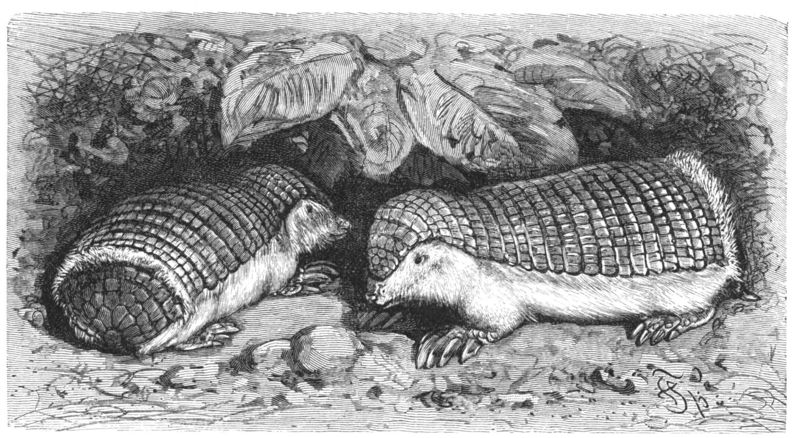
pichiciegosPichiciegos are also a species of Argentine armadillo, armour-coated, blind burrowing creatures active only at night. One of the group tells the others about this animal, how they live and how they are hunted. What most takes their fancy is the way in which, to dislodge them from their burrows, a hunter is forced sometimes to grab them by the tail and stick a finger up their arse. At the shock (or perhaps the pleasure) of the penetration, the pichiciegos lose all resistance and can easily be extracted. Likewise, the deserters are aware that at any moment they may be fucked in the arse by either the Argentines or the Brits.

Still, they stockpile supplies and are prepared to wait the war out. They have yerba mate, cigarettes, liquor, food... everything except chemical toilets, which means they either have to brave the subzero elements to shit outside, or plug up their systems with anti-diahrreal drugs. Yet in their nervous limbo between the two opposing camps, in the fear that is both omnipresent backdrop and specific response to the Harriers, the helicopters, and the other machinery of war, even or perhaps especially here they become themselves as never before.

It's as though it were only in this fearful Exodus that the virtual qualities constituting both individuals and group could be actualized: "It's that fear releases the instinct that everyone carries within him" (103).

In the end, however, this rebel colony--neither one thing nor the other, surplus and so almost invisible to the friend/enemy distinction of war and politics--is almost inevitably extinguished. Poisoned by the carbon monoxide emitted by their own stove once the snow silently blocks the chimney, the pichiciegos are entombed, to become literally part of the landscape, a buried relic of other ways of living the war.

But the maroon experience is also buried by less natural forces: by the Argentine generals' declaration that the war continues, if by other means; and even by the politicians' promises of elections and choice, as though there were anything to choose. Fogwill already anticipates the slogan of Argentina's 2001 uprising: "No... I wouldn't vote for any of them. Let them all go off [¡que se vayan todos!] back to the whore of a mother who bore them!" (55).

One survivor alone remains, an un-named pichiciego who is gradually revealed to be recounting his story to a shadowy narrator who seems to be half-author, half-psychologist. A narrator who may or may not believe the strange tales that he is told (of a hovering Harrier with its engines off, of nuns in the snow, of the "Great Attraction" as a fleet of warplanes disappears into the ether), and who certainly, his informant insists, doesn't understand, cannot understand.

But at least he records, he records the pichiciego's words so that they are not entirely lost to a future whose first glimmering possibilities they may perhaps predict.

Links: Beatriz Sarlo on Los pichiciegos; Julio Schvartzman, "Un lugar bajo el mundo"; and "Fogwill, en pose de combate", a recent interview by Alan Pauls for Clarín.

Sunday, July 02, 2006

voyeurism

Snuff poster1971 saw the release of Slaughter, a low-budget exploitation flick, filmed in Argentina and set in Argentina and Uruguay.

The film told the story of a cult led by a Mansonesque figure rejoicing in the name of Satán or Satahn. The young women who follow Satán, all hippie types with flowing hair and a predeliction for removing their blouses, are kept in servitude by a sort of sadomasochistic desire: transgressions are punished by ritual torture that is experienced as erotic pleasure and observed with voyeuristic glee.

More...

Snuff, in short, becomes a film about the dictatorships, and an allegory of a violence that is in plain sight, paraded before voyeuristic eyes, a violence that is real but pretends to be theatrical, mirroring the film's own violence that is so theatrical as it pretends to be real.

Saturday, June 24, 2006

Hitler

Paraguay has a significant population of German immigrants and their descendants. It's not the only Latin American country with a German influence: see Colonia Tovar in Venezuela, for instance, or the now rather nefarious Colonia Dignidad in Chile. And there's little more surprising in the Yucatán and Belize than the sight of packs of blond Mennonites on the move, all cowboy hats, check shirts, and overalls for the boys and men, headscarves and dresses for the girls and women.

But in Paraguay the German presence is particularly notable. At times it is as though German were the country's second language (or third, after the indigenous Guaraní). This page on German genealogy suggests there are 166,000 speakers of the language in the country. And at the hotel where I was staying last week, for instance, the guide to room services was in Spanish and German, rather than English. Most of the other visitors were speaking German, including a large group of young girls from the Chaco, in town for some kind of sports tournament, chaperoned by a tall young blond man with the air of a Christian youth leader, who spoke heavily accented Spanish.

The German colony in the Chaco are Mennonites who peaceably enough raise cattle and make cheese. By all accounts, the Chaco is a pretty desolate place, and the Mennonites and the Guaraní have it pretty much to themselves. (Even so, early last century the Paraguayans managed to lose a war with Bolivia over the territory.)

But then there are Germans and there are Germans. And the topic of Nazis or former Nazis in South America is always a subject of intrigue and speculation: luridly fictionalized as The Boys from Brazil or The Odessa File, but on the basis of real cases such as most famously Eichmann's flight to and capture from Argentina. Josef Mengele, though he initially fled to Buenos Aires, spent signficant post-war time in Paraguay.

Still, I had either forgotten or repressed from my only previous visit to Paraguay the shock induced, this time, by noting the first day of my stay a Spanish translation of The Protocols of the Elders of Zion on sale at a street corner kiosk. Or, a little later, just off one of Asunción's main squares, on the pavement outside a cybercafe, seeing two pencil drawings of Hitler on sale among the usual collection of secondhand textbooks and shabby novels. No irony, no self-consciousness as far as I could see: just a couple of portraits of the Führer, should I have wished to buy them as a souvenir of Paraguay.

I take it that most Paraguayan Germans shudder somewhat as I did in seeing such reminders of the Reich. Not least now that Germany itself is, with the World Cup, trying to rebrand itself beyond the clichés of either jackboots or dull efficiency. But perhaps more likely, these signs of history's unsavoriness merely blend in with their adopted country's long history of dictatorships (Doctor Francia "the Supreme" as well as that other son of Germany, Stroessner) and injudicious wars of aggression and catastrophic defeat.

UPDATE: Royden Loewen's Mennonite and Nazi would seem to be a book to read, complicating my account above.