Showing posts with label allende. Show all posts

Sunday, January 21, 2007

tolerable

Isabel AllendeIsabel Allende's Eva Luna is perhaps not a terrible book; but nor is it a very good one.

It particularly goes off the rails towards the end as the various narrative strands--the story of eponymous Eva's success as a writer; the long-awaited consummation of her romance with film-maker Rolf Carlé; and her abandonment of previous love interests guerrilla Huberto Naranjo and General Tomoleo Rodríguez--come to an end more or less abruptly and unconvincingly. In this light, Allende's decision to give us two possible conclusions, in one of which Eva and Rolf's love eventually dissipates whereas in the other they live happily ever after, is less a sign of metafictional play than a signal that the book itself has ground to an unceremonious halt.

All this in a book that sets out to celebrate the power of the word, and of story-telling in particular, yet in which (as our narrator tells us) "when all was said and done, everything came down to the elemental fact that I had found my man" (285). All the gestures towards politics, whether feminist or socialist, half-hearted at the best of times, are sacrificed for the sake of a romantic dénouement that even Eva Luna herself finds vaguely unsatisfying.

This sense of dissatisfaction permeates the novel, not least when it comes to the various stories within stories that it presents. Eva Luna gains an audience among her friends by reworking the stories provided her by mass culture: "They'd ask me to tell them what would happen next in the soap opera of the day, and I'd improvise a dramatic conclusion that never coincided with the way things turned out on the radio, but they didn't mind" (121). Yet it emerges that the book we are reading is itself the basis of Eva Luna's own soap opera, one which goes by the title of Bolero; perhaps she's challenging us to come up with a more fitting end to her characters' serial adventures and (mis)fortunes.

If Eva Luna is some kind of doppelganger for Allende herself, it's notable that she is a writer unashamedly oriented towards the market. Throughout, she offers her stories in exchange for some kind of benefit; and as she suggests in the self-reflexive terms of the only story told within the novel itself, "she traveled all over touting her merchandise, adventure stories, mysteries, tales of horror or vice, all at a reasonable price" (262). She makes no grand claims for her fiction, only that in the face of an unknowable and chaotic reality she tries "to put a bit of order to so much chaos, to makes existence more tolerable. When I write, I picture life the way I'd like it to be" (280).

Is it too severe to characterize such sentimental escapism as "bad" literature? Perhaps, though it's notable how deficient it is when Allende (or Eva) comes to account for violence or any other unpleasantness: describing a torture scene, for instance, our narrator tells us "The officer lifted his hand, brought his arm back, and punched me. I don't remember anything else. I awoke in the same room, tied to the chair, alone, they'd taken my dress off. [. . .] I tried to move, but my entire body hurt, above all the cigarette burns on my legs" (183). No wonder Luna's response to another character's bloody suicide has been to clean things up and tell her corpse a story as though (almost) nothing had happened.

And it's an irony if Allende's readership comes to her work looking either for creative imagination or for some kind of political commitment, when all they get are these gestures.

Tuesday, January 16, 2007

cover

There's quite a lot you can judge a book by its cover. A book's cover is a very visible means by which publishers seek to sell their product to readers: indicating what kind of book they're selling, establishing associations to point to a particular market niche.

Isabel Allende's own website has a page featuring all her covers, at least of English translations. There are a variety of designs, though most of them feature cover art that bleeds to the edges. The design for Paula is the simplest, with prominent text imitating handwriting either side of a very small central image. Daughter of Fortune and Portrait in Sepia have covers more suitable to a classic: subdued, neither too busy nor too colourful.

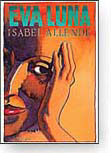
Eva Luna, on the other hand, has a cover dominated by a quasi-modernist painting of a woman's head in close up, in warm but also slightly menacing orange (in which the forehead and background merge), over which the book's title is superimposed in rather clashing green. There seems to be no other text and the overall effect is decidedly garish.

Eva Luna, SpanishHarperCollins (via its Spanish-language imprint Rayo) sells the book in Spanish in the US and Canada with an early twentieth-century sepia photograph and a crescent moon set against a dark brown ground and with a prominent recommendation from the Village Voice right alongside the title itself. Allende's name is more prominent than the title, but only marginally so; beneath is the reminder that she is also the author of La casa de los espíritus This cover is simpler and more tasteful, right down to the use of a lower case sans serif font.

Eva Luna, EnglishIt's Bantam (a mass market division of Random House) that sells the current North American English translation, whose cover depicts a woman writing against a colourful floral background. The type face is more elaborate, reminiscent of art deco, while the artwork itself is fairly interesting: faces lurk in the background; and on the desk at which a woman is writing (though she's looking straight at the viewer) can be found both a sepia photograph of what seems to be an Edwardian woman with parasol, and also a hand grenade. Again, there's something menacing about this cover, especially the woman's somewhat odd gaze, but here perhaps this disconcerting effect is deliberate, rather than accidental.

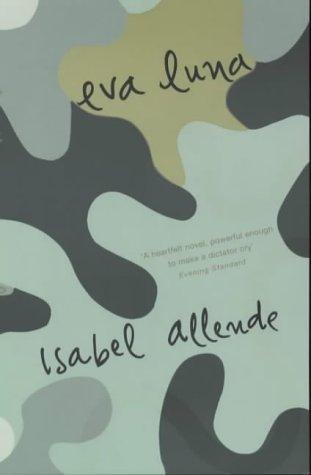
The Penguin (UK) cover picks up on the military theme, but takes it to some extreme: no longer the romantic image or woman's portrait, but an abstract study in camouflage, with a blurb from the Evening Standard placed aslant between title and author's name. I can't but think this is a strange and possibly counter-productive way to sell Allende's work. Maybe the idea is to position her more as an avant-gardist, and to remove all traces of femininity from her image.

Perhaps this is a tension for her publishers: whether to sell her as Virginia Woolf or as Gabriel García Márquez. Likewise, if on a different axis, there seems to be a tension between positioning her as a modernist, experimental writer or as an author of romances (albeit romances with an exotic and politicized edge). Where exactly does she lie on the scale that leads from Barbara Cartland to James Joyce? The truth is, as in so many other things, she's quite squarely in the middle.

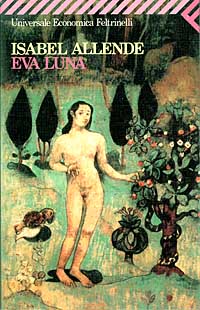
Meanwhile, here is the book in some other languages: Dutch, Czech, and Italian. The Dutch have gone for a fairly plain cover, with a childlike drawing; the Czechs have decided that sultriness is what will sell the story for them. It's not clear what exactly the Italians were thinking.

Eva, DutchEva, CzechEva, Italian

Again, Allende's own website has a page dedicated to covers of translations in a still wider range of languages, from Turkish to Japanese.

Sunday, May 14, 2006

conundrum

The discussion over at the Valve about whether or not literary critics are or should be fans of the authors they study reminds me of what I hereby propose to call "the Allende conundrum."

Isabel AllendeAnyone who works on Latin American literature will be familiar with the scenario. You're at a party, or bar, or whatever. Someone asks you what you do. Teach. What? Latin American Studies. Oh, what? Y'know, literature, culture, politics. "Oh," comes the reply. "That's great. I so loved that Chilean author. What's her name? The one who wrote House of the Spirits."

Here's the conundrum. Should one encourage such interest in one's field? Or should one reveal that, well, in fact just about every Latin Americanist critic with a shred of self-respect hates Isabel Allende.

And the worst thing about the second option is that readers of Allende think that, by reading her, they are proving themselves not only cultured (Third World literature! Magic realism!) but also politically sound (Women's writing! Exiled niece of overthrown Socialist president!).

In other words, by pouring cold water on their enthusiasm for Allende, one risks undoing what is in fact the great motivation and for many the rationale of the field itself: that seductive blend of aesthetics and political commitment encapsulated in the opening lines of my friend Jean Franco's pathbreaking The Modern Culture of Latin America: Society and the Artist (1967):
An intense social concern has been the characteristic of Latin-American art for the last hundred and fifty years. Literature--and even painting and music--have played a social role, with the artist acting as guide, teacher and conscience of his country. (11)
Readers seek vicarious satisfaction from this heady mix. On the whole, people who read Latin American fiction think that they are better people for so doing. They expect to be rewarded with some kind of new respect for revealing how much they love Isabel Allende (or García Márquez, or Borges, or... well, generally the list stops there).

But the truth is, Allende is rubbish.

And she's not alone, of course. There's plenty of Latin American literature that's mediocre, reactionary, boring, unimaginative... And even the good stuff surely doesn't make you a better person for reading it.

I'll admit that there's more than a dose of elitism in this reaction against Allende. But that's far from the end of the story. In any case, surely we should find ways to work with these rather strange affective investments, rather than simply debunking them. In the meantime, though, I remain reluctant at parties to be drawn into discussions about what I do.

I'm sure that there are other fields in which something like the same conundrum prevails. South Asianists probably hate hearing how much people love Rushdie, or are fascinated by Hinduism. Physicists don't want to answer questions about A Brief History of Time. And so on and so forth. At stake in part is the difference between the popular conception of a field of study, and how that field is sensed or understood by those within it.

But the Allende conundrum in this, its original, form seems to hold an especially concentrated series of contradictions and ambivalences.