Tuesday, March 21, 2006

international

Caribe HiltonFrom an architecture designed to repel nomads, to one whose aim is to attract them...

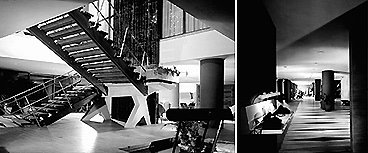
I was staying last week in San Juan's Caribe Hilton. (I know, it's a tough job; but someone has to do it.) At first sight the Hilton is just another hotel like so many others. But in part precisely for that reason, it turns out that this is an important piece of Caribbean architecture, and of "tropical modernism."

According to Enrique Vivoni-Farage's "The Architecture of Power", the designs presented by US architects for this 1949 building were in Spanish Renaissance Revival style, in line with Conrad Hilton's own desires. But all three Puerto Rican submissions to the competition were in International Style, inspired rather by the Modern Movement.

As Periferia puts it, the values the winning design promoted were modernity and efficiency, over "the curious and the picturesque." This fit much better with the spirit of "Operation Bootstrap," the economic and political program by which Puerto Rico would be propelled into industrial modernity.

bar at Caribe Hilton
Apparently, the hotel's original bar was quite a striking example of postwar modernist styling. Now, after a recent extensive refit, its aesthetic is much blander, much less hard-edged. As James Russell observes, today the neighbouring Normandie, designed in 1939 Art Deco imitation of a cruise liner, has in fact the much more interesting interior.

Back at the Hilton, a touch of the exotic has been returned with the presence of two caged parrots in the lobby, opposite the check-in desk--though sometimes, it appears, these birds are allowed to sit on top of their cages, rather than simply within them.

Perhaps this is an emblem of the false freedom that Vivoni-Farage reads in the Hilton's modernism. He sees the choice of the International Style as an illusory decolonization, in which culture stands in for politics. The rejection of Spanish Renaissance style
gave the Puerto Ricans an illusion of "freedom" instead of truly liberating them from a colonial situation. Architecture served as a palliative, where the Modern was synonymous with freedom and the good life.
By contrast, it is the opposite that is usually said of the rest of Latin America: that formal political independence in the 1820s has never really been backed by true cultural autonomy.

Meanwhile, and via The Morning News (full article here), some suitably modern guests of the Caribe Hilton, from 1959:

Caribe Hilton Guests

Monday, March 20, 2006

recolonization

Monday Arguediana

More ruins... But in Todas las sangres Arguedas is less interested in physical ruins than in the fragmentation and ruination of a social order, and particularly of the dying order's dominant class.

The story concerns the transition from a feudal economy based upon agriculture to a modern, capitalist economy of mineral extraction. Such a transition is not an instance of modernization in any simple sense: mineral extraction had always been at the heart of Spanish Imperial ambitions in Peru--above all, of course, Upper Peru, now Bolivia, which contained the "cerro rico" of Potosí. So mining might also be seen as a recolonization, and what's at issue here is the competition between national and international capital, between local landowner Fermín Aragón on the one hand and the foreign corporation Wisther-Bozart on the other.

Potosi mine
From Loïc Venance's photo series on Potosí

Among those caught up in the ensuing struggle are Fermín's brother, Bruno, who is the very model of an old-style landowner; Fermín's mining engineer, Cabrejos, a "faithful disciple of the North American school" (77) who is in fact in the pay of Wisther-Bozart; and Demetrio Rendón Willka, an "ex indian" whose task is to harness Don Bruno's indigenous peons in the name of the mining operation.

Cast aside, meanwhile, is the former governing class of this mining village, the "ruined notables" who have been gradually bought out by the Aragóns (81). Their houses have slowly decayed as though in sympathy with their fate:
the doors now losing their paint or varnish began to be covered in dust, and to take on the ruinousness of the walls, of the roofs, of the large courtyards and dirty arcades. The whole town started to take on an air of irredeemable age. The Aragón de Peraltas flourished by remaining on top of the desperate rival bands, untouchable. (69)
But Fermín still needs the last pieces of land to which this declining aristocracy maintains its title--and Cabrejos aims to ensure that these landowners don't sell up.

At stake is a conflict not only between old capital and new, national and international, but also between the ruination suffered by the old, and the corruption embraced by the ambitious. Fermín, we are told, can no longer hear the birds that belong to a nature he views only extractively: "he has lost the gift of hearing them thanks to corrupt capital"; his wife is asked to "ensure that ambition does not continue to corrupt him" (76).

But the whole town is soon swept into a web of deceit and corruption, in which old grudges or desires are rekindled and stoked by the various competing forces: Rendón Willka's traumatic bullying at the hands of his schoolmates, or the chauffeur Gregorio's fancy for shopkeeper Doña Asusta.

Moreover, the discourse of corruption is also retranslated into meditations on cleanliness and fanaticism, both of which have premonitory resonances for the subsequent history of Sendero Luminoso in highland Peru.

Back with the novel, we'll see what plays out: whether either Bruno or Fermín can overcome the taint of the curses their father throws down at them from the church tower in the powerful scene that opens the novel; whether Cabrejos has met his match in either Fermín or Willka; and whether Willka himself can maintain his mediating role, slipping in and out of indigeneity or mestizaje as circumstances change. (My guesses: no; yes; no.)

Update: In answer to my questions... arguably Bruno does redeem himself, and perhaps so does Fermín, too; then it turns out that Cabrejos meets his match in the woman whose suitor he killed, rather than in any of the men; and at the end, mediation of any kind proves impossible, I think.

Sunday, March 19, 2006

fortification

What would the architecture of the Caribbean be without the pirates from whom the Spanish Empire constantly sought defence and protection?

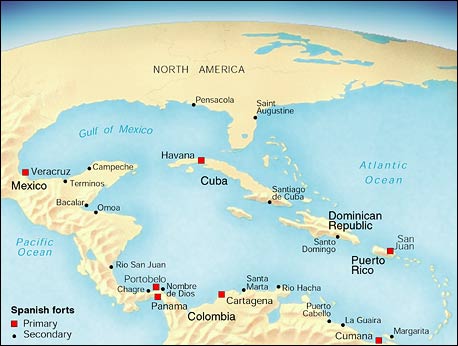
The Spaniards constructed an elaborate system of fortifications across the Caribbean basin: from Veracruz, from which the fleet carrying Mexican silver would sail; to Panama and Nombre de Dios, through which Peruvian and Philippine treasure was routed; on to Havana, where the fleets converged; and San Juan, Puerto Rico, which Philip II called "the key to the Indies."

map of Spanish Caribbean forts
The walled city of San Juan, and the El Morro fort that guards its harbour, are particularly impressive. The first defences were constructed in the sixteenth century, and helped repel Drake's 1595 attack. Three years later, another English privateer, the Earl of Cumberland, took the fort by attacking overland rather than from the sea, but this expedition was defeated eventually as his men succumbed to dysentery. The Spaniards then rebuilt El Morro stronger than ever, and saw off a Dutch attack in 1625. Further building continued for another 150 years, producing massive walls and further forts all around the island on which Old San Juan sits.

El Morro was subject to US bombardment during the war of 1898, but the Americans subsequently themselves rebuilt parts of the site in World War II pillbox fashion, turning it into a lookout now against the possibility of German U-Boats advancing across the Atlantic.

El Morro fort
But although the prodigious engineering that went into this edifice is ascribed to the Irish-born Colonel Thomas O'Daly, surely this architecture of counter-insurgency should also be credited at least in part to the nomadic pirates against whom it was arrayed?

Friday, March 17, 2006

silence

One thing I liked about Pete de Bolla's book Art Matters is his comment on the way in which a work of art can strike the viewer or listener dumb. The aesthetic experience gives us pause, if only briefly. We catch our breath, uncertain as to how to continue.

Mark Quinn, SelfDe Bolla's example of art throwing a spanner in the works of discourse is his account of Marc Quinn's Self. This is a sculpture of the artist's head made with nine pints of his own frozen blood.

I was reminded of this listening the other day to an account of Teresa Margolles's Instalación con Vapor, in which spectators enter a misty cloud made up, they soon learn, of water used to wash the dead in Mexico City's morgue. (More on Margolles, perhaps, anon.)

But there's no need to look simply at experimental or high art. Think for instance of the point at which the credits start rolling in the cinema, and the silence as you walk out of the building, before the commentary begins. We've been affected by the experience, but have yet to convert that affect into critique or analysis.

In these pauses all sorts of reactions are still possible. They constitute a temporality full of intensity, of incompossible articulations that have yet to be actualized. This is a silence that's far from empty.

We are normally suspicious of silence. Silence=Death. Silence is cowardice. Silence is the result of power's silencing.

But especially in the face of the hyperarticulacy that circulates in and around politics, the media, and the academy, it might be worth revalidating those brief pauses in which everything is still to be said, in which positions are yet to be taken. In which judgement remains in abeyance.

Monday, March 13, 2006

cake

Monday Arguediana

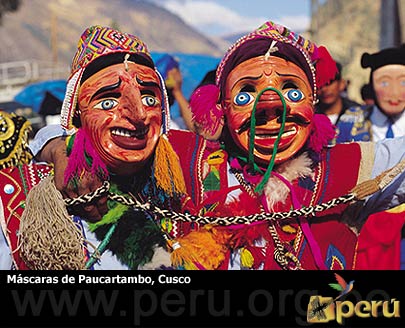
Peru Tourist Board imageDespite everything, readers still come to Arguedas looking for the voice of the subaltern. Arguedas is presented as a privileged translator between Quechua and Spanish, indigenous and Western, archaic and modern. "Speaking and writing from within," his is "an authentic, autonomous, testimonial, and metatestimonial voice" (Sandoval xxxvi).

Yes, critics are usually prepared to concede that nothing is ever quite so simple: the subaltern remains always somehow inaccessible; translation is acknowledged to be a risky, imperfect affair; and claims of authenticity and autonomy give way to the realities of transculturation, mestizaje, and the like.

But still, it is as though with Arguedas we can have our cake and eat it. Theory, precisely the theory that cautions us against such Romantic fantasies of authenticity, can be both affirmed and negated at the same time. We can deploy a theoretical discourse and yet bask in the aura of otherness.

Mignolo Local Histories coverThere's more than a hint of this attitude in Walter Mignolo's influential work. His writing is densely packed with theoretical references and convoluted phraseology, including relative neologisms such as "coloniality of power," "border gnosis," "loci of enunciation," and "pluritopic hermeneutics."

Yet, beneath it all, what's at issue is a remarkably untheoretical inversion: those previously silenced should now be permitted to speak. Take for instance the following complex paragraph that presents the core argument of his book Local Histories / Global Designs:
That colonial modernities, or "subaltern modernities" as Coronil (1997) prefers to label it, a period expending from the late fifteenth century to the current stage of globalization, has built a frame and a conception of knowledge based on the distinction between epistemology and hermeneutics and, by so doing, has subalternized other kinds of knowledge is the main thesis of this book. That long process of subalternization of knowledge is being radically transformed by new forms of knowledge in which what has been subalternized and considered interesting only as object of study becomes articulated as new loci of enunciation. This is the second thesis of this book. The first is explored through a cultural critique of historical configurations; the second, by looking at the emergence of new loci of enunciation, by describing them as "border gnosis" and by arguing that "border gnosis" is the subaltern reason striving to bring to the foreground the force and creativity of knowledges subalternized during a long process of colonization of the planet, which was at the same time the process in which modernity and the modern Reason were constructed. (13)
Put to one side, if you will, the infelicity and even ungrammaticality of expression here--the lack of agreement, for instance, between subject and main verb in the opening sentence. Ignore also the repetition, apparent contradiction, and unnecessary complication.

Mignolo's basic points are in fact straightforward: that modernity promoted one form of knowledge over other forms; and that those other forms of knowledge are now re-emerging from their former suppression.

And though the articulation of such subaltern knowledges is clearly part of a political struggle, for Mignolo there is apparently little reason in theory why we should not have access to the voice of the other, given the right conditions.

The theoretical work required, it seems, amounts merely to a set of successive redescriptions, by which subaltern knowledge is renamed as "new loci of enunciation," only to be renamed once again as "border gnosis" and yet again as "subaltern reason." The theorist, then, becomes a translator and phrasemaker who re-presents subalternity within a suitably rarified frame of reference, so that it comes to seem equivalent, and so implicitly acceptable, to the allegedly mystifying discourse against which it is said to be arrayed.

So however laudable this project of discursive salvage seems at first sight, it's soon clear that such an unproblematic conception of desublaternization does little to overturn the applecart of Western reason: it merely assimilates "subaltern knowledge" to "colonial knowledge" (hence, in the paragraph above, "colonial modernities" and "subaltern modernities" are quickly conflated) and any concept of subalternity, or indeed of coloniality, disappears.

Ultimately this is a consoling exorcism of colonial guilt, whereby an author such as Arguedas can be taken up and celebrated for providing little more than costumbrismo: local colour and the image of difference rather than difference itself. And surely in a story such as "The Agony of Rasu-Ñiti", the most indigenist of all his work, is that not what he provides? No wonder the story is so celebrated. Despite or perhaps because of its anomalousness, it offers a glimpse of what Arguedas's readers want all along: the ventriloquy of "an authentic, autonomous, testimonial, and metatestimonial voice."

The question then is how to read Arguedas otherwise. How perhaps to misread him, to stumble in our reading, to stutter as his awkward, barely literary prose often stutters and threatens to break down, so that subalternity is truly brought to light, or made present, without being wished away by our desires, precisely, for presence. How, in short, to ensure that it is difference that is presented, for the first time; rather than a fantasized sameness that is re-presented, familiarly meeting our expectations.

(And how to do this without being subject to the same critique: of deploying a theoretical discourse and yet basking in the aura of otherness?)

Sunday, March 12, 2006

diagrams II

More on Douglas Oliver's Diagram Poems. NB that, as in the previous post, you can click on the images for larger versions.

I'm interested in the heterogeneity of these drawings. The top tends to be closer to a "pure" diagram. Moving down the page, we find representational images. Often (and we've seen this clearly in the first two diagrams) the same elements are reworked in different forms: a seemingly abstract tracing of movements through space becomes first an airman, then a vaccinated dog; here, a bird's head as icon for a parrot is echoed below by fully-fledged line drawings of a stork, a goose.

Other elements hover between what Peirce would call the iconic and the symbolic. The line at the bottom right here, for instance, both continues the line of the diagrammed fire station wall above, and becomes part of a skeletal representation of a fire alarm, dotted lines symbolizing the klaxon's sounds blaring to both sides, picking up the arrow above that indicates news permeating outside and inside.

Diagram 3
The diagrams encompass both the known and the unknown, the definite and the probable--better, the virtual and the actual. Near a semicircle containing the denotation "P.C.s hide," presented as a record of the raid, is the word "wife" with a question mark hovering above. Is a wife located there, perhaps separated out from the crowd on the left-hand side? Is it a woman, who may or may not be somebody's wife? Or is there nobody at all? Or not yet, for the diagram notes future as well as past: just below the line that divides upper from lower, (floor) plan from artistic (execution), is the bird symbol and the observation "Old man + parrot (to come)." When are this pair to come? How will they enter into the action?

The diagram is the record of the plan, the virtual marshalling of guerilla forces, but also the record of its actualization, and the way in which actualization entails the elimination of incompossible worlds: the virtual is a garden of forking paths that can enfold divergent outcomes, in one of which, say, all adversaries are neutralized, in another of which mistakes occur and a back-up plan has to be sought; as the plan is actualized, at all these points of divergence only one outcome can ensue, either neutralization or back-up.

The next diagram in the series depicts (or draws from) a raid on a telephone exchange. Again, the visual plane is split between a more fully diagrammatic top third, and a more representational lower two thirds. Again, however, there are echoes and resonances between the two sections. A pregnant woman appears first as symbol, then as icon: first, that is, as a conventional sign, like the images representing gender on bathroom doors; second, as a sign that seems to garner its meaning more through resemblance, as though it indicated a specific woman, rather than woman in general.

Diagram 4
The cut cables are also duplicated at top and at bottom, but again with rather different connotations: first to locate the site of sabotage; second to indicate a more fundamental communicational impasse between the woman and the bearded man with a cane. But perhaps the image now also suggests a cut umbilical cord? It's a cut that's at the centre of the generalized flashpoint that envelops the larger part of the diagram, echoing the flash at the top at a street corner subject to a complex network of spectatorship and surveillance.

In the accompanying poem, "Central," Oliver entwines the story of the Tupamaro raid with a dialogue with his dead child, Tom: a strained, broken, and finally impossible communication.
[. . .] I saw the airman signal and I got it. I heard Tom's voice as from a distant receiver and I got it. Seven guerrillas tying up the telephone exchange expertly. then Tom's voice said, "Hallo Central,"
from the booth of death.

[. . .]

Tom, go ahead.
and I'd like to have friends on these streets, friends
who'd look for me in creations of total emergency
in or out of dreams . . . Cut . . . A guerrilla command tone:
"Place the pregnant
woman into the temporary prison with the 40
communication functionaries and consumers. Get on with this.
Cut other connections yourself but obey
the voices that come from long distance, obey sound and feeling."

Tom, go ahead.
But my Tom's in a frightener cell
of the night of youth
where old and young eyes shine and are grey
and the ears fold in
to the internal sounds.

Saturday, March 11, 2006

infarto

Paz ErrazurizThe Chilean Paz Errázuriz is one of my favourite photographers. She works in black and white, and in series, producing primarily portraits of figures who are in one way or another marginal: working class boxers; carnival artistes; street people; transvestites; the institutionalized; the indigenous.

I've just got hold of Paz Errázuriz: Photography / Fotografía 1983-2002, the catalogue from a major retrospective exhibition held in Santiago a couple of years ago. Looking back over twenty years of her work, what emerges is how much Errázuriz is a photographer of affect. She records bodies marked by their encounters with the world, with other bodies. And from these states of affection, she extracts also the abstract affects that surround such bodies, what Deleuze terms "veritable critical entities that hover over the body and judge it" (Essays Critical and Clinical 124).

It is by drawing on the power of affect that these subalternized non-subjects, excluded from conventional discourse, express and construct their individuality--an individuality that may, as in the series El infarto del alma, only be constituted through a couple, through a mutual becoming and doubling.

El infarto del alma (Heart Attack of the Soul) consists of photos of couples that have formed within the confines of the Putaendo psychiatric hospital, a state facility for the destitute deranged. What Errázuriz (and Diamela Eltit, the writer who worked with her on this project) found here was far from the "bare life" of psychotic degradation and institutional repression that one might expect. Rather, she uncovers affective intensities, and the powerful assertion of new individualities.

From El Infarto del Alma
Or in Nelly Richard's words, from the essay that is her contribution to the catalogue:
Identities disarmed by psychotic fragmentation or amorous revolt are restructured in the pose that enforces a synthesis of their disconnected corporealities. Despite the multiple deliria expressed in the intermittent and startled language of the nervous tick, these corporealities manage to regain agency, in a relative synchronicity of gestures and postures, by means of a pose that enunciates, also, the complex ritual of the human couple through the amatory figures of embrace and caress. (21; translation modified)
Fragmented non-organic bodies, composed of gestures and postures, states of bodily affection, come together to constitute new forms of subjectivity captured by, but also facing down, Errázuriz's camera.

Back to Deleuze:
Affective critical entities do not cancel each other out, but can coexist and intermingle, composing the character of the mind, constituting not an ego but a center of gravity that is displaced from one entity to the next, following the secret threads of this marionette theater. Perhaps this is what glory is: a hidden will that makes entities communicate, and extracts them at the favorable moment. (124)
Errázuriz's photography is, in this sense, glorious.

Thursday, March 09, 2006

diagrams I

I've mentioned Douglas Oliver's Diagram Poems (1979) before, following a discussion of Deleuze's concept of the diagram. And I remember somewhere, sometime reading an essay about, or simply mentioning, these poems--I had thought that it was in Marshall Blonsky's On Signs, but no. Then Oliver came up again in a conversation last year with my friend Carol Watts. So I felt I should track this book down.

And behold, thanks to Abebooks, I now have a copy (autographed, no less) of the Diagram Poems. They really are extraordinary.

The poems were inspired by accounts of the Uruguayan Tupamaro guerrillas in the late 1960s and early 1970s. The Tupamaros were a pretty fun-loving, performative lot, at least at the outset. As Lawrence Weschler notes, they projected the image of a "marriage of Chaplin and Che. [. . .] Student radicals all over the world looked upon their Uruguayan counterparts with undisguised admiration. Nowhere else did young radicals seem to bring to their activism quite the brio, quite the panache, that the Tupamaros of Montevideo managed" (100-101). They engaged in a form of guerrilla theatre, showing a measure of humour and consideration for the inadvertent consequences of their action. For instance, as A J Lagguth records:
On one occasion, they burst into a gambling casino and scooped up the profits. The next day, when the croupiers complained that the haul had included their tips, the Tupamaros mailed back a percentage of the money. (qtd. 103)
They attacked symbolic targets. They performed a kind of armed situationism.
Once, in the wee hours of another morning, they ransacked an exclusive high-class nightclub, scrawling the walls with perhaps their most memorable slogan: O Bailan Todos o No Bailan Nadie--Either everybody dances or nobody dances. (104)
Gradually, however, the game became bloodier and more deadly serious, on both sides. And June 1973 saw what Weschler calls "the final culmination of a five-year-long slow-motion coup" (110) with the installation of full-blown military authoritarianism.

Oliver's poems--and the all-important diagrams--are neither celebration nor condemnation of the Tupamaros. They are, perhaps, an attempt precisely to diagram the forcefields within which they operated, and into which they intervened. Oliver doesn't shy away from comedy, especially in the opening sequences: note the cartoon-like qualities of the early diagrams. Nor from tragedy: the final annotation on the final diagram refers simply to the "Festival of the wild beasts" while the accompanying poem includes the lines
it all turns so really funereal for us
as brave as that and as flawed
just a final diagram almost straight
and a heart on which the diagram is scored
beside the deaths of innocences we have known
and even caused a little in the scarface heart.
Here, meanwhile, are the opening couple of diagrams in the book. The first, Oliver describes as "of a general co-ordinator's movements as he visits the various operations by car."

Diagram 1
The second outlines a more complex scenario, in which
one group of raiders, some disguised as airmen, arrives in three separate parties to take over a police station. (Beforehand, they have reconnoitred the station during several visits, posing as members of the public. They brought the same dog, twice, for vaccination formalities.) They begin the seizure by rounding up policemen and placing them, eventually, in cells. A police sergeant, overlooked, appears from a dormitory, fires warning shots to the outside streets, darts through corridors, and aims at the invaders from a central patio. He takes refuge, wounded, in the dormitory and finally gives himself up. Two other police officers walk into the building and are overpowered but a third escapes. These prove crucial hitches in the overall plan.

Diagram 2
And here's a snippet of the accompanying poem, "P. C.":
Like an adder, the sergeant
swerves to cold. From a doorsill he snakes
into the internal.
The hope of speed is stung in a home of pyjamas
or a bullet to the fancy for a long, long time.
At last, in a dreamy sweat, movement
goes peaceably to the sagpit, safety.
More on this anon. In the meantime, if anyone has any idea of the essay I half-remember reading on these poems, from at least fifteen years ago, I'd be most grateful for a reference.

Monday, March 06, 2006

jetman

Monday Arguediana

I'm now less convinced than I was before of Antonio Melis's argument that "the writings of Arguedas should be considered as an integrated totality (i.e. without the constraint of barriers such as genre)" (xi). Or rather, what's striking when comparing Arguedas's work across different genres is the way in which he adopts such very different voices depending on whether he is writing a novel, anthropology, or poetry. Perhaps they are different strategies. But some are surely more successful than others.

Arguedas poetryIf Arguedas's anthropological writing repeats the Western ethnographic gaze, by contrast his poetry constitutes a full-blown performance of indigeneity.

Written in Quechua, then translated usually by Arguedas himself into Spanish, his poetic output is distinguished by its passion and commitment. And this is true even when the theme is far from Arguedas's customary Peruvian concerns, as in his brief declarations of solidarity with Cuba and with the North Vietnamese.

At the same time, it is rather formulaic, especially in these latter two poems. It's as though they were Arguedas's minimal gesture to the international issues preoccupying intellectuals in the late 1960s. The poem to the Vietnamese is entitled "Qollana Vietnam Llaqtaman," translated as "Ofrenda al pueblo de Vietnam," "Offering to the People of Vietnam": this is an offering of due devotion paid to a cause that is not Arguedas's own.

Arguedas is also perhaps paying the price of admission to a community of intellectuals with pretensions to universality. In which case it is worth noting that it is as a Quechua speaker that Arguedas is seeking entry to this exclusive club. Arguedas wants to ensure Quechua is recognized as a language of artistic and intellectual creation.

Another of these poems also turns to the intellectuals. Here, directly so: "Huk Doctorkunaman Qayay" or "Appeal to some Doctors" is addressed to Carlos Cueto Fernandini and John V. Murra; Cueto Fernandini occupied a series of prestigious posts, including the directorship of the National Library, while John Murra was a Cornell-based anthropologist, and close friend of Arguedas's.

"Appeal to some Doctors" begins by acknowledging the way in which indigenous knowledge is ignored: "They say that we no longer know anything, that we are backwardness, that they have to change our heads for other, better ones" (253). It continues by negating such assertions, arguing for indigenous knowledge of nature, plants, and suffering.

But it ends by returning to the theme of ignorance, to an unforeseeable future in the fact of modernization:
We do not know exactly what will happen. Let death makes its way towards us; let these strangers come. We will be on our guard waiting for them; we are the children of the father of all the rivers, of the father of all the mountains. Is it that the world is now worthless, my little brother the doctor? (257)
So Arguedas here fully assumes a subjectivity defined by ethnicity and language: "we are the children." And he shares in their anxious, guarded wait for what the future brings.

This declaration of identity, taking on an indigenous "nosotros" is even more marked in "Tupac Amaru kamac taytanchisman (Haylli-taki)," "To our Creator Father Túpac Amaru (Hymn-Song)," in which Arguedas declares "We are alive, we still are!" as a kind of phatic expression to link a grammatical subject ("we") to ontology and also to history (467). "We still are!" "¡Somos todavía!" "¡Kachkaniraqkun!" (467). The Peruvian congress took up this declaration as the title for its recent edition of Arguedas's "essential works": ¡Kachkaniraqmi! ¡Sigo siendo!.

Pan Am to PeruFinally, though, in "Jetman, Haylli," "Ode to the Jet," Arguedas envisages a modernity in which Quechua, and an indigenous cosmovision, have fully appropriated the fruit of Western technology:
Here I am in this world, sitting most comfortably, on a fiery steed,
Iron alight, whiter than white, made by man's hand, swimming in the wind.
Yes. "Jet" is its name. (75)
The price, or perhaps the advantage, of this techno-indigenism is a blasphemous denial of gods both native and Christian, and an affirmation of the divinity of mankind: "God is man, man is God" (75).

But is there not a still more serious disadvantage in making of Quechua a majoritarian language, albeit in a written form that can have only the smallest of audiences, and so giving up on the project to inflict a minoritarian insurrection on the colonizers' Spanish?

Thursday, March 02, 2006

Caracazo

The Oil Wars blog reminds us of the seventeenth anniversary of the Caracazo.

The Caracazo is the name of a massacre, carried out on the orders of then President of Venezuela Carlos Andrés Pérez, in which hundreds most likely thousands died. As "Oil Wars" comments, "This vicious massacre forever changed politics and in many ways can be said to have paved the way for Chavez's rise to the presidency."

We shouldn't forget, however, that it is also the name of an insurgency, a near-spontaneous protest against neoliberal "reform," a series of riots against the IMF. A multitudinous insurrection.

Caracazo
Here's a question: has Chávez's Bolivarianism more in common with the insurgency or the counter-insurgency? Is chavismo a continuation and expansion of that multitudinous energy? Or does Chávez rather re-establish a social contract otherwise broken in the Caracazo, thereby re-legitimating state power? Or both, of course.

For more on this, see also my friend Juan Antonio Hernández's article, "Against the Comedy of Civil Society: Posthegemony, Media and the 2002 Coup d'Etat in Venezuela." Journal of Latin American Cultural Studies 13.1 (March 2004): 137-145.

(Further links: various articles from Bitbiblioteca; "El Sacudón" by Rafael Rivas-Vasquez; "27 de febrero de 1989" from the Círculo Bolivariano 17 de marzo; "Venezuela después del Caracazo" (.pdf) by Margarita López-Maya; a personal account from priest Charles Hardy; and photos from the Agencia Bolivariana de Prensa.)

Wednesday, March 01, 2006

multitudes

multitudeOne, two, many multitudes?

Michael Hardt and Antonio Negri emphasize the singularity of the multitude. To speak of many multitudes would be no more than a concession or a gesture towards liberal humanism: you have your multitude, we have ours, let a thousand multitudes bloom.

No, they insist, there is but one multitude, though that multitude is composed of multiplicities. For if the multitude is already multiple, then it is at best a tautology, at worst a distortion, to pluralize it, to speak of many multitudes.

But how many multitudes are there in Hardt and Negri's own work? And are they compatible? An enumeration is in order.

First, there is the multitude still to appear. It's this multitude that's the focus of the book Multitude. The multitude that is, now, perhaps emergent with the rise of affective labour, with Empire and the exhaustion of concepts such as the popular or class. This multitude is a "coming community" (as Agamben might put it). Its arrival is the horizon or history. Better, its arrival would mean the end of history, the inauguration of Communism.

Second, however, there is the multitude that made its first appearance at the birth of modernity. This is Spinoza's multitude, the multitude associated with the rise of capitalism and the disputes that fractured early modern political philosophy. This is a multitude whose intemperate appearance was soon overcoded by the contrasting notion of the popular. It's in this sense that Paolo Virno can tell us that we are now in a new sixteenth century, replaying the struggle between multitude and people, Spinoza and Hobbes, that had earlier been resolved, albeit temporarily, in favour of the people.

Third, then, there is the multitude as remnant and subterranean presence throughout modernity. For the historical multitude could not be so easily dispatched, and it reappeared at every time of crisis and rebellion. This is the multitude of Negri's Insurgencies, that rises anew with the English, French, American, and Russian Revolutions, only each time to be (ever more precariously) repressed by the new Thermidors that win out.

Fourth, as a consequence, Negri can suggest an ontological multitude. Beyond these occasional appearances, the multitude is the ground of modernity and social cohesion tout court. This is the multitude that we can identify fully with constituent power. It's a multitude always at work, but actualized in other, distorted, forms according to the regime of constituted power of the moment.

But in the slippage between constituted and constituent power, is there not a fifth multitude? A multitude that forms and coalesces along the lines of flight within each and every social formation? A multitude then that is sociological, incarnated in piracy, in everyday life, in Temporary Autonomous Zones, in the quotidian refusals and resistances by which we make our lives bearable. This multitude is actual, rather than simply virtual. We already share in and participate its activity.

So, a multitude to come. A historical origin. A periodic irruption into history. An absolute ground. The very fabric of the everyday.

Again, are these all one and the same multitude?

[Update: Now go read Nate's thought-provoking response to this post.]

Tuesday, February 28, 2006

refusal

Ya BastaA plan is afoot at archive : s0metim3s for a discussion of Mario Tronti's "The Strategy of Refusal". This comes on the heels of Jodi's Long Sunday post on "Bartleby in Power" and coincides with Nate's encouragement: Leggiamo Tronti.

We all want to say "We prefer not to." The brilliance of the "strategy of refusal" is its immediate appeal. Against the moralism that so often characterizes the Left. Against notions of sacrifice, struggle, or self-improvement. A valorization of what starts as an exasperated sigh: "Enough already!"

And a realization that the real moralism lies elsewhere.

Monday, February 27, 2006

copy

Monday Arguediana

Angel RamaAngel Rama's introduction to Arguedas's Señores e indios is perceptive about the challenge Arguedas faced in adapting an essentially social realist novelistic form to his own purposes.

Rama suggests that Arguedas resorted to "a type of return to the accumulative system corresponding to earlier stages in the development of the genre" (35). Instead of the "organic unity" of the nineteenth-century novel, in which plot and character develop mutually and linearly, Arguedas's novels turn around "the accumulation of intense and sudden 'illuminations,' structured and synchronic visions of an apprehension of the real that retains all its possible manifestations" (36).

In other words, Western narrative proceeds by the elimination of possibilities, as the plot puts options to characters who are unable to move on without making a decision between them. By contrast, Arguedas maintains a sense of the possible--perhaps better, the always present virtual--implicit in a landscape, human and natural, that always goes beyond the individual and his or her decisions. Or rather, bringing together the two forms, one Western the other closer to an indigenous worldview, Arguedas presents:
a double operation: on the one hand, a causal chain of actions and characters comes together in line with the traditional requirements of realist narrative; on the other, unexpected 'illuminations' arise, that may or may not be connected to the sphere of the action, but which enable another development and another interpretation that the author sees as more profound, and more effective as literature. (37)
Hence, for Rama, Arguedas offers a model of literary transculturation. More precisely, he offers his literature as a model of an ideal transculturation that might be an object lesson for Peruvian culture as a whole. Because "if it were possible in literature, then it might also be possible in the rest of the culture" (15).

So Arguedas's is a transculturation in reverse: it is not that his novels are the products of transculturating forces; it is that they themselves aim to force the production of transculturation elsewhere.

It's a little strange, however, that Rama should make this eloquent case for the importance of Arguedas's literary project in the introduction to what is a collection of anthropological essays. Indeed, Rama says little to illuminate the thirty eight short pieces that his own essay supposedly introduces.

Perhaps Rama's silence owes something to the fact that however much Arguedas may have struggled with literary form, however much his novels were a series of more or less inconclusive, even unsatisfactory, experiments, he seems not to have struggled in the same way with the conventions of anthropological writing.

There is very little sign in Señores e indios of the tensions that would later in the twentieth century lead to the myriad critiques and auto-critiques that have both plagued and invigorated the discipline of Anthropology. For all the autobiographical elements in Arguedas's writing (for instance in "Canciones quechuas") or the more journalistic accounts in which he writes of his own observations (such as "Andahuaylinos, alemanes y amueshas"), there is no point at which he produces anything like a self-conscious or self-reflexive approach to the business of studying Peruvian customs and culture.

There is in fact hardly anything like an explicitly theoretical approach. And though he declares that he is avoiding theory in what are mainly semi-popular essays (destined for newspapers rather than specialized journals), Arguedas is happy enough to endorse a straightforwardly positivist and empiricist, even scientistic, attitude to his object of study. In a discussion of Andean music, for instance, he deplores those who are ignorant of even "the rudiments of the science devoted to the study of this aspect of the culture" (210). Such ignorance leads, he tells us, to the adoption of "bluntening and deforming measures" (210) that increase the likelihood of "what we can perfectly properly call falsifications" (209).

And in what does such falsification consist? In an inability to tell the original from a copy. This is what anthropological science can provide: a distinction between the true and the false; between model and imitation. Here, however, a whole can of worms opens up. For it turns out that the "copy" that Arguedas is denouncing involves a return to what one might otherwise suggest would be an "original" pre-Hispanic, "Incaist" cultural identity.

Arguedas insists that this Incaist return to some pre-Hispanic form not only denies the continuity between Inca civilization and contemporary indigenous culture, but also thereby loses sight of the "authenticity" of that culture, much of which is in fact "richer and more extensive than the ancient, because it has assimilated and transformed excellent instruments of expression that come from Europe, and that are more perfect than the ancient" (216). This leads him to the counter-intuitive stance of defending transculturation on account of its authenticity and originality, and denouncing nativism for its artificiality and secondariness.

But above all: why and on what grounds denounce this transculturation, the product of the current vogue for indigeneity among an intellectual elite in Lima, but not the former transculturation, that has already taken place in the Andes?

John Galliano for DiorWhy denounce the "abyss between the original and the imitation" when it comes to the coastal appropriation of highland folk dances and music (219), but not when it comes to the centuries of very similar appropriations that, Arguedas emphasizes, have given rise to this very culture in the "first" place?

And what of John Galliano's collection for Dior last year, inspired by Andean traje? Would this not confirm Arguedas's intuition that were indigenous cultures presented properly abroad, "we would conquer the world for Peru" (232)?

In short: what are transculturation's limits? And who can legislate as to those limits? The anthropologist as scientist?

Saturday, February 25, 2006

unlearning

Last night we were discussing the differences between "presentist" and "historicist" approaches to literature, especially in the classroom. I'm not entirely sure that this distinction is well put, though it echoes the recent discussion over at Long Sunday about "interpretation".

A presentist approach to a text would treat it as though it spoke directly to our present circumstances. So we read Virgil on Empire, Chaucer on popular culture, Sarmiento on barbarism, because they like us are concerned with these issues. Shakespeare is our contemporary. And if Dylan is the new Keats, that's because Keats was the old Dylan. Whether because of transcendent values (great works speak across the ages), transhistorical problems (the poor you always have with you), or tactical considerations (selling the classics to the kids), the point is to emphasize how familiar these texts are.

A historicist approach would say: no, we are not yet equipped to read the text. When we fancy we see our own concerns addressed in Chaucer or Keats, in fact we are imposing those concerns upon these authors. We need, rather, to read these texts as they were read in their time: and Empire meant something rather different to Virgil than it does to us; and Shakespeare's plays only fully give up their sense once we see them as embedded in a whole series of cultural and political discourses very much of their own time (and place). So the point is to show the strangeness of these texts.

But this dichotomy is itself strange. On the one hand, the present is elusive: which present? Whose present? On the other hand, so is the past: and when precisely does a work become historical?

And a text in a class is unavoidably contemporary: we are all Pierre Menards; we cannot unlearn what we know and Cervantes did not. But it is also unavoidably strange: it comes from elsewhere, bearing the mark of the other. And so in reading we always run the risk of being moved or disturbed, or losing ourselves to some small extent. But isn't that the attraction of literature, or indeed art in general? That it offers an unlearning: we are no longer quite so sure of who we are.

Or so, at least, one might hope...

Bush reading

Wednesday, February 22, 2006

assembly

As I seem to have a sideline on Latin American elections (Bachelet, Morales), and with all the talk of Latin America's "leftward drift"...

Salvador flagIt's worth noting then that according to Tim's El Salvador Blog the FMLN are leading the polls in advance of Salvador's upcoming National Assembly and mayoral elections.

The country's Presidential election took place two years ago, and was won by Tony Saca of ARENA, the party that was, notoriously, the party of the death squads during the 1980s civil war.

The FMLN's candidate in 2004 was their veteran leader, Schafik Handal, who died in January at the airport, returning from Evo Morales's inauguration. It seems likely that the party's current standing in the polls owes not a little to the sentimental affection expressed for Handal after his death, whereas in life the Communist leader was much vilified.

(For another example of a Communist leader whose recent death has done much to boost her public acceptability, see Chile's Gladys Marín.)

At the same time, Schafik's departure may enable some renovation within the FMLN. See again Tim's discussion of the party's internal debates. Splits within the FMLN--always at best a loose coalition, but united in the 1980s in line with the necessities of insurgency--have long meant that the left have failed to capitalize in peacetime on their strength and definite popularity as a rebel force. The party has never really recovered from the defection of Joaquín Villalobos, wartime strategist, who decided to ally with ARENA in 1994. Michael Zielinski summarizes the situation in the mid-1990s here. And Margaret Swedish comments on further divisions here.

Still, the former guerrillas have more recently performed well in Assembly elections and in local politics alike. In 2003, with 34% of the vote, they won a qualified majority in the Assembly. But they remained the opposition, facing a right of centre coalition dominated by ARENA. And the current mayor of San Salvador was elected as a member of the FMLN, even though he quit the party last year. Perhaps this year will see an electoral breakthrough. Which will irritate the US, if nothing else. But let us hope it achieves more than that.

For more news on Salvador, in addition to Tim's fine blog, see the UCA's Proceso, extracts of which are available in both English and Spanish.