Showing posts with label history. Show all posts

Wednesday, December 02, 2009

Winnipeg

While I'm at it... I am coming to believe that Winnipeg is in fact the site of the "real" Canada.

This makes sense on so many levels. It's the geographic center of the country, after all. It also has a prairie. And clearly British Columbia, for instance, isn't Canada (too mild). Nor is Toronto or the rest of Ontario (too much like the USA). Quebec is, well, a case apart. Calgary is a weird bit of Texas transplanted to northern climes. And the Maritimes are too far away from anything. Newfoundland is a lost rock in the Atlantic Ocean, that only joined the Confederation when forced to do so. The Territories are empty and barren. No, only Saskatchewan comes close. But Manitoba, I think, is like Saskatchewan only more so.

So in the same way that the Weakerthans are really singing about Canada when they declare their hate for their native city, so surely Guy Maddin's marvellous movie My Winnipeg should similarly be read allegorically, as a film about the best and the worst that this country could be and is.

It's a mesmerizing, magnificent film, deeply strange and troubled, which is loosely premised on the film-maker's eternally ill-fated attempt to leave this place in which everyone is strangely half-asleep.

My Winnipeg is also a lament. And after all, if Canada has an identity, it involves a lament for an identity is now lost, and was never recognized at the time; Canada's identity is permanently après coup, as Lacan would say. (This is also the theme of Douglas Coupland's Souvenir of Canada, as I've hinted before, in not dissimilar circumstances.) Specifically, Maddin's lament revolves around the demolition of the Jets' stadium, and so the departure of major league hockey from the town.

And (forgive the spoiler) the film ends with the most astonishing vision of some kind of prairie socialist realist goddess reversing the flow of time and conjuring the stadium back from the rubble. It's an amazing finale, and well worth the occasional longeur en route.

Anyhow, here's the trailer...

Monday, September 07, 2009

environment

There is almost always something reticent about a ruin: a ruin is a retreat, a fading away. What was once foreground starts to melt into the background as the built environment cedes to the natural environment. Nature takes the place of culture as weeds start to push through cracked stones, wood rots away, or solid rock sinks into the sand. There may come a point at which it is hard to discern the ruin from the jungle or the desert. At some point the ruin may disappear altogether as it becomes one with its surroundings.

The disconcerting thing about Head-Smashed-In Buffalo Jump, a UNESCO-designated site in southern Alberta, is that from the outset it was already fully part of its surroundings. Figure was already ground. For the ruin is simply a cliff (and a relatively slight one to boot) that briefly interrupts the long descent from the Rockies to the Great Plains. It was here that, for several millennia, native Americans enticed buffalo to their death, again precisely by blurring or dissimulating the distinction between human activity and natural environment.


Indeed, it is hard to locate the site of the Buffalo Jump itself. You have to be told or shown. Head-Smashed-In depends upon the pedagogical work of demonstration, explanation, and interpretation without which it would hardly even come to light. Or more precisely, Head-Smashed-In highlights the role of imagination in the construction of the ruin: it's no accident that archaeologist Jack Brink's book about the site is entitled Imagining Head-Smashed-In. As he puts it, "capturing people and events that disappeared from our world centuries ago requires a judicious helping of imagination." But never is this more true than with those "many ancient cultures that [. . .] managed to survive in demanding environments for extraordinary lengths of time without leaving towering monuments to themselves." Brink's task is "to show how simple lines of rocks stretching across the prairies are every bit as inspirational as rocks piled up in the shape of a pyramid" (xii). He has to sell us the idea that this is a ruin.

Hence at Head-Smashed-In it is the interpretive center that is the focus of the visit experience. Many ruins have some kind of signage or attached museum, but usually they can be appreciated well enough without resort to such ancillary explanation. Here, however, the interpretation overwhelms the ruin itself. The museum is built into the cliff alongside the Jump, and it is impossible to see the archaeological site from within its galleries. Though you can access a gallery from which to view the cliff-face at the top of the building, the majority of a visitor's time is necessarily spent in the enclosed space of the museum through which you have to pass twice, both on the way up and on the way down. And this interpretive center, while dedicated to explaining what is just outside, in fact looks in on itself and the multiple reconstructions of the site that it contains. For all intents and purposes, this museum could be any place whatever.

The reconstructions of the site within the museum include scale models, images, and video. Three full-size replica of buffalo at the top of a fiberglass cliff dominate much of the interior space. Staff direct you to a fifteen-minute filmed reconstruction of the indigenous buffalo hunt (made by a company called "Myth Merchant Films") in which computer-generated imagery aids a spectacle that aims at considerable realism. In helping us imagine the buffalo jump, the interpretive center leaves little to the imagination.


But whose imagination is at work here? The museum's problem is that it has to negotiate between multiple modes of interpretation: deductions based on archaeological evidence, readings of historical texts left by European travelers, and memories passed down through oral history among the First Nations. Often there is a tension between these different narrative strategies, and the museum tries to maintain a counterpoint between some fairly standard displays and, for instance, the text of indigenous legends that is projected upon those displays.

So in some ways the Head-Smashed-In Buffalo Jump is peculiarly detached from its ostensible object, both because it reproduces that object within a space that is literally to one side, and because the multiple interpretations that the object generates are allowed more or less free reign. The visit experience becomes all about the creative vagaries of imagination. And yet the notion that this is a physical site is also clearly of vital importance, in that it is to anchor these otherwise drifting narratives, to help us re-read the natural environment as shaped by cultural and historical processes. In the end both the scientific and the mythic narratives come together in the indigenist claim that native Americans have a particular relationship to the landscape, and indeed to the land itself.

Thursday, February 12, 2009

silencing

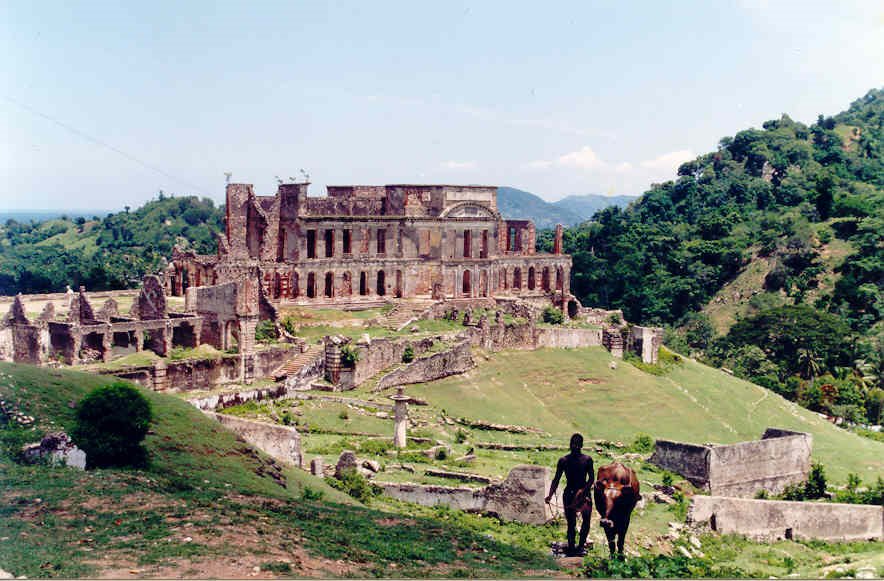
Michel-Rolph Trouillot's "The Three Faces of Sans Souci" takes the Haitian ruins of Sans Souci as a case study for his investigation into historiography and the "silencing of the past." What's interesting is that he regards the ruins themselves as both complicit in this silencing and as a form of resistance against it.

Sans Souci refers, in the first instance, to the lavish palace built by Henry Christophe, self-styled post-revolutionary King of Haiti (or rather, the north of the country) in the early nineteenth century. In the second instance, it refers to another palace of the same name, built a few years earlier by Prussian Emperor Frederick the Great in Potsdam, near Berlin. Finally, Sans Souci was also the name of a now almost forgotten Haitian revolutionary who had, in fact, been put to death on Christophe's orders.

Trouillot's argument is that the Haitian palace is named for Christophe's former rival, in order both to establish and to extirpate his memory. On the one hand, "Henry killed Sans Souci twice: first, literally, during their last meeting; second, symbolically, by naming his most famous palace Sans Souci . . . [which] erased Sans Souci from Christophe's own past, and it erased him from his future." On the other hand, "Christophe may even have wanted to perpetuate the memory of his enemy as the most formidable one he defeated" (59). However, now that it is generally assumed that the source of the name was its German precursor, even that original silencing is itself silenced and the revolutionary Sans Souci effectively disappears from history. The final result is "an erasure more effective than the absence or failure of memory, whether faked or genuine" (60).


Yet Trouillot also suggests that acts of erasure such as Henry Christophe's are "silences of resistance, silences thrown against a superior silence," specifically here the silence "which Western historiography has produced around the revolution of Saint Domingue / Haiti." In this context the now "crumbling walls" of the former palace "still stand as a last defense against oblivion" (69). They recall at least one move in the internecine strategies played out among those who led the Haitian revolution, disrupting both the heroic narrative preferred by Haitians themselves, and also the broader attempt to portray the revolution as some kind of non-event.

Finally, Trouillot further argues that history is necessarily incomplete, and so warns against the hyper-empiricist fantasy that "an enlargement of the empirical base" will necessarily lead to "the production of a 'better' history." No: "Silences are inherent in history because any single event enters history with some of its constituting parts missing" (49). As such, history is always a collection of ruins; it is history itself that is, at root, ruined in advance.

Tuesday, January 13, 2009

declassification

Cartas mapuche coverA brief note. In Chile in December, thanks to Rodrigo Naranjo, I came across the work of the Laboratory of Declassification. Rodrigo also introduced me to Jorge Pávez, who kindly gave me a copy of his book, Cartas mapuche: Siglo XIX, which is in large part an outgrowth of this declassification project. The book is to be formally launched on Thursday; on the off-chance I have any readers in Chile, I urge you to attend.

Jorge has written a very interesting introduction to the volume, which I hope to comment upon at some point. And Rodrigo was quite insistent that Posthegemony was merely a new Latin American cartography (to return to such topological metaphors) or, I suppose, a restratification. I'm not convinced about that, or that in fact declassification doesn't inadvertently fall into a similar trap: isn't every declassification also necessarily a reclassification, too?

However, and again in light of the fact that subaltern studies qua subaltern studies never in the end produced very much in the way of redescriptions, let alone historical redescriptions, of Latin America, perhaps declassification is the true inheritor of the subalternist project?

Link: The Laboratory also has a blog which, although it has not been updated for some time, has some interesting texts, including by people such as Federico Galende.

Wednesday, June 18, 2008

substratum

Constituent power is continuous and everyday. Appearances, however, are deceptive: in appearance, constituent power emerges only in moments of crisis, in the transition from one political order to another, soon thereafter to disappear. As Negri notes, "once the exceptional moment of innovation is over, constituent power seems to exhaust its effects" (Insurgencies 327).

The normative regulations of constituted power are more familiar than is the uproarious intensity associated with constitutional assemblies, when constituent power is glimpsed in full force as it intervenes decisively on the political stage. But for Negri, this "appearance of exhaustion" is simply "mystification"; in fact, "the only limits on constituent power are the limits of the world of life" (327, 328).

Constituent power "persists": once a constitution is declared, it goes underground; unseen, it continues to expand until it erupts once more to interrupt constituted power, forcing drastic changes in social relations. Capital responds with a series of class recompositions that it presents as natural; the state reacts with periodic refoundations that it presents as simple renegotiations of some original social pact.

At each stage, the multitude is beaten back, temporarily defeated, "absorbed into the mechanism of representation" (Insurgencies 3) and so misrecognized as class, people, mass, or some other docile political subject. But even such misrecognitions, Negri claims, signal an "ontological accumulation" (334). Being itself is transformed through the "continuous and unrestrainable practice" that is the multitude's everyday, permanent revolution (334).

A focus on constituent power, then, rather than on the different forms taken by constituted power, opens up "a new substratum" of history, "an ontological level on which productive humanity anticipate[s] the concrete becoming, forcing it or being blocked by it" (232).

Sunday, March 02, 2008

perpetual

More on Roa Bastos's Yo el supremo...

History

"En cuanto a mí veo ya el pasado confundido con el futuro" (369)

I the Supreme is a historical novel in more than one sense of this phrase. In the first place, it is a novel set in the past: Roa Bastos has chosen to write about a figure who had been dead over a century by the time of the book's publication. In this sense (and not unlike even the "pulp fiction" of, say, a Catherine Cookson) the novel functions to animate or dramatise--bring to life or "make real"--a period with which its readers will have no direct experience. Historical fiction works (and finds much of its justification) because of the way in which the license allowed to the novelist enables him or her to fill in the gaps left the historical record, to give us some imagined sense of what it must have been like to live in a particular epoch or now past period by giving us the emotions, voices (often interior or psychological) voices and motivations that have not survived in the archive of historical documentation. Here, the historical novel points to and makes use of the deficiencies of other forms of history.

Second, however, this novel also quotes and uses these same historical sources; it is not merely set in the past, it also provides us with excerpts from many of the kinds of documents that professional historians also use to shed light on the actual events and figures that it also treats fictionally. Often therefore we are presented both with a fictionalized version of situations or happenings and (by means of the footnotes, a device more usually found in texts that are thought to be factual) also a version of those same situations as they have been recorded in documents, letters, and publications of the nineteenth century. On several occasions these different accounts seem to contradict each other: to be more precise, the "compiler" presents the historical record as a correction to the account that is presented in the voice of the Supreme. Here, the novel would seem to be pointing to the deficiencies of either memory (if we take the Supreme's narrative at face value as a remembrance of incidents in which he has played a part) or fiction itself.

Third, then, this is also a novel that thematizes history as one of its key concerns. This thematization takes place on a number of levels, one of which involves the way in which the Supreme (above all in his "perpetual circular," an ascription that also has something to say about the writing of history) narrates the historical foundation of the Paraguayan republic, and his role in the construction of the nation, in part to justify and legitimate his own hold on power in the (novel's) present. At the same time, prompted by the reminder of his mortality that opens the story (the "historia" in Spanish), the Supreme is also concerned to establish a sense of his legacy to the country. Hence there is a concern with history as it is written (and as it is therefore perpetuated), as opposed to history as it is (mis)remembered in an oral tradition. The novel thus repeats (or mirrors) on another level some of the concerns that we have also seen shared by the compiler, that is, the difference between memory (or myth) and written, documented, history.

Finally (though there is as always much more that could be said), the novel is historical in the sense that it was written at a particular historical conjuncture (now over thirty years past), that is, the epoch in which dictatorial or military regimes ruled in many Latin American countries, not least Paraguay (under Stroessner), and at a point when Argentina (where the book was written) was also about to be subject to the military coup of 1976. We can therefore read the book in the light of the historical context of its production--as well as the context of a literary history for which, some argue, this is the last great modernist novel of world literature (or the first great postmodernist novel of Latin American literature).

Wednesday, December 12, 2007

Vilcas

I mentioned this paper some time ago, but I realize that I never uploaded it. Here goes...


Having some time to spare in Vilcashuamán, Ayacucho, highland Peru, I climbed the pyramid that looms over the small town. Vilcashuamán (also known simply as Vilcas) was once a significant Inca cultural and administrative center, occupying a strategic location at the crossroads of the various trade routes that crisscrossed the Inca empire: it was the point at which the road from Cuzco to the Pacific met the Empire’s main North-South highway. Moreover, according to Spanish chronicler Pedro Cieza de León’s reports of native accounts, the town was at the geographical midpoint of the Tawantisuyu, the Inca Empire: “for they state that it is the same distance from Quito to Vilcas as from Vilcas to Chile, the limits of their empire” (126). But Vilcas is now a town full of ruins--though one might also say that the place is a set of ruins that enclose a town, as it can be hard to say where the ruins end and the town starts, and vice versa. Houses and shops nestle up against or are perched upon Inca walls and stones, and are themselves made of this same recycled material. As a result, the site is, in Gasparini and Margolies’s words, in an “advanced state of destruction and deformation” (112). It remains, however, undeniably impressive, in part because here you are everywhere up against and on top of the ruins, like it or not. There is no measured distance between contemporary life and sacrosanct historical artifact: no ropes, no fences marking off the museal from the everyday. The ruins of Vilcashuamán are fully if sparsely inhabited; they show no signs of their exceptionality. In John Hemming’s words, conjuring up a scene of desolation, “Vilcashuamán is now a small village, remote on its hill-top, perched on the ruins of the great Inca city whose temples have been pillaged for building blocks, and surrounded by rolling, hilly country with few trees and little population” (Monuments of the Incas 187). History seems to have passed it by, to have set it free from whatever stories it once inspired. Certainly, when I had been taken to Vilcas for the day, with a group of anthropologists and aid workers, I had had no idea I would end up climbing a pyramid.

Vilcashuaman
Indeed, these are in no way the most famous ruins in Peru, and are far from being the most visited, meriting at best a couple of lines in the guidebooks. Rather, that honor goes to Machu Picchu, now perhaps South America’s foremost tourist attraction, which attracts around 450,000 visitors a year, up to 2,000 a day. Machu Picchu stands synecdochically for Peru, and often enough for Latin America as a whole. Arguably, Machu Picchu is a more “modern” set of ruins, being “discovered” (better, invented) only in the early twentieth century, with Hiram Bingham’s Yale-sponsored expedition of 1911. Bingham was fêted for having discovered the “lost city of the Incas.” That claim, however, rings rather hollow when it is realized not only that it was a local tavern proprietor and landlord, Melchor Arteaga, who led him to the site “with the promise of a whole silver dollar,” but also that Bingham himself noted graffiti on the stones: “the name, ‘Lizarraga,’ and the year, ‘1902’” (Alfred Bingham 6, 13). Bingham gave this Lizarraga credit for the “discoveries” in his first book about the expedition, Inca Land; yet by the time of his later account, Lost City of the Incas, Lizarraga’s name disappears (Alfred Bingham 26). Meanwhile, Bingham’s opinion of indigenous knowledge can be inferred from his own comment that “readers of Inca Land will remember that Professor Harry W. Foote and I had often been obliged to add, when discussing reports of ‘noteworthy and important ruins’--‘but he may have been lying’” (Hiram Bingham 10). He observes that the local campesinos do not mark the ruins in any particular way: “Presumably, to him and his kind, Inca ruins of temples and palaces built by their remote kindred are not in themselves interesting but merely evidence that the latter found the land worth occupying and cultivating” (10). In this sense, Bingham’s achievement was to put Machu Picchu into discourse: to articulate its stones, to make them speak in the recognizably modern idiom of ruination.

This, then, is where Vilcashuamán is different. For the ruins of Vilcas have, without entering the narratives of international tourism, and despite not being excavated until the 1980s, a much longer history of being repeatedly articulated and rearticulated to competing stories about Peruvian modernity, from almost the very moment of Spanish conquest and so their initial fall into ruin. We might therefore say that Vilcas is more eloquent about Peru’s modernity than Machu Picchu, especially now that the latter has assumed the status of a brand, a signifier almost without content--like the Nike swoosh or McDonalds’ golden arches. Machu Picchu says “Peru,” or says “Latin America,” but says almost nothing about these places. By contrast, in the to and fro of the conflicting versions of what Vilcas’s ruins might be made to say, a whole series of narratives have been advanced about historicity and hegemony, modernity and, more to the point, the (still essentially modern) lament that Peru has failed to become modern. Mario Vargas Llosa notoriously opens his monumental novel Conversation in the Cathedral with the question “At what precise moment had Peru fucked itself up?” (3). We might not know when; but it would not be far-fetched to argue that Vilcashuamán is a contender for a precise place where Peru fucked itself up. It is a place marked by the series of interruptions that, for a writer such as Vargas Llosa, indicate the fuck-ups that have (he would claim) stalled progress towards modernity. Interruptions, symbolized or, better, materialized in the strewn stones of the former Inca edifices, that have served as fissures within which variously confident, wistful, and messianic narratives have sought firm footing, like weeds in the dirt. Yet these interruptions have also, in almost the same moment, brought these stories to their own ruination, their disarticulation.

Read more... (.pdf file)

Tuesday, April 24, 2007

historicity

More...

Belief is a matter of the body: "To speak of 'ideologies' is to locate in the realm of representations [. . .] what in fact belongs to the order of belief, that is, to the level of the most profound corporeal dispositions" (Practical Reason 55). It is also therefore immediate. Bourdieu adapts and radicalizes Pascalianism. If for Pascal, belief arises from corporeal dispositions, for Bourdieu it is located in those dispositions themselves, and needs never rise to consciousness. Though praising Pascal's challenge to "all those who insist on seeing belief in terms of representations" (The Logic of Practice 49), Bourdieu argues that Pascal maintains a pre-eminence of consciousness over practice, "as if will and consciousness were the basis of the disposition which 'with no violence, art or argument makes us believe'" (49). For Bourdieu, however, dispositions are always primary: "what is essential goes without saying because it comes without saying" (Outline 157; emphasis in original). There is no prior decision, and so no wager. Institutions work directly on the body; social order produces no rationale so long as it needs none, and "the principles embodied in this way are placed beyond the grasp of consciousness" (94). Everything begins and ends at the level of the corporeal, as we are habituated to subjection. We are steeped in doxa, "the relationship of immediate adherence that is established in practice between a habitus and the field to which it is attuned, the pre-verbal taking-for-granted that flows from practical sense" (The Logic of Practice 68). Despite its immediacy, however, there is always some slippage between habitus and social order. Something always escapes. For as a deposit of the power relations that structure a given social field, habitus is always a residue, an embodied memory of a previous state of that field. And because fields are always in flux, in that their contours are determined only in the course of a permanent struggle between social agents and their continual position-takings, habitus and field are never fully synchronized. Hence the historicity of habitus, or rather what Bourdieu terms its "double historicity" in that it is both the product of history and the force that, by generating practice, produces history (Invitation 139; see also Outline 82). More fundamentally still, habitus generates time itself, for "time is what practical activity produces in the very act whereby it produces itself. [. . .] Time is engendered in the actualization of the act" (Invitation 138). History and time, in short, are also fully immanent: "the theory of practice condensed in the notions of field and habitus allows us to do away with the metaphysical representation of time and history as realities in themselves, external and anterior to practice" (138).

The historicity of habitus secures social reproduction, but also and at the same time allows for the possibility of resistance. It is because the practices it generates express dispositions structured by a previous state of the field, that habitus provides the continuity that ensures that historical structures are reproduced in the present. But the encounter between dispositions shaped by history and the field in its current state, and the inevitable slippage between the two, makes for unpredictable effects and so the possibility of a new history. Habitus ensures resonance, but also leads to dissonance. Hence the "hysteresis effect necessarily implied in the logic of habitus," which means that "practices are always liable to incur negative sanctions when the environment with which they are actually confronted is too distant from that to which they are objectively fitted" (Outline 78). Hysteresis can account for missed opportunities, for clumsy or unsuccessful practices by which an individual or group confirms, despite themselves, their social decline. Equally it can provide an embodied memory that serves as a resource or resistance, just as Paul Gilroy argues that the "structures of feeling which underpin black expressive cultures" derive from embodied memory both of "the once forbidden drum" and of "a terror which has moved beyond the grasp of ideal, grammatical speech" (The Black Atlantic 77, 76, 71). In either case, the gap that arises in the slippage between embodied structures and actual practices opens up a time for strategy. It is the strategic aspect of practice that means we can speak of a social game: though the playing field is never level, structured as it is by symbolic domination and unequal distributions of capital, still the result of each move is always partly in doubt. Time enables strategy, which in turn depends upon timing. As Bourdieu observes in his analysis of gift exchange, what counts is not some transcendent structure or invariable rules, but "the tempo of action" and "the interval between actions," such that a successful outcome is guaranteed only by the skilful management of time, by acting neither too precipitately nor too late (The Logic of Practice 106).

Wednesday, February 21, 2007

trek

My institution has taken the notion of a "trek" as the organizing metaphor for its mission statement and medium to long-term goals, appealling thereby to a previous "refoundation," a 1922 student-led demostration "now known as the Great Trek".

UBC Great TrekStrictly speaking, the university had been founded in 1908 with the passage of the relevant Act of establishment and incorporation. Shortly thereafter, a site for the new university was identified: Point Grey, a promontory on the outskirts of the city. But when in 1915 the university opened for business, it was in the city itself, as construction continued at the promised site of Point Grey. Then in October 1922, some 1,500 students made their way from downtown to Point Grey, occupying and hanging banners from the still incomplete buildings, "as a symbolic gesture to lay claim to the unfinished campus". It is this demonstration that came to be known as the "great trek." And in 1925 the Point Grey campus finally opened.

But to call this a "trek" is curious terminology. Indeed, if the word was used in 1922 to describe student claims to Point Grey, it would antecede by almost twenty years the OED's first reference to "trek" being used outside of Africa.

For "trek" is a South African word, and any mention of a "Great Trek" in 1922 could only invoke the Boer founding myth of the Great Trek of 1835 to 1838. This was "a landmark in an era of expansionism and bloodshed, of land seizure and labour coercion": up to 12,000 Afrikaners, Dutch settlers living in the Southern Cape under British jurisdiction, hitched their wagons and headed North and East in search of their very own "promised land." These "Voertrekkers" thereby also sought to secure the white dominance and racial separation that they felt British policies were underminding.

Battle of Blood RiverThe Trek's key episode was the Battle of Blood River, in which 3,000 Zulu warriors were killed at the cost of only slight injuries to three of the Boers. The Trekkers took this as "a sign from God that they were indeed a chosen people". In 1949 the Apartheid state inaugurated the Blood River monument at the site of the battle, and the Voortrekker Monument in Pretoria, symbolic legitimation for a nation built on the myth of racial superiority incarnated in the trek and its triumphal massacre.

Surely then these same resonances of a chosen people's resistance to a colonial authority felt to be insufficiently expansionist would also have been in the air in 1920s British Columbia?

Point Grey has been, we are also told, "home to the Musqueam band since 'time immemorial'". At the turn of the twentieth century, to identify the land as some rural Arcadia full of natural splendour and the requisite peace for higher education and learning was necessarily also to erase an entire history of indigenous population and colonial dispossession.

But the repressed always returns. The decidedly unusual choice of the term "Great Trek" marks the coincidence and commonality between the aims and desires of two sets of white colonizers, each anxious to construct for themselves the idea of a "promised land" in the face of indigenous resistance on the one hand, and what was felt as bureaucratic accommodation on the other.

One might also wonder what metaphoric or symbolic work the term's contemporary resurrection accomplishes.

Sunday, April 09, 2006

american

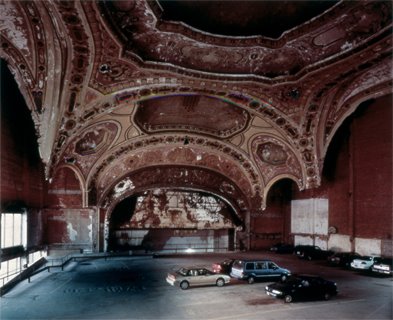
Sans SouciI have discussed ruins before, and one of my side projects is a book on what I call "American Ruins." The idea is to analyze a number of exemplary but rather different ruins from this hemisphere: Vilcashuamán, Peru; Sans Souci, Haiti (which is the image to the right); the Michigan Theater, Detroit (at the bottom of this post); Pino Suárez metro station, Mexico; and the Ochagavía hospital, Chile.

Just now I'm finishing up a paper that focusses on the first of these, Vilcashuamán. Here are the first couple of paragraphs of that paper, outlining the conjunction between American-ness and ruination. (Post-9/11 there are others, of course.) Sadly, Scott won't like the last line. But there we go...

There is no such thing as an ancient ruin, for the ruin is always a modern concept. Ruination and modernity go hand in hand, as the modern displaces the ancient, marks it as irredeemably part of the past precisely by construing it as ruined. Ruins are the site of what has been put behind us. But at the same time they remain front and center: for modernity occasions a sometimes anxious reflection on the conditions and effects of “progress,” on this process of temporal displacement for which the ruin serves as a memento mori. Modernity creates the ruin as something both to be discarded and also to be read, obsessively. We moderns construct and interpret ruins as judgment on the past and warning for the future. “Men moralize among ruins,” observed Benjamin Disraeli, “or, in the throng and tumult of successful cities, recall past visions of urban desolation for prophetic warning. London is a modern Babylon; Paris has aped imperial Rome, and may share its catastrophe” (138). A sign of modernity’s success and vitality is that past civilizations are in ruins all around; but they remind us that there can be no guarantee that today’s proud edifices will not, in turn, fall to rack and ruin. Ruins demonstrate that whole cultures, just like the lives of mortals, are transient. Hence they are invented by cultures that feel their own transience. And no culture feels more transient than the American.

Though the Americas have long been envisaged as the “New World,” and despite Goethe’s assertion that “America, you have it better / Than our old continent; / You have no ruined castles / And no primordial stones” (qtd. Lowenthal 110), in fact the hemisphere has more than its share of ruins. This should be no surprise: modernity was after all abruptly conceived in the encounter between Old and New Worlds, and built upon the ruins of the civilizations first encountered by the Spanish conquistadors. The traces of imperial grandeur are now themselves ruined, and where there are no ruins easily to hand, they have often enough been built from scratch or substitutes have rapidly been found. From Hearst Castle or campus gothic to the dinosaur bones patronized by tycoons such as Andrew Carnegie, as the US became the dominant world power at the end of the nineteenth century and in the first decades of the twentieth, it increasingly sought out its own ruins. Frequently, those ruins were south of the border: this was also the heyday of a burgeoning archaeology, and the discovery of “lost” cities in rainforests and remote valleys the length and breadth of the continent. Today, ruins are big business (Tikal, Tenochtitlan), even as big business leaves its own ruins behind (from the Rust Belt to reclaimed factories).

Michigan Theater
The Michigan Theater, Detroit, photograph by Stan Douglas

Wednesday, March 01, 2006

multitudes

multitudeOne, two, many multitudes?

Michael Hardt and Antonio Negri emphasize the singularity of the multitude. To speak of many multitudes would be no more than a concession or a gesture towards liberal humanism: you have your multitude, we have ours, let a thousand multitudes bloom.

No, they insist, there is but one multitude, though that multitude is composed of multiplicities. For if the multitude is already multiple, then it is at best a tautology, at worst a distortion, to pluralize it, to speak of many multitudes.

But how many multitudes are there in Hardt and Negri's own work? And are they compatible? An enumeration is in order.

First, there is the multitude still to appear. It's this multitude that's the focus of the book Multitude. The multitude that is, now, perhaps emergent with the rise of affective labour, with Empire and the exhaustion of concepts such as the popular or class. This multitude is a "coming community" (as Agamben might put it). Its arrival is the horizon or history. Better, its arrival would mean the end of history, the inauguration of Communism.

Second, however, there is the multitude that made its first appearance at the birth of modernity. This is Spinoza's multitude, the multitude associated with the rise of capitalism and the disputes that fractured early modern political philosophy. This is a multitude whose intemperate appearance was soon overcoded by the contrasting notion of the popular. It's in this sense that Paolo Virno can tell us that we are now in a new sixteenth century, replaying the struggle between multitude and people, Spinoza and Hobbes, that had earlier been resolved, albeit temporarily, in favour of the people.

Third, then, there is the multitude as remnant and subterranean presence throughout modernity. For the historical multitude could not be so easily dispatched, and it reappeared at every time of crisis and rebellion. This is the multitude of Negri's Insurgencies, that rises anew with the English, French, American, and Russian Revolutions, only each time to be (ever more precariously) repressed by the new Thermidors that win out.

Fourth, as a consequence, Negri can suggest an ontological multitude. Beyond these occasional appearances, the multitude is the ground of modernity and social cohesion tout court. This is the multitude that we can identify fully with constituent power. It's a multitude always at work, but actualized in other, distorted, forms according to the regime of constituted power of the moment.

But in the slippage between constituted and constituent power, is there not a fifth multitude? A multitude that forms and coalesces along the lines of flight within each and every social formation? A multitude then that is sociological, incarnated in piracy, in everyday life, in Temporary Autonomous Zones, in the quotidian refusals and resistances by which we make our lives bearable. This multitude is actual, rather than simply virtual. We already share in and participate its activity.

So, a multitude to come. A historical origin. A periodic irruption into history. An absolute ground. The very fabric of the everyday.

Again, are these all one and the same multitude?

[Update: Now go read Nate's thought-provoking response to this post.]

Wednesday, November 09, 2005

otaheite

Spurred on by Le Colonel Chabert, here are some thoughts I wrote up a little while ago about Caroline Alexander's The Bounty: The True Story of the Mutiny on the Bounty...

At the end of it all, the most interesting thing that emerges is the extent to which the mutineers (but not just the mutineers) were affected by their five-month stay in Tahiti (Otaheite as they called it), picking Breadfruit prior to the voyage home. Allegedly (and on this, as on much else, there's much dispute) as they sailed off from Bligh and his loyalists after the mutiny, they called out "Huzza for Otaheite!" This has been disputed by those sympathetic to Fletcher Christian et. al., who wish to suggest that their motive was not to return to the easy life (and easy sex) of the South Pacific, but to rid themselves of Bligh's tyrannical authoritarianism. But why should the two be mutually exclusive?

Or even, why not revolt for something better, rather than merely against something worse?

Otaheite
Moreover, and pace Alexander's refrain as to how much the Europeans tainted and finally destroyed the Pacific paradise (introducing sexually transmitted diseases, but also the general strife and possessive individualism of Western ways), what's really remarkable is the extent to which the Europeans were themselves affected or even infected by Tahitian custom and culture.

It seems that the Bounty's crew would frequently converse in the Tahitian language, and indeed one of the (convicted, but pardoned) mutineers, Peter Heywood, spent most of his time awaiting what he thought would be execution writing up a dictionary of the language. Another mutineer, James Morrison, devoted "nearly half" of the 382-page book that was his account of the voyage and defence of his actions to "Tahitian culture and customs, geography and natural history. [. . .] The work is an extraordinary and valuable document of Tahitian life as it had been before the coming of the Europeans, and would never be again" (335).

Well, yes, Tahiti was irrevocably altered; but so were these Europeans, and perhaps also Europe as a whole. Alexander's main argument (in so far as she has one, in the morass of description) is that the Bounty story struck home so because it occurred at the cusp of Romanticism, and Christian stood as "the perfect Romantic hero" at "the dawn of this new era, which saw devotion to a code of duty and established authority as less honourable than the celebration of individual passions and liberty" (344, 345).

From this perspective, the Bounty story revolves less around the power relations between master and crew, though that is how it has been read, in terms of whether or not Bligh deserved to be overthrown; rather, it's more about the possibility of "going native," a possibility that carries with it the germ of what will become Romanticism.

Thursday, September 29, 2005

Arrighi II

Giovanni Arrighi's "Hegemony Unravelling 2" is, frankly, rather disappointing. I commented on "Hegemony Unravelling 1" in an earlier entry. This second installment continues the argument that US global dominance is in terminal decline, and compares the end of this particular capitalist "spatial fix" with the successive declines of Genoa, the United Provinces, and Great Britain, each of which anchored earlier "cycles of accumulation."

Unlike Hardt and Negri, however, who likewise claim that the current global system is shortly coming to an end, Arrighi believes that it will merely be superseded by a new system, this time with China in the driving seat: just as the US was the beneficiary of European wars in the first half of the twentieth century, so it is "China" that is "the real winner of the War on Terrorism" (115).

But as for "whether this 'victory' can translate into a new global spatial fix and what such a fix will look like" (115), Arrighi declines to elaborate. He has even less to say about the "less violent and more benevolent alternatives" that he invokes in his article's dying breath (116).

Meanwhile, of hegemony in the Gramscian sense of order secured through consent, all Arrighi adds is the notion that the US has, since Vietnam, moved from offering protection against real external threats to operating a "protection racket" that provides security only from threats (real or imagined) that it itself generates. Hence states such as Japan and Germany, acting as rational actors in the global game of fiscal and political trust, have withdrawn their support from US overseas adventures, leaving the global hegemon for the first time to shoulder the military, political, and economic costs of its imperial project: "the failure of George W. Bush to make US clients pay for the second Iraq war [. . .] can be taken as a sign that by then the United States had lost both hegemoney [i.e. the ability to extort tribute] and hegemony [i.e. legitimacy]" (112).

The rise and fall of empires obeys, for Arrighi, the logic of some profound universal and transhistorical set of laws. There's precious little room here for agency on the part either of the dominant or the dominated. Occasionally it is suggested that Bush's neoconversative team made mistakes, for instance by "pushing" the American protection racket "too far" (113), but really it hardly seems to matter as, Arrighi suggests, US decline is as inevitable as, in retrospect, was the sun setting on the British Empire a century or so ago.

And as for the notion that subalterns (the proletariat, the Third World, or whatever) might become historical actors: well, Arrighi seems to be saying, forget about it.

Monday, September 19, 2005

parables

wood s lot points us to Jeremy Ravi Mumford's "The Inca Priest on the Mormon Stage", an interesting essay on Mormonism, nineteenth-century indigenism, and images of Inca society. Mumford shows how the early Mormon leader Brigham Young acted out his religion's claims to respectability through a performance of Incaism.

This in the context not merely of familiar elegies for the vanished noble savage, but a more particular construction of Inca society befitting US (and Mormon) self-imagination:
An Enlightenment revival of Hispanic scholarship had made English-speaking readers familiar with the Inca Empire as a profoundly alien society, yet one that was in many ways admirable. The Inca, according to much of this literature, were authoritarian in their politics but that authoritarianism produced admirable order and happiness. The success of Sheridan’s Pizarro in 1799 created a new wave of interest in the Incas among English speakers. The next year saw the publication of a children’s dialogue about the Incas, with lines such as: "Excellent people! Who can avoid respecting them?"
Of course, it should come as no great surprise that the Incas have also been eulogized, not least by the great early twentieth-century Peruvian Marxist José Carlos Mariátegui, as incarnating a form of primitive Communism. Indeed, of all pre-Columbian societies, the Inca Empire offers most ideological malleability: I don't think that quite the same range of claims has been made for the Aztecs, for instance.

What struck me about Mumford's essay, however, is that there really is something to the comparison between Incas and Mormons, in this if no other regard: both are groups upon which social parables are played out with remarkable frequency.

Take Jon Krakauer's Under the Banner of Heaven, a book for which a murder in American Fork, Utah, provides the canvas on which to assay quasi-philosophical conjectures about "violent faith" and, indeed, the nature of life itself:
If I remain in the dark about our purpose here, and the meaning of eternity, I have nevertheless arrived at an understanding of a few more modest truths: Most of us fear death. Most of us yearn to comprehend how we got here, and why--which is to say, most of us ache to know the love of our creator. And we will no doubt feel that ache, most of us, for as long as we happen to live. (341)
As befits a writer on mountaineering, Krakauer has long "yearned" to say something about death, violence, and sublimity, and it's in Mormonism that he feels he's found a suitable subject, whereas for instance the autobiographical reflections framing Into the Wild were rather forced onto a tale of Boy's Own anomie gone wrong.

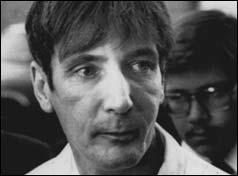
Gary GilmoreBut Krakauer's book pales beside the granddaddy of them all, Norman Mailer's epic The Executioner's Song, which tracks the movement from petty thievery to careless murder to the point at which judicial execution became once again enshrined as apex of the American way of life (and death). Mailer shows how, despite the best efforts of liberal organizations such as the ACLU, Gary Gilmore summoned forth the new authoritarianism, a new "admirable order."

The thousand and more pages of Mailer's door-stopper cast this drama of, first, robbery and killing and, then, lawyering and killing, as "Eastern voices" responding to "Western voices."

And the West to which the East responds, the West that shapes the neo-conservative constitution of order through firing squad, electric chair, and lethal injection, is the West of Provo, Spanish Fork, and Salt Lake City, the West of Mormonism, the West to which Brigham Young led his people in transcontinental Exodus.

Friday, August 05, 2005

more piracy

This is mostly a placeholder.

A blog by the name of Organic Warfare has two recent entries on contemporary piracy and insurgency: Piracy in the Malacca Straits and Piracy and the Global Insurgency.

"Organic Warfare" states that "modern pirates are now using tactics similar to terrorism to capture ships and goods." By contrast, of course, I'd suggest that the relation is inverse: it is the terrorists who are the inheritors of piracy's historic tradition. Which does not preclude feedback and cross-contamination between the two forms of activity.

UPDATE: John Robb of Global Guerrillas (I'm not sure what the relation is between his two blogs) points to an article in the Sunday Herald on private navies, also in the Malacca Straits.

But as I point out in my comment on Robb's entry, the irony is that "private navies" are far from being "a radical new solution." After all, "privateers" were, precisely, private military forces that flourished before the nationalization of naval warfare. So from privateers to pirates, and back to privateers...