 Ugh.
Ugh.
Showing posts with label race. Show all posts
Showing posts with label race. Show all posts
Saturday, February 05, 2011

Wednesday, February 02, 2011
Asian
After a fun class yesterday on Neruda, in which students acted out Poem 15 from Veinte poemas de amor and then wrote letters or poems to the poet from the point of view of the woman or women he addresses (my favorite: "¿Pór que no te callas tú de vez en cuando?"), I was extolling the virtues of UBC undergraduates to some friends.
As further evidence, my buddy Alec mentioned the following video, produced by a UBC class in response to a now somewhat infamous article in Maclean's arguing that Canadian universities are "too Asian":
For more, see Tetsuro Shigematsu's account of the making of the video, "Too Asian?", and Brian Lamb's take, "Is UBC 'too Asian'? Let’s sing and find out".
As further evidence, my buddy Alec mentioned the following video, produced by a UBC class in response to a now somewhat infamous article in Maclean's arguing that Canadian universities are "too Asian":
For more, see Tetsuro Shigematsu's account of the making of the video, "Too Asian?", and Brian Lamb's take, "Is UBC 'too Asian'? Let’s sing and find out".
Saturday, May 01, 2010
bigot
 Well, yes, she is a bigot.
 As Milena Popova points out (but sadly precious few others), what Gillian Dufffy said was indeed unacceptable.
Indeed, Duffy herself knows it. Here's the interesting thing: she presents her xenophobic comments as though she were bravely speaking out in the face of some tyranny of political correctness:
You can't say anything about the immigrants because you're saying that you're... all these Eastern Europeans what are coming in, where are they flocking from?Presumably the ellipsis here indicates that "you can't say anything" about immigration because (surprise surprise!) you'll only be accused of racism.
Sadly, however, "Bigotgate" proves the opposite.
Gordon Brown can only point out anti-immigrant bigotry in what he assumes to be the privacy of the back seat of his campaign car. And when it turns out that this candid moment was overheard by Sky News's microphone, he cravenly apologizes (first on air, then in person) rather than simply making the point more eloquently and forcefully in public than in private.
Meanwhile, once again in the leader's debate Brown competes with Cameron to present himself as more forcefully against immigration even than Clegg's tepid proposal for a regional points-based policy and the occasional amnesty.
It is as though the BNP and the Daily Mail had fully succeeded in setting the agenda on immigration. For some reason it is now impossible, except (supposedly) discreetly and in private, to point out the everyday bigotry that blights British public discourse.
This is a craven capitulation by a political class that should and (as Brown's indiscretion shows) actually does know better.
And it foments a strangely unabashed xenophobia that hesitates only briefly to announce itself, like a nervous tic, before continuing on regardless: "I know this is racist, but I'll say it none the less and I dare you to correct me..."
Monday, March 01, 2010
celebration
It's three in the morning, many hours after the Winter Olympics came to a close and (more to the point) long after Sid "the Kid" Crosby scored the dramatic overtime goal that gave Team Canada its final, and most dearly coveted, gold medal by beating the USA at (ice) hockey.
Yet even now I can hear the shouts and celebrations on the streets of downtown Vancouver below my apartment window. And I don't even live that close to the epicenter of the extraordinary street party that broke out as soon as that puck entered the net. The celebrations are no doubt in full swing on Granville and Robson Streets, some six or seven blocks away.
In the afternoon and early evening, the so-called Granville Entertainment District and nearby Robson Square were mobbed with thousands of mostly red-and-white clad revelers, chanting "Go Canada Go" or "Crosby, Crosby, Crosby," giving each other high fives and hugs, ringing cowbells and hooting horns, climbing lampposts and bus shelters, and bursting into impromptu renditions of "O Canada!"

This notoriously reticent and self-effacing country has perhaps finally learned the trappings and gestures of nationalism. Of course, Canadians have always quietly considered themselves superior; but the emphasis has been on the quiet sense of distinction. Indeed, the exuberant displays of pride visible over the past few hours would previously have been considered to be precisely the kind of gauche jingoism that Canada had associated with other, more vulgar and less civilized nations.
So one consequence of all the flag-waving and chanting is that Canadians may be a little less smug in the future: they've shown that they can be just as blindly patriotic as (say) their neighbors to the south. As they become more ostentatiously Canadian, they undermine that sense of entitlement that comes precisely from the notion that "ostentatious" and "Canadian" are two words that don't really belong in the same sentence.
The more visibly Canadian they become, the less "Canadian" they actually are.
And perhaps it's for this reason that so many of the most visibly and audibly frenetic of the revelers were the so-called "new" Canadians, the relatively recent immigrants (and their children) from China, Japan, India, and so on.
Vancouver is, after all, an extraordinarily multicultural city; about 40% of its inhabitants were born outside of Canada, most of whom come from Asia though with a significant proportion also from places such as Southern or Central Europe. And yet there are times when this is not so obvious: the various ethnic groups are parceled out around the city and a huge number of Chinese Canadians, for instance, live and work in suburbs such as Richmond, just to the south.
Yet it was clear that very many of the crowds who poured across the bridges (some of which were soon closed to vehicular traffic because of the sheer numbers of pedestrians) to get to the downtown peninsula came from precisely these outlying suburbs.

I wonder if this is because painting your face with a maple leaf or waving the flag from a hockey stick is a form of nationalism that is more available to new immigrants than the rather more insidious distanced self-regard that has hitherto characterized Canadians' sense of themselves. It is a habitus that can more easily be picked up or (better) incarnated, whatever one's background or skin color.
In any case, with the Olympic celebrations, and with the multitude that packed its thoroughfares to shout and holler, Vancouver city center felt distinctly less white than it does on a regular business day.
And it is certain that the experience of the Olympic Canada (literally) on the streets was much more multiracial than the image presented by either the opening or the closing ceremonies, both of which gave us only a tokenism towards First Nations as a flimsy cover for an otherwise overwhelmingly white and European depiction of the country. (As many have pointed out, for instance, there was no official recognition at all of Asian Canada during the opening ceremony held in this most Asian of Canadian cities.)
Almost four years ago, and while recognizing all the legitimate critiques of this over-commercialized festival brought to us by Coke and Visa, I asked "why not rescue something of the (perhaps utopian) commonality that still resides in the Olympics, rather than, inaccurately, damning them as simply another set of enclosures?"
It seems to me that we have indeed seen some of this utopian commonality in action on the streets of Vancouver over the past couple of weeks, albeit (ironically) ultimately clad in a maple-leaf flag. And we have seen both its distance from the official representation as well as the ways in which it potentially challenges, transforms, and ultimately undermines the national symbols around which it seems, superficially perhaps, to be organized.
Update: Mike Cowie says something similar about this being an Olympics on and of the streets.
Yet even now I can hear the shouts and celebrations on the streets of downtown Vancouver below my apartment window. And I don't even live that close to the epicenter of the extraordinary street party that broke out as soon as that puck entered the net. The celebrations are no doubt in full swing on Granville and Robson Streets, some six or seven blocks away.
In the afternoon and early evening, the so-called Granville Entertainment District and nearby Robson Square were mobbed with thousands of mostly red-and-white clad revelers, chanting "Go Canada Go" or "Crosby, Crosby, Crosby," giving each other high fives and hugs, ringing cowbells and hooting horns, climbing lampposts and bus shelters, and bursting into impromptu renditions of "O Canada!"

This notoriously reticent and self-effacing country has perhaps finally learned the trappings and gestures of nationalism. Of course, Canadians have always quietly considered themselves superior; but the emphasis has been on the quiet sense of distinction. Indeed, the exuberant displays of pride visible over the past few hours would previously have been considered to be precisely the kind of gauche jingoism that Canada had associated with other, more vulgar and less civilized nations.
So one consequence of all the flag-waving and chanting is that Canadians may be a little less smug in the future: they've shown that they can be just as blindly patriotic as (say) their neighbors to the south. As they become more ostentatiously Canadian, they undermine that sense of entitlement that comes precisely from the notion that "ostentatious" and "Canadian" are two words that don't really belong in the same sentence.
The more visibly Canadian they become, the less "Canadian" they actually are.
And perhaps it's for this reason that so many of the most visibly and audibly frenetic of the revelers were the so-called "new" Canadians, the relatively recent immigrants (and their children) from China, Japan, India, and so on.
Vancouver is, after all, an extraordinarily multicultural city; about 40% of its inhabitants were born outside of Canada, most of whom come from Asia though with a significant proportion also from places such as Southern or Central Europe. And yet there are times when this is not so obvious: the various ethnic groups are parceled out around the city and a huge number of Chinese Canadians, for instance, live and work in suburbs such as Richmond, just to the south.
Yet it was clear that very many of the crowds who poured across the bridges (some of which were soon closed to vehicular traffic because of the sheer numbers of pedestrians) to get to the downtown peninsula came from precisely these outlying suburbs.

I wonder if this is because painting your face with a maple leaf or waving the flag from a hockey stick is a form of nationalism that is more available to new immigrants than the rather more insidious distanced self-regard that has hitherto characterized Canadians' sense of themselves. It is a habitus that can more easily be picked up or (better) incarnated, whatever one's background or skin color.
In any case, with the Olympic celebrations, and with the multitude that packed its thoroughfares to shout and holler, Vancouver city center felt distinctly less white than it does on a regular business day.
And it is certain that the experience of the Olympic Canada (literally) on the streets was much more multiracial than the image presented by either the opening or the closing ceremonies, both of which gave us only a tokenism towards First Nations as a flimsy cover for an otherwise overwhelmingly white and European depiction of the country. (As many have pointed out, for instance, there was no official recognition at all of Asian Canada during the opening ceremony held in this most Asian of Canadian cities.)
Almost four years ago, and while recognizing all the legitimate critiques of this over-commercialized festival brought to us by Coke and Visa, I asked "why not rescue something of the (perhaps utopian) commonality that still resides in the Olympics, rather than, inaccurately, damning them as simply another set of enclosures?"
It seems to me that we have indeed seen some of this utopian commonality in action on the streets of Vancouver over the past couple of weeks, albeit (ironically) ultimately clad in a maple-leaf flag. And we have seen both its distance from the official representation as well as the ways in which it potentially challenges, transforms, and ultimately undermines the national symbols around which it seems, superficially perhaps, to be organized.
Update: Mike Cowie says something similar about this being an Olympics on and of the streets.
Thursday, August 13, 2009
negative
 About halfway through Shiva Naipaul's Journey to Nowhere, the author finds himself at a "New Earth Exposition" in San Francisco, confronted with a panoply of hippies and New Agers as well as people he describes as "shaggy feminists, liberated homosexuals" and "earnest, mustachioed teachers worried about Energy" (188). He falls into conversation with a succession of representatives of the "World Hunger Project," one of whom remarks "I can see you're a pretty negative type, Shiva. [. . .] You're hung up on logic and all that kind of bullshit" (198). For Naipaul, this is one of those moments when the deluded proponents of alternative lifestyles condemn themselves, leaving little more to be said. But there's no doubt that the hippy was right about one thing: Shiva is certainly a "pretty negative type."
Journey to Nowhere is an account of the Jonestown disaster (about which I've written before). Naipaul's book, published in 1980, is written almost in the immediate aftermath of the disaster, and indeed he visits Guyana just a couple of weeks after this "revolutionary suicide" of almost a thousand Americans, at a time when there is still much press interest in the events.
What makes Naipaul's approach different is that he believes that hitherto the blame has not been spread widely enough. "No one," he argues, "accepted any measure of personal responsibility for what had happened" (228). For instance, he quotes numerous survivors and defectors from the People's Temple but notes that not a single one "has ever admitted any culpability for the carnage that occurred at Jonestown. Not one has ever conceded that past complicities may have contributed to the Guyana tragedy" (157). This was no case of simple brainwashing on the part of a devious would-be messiah, Naipaul tells us; they were in fact all in it together. What's more, even the so-called "Concerned Relatives" are almost as much to blame as the people they ultimately failed to save: "by their words and action, they helped create the conditions" for the mass suicide; "their hysteria goaded [the People's Temple] toward extinction" (156).
But the blame is ultimately spread much further still. Naipaul has little truck for the notion that Jonestown is a case of utopian idealism that somewhere went wrong. He finds fault with the idealism in the first place, which "had already gone wrong [. . .] eaten up with inner decay" (297). Hence the seeds of Jonestown's destruction are already found in San Francisco's "New Age Exposition," Los Angeles hedonism, Berkeley's student radicalism, and Oakland's Black Panthers. California, that glittering, sun-drenched mirage, turns out to be the setting for wholesale "intellectual and spiritual collapse" (208), a place where "the intellect was dead and its place taken by a set of shared pathological obsessions" (211). Moreover, Naipaul wants us to take the metaphor of sickness seriously: "ideas had indeed become viruses" (211); "they were a disease you caught; a contamination of the intellect" (196).
California, however, is simply the concentration of a set of obsessions and pathologies that are distinctively American, a "laboratory" (199) in which all that is wrong with the country comes to the surface: "America's wilder dreams have always rolled to the Far West. Fantasies flourish best in a warm, sensual climate" (202). And so it was with Jim Jones and his followers. It was not just that they had been infected by some Californian contagion; they had brought the madness with them in their trek (which Naipaul repeatedly calls a "hegira") from Indiana and the Middle West. For everything "was already in place when Jones left Indianapolis for the Redwood Valley. Those who were received into its inner circles knowingly recruited themselves into corruption" (249).
It gets worse. There's a reason why Naipaul subtitles his book "A New World Tragedy": he sees Jonestown as an indictment of the Americas as a whole. This is no simple anti-Americanism in which the vices of the dominant are mocked or denounced. If anything, it is the dominated, and particularly the blacks who figured so strongly in Jones's multiracial vision, who are to blame. Was it not Huey Newton who came up with the notion of "revolutionary suicide"? Had not "the basic groundwork [for Jones's fatal paranoia] been done by his black radical precursors" (288)? What the People's Temple suffered from, in the end, was "an intolerably aggravated racial consciousness. [. . .] The Temple was the disease it claimed to be fighting. In that lay its most hopeless corruption" (249).
Hence the appropriateness of the Guyanese setting for the final denouement. Naipaul portrays Guyana as a sort of Jonestown in macrocosm, ruled over by a paranoid leader (Forbes Burnham), in thrall to ideologies of black consciousness and socialist cooperation (a "Cooperative Socialist Republic"), suspicious of visitors who are subjected to surveillance and vacuous propaganda. Guyana, like the People's Temple, is a place of "degeneracy," of "moral decay" (105), of "a kind of universal mental retardation" (31). Or perhaps not quite universal: Naipaul describes going to a party in Georgetown where his host's enervated young English wife dances with him and whispers in his ear "Take me away with you! You must take me way from here! [. . .] Every night I dream it's my turn to drink the poison" (111). Coming from Trinidad, it is as though Naipaul is a "concerned relative" aghast at what he repeatedly terms the "cultural and intellectual regression" born of "the vocabulary of resentment and racial self-assertion" (26).
The figure to whom Naipaul ultimately resorts to understand Guyana (and so by extension Jonestown) is, perhaps unsurprisingly, that of the first black post-independence leader in the Americas: "In the Caribbean, only Haiti could furnish parallels to this almost complete subversion of government: King Christophe had been reborn" (39).
Finally, however, it would be worth putting to Naipaul the same question that he implicitly puts to the concerned relatives of Jonestown. Is not his own description of the postcolonial Americas, with the "riffraff" (27) like "animals" (17) in the grip of nefarious ideologies of racial and cultural empowerment amidst a "jungly nightmare" (13) . . . is all this not a little hysterical? Indeed, has not Naipaul rather lost touch of his much-prized "logic and all that bullshit" in his total negativity towards the Americas and any possible dream of liberation or social justice?
Tuesday, August 04, 2009
tension
There is the interior of Guyana, explored by Evelyn Waugh, and then there is the coastal strip that stretches from the capital, Georgetown, to the Suriname border. The former is, even now, a vast swathe of jungle and savannah thinly populated by indigenous groups and the occasional ranch. There is some logging, some mineral and gold extraction, and increasing amounts of ecotourism, but essentially it is wilderness with just the one unmade road leading to Lethem and the Brazilian border.
The coast, however, has a reasonably well-made road to Corriverton and Moleson Creek in the East, and even a brand-new bridge spanning the Berbice river that means that you can now drive the whole way without taking a ferry. Moreover, strung out along the road are an endless succession of small settlements; indeed, it might be better to say that the entire road is one long, thin, ribbony settlement that stretches for well over a hundred miles.
Taxis and minibuses zip along the road at surprising speed, though drivers have always to be alert to avoid potholes, stray dogs, cows, or other livestock. Guyana is an untidy country (the contrast with neighbouring Suriname is noticeable) and nothing quite stays in its place. The route is also marked, especially in the straggling suburbs of Georgetown, by a profusion of mosques and temples, a reminder that up to two thirds of the population (the highest proportion in the Caribbean) is of East Indian descent.

Indeed, the country's politics (and to some extent also its culture) are inflected by a simmering tension between black and East Indian that has to be almost unique (though perhaps nearby Trinidad is somewhat similar). Political parties are organized on racial lines and, during election periods at least, exacerbate the differences between the two communities to the point of encouraging sporadic intercommunal violence. At other times the tension is much more muted, though apparently when the Indian cricket team comes to town they are not without supporters among the local South Asian population even though some of the most prominent current West Indies players (such as Shivnarine Chanderpaul and Ramnaresh Sarwan) are also of East Indian origin.
It is unique because I can't think of another example (though I'm willing to be corrected) of a postcolonial society so structured by a tension not between colonizer and colonized but between two groups imported into the colonial situation by the colonizers--the blacks as slaves, and the East Indians as indentured labor. Of course, colonialism and more generally capital has often thrived on playing off the differences between immigrant groups, such as between the Italians and Irish in the Northeastern United States. But here, with the indigenous a tiny minority in the interior and the whites effectively absent, this has now become the primary political and social difference.
Guyana wants to present itself as a model multicultural postcolonial society. Its capital features an "Umana Yana," a huge indigenous hut built for the 1972 Non-Aligned Foreign Ministers Conference, as well as a monument to the Non-Aligned Movement itself, with busts of its founders Nasser, Nkrumah, Nehru, and Tito. No doubt for the most part the messy, sprawling community that stretches along the coastal road is a good instance of everyday cooperation and exuberant hybridization between the various communities that make up the country. But there are plenty of reminders that colonialism's "divide and rule" policies run deep, even once the rulers have packed up and gone home.

The coast, however, has a reasonably well-made road to Corriverton and Moleson Creek in the East, and even a brand-new bridge spanning the Berbice river that means that you can now drive the whole way without taking a ferry. Moreover, strung out along the road are an endless succession of small settlements; indeed, it might be better to say that the entire road is one long, thin, ribbony settlement that stretches for well over a hundred miles.
Taxis and minibuses zip along the road at surprising speed, though drivers have always to be alert to avoid potholes, stray dogs, cows, or other livestock. Guyana is an untidy country (the contrast with neighbouring Suriname is noticeable) and nothing quite stays in its place. The route is also marked, especially in the straggling suburbs of Georgetown, by a profusion of mosques and temples, a reminder that up to two thirds of the population (the highest proportion in the Caribbean) is of East Indian descent.

Indeed, the country's politics (and to some extent also its culture) are inflected by a simmering tension between black and East Indian that has to be almost unique (though perhaps nearby Trinidad is somewhat similar). Political parties are organized on racial lines and, during election periods at least, exacerbate the differences between the two communities to the point of encouraging sporadic intercommunal violence. At other times the tension is much more muted, though apparently when the Indian cricket team comes to town they are not without supporters among the local South Asian population even though some of the most prominent current West Indies players (such as Shivnarine Chanderpaul and Ramnaresh Sarwan) are also of East Indian origin.
It is unique because I can't think of another example (though I'm willing to be corrected) of a postcolonial society so structured by a tension not between colonizer and colonized but between two groups imported into the colonial situation by the colonizers--the blacks as slaves, and the East Indians as indentured labor. Of course, colonialism and more generally capital has often thrived on playing off the differences between immigrant groups, such as between the Italians and Irish in the Northeastern United States. But here, with the indigenous a tiny minority in the interior and the whites effectively absent, this has now become the primary political and social difference.
Guyana wants to present itself as a model multicultural postcolonial society. Its capital features an "Umana Yana," a huge indigenous hut built for the 1972 Non-Aligned Foreign Ministers Conference, as well as a monument to the Non-Aligned Movement itself, with busts of its founders Nasser, Nkrumah, Nehru, and Tito. No doubt for the most part the messy, sprawling community that stretches along the coastal road is a good instance of everyday cooperation and exuberant hybridization between the various communities that make up the country. But there are plenty of reminders that colonialism's "divide and rule" policies run deep, even once the rulers have packed up and gone home.

Thursday, November 06, 2008
Thursday, February 21, 2008
Barack

Stuff White People Like.
While you're there, read through the rest of the blog and comments... it's hilarious. (Via phronesisaical.)
See also The Pinocchio Theory on "magical negroes".
Sunday, April 22, 2007
Jonestown
 The other day I saw the documentary Jonestown: The Life and Death of Peoples Temple, the story of the rise and spectacular fall of Jim Jones and his quasi-socialist experiment in constructing an alterative society first in Northern California, latterly in a remote outpost in Guyana.
An interview with the director and some clips from the film are available on YouTube.
The film features many interviews with former members of the Peoples Temple, not least with some of the few survivors of the events of November 17 and 18, 1978. It also has a wealth of archive footage: of services in San Francisco, and of the visit of Congressman Leo Ryan whose visit to the Jonestown colony precipitated the final crisis and mass suicide.
Ryan, very much a hands-on politician, went down to Guyana to investigate reports of abuses. At first the visit went well from the perspective of Jones and his followers. There's an extraordinary moment in which Ryan addresses a meeting of the community and declares "whatever the [questions and criticisms] are, there are some people here who believe this is the best thing that ever happened to them in their whole life." This statement is followed by thunderous, overwhelming, and evidently spontaneous applause. The tumult of noise simply doesn't stop. Ryan tries to say more, but is evidently taken aback, embarrassed but also somehow pleased, by the sheer force of the affect he has conjured up.
Now imagine being Jim Jones and receiving such a response on a regular basis.
The screening I attended was followed by a discussion led by a particularly clueless psychologist who repeated all the usual clichés about cults and brainwashing. What was striking was the way in which his discourse simply mirrored that of so-called cults: establishing a clear line between "us" and "them," and warning us that "they" might seem superficially attractive and rational, but were in fact deeply dangerous and deceitful.
Watching the documentary itself, however, revealed the continuities between the Peoples Temple experience and the atmosphere of the time. Jim Jones emerged at the intersection of a potent cocktail of political radicalism, religious fervor, racial utopianism, and a general questioning of all norms.
Jones's extraordinarily liberal racial politics were particularly evident, and clearly also long-standing and deep-held. One of the film's interviewees was Jones's adopted son, Jim Jones Jr. (he happened to be away from Jonestown the night of the massacre), who points out that he was the first African American child to be adopted by a white family in the state of Indiana. Other interviewees comment that, as far as they were concerned, Jones was not a white pastor: his empathy and understanding for the African American experience was almost instinctual, innate.

The film was particularly effective in conveying the appeal of the Peoples Temple: the way in which it offered an affective community, a dose of ecstasy, an amalgamation of Freedom Ride and hippie commune and underground cell. No wonder at least one former member comments:
a part of the film made me long to be back there in Peoples Temple. [. . .](Other responses are here).
I wish that I could again experience the warmth of that Peoples Temple family and see the look of joy on the faces of my children as they interacted with that great big family. Back then I knew that I was a part of something that was going to make a difference in this world, and I was so happy that my children were going to be a part of it. I knew then that my life had purpose, and that I had done the right thing for me and for my children. I was glad that my mother [. . .] was also a part of this.
But then there is the sense of disappointment, the tragedy that something, somewhere, went wrong. Somehow paranoia took over, the multitude turned bad:
I wanted November 18, 1978, to have been an ordinary day in the life of Peoples Temple, the day after November 17, the day before November 19 and so many days after.For more, see the film's website, this YouTube montage, as well as Rebecca Moore's indispensable Alternative Considerations of Jonestown and Peoples Temple.
It is all inside my head, too much inside my head. I find myself wanting to scream “Let’s have a do over. Let’s not have anyone die. Let’s not have Jonestown and Peoples Temple be what people say to describe a cult.” But if you have a do-over, where do you start from?
How it hurts to have to remember that it is all gone.
Wednesday, February 21, 2007
trek
My institution has taken the notion of a "trek" as the organizing metaphor for its mission statement and medium to long-term goals, appealling thereby to a previous "refoundation," a 1922 student-led demostration "now known as the Great Trek".
 Strictly speaking, the university had been founded in 1908 with the passage of the relevant Act of establishment and incorporation. Shortly thereafter, a site for the new university was identified: Point Grey, a promontory on the outskirts of the city. But when in 1915 the university opened for business, it was in the city itself, as construction continued at the promised site of Point Grey. Then in October 1922, some 1,500 students made their way from downtown to Point Grey, occupying and hanging banners from the still incomplete buildings, "as a symbolic gesture to lay claim to the unfinished campus". It is this demonstration that came to be known as the "great trek." And in 1925 the Point Grey campus finally opened.
But to call this a "trek" is curious terminology. Indeed, if the word was used in 1922 to describe student claims to Point Grey, it would antecede by almost twenty years the OED's first reference to "trek" being used outside of Africa.
For "trek" is a South African word, and any mention of a "Great Trek" in 1922 could only invoke the Boer founding myth of the Great Trek of 1835 to 1838. This was "a landmark in an era of expansionism and bloodshed, of land seizure and labour coercion": up to 12,000 Afrikaners, Dutch settlers living in the Southern Cape under British jurisdiction, hitched their wagons and headed North and East in search of their very own "promised land." These "Voertrekkers" thereby also sought to secure the white dominance and racial separation that they felt British policies were underminding.
 The Trek's key episode was the Battle of Blood River, in which 3,000 Zulu warriors were killed at the cost of only slight injuries to three of the Boers. The Trekkers took this as "a sign from God that they were indeed a chosen people". In 1949 the Apartheid state inaugurated the Blood River monument at the site of the battle, and the Voortrekker Monument in Pretoria, symbolic legitimation for a nation built on the myth of racial superiority incarnated in the trek and its triumphal massacre.
Surely then these same resonances of a chosen people's resistance to a colonial authority felt to be insufficiently expansionist would also have been in the air in 1920s British Columbia?
Point Grey has been, we are also told, "home to the Musqueam band since 'time immemorial'". At the turn of the twentieth century, to identify the land as some rural Arcadia full of natural splendour and the requisite peace for higher education and learning was necessarily also to erase an entire history of indigenous population and colonial dispossession.
But the repressed always returns. The decidedly unusual choice of the term "Great Trek" marks the coincidence and commonality between the aims and desires of two sets of white colonizers, each anxious to construct for themselves the idea of a "promised land" in the face of indigenous resistance on the one hand, and what was felt as bureaucratic accommodation on the other.
One might also wonder what metaphoric or symbolic work the term's contemporary resurrection accomplishes.
 Strictly speaking, the university had been founded in 1908 with the passage of the relevant Act of establishment and incorporation. Shortly thereafter, a site for the new university was identified: Point Grey, a promontory on the outskirts of the city. But when in 1915 the university opened for business, it was in the city itself, as construction continued at the promised site of Point Grey. Then in October 1922, some 1,500 students made their way from downtown to Point Grey, occupying and hanging banners from the still incomplete buildings, "as a symbolic gesture to lay claim to the unfinished campus". It is this demonstration that came to be known as the "great trek." And in 1925 the Point Grey campus finally opened.
But to call this a "trek" is curious terminology. Indeed, if the word was used in 1922 to describe student claims to Point Grey, it would antecede by almost twenty years the OED's first reference to "trek" being used outside of Africa.
For "trek" is a South African word, and any mention of a "Great Trek" in 1922 could only invoke the Boer founding myth of the Great Trek of 1835 to 1838. This was "a landmark in an era of expansionism and bloodshed, of land seizure and labour coercion": up to 12,000 Afrikaners, Dutch settlers living in the Southern Cape under British jurisdiction, hitched their wagons and headed North and East in search of their very own "promised land." These "Voertrekkers" thereby also sought to secure the white dominance and racial separation that they felt British policies were underminding.
 The Trek's key episode was the Battle of Blood River, in which 3,000 Zulu warriors were killed at the cost of only slight injuries to three of the Boers. The Trekkers took this as "a sign from God that they were indeed a chosen people". In 1949 the Apartheid state inaugurated the Blood River monument at the site of the battle, and the Voortrekker Monument in Pretoria, symbolic legitimation for a nation built on the myth of racial superiority incarnated in the trek and its triumphal massacre.
Surely then these same resonances of a chosen people's resistance to a colonial authority felt to be insufficiently expansionist would also have been in the air in 1920s British Columbia?
Point Grey has been, we are also told, "home to the Musqueam band since 'time immemorial'". At the turn of the twentieth century, to identify the land as some rural Arcadia full of natural splendour and the requisite peace for higher education and learning was necessarily also to erase an entire history of indigenous population and colonial dispossession.
But the repressed always returns. The decidedly unusual choice of the term "Great Trek" marks the coincidence and commonality between the aims and desires of two sets of white colonizers, each anxious to construct for themselves the idea of a "promised land" in the face of indigenous resistance on the one hand, and what was felt as bureaucratic accommodation on the other.
One might also wonder what metaphoric or symbolic work the term's contemporary resurrection accomplishes.
Wednesday, September 20, 2006
modest
 I had the good fortune this week to read a wonderful book proposal about development work, and more specifically the "desire for development," particularly among white women in the North.
 The focus is on Canadian aid workers in sub-Saharan Africa, and the ways in which their investment in their work (and even their resistance) enables their self-constitution as moral subjects. The manuscript includes the following marvellous quotation about the ways in which the assumption of global difference constructs and confirms a sense of moral purpose in Canada above all:
A Canadian today knows herself or himself as someone who comes from the nicest place on earth, as someone from a peacekeeping nation, and as a modest, self-deprecating individual who is able to gently teach Third World Others about civility. (Sherene Razack, Dark Threats and White Knights 9)This is another approach to the problems I've mentioned before inherent in the self-proclaimed mission to teach "global citizenship".
The manuscript also notes something that surprised me, but probably shouldn't have, that "there are likely more expatriate development workers operating in Africa at this point than there were ever colonialists in the era of empire" (cf R L Stirrat, "Cultures of Consultancy," Critique of Anthropology 20.1 [2000]: 31-46).
Monday, June 05, 2006
bus
Stranded by Continental Airlines in Houston for 24 hours, I decided to take the bus downtown from the airport hotel in which they'd put me.
Given that buses were the spark and focus of so much of the civil rights movement, what's striking now is that, yes, African Americans have won the right to sit at the front of the bus. But that's because they are also sitting at the back and in the middle: essentially, whites have abandoned public transport altogether in a city such as Houston. And this despite, or rather because of, the fact that it's astonishingly cheap ($2 for an all-day pass, though you need to top that up on express buses in the evening rush hour... see below).
So from an explicit divide drawn through the middle of the bus, we now have an implicit, and so invisible, line drawn between transport users and the suburban commuters in their trucks and SUVs.
Interestingly, however, there were no Latinos on the buses I took. And this despite the fact that in many ways Houston is a bicultural city: all signs and announcements are in Spanish as well as English, and on the street at least I heard Spanish probably more than English. Just about every service worker I encountered, from the check-in agents at the hotel to the guys leaf-blowing the streets, to the bus driver and the cleaners at the airport... they were almost all Latino.
But on the return journey to the airport, it was a white guy who gave me a dollar on seeing that my pass no longer worked. Perhaps an act of racial solidarity among the bus-borne minority.
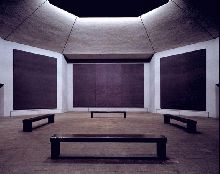 Meanwhile, I went down to the Rothko Chapel, which I first saw almost two decades ago. I still feel rather underwhelmed, but it was good to return and to re-experience the underwhelment. I also stopped by the Jung Centre. Most of the other museums were closed, it being a Monday.
Even so, I should apologize to my friend Ivonne, Houston native and very much a booster of her home city. The place is far better than I remember it. The public transport works, or at least it worked for me. There's plenty to do. I even managed to find a few decent bars. And it's not its inhabitants fault that the place is so damn hot and humid.
Though perhaps my good feelings towards Houston are also because in the interim since my last visit I have seen cities such as Dallas, a better example of the disaster that American cities can become.
Given that buses were the spark and focus of so much of the civil rights movement, what's striking now is that, yes, African Americans have won the right to sit at the front of the bus. But that's because they are also sitting at the back and in the middle: essentially, whites have abandoned public transport altogether in a city such as Houston. And this despite, or rather because of, the fact that it's astonishingly cheap ($2 for an all-day pass, though you need to top that up on express buses in the evening rush hour... see below).
So from an explicit divide drawn through the middle of the bus, we now have an implicit, and so invisible, line drawn between transport users and the suburban commuters in their trucks and SUVs.
Interestingly, however, there were no Latinos on the buses I took. And this despite the fact that in many ways Houston is a bicultural city: all signs and announcements are in Spanish as well as English, and on the street at least I heard Spanish probably more than English. Just about every service worker I encountered, from the check-in agents at the hotel to the guys leaf-blowing the streets, to the bus driver and the cleaners at the airport... they were almost all Latino.
But on the return journey to the airport, it was a white guy who gave me a dollar on seeing that my pass no longer worked. Perhaps an act of racial solidarity among the bus-borne minority.
 Meanwhile, I went down to the Rothko Chapel, which I first saw almost two decades ago. I still feel rather underwhelmed, but it was good to return and to re-experience the underwhelment. I also stopped by the Jung Centre. Most of the other museums were closed, it being a Monday.
Even so, I should apologize to my friend Ivonne, Houston native and very much a booster of her home city. The place is far better than I remember it. The public transport works, or at least it worked for me. There's plenty to do. I even managed to find a few decent bars. And it's not its inhabitants fault that the place is so damn hot and humid.
Though perhaps my good feelings towards Houston are also because in the interim since my last visit I have seen cities such as Dallas, a better example of the disaster that American cities can become.
Subscribe to:
Posts (Atom)