I've been reading Janice Thomson's Mercenaries, Pirates, and Sovereigns: State-Building and Extraterritorial Violence in Early Modern Europe, a book that Craig of theoria recommended to me some time ago. The title is somewhat unhelpful, in that it's not really about early-modern Europe, rather about the eighteenth- and nineteenth-century constitution of international order. But the book is certainly interesting, and I'll post some further comments in the next couple of days.
In the meantime, a happy new year to one and all.
Monday, January 02, 2006

Tuesday, December 13, 2005
conviviality
 Writing in 2000, a period during which the FARC still enjoyed state-sanctioned control of large swathes of South-Central Colombia marked out as a "zona de despeje," a cleared zone, Alma Guillermoprieto notes the grubby normality of everyday life in this safe haven. In San Vicente de Caguán, "there are loud cantinas; fleshy women in too much makeup under the glaring sun; block after block of storefronts selling boom boxes, high-heeled shoes, glitter eye shadow, and telephones shaped like hot dogs" (Looking for History 55).
The guerrilla, as far as Guillermoprieto can see, spend their time mostly lounging about: buying mascara and nail polish; chatting with neighbours; watching TV, their FALs and AK-47s casually propped up in the corner of the room. Of course, the point about a safe haven is that it's a good place for a little R&R; it's not as though there's no war on, and indeed with up to 20,000 people under arms, the FARC are able to carry out significant actions, "waging something very like real war against the Colombian state" (60). (And here's a pretty good round-up of recent accounts of "Latin American's Longest War".) But even this war has become very much a habit among its combatants, some of whom have known little else than life as a guerrilla.
For instance, compañera Nora, "a trim, agreeable woman in charge of the FARC's liaison with the public" (57) has spent well over half of her thirty-three years in the rebel ranks. Meanwhile, the insurgent leader, Manuel Marulanda or "Tirofijo", has been out in the hills in one form or another since the "Violencia" of 1948 to 1958. In Colombia, civil war is very much a way of life, for some almost a lifestyle option: Nora is reported as saying that she joined the FARC, at the age of fifteen, after she had seen a guerrilla column with its "brisk young women, in uniform and carrying guns, and thought they were the most powerful and glamorous creatures she had ever seen" (59).
At the time of Guillermoprieto's visit, the FARC and the Colombian government (under President Andrés Pastrana) were engaged in a "peace process," though these are hardly exactly peace talks: they are rather a "ritual encounter" celebrated "on a regular basis, and call[ed] progress" (64). No real dialogue was underway, and in any case everyone knew that at the margins prowled the military and their comrades in (para)military arms, the so-called "self-defence" units.
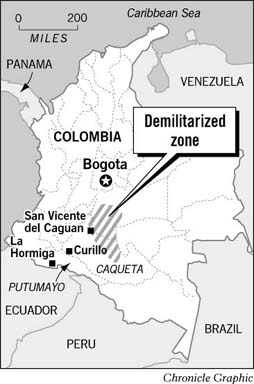 But in any case, such hope as Guillermoprieto entertains is based on the notion that the FARC's experience in this demilitarized zone might bring about a rehabituation. In that they had not been granted sovereignty of this territory that was often misleadingly nicknamed FARClandia, Guillermoprieto notes that ""for the first time, the guerrillas are coexisting with the citizens of a small town, and even having to get along with its mayor" (66). The rebels are forced, in their downtime, at ease, to be "sharing social and political space with the inhabitants of San Vicente" (68).
For Guillermoprieto, then, the experience is a lesson in conviviality, that takes place at a level well below the comandantes non-negotiations with their official counterparts, and even well below the ideology that in any case is hardly the rebels' motive force.
This is not to say, however, that this process of conviviality is not connected in some way with the media--though it may not be mediated in any conventional sense. For Guillermoprieto ends her account with what we are to take as a hopeful sign: a sudden realization that comes to her on her last morning, as she is taking breakfast at a fonda, or small restaurant, abutting the local FARC headquarters. A television is on, as in Latin America one always is. And the programme playing was Xena: Warrior Princess, the TV industry's ironized take on fighting women. But this irony establishes, perhaps, some common ground:
Two waitresses, as young as the guerrillas next door, were glued to the program. And then I realized that the guerrillas were too. The FARC videos were still playing just on the other side of the wall, but the kids were taking turns sneaking out of the headquarters to stand at the doorway of the fonda, watching Xena. (71)Of course, as a postscript acknowledges, just a couple of months later the US Congress approved "Plan Colombia". And by early 2002, the state withdrew its support for a demilitarized zone, the army returned, and so disappeared any hope for Xena-blessed conviviality.

Thursday, December 08, 2005
december
[A service announcement...]
What with one thing and another, mostly travel, I probably won't be able to update this blog very often over the rest of December. Normal service will resume in January.
Among my travel destinations, I will be at the MLA in Washington DC at the end of the month. Probably with a fair amount of time on my hands. So I'd be pleased to meet up with any like-minded (or even differently-minded) people who may also have the misfortune to be attending said conference.
I will also be in the UK earlier in December, but with much less time on my hands.
[Here ends the service announcement.]
Wednesday, December 07, 2005
seduction
 Gioconda Belli's The Country Under My Skin documents both the euphoria and the disappointment of the Nicaraguan revolution. It's also a meditation on the relations between power, affect, and knowledge. And it's a seductive tale warning of the dangers of seduction.
Belli is in Costa Rica in the days leading up to Somoza's downfall, frustrated about her distance from the real action. But thanks to her access to radio communications with rebel commanders on the front lines, she is able to follow the action if anything more closely than most of those on the ground: "It was mesmerizing to hear about the progress of the insurrection, to hear what was happening in real time" (234).
The final weeks and months of the Sandinista triumph went by astonishingly rapidly. Rather than leading, the Sandinistas were running to catch up with their impending triumph. Belli captures the "sensation of unreality" as victory finally, unexpectedly, raced up to meet them and the FSLN were thrust, blinking in the light, onto the world stage: "Sometimes it seemed as though they couldn't be talking about my tiny country, abandoned by everyone and beholden to a bloody dictator for half a century, but about a major power, able to make policy decisions that would alter Latin America's future" (236).
And then suddenly, almost anticlimactically, Somoza leaves office. And the Sandinistas, as much as anyone else, are left wondering what happens next: "Nobody spoke. Nobody moved. Everyone's eyes glittered with anticipation" (239).
Then the celebration: "Overcome with joy, we fell into one another's arms. 'Somoza left!' we repeated to each other, as we kissed, danced and hugged." And Belli echoes Neruda's famous "Heights of Macchu Picchu" in her invocation of the dead reborn in triumph: "Multitudes of our beloved dead came to life among us with their empty eyes, their deaf ears, the dust of their bones that could never celebrate with us" (239). It's a mythic time of (re)creation: "The 18th, the 19th of July 1979. [. . .] Two days that felt as though a magical, age-old spell had been cast over us, taking us back to Genesis, to the very site of the creation of the world" (241).
Such is the world-making power of revolutionary violence.

But Belli, closely associated with the cúpula of the FSLN leadership, is soon entrusted with part of the transformation of that constituent power into constituted power: the construction of a nation, reconstruction of the state. Her task is to represent the revolution, to produce the "victory issue" of a new newspaper, to be called Patria Libre. This task can only be completed from the distance that representation requires, the newspaper then imported into the newly liberated country.
Flying into Managua on a plane loaded down with newsprint, Belli finds the airport almost deserted: the action is elsewhere. Only an old school friend has turned up to greet her, but Belli turns her away, judging her guardianship of the papers to be more important. Here, even at arrival, is the first disappointment, the first betrayal, of the revolution: over the "eerie desolation" of the airport terminal "Justine's face would be always superimposed. I managed to shake off my uneasiness. There would be time later on to explain things to Justine, to my parents, I said to myself. They would wait for me, they always did. But history wouldn't" (246).
Belli sets off, with her precious copies of Patria Libre, seeking to track down the history that the newspaper already claimed to represent. Her truck passes jubilant crowds: "their joy had the taste of sweet, red watermelon, its juice dripping down my chin" (247). But when at last they get to the city and reach the central plaza "there was no one left. That was when we realized that the crowds we'd seen on the road had been walking home after the celebration. All that was left in the great, deserted plaza were wrappers, trash" (248).
 In place of this unpredictable, mobile multitude, the Sandinistas establish a militarized state as totem and fetish, positing its institutions and its leaders as the object of revolutionary desire--thus inverting the relationship constitutive of the triumph itself. Belli notes the demobilizing effect of this inversion, describing her lover Modesto and his "bodyguards, who only a month earlier had fearlessly confronted Somoza's tanks, [and now] were docile and obedient in their leader's presence" (266).
She observes the ways in which "military protocol had its grandiose, seductive side. [. . .] Modesto--comandante, member of the Sandinista National Directorate, maximum authority in Nicaragua both during and after the Revolution--would move calmly amid the soldiers hurriedly standing at attention" (266).
It's not long before Belli also realizes that "the dazzling spell of power"--constituted power, we should clarify--also entails self-delusion among those who wield it: "these men had been seduced by the spell of their own self-image [. . .]. They felt eminently astute and capable, a cross between political bright boys and heroic, strapping knights-errant" (275).
The Sandinistas begin to believe their own myth of leadership, rather than learning from their experience of belatedness. The only indication of what has been lost in this transition is the lingering nostalgia that pervades Belli's memoir, a "nostalgia for what we had been" (291) before the rigidity that set in with the state's consolidation, and before the FSLN retrospectively branded everything in sight with their red and black logo.
Tuesday, December 06, 2005
substitution
Le Colonel Chabert offers a fervent defence of populism--or rather, a fervent critique of anti-populism, which the colonel links to the anti-fanaticism of the war against terror. But it's an error to conflate populism and fanaticism, or to think that all enemies of one's enemies are alike. Populism is itself very clearly anti-fanatical. Yes, it mobilizes passions, but only then to demobilize and contain them. Whereas fanaticism seeks immanence, populism re-establishes transcendence.
Populism, especially indeed the neo-populism of someone like Chávez, is the last gasp of the social contract. (What the escuálidos don't realize is that Chávez is the great saviour of puntofijismo, not its downfall.) As such, it's a pre-eminent mode of counter-insurgency.
(Update: and now over on Lenin's tomb we read that "we have to side unflinchingly with populist movements".)
Here, more from Posthegemony, whose first chapter is devoted to populism (and whose second chapter deals with fanaticism)...
The dream of abstracting some radical impulse from populism's anti-authoritarian and rebellious sentiments is shipwrecked on the fact that, under the guise of subversion, populist movements only ever construct and consolidate sovereignty, authorizing a people whose rebelliousness never rises above sentimentality.
Populism, as exemplified by classical political movements such as Peronism and contemporary intellectual tendencies such as cultural studies, and as theorized by Laclau, entails a systematic set of substitutions. It presents us with people instead of classes (or multitude), rhetorical gestures instead of analysis (or struggle), morality instead of politics (or ethics), sentiment instead of affect (or habit) socialized identities instead of social forces (or preindividual singularities), transcendence instead of immanence (or quasi-causes), unity instead of multiplicity (or contingency), the body of the sovereign instead of the power of the state (or constituent force). As Kraniauskas observes, quoting Freud on fetishism, in each case "something else has taken its place, has been appointed its substitute, as it were, and now inherits the interest which was formerly directed to its predecessor" ("Rodolfo Walsh y Eva Perón" 113; emphasis in original). Through these serried substitutions, populism constructs a drastically simplified image of social space. What has been substituted is quickly forgotten, erasing also the process that has constructed this falsely simplified scenario of easy dichotomies, crystal clear antagonisms, and well-worn assumptions. It is true that these disavowals conserve some remainder of what has gone, but analysis must move beyond the mere examination of such symptoms.
Above all, populism presents us with hegemony instead of any other conception of politics, and the state's expansiveness as though it were cultural subversion or a flourishing civility. In the name of a purported counter-hegemony of anti-authoritarian sentiment, populism's self-erasing state logic permeates and coordinates everyday life. In an article tracing Marxist theories of the state, Laclau himself equivocates on this precise point. He notes that state logic has come to organize society as a whole: "the form of the state defines the basic articulations of a society and not solely the limited field of a political superstructure" ("Teorías marxistas del estado" 54); but he immediately disavows this insight by claiming that "political struggle has passed now to extend to the totality of civil society" (54). This only repeats the populist substitution: the state is conflated with civil society, political struggle with sovereign command. So long, therefore, as political analysis remains confined to the theory of hegemony, as is contemporary cultural studies, it will remain confined to a logic of populism unable either to differentiate itself from the populism of the right or even to recognize and so criticize the transformations and substitutions that populism demands and entails. Moreover, it will be anxiously haunted by the remainder that hegemony contains of what has been lost. Rather, then, than fixating on discursive articulations within civil society, we might do better to re-examine the differential inter-imbrication of culture and state. Or rather, we might again see the state as what has to be explained, in its dependence on but distinction from the affective performativity and cultural habit that sustains it.
Saturday, December 03, 2005
party
What's odd about Walter Benjamin's "Critique of Violence," at least from our present context, is how little the essay has to say about power. There is much about violence (of course) and much about the law. But the question of power hardly arises, and when it does its relation to violence and law is unclear.
"Lawmaking is power making," Benjamin tells us, "and, to that extent, an immediate manifestation of violence. Justice is the principle of all divine end making, power the principle of all mythical lawmaking" (295). Here, on the one hand, law and power are intimately related: to make law is to make power. On the other hand, power and justice are counterpoised: justice relates to ends and to divine violence; power relates (presumably) to means, and to mythical violence.
And this comes immediately after the observation that lawmaking, and so mythical violence, "establishes as law not an end unalloyed with violence, but one necessarily and intimately bound to it, under the title of power" (295). Power, here, is the "title" under which law and violence are "necessarily and intimately" bound one to the other.
This relative silence about power is odd in our present context, because for the past thirty years or so, political theory has been concerned above all with the problem of power. It has been the project of, first, Michel Foucault and, then, Antonio Negri to reconceive power, to rethink its origins and its historical vicissitudes. Indeed, at the core of Foucault's and Negri's political philosophy is power's relocation, even dislocation: Foucault with the concepts of disciplinary, capillary, and (most influentially at present) bio power; Negri with the fundamental distinction between constituent and constituted power.
It's not immediately clear how to map Benjamin's essay on to our contemporary concern with power. I'm not convinced by Paul Passavant's suggestion that we can read "violence" as "power." That's a little quick. It's true that Benjamin indicates that "mythical violence is bloody power" and "divine violence[,] pure power" (297). There's surely a nexus between violence and power. And there's no doubt that government without violence, or rather parliaments without "the sense that a lawmaking violence is represented by themselves," also lacks power, and proves unable to "achieve decrees worthy of this violence" (288). Yet the fact remains that Benjamin's is a critique of violence, not a critique of power.
I wonder if this is not because, whatever Benjamin's hesitations towards Bolshevism and the Soviet Union, he is not yet prepared to question the party form. It is not, yet, part of what Althusser would call his "problematic."
After all, the post-1968, perhaps better post-1956, critique of power for which I have provided the ciphers of Foucault and Negri (but one could add Deleuze and Guattari and even the whole tradition of cultural studies) is premised on an unease with if not outright rejection of the party form. This unease provides the problematic of contemporary political theory. It is only very recently indeed, essentially with Zizek's somewhat quixotic revival of Lenin, that anybody has had anything much good to say about the party as a mode of political organization. But this reassessment has entailed also a frontal assault on and so acknowledgement of the dominant problematic.
By contrast, Benjamin, for all that he draws on Sorel, is not yet, at least, post-Leninist. This is what is fundamentally alien about his essay.
Benjamin writes of the "state power" that the "proletarian general strike" is set to destroy (291), but in such a way that the phrase "state power" is almost an unexamined tautology. It is certainly not interrogated alongside the "educative power" that, for Gramsci (writing at about the same time), is the power of hegemony incarnated in the party cadre. Gramsci, of course, happily welcomed the notion that the party and the state wielded the same form of power: both aspired to hegemony, to be Prince, old or modern.
And Benjamin, for all the inkling of something like constituent power that this essay so tantalizingly invokes, is not yet able either to critique the party or to suggest an alternative to hegemony.
(Cross-posted to Long Sunday.)
Friday, December 02, 2005
factory
Simone Weil's "Factory Work" is a phenomenological account of the Fordist labour process and its "transmutation of man into workman" (55). Though the experience of the factory assembly line, full of sensation, sound, and movement, could in other contexts be considered "exhilarating" (54), this sensorial wealth goes unappreciated by the labourer: "Those who people the factories do not feel [its joys], except in rare and fleeting moments, for they are not free [. . .] for the vise of their servitude grips them through the senses, their bodies, the thousand and one little details that crowd the minutes of which their lives are constituted" (55).
What's interesting here, in the first place, is the way in which Weil describes Fordism as a mode of subjection through affect: it consists in the immediate capture of the senses that is simultaneously a desensitization, and so also a habituation to the machine. Reason is bypassed. Rather "what is recognized [. . .] is the barracks formula: 'Never mind the reasons!' [. . .] Come what may, the work must go on. It is up to the worker to get on with the job. And he does get on with it" (55).
 Weil's account of the factory process is also an astute observation of the way in which subjection through affect and habit involves a detemporalization, or rather the denarrativization of time. The worker is unable to relate means to ends, and so "thought draws back from the future. This perpetual recoil upon the present produces a kind of brutish stupor" (57).
The resulting "mixture of monotony and accident" (58) makes of the labourer little more than an animal, who responds insensately, because so wrapped up the senses, to immediate stimuli and no more. The overall affective tone of the labour process is a "pervasive anxiety--the anxiety of not working fast enough--that is diffused through every working moment" (58).
It's because of its fundamentally non-narrative temporality that the factory experience also resists representation. For representation would entail the imposition of narrative upon an experience whose very essence is the loss of narrative. No wonder then that "workingmen themselves do not find it easy to write, speak, or even reflect on such a subject" (54).
So it is clear that the factory worker's subjugation is fundamentally non-hegemonic. And Weil's response to this predicament is to call for a hegemonization of the labourer within the production process. Weil sketches out a reformed factory system in which, though "nothing might accrue to [the worker's] actual rights" (70), labour could be emplotted within a master narrative of meaningful human activity, so producing a vision to which the worker would be wedded to his work, his consent finally secured:
 Even, then, in envisaging a workplace hegemonized, Weil already anticipates the posthegemonic real subsumption of society by capital achieved in post-Fordism with its "take your daughter to work" days and its language of "stakeholding" and individual proprietorship in the productive process.
The result, however, being that workers are their own masters only in the sense that they are encouraged to coordinate and so embrace their own alienation.
[UPDATE: See Jeremy's response in "factory revisited".]
What's interesting here, in the first place, is the way in which Weil describes Fordism as a mode of subjection through affect: it consists in the immediate capture of the senses that is simultaneously a desensitization, and so also a habituation to the machine. Reason is bypassed. Rather "what is recognized [. . .] is the barracks formula: 'Never mind the reasons!' [. . .] Come what may, the work must go on. It is up to the worker to get on with the job. And he does get on with it" (55).
 Weil's account of the factory process is also an astute observation of the way in which subjection through affect and habit involves a detemporalization, or rather the denarrativization of time. The worker is unable to relate means to ends, and so "thought draws back from the future. This perpetual recoil upon the present produces a kind of brutish stupor" (57).
The resulting "mixture of monotony and accident" (58) makes of the labourer little more than an animal, who responds insensately, because so wrapped up the senses, to immediate stimuli and no more. The overall affective tone of the labour process is a "pervasive anxiety--the anxiety of not working fast enough--that is diffused through every working moment" (58).
It's because of its fundamentally non-narrative temporality that the factory experience also resists representation. For representation would entail the imposition of narrative upon an experience whose very essence is the loss of narrative. No wonder then that "workingmen themselves do not find it easy to write, speak, or even reflect on such a subject" (54).
So it is clear that the factory worker's subjugation is fundamentally non-hegemonic. And Weil's response to this predicament is to call for a hegemonization of the labourer within the production process. Weil sketches out a reformed factory system in which, though "nothing might accrue to [the worker's] actual rights" (70), labour could be emplotted within a master narrative of meaningful human activity, so producing a vision to which the worker would be wedded to his work, his consent finally secured:
If a workingman's job is to drop a die punch on a piece of brass destined for some device in a subway, he ought to know it. Moreover he ought to have a clear-cut image of the place and function of that piece of brass on the subway line, what operations it has already undergone and which ones are to follow before being put into place. the plea here is not, of course, for a lecture to each worker at the beginning of each piece of work. What is possible is such things as having each work group occasionally explore the plant by turns for several hours, at the usual wages, all to the accompaniment of appropriate explanations. Even better would be to allow each worker to bring his family along. And why not? [. . .] A workingman truly wedded to his job would be proud and happy to show his place of work to his wife and children. (67)Here we see the pedagogic project of hegemony outlined. With sufficient education, the worker can enter heart and soul (rather than simply body and sense) into production. What's more, hegemony might also secure the expanded field of social reproduction, securing the consent not simply of the male worker, but also his wife and children. For it is a double wedding that ensues: married to the job as well as to his civil spouse, the worker inducts his family into subjugation to the machine age.
 Even, then, in envisaging a workplace hegemonized, Weil already anticipates the posthegemonic real subsumption of society by capital achieved in post-Fordism with its "take your daughter to work" days and its language of "stakeholding" and individual proprietorship in the productive process.
The result, however, being that workers are their own masters only in the sense that they are encouraged to coordinate and so embrace their own alienation.
[UPDATE: See Jeremy's response in "factory revisited".]
Thursday, December 01, 2005
economy (stupid!)
I'm very pleased to present the following guest post from my friend Jeremy, on recent events in France...
It’s the Economy, Stupid!
Both in France and in Britain, media coverage and commentary on the recent disturbances in the banlieues has focused on the perceived fundamental differences between the French republican model of “integration” and the so-called “Anglo-Saxon model” of multiculturalism. Commentators on either side of the Channel, or indeed the Atlantic, rarely miss an opportunity to point to problems in the other country as evidence of the inherent failings of the foreign model and the superiority of their own.
Peter Mandelson, formerly the architect of Blairism, currently EC Trade Commissioner, was recently featured on BBC’s Newsnight programme, preparing to meet the French Trade and Agriculture Ministers in advance of the latest round of world trade talks. As Mandelson walked to the meeting, an advisor suggested he should break the ice by expressing his sympathy for the problems the French government was experiencing in quelling the nightly disturbances in the banlieues. “So much for the French social model they’re always telling us must be defended at all costs!” came Mandelson’s audible, acerbic reply.
Such evident Schadenfreude was perhaps understandable given the eagerness of French observers to lecture those in the so-called “Anglo-Saxon world” on the inherent superiority of the “French model.” In their analyses of the riots, several French commentators have been unable to resist comparing race relations in France with the situations in both Britain and the US, predictably concluding that things are far worse “chez les Anglo-Saxons.” For example, in the left-leaning Le Nouvel Observateur, Jacques Juillard and Jean Daniel insisted that where the July bombings in London demonstrate failings inherent to the “Anglo-Saxon model” of multiculturalism, rioting in the banlieues is in no way a symptom of equivalent flaws in French republican universalism; such problems, they assure us, relate to the purely contingent failure to apply republican values properly.
The mistake, when confronted with such patent examples of self-serving chauvinistic myopia, would be to play the French at their own game, by trumpeting the superiority of our own national models or traditions. However tempting, matching nationalistic bad faith with nationalistic bad faith will not advance us far.
What is really significant about the tendency of so many in France to champion the benefits of their own “social model” is that such apparently confident assertions of national superiority merely reveal the deep anxiety at perceived French national decline that in fact lies at their root. Moreover, what lies behind the periodic, largely directionless outbreaks of violent protest in the banlieues is not the failure of one or other model for “integrating” ethnic minorities. Rather, what’s at stake here is the breaking of the link between such differing conceptions of national belonging and the mode of capitalist accumulation that used to underpin them.
It is commonplace in France to claim that earlier immigrant generations were integrated into the Republic relatively unproblematically. Too often forgotten is that such immigrants either arrived as adults or, if children, had a mercifully brief exposure to the French education system, that talismanic site of republican integration. Arriving as adults or leaving school at 15, such immigrants and their offspring were in fact integrated in the Fordist workplace, through both labour and the labour movement, thanks to the ramified political, social, and cultural networks of unions and the Communist Party. The role of republican institutions was limited to equipping such workers with certain linguistic skills and a fairly minimal sense of specifically French cultural values and traditions.
The banlieues were, of course, the necessary adjuncts to Fordism. Inspired, architecturally, by Le Corbusier’s “factories for living,” they were located close to areas of heavy industry to provide housing for workers in France’s booming post-war economy. The decline of the banlieues has thus precisely mirrored the decline of French heavy industry and the shift to a post-Fordist mode of accumulation. As unskilled and semi-skilled factory jobs have dried up, so the young French working class, ethnic minorities and others alike, have been encouraged to spend ever longer in formal education, to be confronted on a daily basis with evidence of the disparity between the republican school’s promises of equality and meritocratic social promotion and the reality it can actually deliver.
As the bases of Fordism as mode of both governmentality and capitalist accumulation disappear, so republican institutions, and the school in particular, are left to take up alone the task of integrating France’s most economically and socially deprived groups. Unsurprisingly, this is a task which such institutions are unable to achieve in isolation. The more such institutions fail, the more politicians and commentators across the political spectrum insist that their founding values must be safeguarded and reasserted. But reasserting the very republican values and institutions whose failings banlieue inhabitants confront on a daily basis can only produce effects opposite to those desired. The thousands of burnt-out cars littering the streets is depressing evidence of such unintended consequences.
French Prime Minister Dominique de Villepin’s response to the rioting, which has included a plan to revive “pre-apprenticeship” schemes for young male immigrants, at least has the merit of moving beyond the traditional exclusive focus on republican institutions and the school. Indeed, his proposals might be interpreted as an attempt, doubtless vain, to suture the fractured link between republicanism and the Fordist mode of accumulation that had previously ensured the “integration” or disciplining of generations of French citizens into the body politic.
Another of De Villepin’s proposals, to introduce a form of “voluntary civil service” to replace the compulsory military service demanded, until a few years ago, of all male French school-leavers, is also telling. As Michael Hardt and Antonio Negri point out in Multitude, the disciplining of bodies under mass conscription paralleled the disciplining of bodies in the Fordist factory. It is this parallel, they argue, that Céline explores in Journey to the End of the Night, as his narrator recounts his experiences on the Western Front and, later, as a worker at the Ford factory in Detroit. What Hardt and Negri neglect to mention is that between these two experiences, Céline’s narrator recounts his encounter with French imperialism, in French West Africa. What Hardt and Negri term Fordist “disciplinary governmentality” did not merely involve a parallel between mass soldier and mass worker: it also rested on Western imperialism.
In France today, the Fordist factory has all but disappeared, mass conscription has been abolished, and the grandchildren of France’s former colonial subjects have arrived in the imperial metropolis to confront residual forms of colonial arrogance and violence; the old mission civilisatrice will no longer be enacted in a primary school in Kabylia, but in one of the newly designated Zones d’éducation prioritaire in the metropolis’s all too proximate periphery, the banlieue – open to all French residents, universally, as long as they leave their Islamic headscarves at the door.
De Villepin’s attempts to return to a more certain age, through a reassertion of republicanism, a dose of national service, and precocious insertion into the workplace, will doubtless prove in vain. Yet this should not be cause for any Mandelsonian Schadenfreude. For it is precisely the failings of the nation state, its institutions and traditions, that is at stake here, so that any analysis that falls back on disparaging comparisons between the failings of “their model” as against the strengths of “ours” paradoxically becomes a symptom of the very malaise it claims to diagnose.
Or rather, what’s at stake is the failed articulation between the nation state and the economy, between national ideology and the contemporary mode of capitalist accumulation. The fact that the London bombers hailed from declining industrial communities of the Midlands and the North should remind us that, contra Juillard and Daniel, what was significant in the UK, too, was not the inherent failings of a so-called “Anglo-Saxon” multiculturalism but the disappearance of Fordist structures of work and socialisation – it’s the economy, stupid!
This has been a guest post from Jeremy.
Wednesday, November 30, 2005
traje
 Alicia Velásquez Nimatuj offers a stirring defence of Guatemalan indigenous dress or traje. She opens with an anecdote of how she was refused admittance to a Guatemala City restaurant solely (she tells us) because she was wearing K'iche dress. She argues that wearing traje "is not just a matter of standing up for our cultural rights. Since 1997, in post-war Guatemala, it has become a political challenge: that of breaking the various ideological, legal, colonial, and contemporary racist structures that exist in all spheres of the Guatemalan State" ("Ways of Exclusion" 158).
But if the survival of traje is an instance of both "historical resistance" and "everyday resistance," indeed if in the history of Mayan resistance to colonialism "women's regional dress has played a leading role" (159), then what to say of the fact that increasingly, and especially in the cities, it is now replaced by "fashionable jeans and jacket" (161)? For Velásquez Nimatuj, the shift from regional to conventional Western dress shows "how racism is internalized for some Maya women [. . . they] have come to accept what the dominant ideology has repeated over and over again, that our regional dress stands for 'backwardness,' 'underdevelopment,' 'poor hygiene,' 'ignorance,' and 'living in the past'" (160).
On the other hand, the role of "Maya intermediaries" in "the folkloric exploitation and abuse of Maya women and their traditional dress" is equally "reprehensible" (162). Velásquez Nimatuj notes that "sadly" even "a few Maya" are involved in organizing Cobán's annual folk festival that features a beauty pageant for indigenous girls in ceremonial costume (162).
In short, both wearing traje and not wearing it properly, treating it as semi-archaic folklore rather than as living resistance, are equally damned as something very close to ethnic betrayal.
Indigenous dress threatens both betrayal and counter-betrayal: in so far as it constitutes the performance of ethnic authenticity and resistance, it "betrays" the fact that its wearer will never be fully ladinized, that she is always treated as stubbornly subaltern to be banished to the margins of Guatemalan society; but by contrast, when the dress is put centre-state as the fetishized image of national identity, for instance in airport shops or tourist brochures and boutiques, another betrayal is afoot in this improper performance of authenticity.
In other words, though Velásquez Nimatuj wants to tell us that dress somehow expresses the intimate essence of ethnic identity, "the visible proof and cultural marker that locates us in the category of 'Indians'" (160-161), not only does she therefore collude with the restaurant doorman who likewise interprets clothing as ethnicity, but she is also forced rather futilely to police the evident fissures between the two. She insists that studies focussing only on the material aspects of indigenous weaving are insufficient, but this is surely because now traje has become for her a political style on which she, like any other self-appointed arbiter of fashion, has set herself up to judge.
By contrast, then, I find Carol Hendrickson's more nuanced analysis to be also more persuasive. For Hendrickson, wearing regional dress is best understood as strategy rather than essence, allowing "Guatemalans acting within a given social moment [to] contemplate and adjust their own appearance (if only momentarily and on an extremely small scale) and hence the social role assigned to them" ("Images of the Indian in Guatemala" 303). As a strategy, then, the consequences of traje are never fully predictable. It is an always uncertain risk, which may bring rewards as well as stigma, benefits as well as losses. "This is particularly true when the situation is anything more than routine and when it is not obvious which image of the Indian will come into play for any particular circumstance" (304).
Velásquez Nimatuj prescribes pre-destined resistance, whose limits she claims to legislate as native anthropologist/informant. But Hendrickson presents dress as a terrain of corporeal experimentation and investment, which may or may not lead to politically significant incorporeal transformations, in a contested field in which identity traits are at least partially dislocated and so still up for grabs.

Tuesday, November 29, 2005
technorati redux
[Apologies for another bout of meta-blogging...]
Technorati have again, it seems, given up a) on indexing this blog and b) on responding to customer support queries.
(See here for previous travails. I'm also still not the only one with this problem. Someone's even written a poem on the topic.)
Regarding the lack of customer support response, I'm prepared to give them a bit of slack given that it's been Thanksgiving weekend in the US.
But the erratic indexing itself remains something of a pain. One would like to have a little more faith in the reliability of tagging.
(Meanwhile over on Latin America on Screen, in the last week some posts have been indexed, but others not.)
The fact that the problem should reoccur just now is rather timely. It so happens that later today I'll be meeting up with Brian Lamb of Abject Learning to discuss the ways in which tags might be used as part of an experiment in blogging a class I'll be teaching next semester.
Even on a more limited scale, this semester I've been writing up some notes on readings connected to a class I've been teaching. I'd like to be able to point students to the appropriate Technorati tag so that they can access the relevant entries without having to wade through my disquisitions on Agamben or cultural studies or whatever. Their exam is coming up, so they might especially appreciate this in the next week or so.
But if we can't trust Technorati (or can't trust them to fix problems in good time), all this rather goes down the tubes. Brian himself notes the risks of relying on third-party applications. At the same time, I dislike more than almost anything else software made specifically for the educational market. (Exhibit A: the horror that is WebCT.)
Back to the issue at hand, it's not at all obvious why this happens (there's nothing on Technorati's help pages that deals with the issue), nor therefore what can be done to prevent it. And if customer response time remains so slow, then it's not as though it can be rectified unproblematically.
Though I can say that Ice Rocket is much, much worse.
Anyhow, I'll update this post as and when progress is made.
[Update: rather surprisingly quick progress... now this post and the previous one seem to have been indexed, at least partially; earlier posts such as this one remain unindexed. Even so, this is definitely a step forward.]
[Update: new posts are being indexed; other ones, still on this front page, are not.]
[Update: I've increased the number of posts on this front page, waiting until they are indexed. No sign yet...]
[Update, a week later: Though I have still not heard anything from them or their customer service via email, Technorati have now caught up on the backlog of posts to be indexed. Normal service to be resumed...]
Sunday, November 27, 2005
affinity
Both the title and the subtitle of Richard Day's Gramsci is Dead are misleading. The title because, though Day has much to say about hegemony, his version of the concept is sufficiently broad that he traces it back to (at least) Hegel, and he hardly discusses Gramsci's contribution. (I suppose, however, that Hegel is Dead would have been a marginally less alluring title.)
The subtitle, "Anarchist Currents in the Newest Social Movements" is also something of a misnomer, mostly because Day is less concerned to establish influences than to point to resonances between social movements and the anarchist tradition. Even then, he is interested primarily in the ways in which recent theory as well as recent practice might help release anarchism (as well as Marxism) from what he terms "the hegemony of hegemony."
Day establishes an opposition between the "logic of hegemony" and the "logic of affinity." Hegemony, he tells us, is totalizing and state-centered. It operates, equally in either what he likes to term its "(neo)liberal" or its "(post)marxist" variants, by means of demand, representation, recognition, and integration. From the very moment that politics is predicated on the demand, it implies and invokes the existence of a state before which the individual or group constituted in the demand seeks to be represented, and by which it hopes to be first recognized and then integrated. Affinity, on the other hand, begins with Exodus and establishes self-generated (and self-valorizing) communities predicated on a "groundless solidarity" and "infinite responsibility" that are always open to the new and the other.
Though inspired by, and driven in part by an attempt to revindicate, the historical tradition of anarchist thought from William Godwin to Gustav Landauer, Day also stresses the contribution of poststructuralist and postmodern theorists such as Foucault and (above all) Deleuze and Guattari. He is particularly interested in the figure of the "smith" found in A Thousand Plateaus: the smith, located somewhere between nomad and citizen, opens up and inhabits the "holey space" that is neither fully smooth nor fully striated. The smith, Day argues, is "the autonomous subject of the coming communities" (128).
Day puts his case forcefully and in large part convincingly. There is no doubt that we should leave the dead carcass of hegemony and hegemonic thought well behind us. Yet the final few pages of Gramsci is Dead indicate some gnawing problems with his grand narrative pitting hegemony against affinity. Here he acknowledges that states are no longer sovereign as they once were, and that this is in part because "corporations [are] working to undermine" them (217). "Decentralization," Day admits, "just as easily, and much more likely under current conditions, means a shift from modern discipline to postmodern control" (216). Distinguishing between "radicle and radical forms of rhizomatic organization," he notes that "maintaining this differentiation will become an ever-more pressing task" (216).
For indeed, the notion of a grand struggle between hegemony and affinity no longer makes much sense (if it ever did). We live in posthegemonic times, in which control is exerted directly and immediately by affective and habitual means. And on the other hand, for all the fine examples of social movements that Day puts forward, from the Zapatistas to No One is Illegal, from Participatory Economics to People's Global Action, I am not sure that we can be quite so sanguine these days about Temporary Autonomous Zones, or that "clearly, an experiment carried out as part of a mass movement is much more dangerous than the same experiment undertaken by one or more packs" (176). What, after all, about the pack that carried out its experimentation on September 11th 2001, a day that cannot be so glibly despatched as "the Day of the Great Excuse for Oppression" (32).
In short, beyond attention-grabbing and unenlightening exclamations (Gramsci is Dead!), rather more work is required to construct a theory of posthegemony.
(Cross-posted to an ungrammatical multitude.)
Thursday, November 24, 2005
delinquency
Three short articles--crónicas--on contemporary urban violence in Colombia and Venezuela.
 For José Roberto Duque, it is still the state that's at issue. He describes a police murder: a raid on a house in a poor Caracas neighbourhood, the special forces storming up the stairs to their target, the body thrown out of the window, the witnesses coached to say the victim was a "bully, a delinquent," the falsified autopsy and death certificate. Everything conducted smoothly enough, an efficient exercise in limpieza, cleansing. People play along. "Nobody wants to get in trouble, right?" ("A Small Mistake" 123).
The problem, however, is the "small mistake" of the title: while the police are still conducting their operation their informed by panicked relatives that they have the wrong address. "No, sir. This is house number 20, but on Ricuarte Alley. La Vuelta del Mocho is about eight blocks up." The police response: "Ah, shit." But too late, because the bureaucratic machinery of law enforcement can't be halted so easily. After all, it operates according to its own logic, at some remove from reality. The drugs and weapons have already been planted. The original victim is infinitely replaceable; the objects of state repression are "whatever" victims, their individual names interchangeable and ultimately irrelevant. Due process and procedure can't be derailed by these small details of individual identification.
But this depersonalized, common object of state repression is also, in José Navia's piece from Bogotá's marginal urban slums, a common subject he terms the "multitude." And if for Duque the barrio is the site of random death, for Navia the multitude makes it also a place in which that institutionalized death drive faces the forces of life. The "rest of the city" slumbers while "a multitude begins to stir in the narrow, labyrinthine, unpaved alleys of Ciudad Bolívar" ("Ciudad Bolívar: Brush Strokes against Death" 125). Though "stigmatized by death" (125), the multitude are "youths on their feet, united, demanding a future, building a life [. . .] they invite life to be created in the place of death" (126).
Finally, however, Alberto Salcedo Ramos's vision is much darker. Here it's not so much the state versus the subaltern, margin lined up against the periphery, as an urban environment saturated by danger and violence. Mobility is no salvation, indeed it only invites further risk: "hailing a taxi on a Bogotá street at night--or even during the day--turns us into Russian roulette players." Salcedo Ramos goes on to suggest that "the only defensive manoeuver we have left is hoping, sometimes with ingeniousness, sometimes with arrogance, that the fatal shot doesn't hit us" ("The Drive-By Victim" 130). Of course, his perspective is partly that of the educated professional expressing the fear that his own city has become a no-go area in which any even semi-ostentatious display of privilege is pounced upon. He describes his experience being subject to a taxi-jacking, and describes himself as "a presumptuous animal that didn't know the laws of the jungle" (131).
Here again mistakes can be made, and here again those mistakes are somehow irrelevant: "If I wasn't rich but merely a poor copy, all the worse for me, not for them" (132). But the people who hold him up haven't quite made a mistake: he does after all have a savings account, he can after all procure money from a cash dispenser. And he has three cigarettes left, that the thieves can't pass up: "We smoke, too" (137).
But even Salcedo Ramos recognizes the sense of honour that runs through delinquency. It's a common trope, of course, of criminal society as equally, perhaps even more, rule-bound than the sovereign normality against which it rebels. "'We're thieves, man, not killers,' said the fat one, in a tone of offended dignity" (136). The middle classes have simply to learn this code of conduct, and abide by it. It's a world turned upside down, of course, but it has its logic. Salcedo Ramos ends up feeling grateful to his kidnappers, precisely because they maintained their calm and composure and stuck to their rulebook even as he himself tried to dodge and feint. When they release them he says "If I didn't shake their hands and invite them to breakfast the next day, it was because I wasn't brave enough. [. . .] And I thought that we are so screwed in this country that the only option left to us in the end is thanking the thieves" (137).
Isn't that because the country owes what little cohesion it has to the old-fashioned pragmatism of delinquency, so baldly opposed to the neoliberal state's mechanistic administration of bare life?
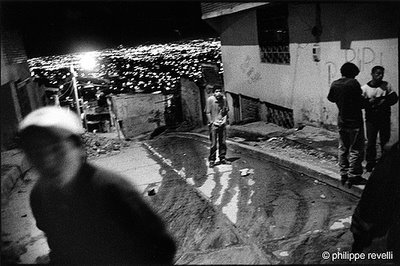
See Philippe Revelli's excellent photo series on Bogotá youth
 For José Roberto Duque, it is still the state that's at issue. He describes a police murder: a raid on a house in a poor Caracas neighbourhood, the special forces storming up the stairs to their target, the body thrown out of the window, the witnesses coached to say the victim was a "bully, a delinquent," the falsified autopsy and death certificate. Everything conducted smoothly enough, an efficient exercise in limpieza, cleansing. People play along. "Nobody wants to get in trouble, right?" ("A Small Mistake" 123).
The problem, however, is the "small mistake" of the title: while the police are still conducting their operation their informed by panicked relatives that they have the wrong address. "No, sir. This is house number 20, but on Ricuarte Alley. La Vuelta del Mocho is about eight blocks up." The police response: "Ah, shit." But too late, because the bureaucratic machinery of law enforcement can't be halted so easily. After all, it operates according to its own logic, at some remove from reality. The drugs and weapons have already been planted. The original victim is infinitely replaceable; the objects of state repression are "whatever" victims, their individual names interchangeable and ultimately irrelevant. Due process and procedure can't be derailed by these small details of individual identification.
But this depersonalized, common object of state repression is also, in José Navia's piece from Bogotá's marginal urban slums, a common subject he terms the "multitude." And if for Duque the barrio is the site of random death, for Navia the multitude makes it also a place in which that institutionalized death drive faces the forces of life. The "rest of the city" slumbers while "a multitude begins to stir in the narrow, labyrinthine, unpaved alleys of Ciudad Bolívar" ("Ciudad Bolívar: Brush Strokes against Death" 125). Though "stigmatized by death" (125), the multitude are "youths on their feet, united, demanding a future, building a life [. . .] they invite life to be created in the place of death" (126).
Finally, however, Alberto Salcedo Ramos's vision is much darker. Here it's not so much the state versus the subaltern, margin lined up against the periphery, as an urban environment saturated by danger and violence. Mobility is no salvation, indeed it only invites further risk: "hailing a taxi on a Bogotá street at night--or even during the day--turns us into Russian roulette players." Salcedo Ramos goes on to suggest that "the only defensive manoeuver we have left is hoping, sometimes with ingeniousness, sometimes with arrogance, that the fatal shot doesn't hit us" ("The Drive-By Victim" 130). Of course, his perspective is partly that of the educated professional expressing the fear that his own city has become a no-go area in which any even semi-ostentatious display of privilege is pounced upon. He describes his experience being subject to a taxi-jacking, and describes himself as "a presumptuous animal that didn't know the laws of the jungle" (131).
Here again mistakes can be made, and here again those mistakes are somehow irrelevant: "If I wasn't rich but merely a poor copy, all the worse for me, not for them" (132). But the people who hold him up haven't quite made a mistake: he does after all have a savings account, he can after all procure money from a cash dispenser. And he has three cigarettes left, that the thieves can't pass up: "We smoke, too" (137).
But even Salcedo Ramos recognizes the sense of honour that runs through delinquency. It's a common trope, of course, of criminal society as equally, perhaps even more, rule-bound than the sovereign normality against which it rebels. "'We're thieves, man, not killers,' said the fat one, in a tone of offended dignity" (136). The middle classes have simply to learn this code of conduct, and abide by it. It's a world turned upside down, of course, but it has its logic. Salcedo Ramos ends up feeling grateful to his kidnappers, precisely because they maintained their calm and composure and stuck to their rulebook even as he himself tried to dodge and feint. When they release them he says "If I didn't shake their hands and invite them to breakfast the next day, it was because I wasn't brave enough. [. . .] And I thought that we are so screwed in this country that the only option left to us in the end is thanking the thieves" (137).
Isn't that because the country owes what little cohesion it has to the old-fashioned pragmatism of delinquency, so baldly opposed to the neoliberal state's mechanistic administration of bare life?

Wednesday, November 23, 2005
ungrammatical
An ungrammatical multitude is a group blog that has been, well, dormant for some time. To be honest, it's had its problems even getting off the ground. But it's also the online presence of what is a real-life reading group, and a day or two ago we met up again (also after a hiatus) and decided to give the blog another go.
In this spirit, my friend Sebastián has posted a translation of some comments by Badiou on Deleuze and Negri. Go read 'em. And look for more renewed activity (and most likely a site redesign) from an ungrammatical multitude in the near future.
Meanwhile, if it's a grammatical multitude you want, theoria has what you need.
anti-politics II
My earlier excerpt on Cultural Studies as an anti-politics has attracted some attention. To balance things out, I should say that Cultural Studies hardly has a monopoly on anti-politics. Posthegemony's second chapter is a critique of the social scientific discourse of "civil society." If Cultural Studies is populist, I suggest, then civil society theory is fundamentally neoliberal...
What then is eliminated in civil society theory's, and neoliberalism's, exclusion of culture from the state? The excluded culture is above all the matter of affect, passion, and the body. This is replaced by a statistical articulation, a hyper-articulacy. Affects are replaced by reasons (by Reason) as answers are demanded to the questions of management and state direction. Opinions are solicited and constructed in society's constant self-interrogation, that contrasts so baldly with populism's construction of a barely articulable ontology of affect. If populism is apolitical, it is a very different form of anti-politics than that of neoliberalism. Populism is an under-articulate disposition of the body, an incorporated common sense or habit, as opposed to neoliberalism's over-articulate frame of mind, its ability to produce opinion. Neoliberalism excludes any affective sense of bodily location. It is not that populism, with its material, bodily grounding, is somehow more natural than neoliberalism. Neoliberalism enjoys a very similar aura of the natural, of transparency, as though it harnessed a spontaneous production of popular opinion, varnished with the sense of rightness that rationalization and reason bring. Moreover, as neoliberalism's method is so in harmony with a whole range of social scientific methods and ideologies, it gains additional purchase in as much as its constitutive distortions mirror those of its social scientific observers.
A range of experiences and affects are processed by the state and through its ancillary mechanisms, of which perhaps the most important is civil society, to construct the realm of managerial reason. Normally this process can pass more or less unnoticed, but where the state is challenged by a counter-state and thus its double appears, the constituent force of this excluded affect reappears.
[. . .]
Affect is visible with the crisis of the state. The extent to which social relations are structured in terms of affect rather than (or on another level from) discourse becomes clearer, and other logics of the social begin to emerge. But in the face of this disturbing fundamentalism, civil society theory aims to return a sense of rationality and agency to subaltern subjects: if traditional political models had assumed a vanguard role for intellectuals, who have then to bring the masses to conscientización, a focus on new social movements emphasizes rather the myriad negotiations and initiatives performed by subaltern subjects. No doubt this has been a progressive move, to counter the view that peasants (particularly) are formed by premodern communities bound by tradition and superstition, outside of history or politics. An emphasis on peasant agency and reason is a welcome corrective in this context. Yet at times it is almost as though subalterns were presented as perfect rational choice actors, conforming to the most ideal of Western liberal paradigms of reason. As Starn points out, presenting them as rational actors of this type deculturates and depoliticizes such agents by presenting them "as if they were outside culture and ideology" ("Maoism in the Andes" 405). The price subalterns pay is that their activities are recognized only so long as they accord to a notion of reason imposed upon them. (Can the subaltern act?) So long, that is, as efficiency and modernization continue to be the ground of civil society. Such actors then are to be ascribed agency, but only on the terms of the social theorist. Anything that cannot be interpreted within such a framework becomes invisible, the democratic task the substitution of a rational civil society for affective and cultural relations seen, from the perspective of the state, as distorting its managerial transparency. Most importantly, such a policy also necessarily involves a massive expansion of the sphere of the state, a wholesale elimination of culture and corruption as the sole politics.
It was perhaps for the sake of such an eliminatory program, such a single-minded prioritization of logical structure over affective relations, that Sendero Luminoso wreaked such havoc in Peru, its reason unleashing the fiercest of affects. We learn from Sendero the importance of affect in politics, as they bring us back to the relation between culture and the state, the impossibility of fixing a border between civil and political society. But surely the fundamentalism of a Sendero or an al-Qaida is not the only one imaginable. Could there be a fundamentalist program driven by vitality, affirmation, and life, rather than the death drive of mutual immolation? Another way of being multitude. Refusing the constrictions and anti-democratic democracy of civil society theory, it might be time to consider embracing the immediacy of social movements in their excessive and passionate demands. What would it mean to take on fanaticism (in a way that Sendero's cult of reason manifestly does not)? Encore un effort. García Canclini asks how to be radical, without being fundamentalist. We might better ask: how to be fundamentalist, without being Sendero?
Tuesday, November 22, 2005
useless
Glen's comment on my last entry prompts me to dig up the following thoughts about interdisciplinary initiatives and the uses of culture...
Our aim should be to prevent any recourse to expediency, to the easy platitudes and naïve appropriations implicit in the notion of "making use of culture." But the challenge is to prevent such an aim from becoming itself a programme, and so to avoid descending into the cynical and self-serving expediency of the non-expedient, of the notorious "academic game" as analyzed by Pierre Bourdieu: a refusal to take up a position that is itself a position-taking, whose disinterest is only an all the more effective, if deferred, investment in future interest.
Alberto Moreiras has addressed precisely this issue. In our drive to innovation and interdisciplinarity, can we be sure we are not simply reinforcing the tendencies implicit in the new, corporate university, governed by the neoliberal logic of profit accumulated in exchange perpetuated and extended across now vanishing institutional borders? In Moreiras's words:
That question, how to evaluate the present, how to come to terms with the professional everyday and take a close look at the present and the future in order to determine the best directive, the best course of action, the best or most profitable way of administering our knowledge as well as our relationship with non-knowledge--when the question is asked we are already becoming subjects of calculation, and we are allowing our labor time, our laboring or professional identity or subjectivity, to be predominantly or tendentially defined by calculation, by calculative ratio. [. . .] We need to wonder then how far or how close that must be from neoliberal rational-choice economics, and thus how far or how close the very question about the critical effectivity of critique is from becoming a functional part of current constraints on immaterial labor, of the constraining ideology of immaterial labor at the time of globalization.The question of "our laboring or professional identity or subjectivity" is more pressing than ever. Precariously weaving between contending impulses towards discipline or control, the most urgent problem for the academy, at least, concerns negotiating between the uselessness of use and the use of uselessness.
Subscribe to:
Posts (Atom)