Tuesday, January 31, 2006

symbolic

Inspired by Matt's comment on Charles Bourbaki's "difference without apologies" at Long Sunday...

Social scientists, or at least social scientists of a particular stripe (perhaps it would be better to say political scientists?), are fond of referring to culture as the "symbolic." Moreover, often if not always this terminology is both containment and diminution. Cultural conflicts and negotiations are "merely" symbolic; it is the matter of policy-making, economic development, the legal code, the use of force (or whatever) that counts. And, we might add, that can be counted. Relegating cultural processes to this other arena of the symbolic, viewing them as ancillary to the main event, is also a methodological presupposition: it clears the terrain of, above all, affect; it substitutes quantitative extension for qualitative intensity.

So, in excluding the symbolic for being a site of repetition, a place where fundamental conflicts are played out but in another register, such an approach discards while also tacitly acknowledging the specificity of the cultural. It brushes under the carpet, as it were, the ways in which even in its reiteration or reflection of positions established elsewhere, culture is non-coincident with (say) political interest. That non-coincidence is at best an aberration, an irrationality. Hence the myth of the "rational actor," who is of course a deculturated actor, an agent who behaves always and only in line with his or her interest.

albatrossMeanwhile, traditional literary criticism has also understood the symbolic to be a form of repetition or reiteration. A symbol is an instance of double voicing: where a given word or thing signifies on two (or more) registers. Thus to say that, for example, the albatross in Coleridge's "Rime of the Ancient Mariner" functions as a symbol, is to say that the bird is more than it first appears: not only is it an element within the ostensible plot; it also carries with it broader connotations. So when the mariner kills the bird, he kills more than just a feathered beast.

Indeed, this symbolization is thematized within Coleridge's poem itself, which is in some ways a didactic text concerned precisely with the power of symbols.

And that is where the literary tradition and the social scientific diverge: the former ascribes power to the symbolic, where the latter denies it that power.

For in literature, the symbolic is viewed as the site of a particular intensity and for that reason the object of particular attention and interest. In the symbol's concentration and condensation of meaning and attention, it is ascribed a privileged mark of the literary itself, and of literature's capacity to affect and be affected. Whereas for the social scientist, the whiff of intensity provides an excuse for delegitimation.

But an anxiety over the power of the "merely" symbolic haunts social science still. God help us, after all, should people act affectively rather than "rationally."

Monday, January 30, 2006

ruins

"Allegories," Walter Benjamin famously tells us, "are, in the realm of thoughts, what ruins are in the realm of things" (178). And, to turn the comparison around, it's no surprise that ruins have long been viewed as allegories: as always pointing beyond themselves, to some absent totality. Moreover that, at another level of abstraction, the gap itself between ruin and totality has itself been insistently conceived as some kind of second-order allegory. Allegory upon allegory, ruin upon ruin.

Benjamin's interest here is in the Baroque--though, more abstractly still, he is reading modernity through the Baroque, and the Baroque work of art as an allegory for the work of art in general. But it is with Romanticism that the ruin really comes into its own.

Or rather, the point of a ruin is the extent to which it falls short of "its own," the extent to which it is non-coincident with the structure that it implies. And Romanticism takes particular note of that discrepancy between the absent presence of the material trace and the present absence of the sublime that it invokes in its very default.

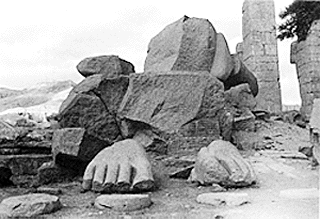
OzymandiasIn invoking totality and sublimity, ruins have been read as particularly vivid allegories of power and sovereignty--and their vicissitudes. Take, for instance, Shelley's "Ozymandias." Here the poet relates the tale of a traveller coming across a desert ruin, the toppled remains of a vast sculpture of power. On its pedestal
            these words appear:
"My name is Ozymandias, king of kings:
Look on my works, ye Mighty, and despair!"
Nothing beside remains. Round the decay
Of that colossal wreck, boundless and bare
The lone and level sands stretch far away. (11)
The levels of allegory and irony are complex. The inscription, for instance, with its injunction to despair, was presumably first intended to be interpreted in terms of the king's transcendent and overarching authority. Yet the mighty could now be tempted to despair for quite another reason: because in the fallen desolation of the broken monument they can perceive the temporary nature of even the most overweening despotism. But, in yet another twist, the fact that this missive, however ruined, endures even as all around the civilization over which Ozymandias presided has faded without trace, could also be seen to bear out the truth of the sentiment: that the signs of transcendence prevail over the most calamitous of social and natural catastrophes.

In other words, long after all memory of his kingdom has disappeared, long after all detail of the social order that he secured has faded into the real of this desert, we still remember the name of Ozymandias. The ruin ensures (to paraphrase Benjamin again) that his legacy has transcended history, by becoming immanent with nature itself. "In the ruin history has physically merged into the setting" (177-178). This is Ozymandias's final triumph.

And this is thanks to the power of narrative, which again here is multilayered. We have not only the inscription--which itself implies a prior order, the imperative of temporal power. We also have the fact that Shelley's poem consists almost entirely (all bar the first line) of the reported speech of an un-named "traveller from an antique land." Whose account is then repeated, recorded and enshrined, in published verse.

So here's the challenge: is there any way to resist the lure of narrative? To undo the symmetry between ruin and allegory? To see, in short, the ruin in itself, rather than as sign of an uninterrupted idea of sovereignty?

Sunday, January 29, 2006

recognition

[Customary apologies for meta-blogging...]

This blog has been nominated for an award. Not that it is the only blog to be so nominated: it is among 300 up for a "Koufax Award" in the category "most deserving of wider recognition".

Which is, itself, a form of recognition. And what's not to like about that?

Most of the 300 are very much focussed on the US political and foreign policy news agenda. But among other notable blogs on the list for this category are: the excellent 3 Quarks Daily; Jodi Dean's I cite; the pugnacious Lenin's Tomb; the "theory" group blog with which I am involved, Long Sunday; one of the better political blogs, Opinions You Should Have; and then how could I not mention We move to Canada?

Saturday, January 28, 2006

tiredness

"The body is never in the present," Gilles Deleuze notes, "it contains the before and after, tiredness and waiting. Tiredness and waiting, even despair are the attitudes of the body" (Cinema 2 189).

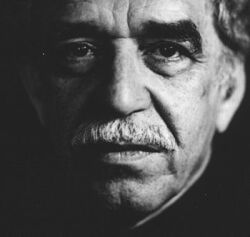
Gabriel Garcia MarquezGabriel García Márquez's "No One Writes to the Colonel" is concerned above all with tiredness and waiting--and so also the corresponding attitudes of the body. It provides, therefore, a version of what Deleuze terms the "time-image":
the series of time. The daily attitude is what puts the before and after into the body, the body as the revealer of the deadline. The attitude of the body relates thought to time as to that outside which is infinitely further than the outside world" (189)
The story opens with the colonel of the novella's title making his wife a cup of that ubiquitous stimulant, coffee, banishing tiredness with caffeine. The process is described in all its material determinants: the ground beans, the boiling fluid, and a series of containers that themselves leech into the resulting mixture as he "scrape[s] the inside of the can with a knife until the last scrapings of the ground coffee, mixed with bits of rust, fell into the pot" (109).

At the same time, we also get an early insight into the physical maladies that ail both the colonel and his wife. He finds his gut and stomach affected: "the colonel experienced the feeling that fungus and poisonous lilies were taking root in his gut" (109). She "had suffered an asthma attack" the previous night and "sip[s] her coffee in the pauses of her gravelly breathing. She was scarcely more than a bit of white on an arched, rigid spine" (109, 110).

The pair's deteriorating corporeal condition is a direct result of their long wait for the colonel's overdue pension. "For nearly sixty years--since the end of the last civil war--the colonel had done nothing else but wait" (109). And in the novella's sixty or so pages that follow, there is not much in the way of action except for the small routines that occupy the couple in their quiet, desperate poverty.

In the first few of these pages, the colonel makes coffee, winds the pendulum clock (one of their few remaining possessions, a constant reminder of time's passage), sees to the rooster they are keeping for a forthcoming cockfight, seeks out his suit, shaves, dresses... "He did each thing as if it were a transcendent act" (112). But of course these habits are far from transcendent; they are the endlessly iterated reflexes of a life spent waiting for transcendence, for a response from that department of state bureaucracy charged with allocating money to war veterans.

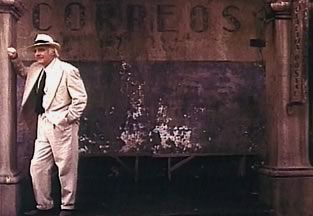
For of all the colonel's routines, the most symptomatic is his weekly trip down to greet the mail launch, follow the postman to the post office, and watch him sort the mail. "And, as on every Friday, he returned home without the longed-for letter" (127).

Colonel waiting
Still from the film El coronel no tiene quien le escriba

These are, then, bodies that have yet to be scripted into the national narrative. The colonel frequently and somewhat obsessively casts his mind back to his role in the revolution--in which ironically he himself was a type of mailman, whose own arduous journey delivering funds for the war is somewhat belated, arriving only "half an hour before the treaty was signed" (131). But he receives a receipt for his delivery, a proof of his service, and can't believe that it can now have been mislaid in the national archives. "'No official could fail to notice documents like those,' the colonel said" (131).

But indeed, despite the myriad documents and missives that circulate through the story--newspapers, pamphlets, an air-mail letter for the local doctor--the story emphasizes the lives and experiences that never achieve representation. All this writing is characterized by its absences, its lacks. The national papers are subject to censorship, demanding but also frustrating suspicious interpretation: "'What's in the news?' the colonel asked. [. . .] 'No one knows,' [the doctor] said. 'It's hard to read between the lines which the censor lets them print'" (119). While there's little hope that any outsiders will interest themselves in local happenings: "'To the Europeans, South America is a man with a mustache, a guitar, and a gun,' the doctor said, laughing over his newspaper. 'They don't understand the problems'" (127).

And though there are also clandestine missives and messages that attempt to make up for this representational lack, these endlessly say "the same as always," and the colonel doesn't even bother reading them (137).

Waiting, waiting, the colonel and his wife are subject to a "slow death" (165). But almost to the end, they maintain their patience, however much it is tried in their various squabbles as they figure out strategies to keep their bodies at least semi-nourished. Should they sell or keep the clock, and above all the rooster whose fight might lead to a big pay-out? "But suppose he loses," objects the wife (165).

In the end, the couple are reduced to something like what Giorgio Agamben terms "bare life". What are the two then to eat? And yet it is, strangely, this condition, in its loss of hope for transcendence and realization of pure, immanent materiality, that is portrayed as a moment of almost ecstatic ascesis. After all his hesitations, his anxiety, after all the ways in which he is ignored or taken advantage of by the state and local notables alike, somehow the waiting is over:
It had taken the colonel seventy-five years--the seventy-five years of his life, minute by minute--to reach this moment. He felt pure, explicit, invincible at the moment that he replied:

"Shit." (166)
(In the meantime, it would seem that García Márquez himself is now tired of writing.)

Friday, January 27, 2006

superheroes

[I've temporarily interrupted the hiatus over on Latin America on Screen for an analysis of Kill Bill.]

Kill Bill posterPerhaps surprisingly, at the end of a two-part movie extravaganza that's so much a homage to pop culture Orientalism, the climactic "final chapter" of Quentin Tarantino's Kill Bill turns out to be a rather sedate melodrama in Latin American setting.

It's true that plenty of the preceding action has also taken place on the Southwestern frontier: Texas and Southern California. The shift south of the border is, then, not unlike the move in the Tarantino-penned From Dusk to Dawn from an extended crime sequence in the US desert to the occult sensuality of a Mexican biker bar.

Still, the sudden and (here) almost random displacement is jarring in both films.

More...

Thursday, January 26, 2006

duration

Another short post, mainly a placeholder. I very much like the following image, by Russian photographer Alexey Titarenko:

Crowd
Viewed from the perspective of a slight temporal extension or duration, running together or blurring the precise chronometric moments fixed in ordinary snapshots (not quite sub specie aeternitatis, but getting there), the crowd shows its commonality. Individuality disappears even as elements of singularity (hands, shoes) remain readily discernable.

From lens culture via Space and Culture.

Wednesday, January 25, 2006

brain

Via 3 Quarks Daily, an MSNBC report of an experiment on brain activity in response to politically oriented stimuli:
"We did not see any increased activation of the parts of the brain normally engaged during reasoning," said Drew Westen, director of clinical psychology at Emory University. "What we saw instead was a network of emotion circuits lighting up, including circuits hypothesized to be involved in regulating emotion, and circuits known to be involved in resolving conflicts." [. . .]

Then, with their minds made up, brain activity ceased in the areas that deal with negative emotions such as disgust. But activity spiked in the circuits involved in reward, a response similar to what addicts experience when they get a fix, Westen explained. [. . .]

"None of the circuits involved in conscious reasoning were particularly engaged," Westen said. [. . .]

Notably absent were any increases in activation of the dorsolateral prefrontal cortex, the part of the brain most associated with reasoning.
Now, the interpretation put on these results, by MSNBC if not by the Emory team itself, concerns the irrationality of partisan "bias." "Nonpartisanship" is such a strange fetish in US media and political culture.

But of course political habits are about affective fixes; and political responses are affectively conditioned before they are reasoned--or even ideological--judgements. No great surprise or scandal there.

Update: further discussion at Alas.

Tuesday, January 24, 2006

portrait

Rolf Harris portraitIt's a serious business painting the sovereign. And it remains so even when, as in the most recent instance with Rolf Harris's commission, entrusted to a comedian.

Rolf is one of those Australians probably better known in the UK than in his homeland, in that he has taken it upon himself to represent the Antipodes to the (former) motherland. This he has done through a musical oeuvre that began with "The Wild Colonial Boy" (Rolf Harris Thursday Night at the Down Under Club London [1957]) and notably includes "Tie Me Kangaroo Down Sport" (Relax with Rolf [1960], but much reprised since).

Rolf crosses genres with gusto: he has inducted the Brits into the sound of the digeridoo, and has also spent much screen time demystifying the world of high art, with his mid-composition catchphrase of "Can you see what it is yet?" (One must imagine Michelangelo shouting down the same question from his scaffold while halfway through the Sistine Chapel ceiling.)

And as Rolf's trademark goatee has slowly turned white with age, British television viewers have come to see him less as an over-chirpy annoyance and more as the object of some affection. He is, after all, in many ways our creation, a fixture in the media landscape since time immemorial and for reasons long since forgotten.

The same is, mutatis mutandis, true of Queen Elizabeth II, of course. Like Rolf, the queen is a hangover from a previous age: born into Empire, and still intangibly associated with that curious and much misunderstood international organization, the Commonwealth; her contours gradually softening in old age; for most of us, she has simply always been there, consistently if periodically mentioned in the media, with a glitzy special on the telly at Christmas. So it makes a certain sense that Rolf should be her latest portraitist.

(Hitherto, Rolf's closest brush with the political came with Margaret Thatcher's unexpected and emotional revelation on Desert Island Discs that his version of "Two Little Boys" was her favourite song of all time.)

The Queen, detailRolf declared that his aim was to represent the queen as "one of us." To put a smile on her lips, and so also on ours. Queenie would be everybody's granny: a little rumpled, a little out of it, sitting in the corner, mostly ignored as the conversation goes on around her.

Close up, however, Rolf also manages to give the Queen's eyes a maniacal glint. Does this pensioner's harmless façade harbour untold dreams of power?

For Rolf reveals the real predicament of representing royalty: how to give a sense of the monarch's two bodies, the mortal and the juridical. With Rolf's portrait, it is in the eyes, but also the rather awkwardly rendered hands, which reveal not only our artist's struggles with draughtsmanship, but a definite tension, too. The queen is sitting under some kind of duress: she'd rather be with the corgis. But here she is, paraded again for our inspection, the face (and head) of state.

Monday, January 23, 2006

election

It may have passed the attention of some that Canadians have been voting today. Not all of them, mind you: Craig of theoria and RIPope of Long Sunday have both made clear that they have better things to do. Or rather, that they are holding out for such better things. In RIPope's words:
it is precisely because I feel so much pathos that I won’t just make myself feel a bit better by voting. I’m willing to suffer this hell for the sake of something Other.
There are, on the other hand, two scare stories circulating to encourage people to the polls.

One, much promulgated by the Liberal party, is that the election of Stephen Harper's rejuvenated Conservative party would mean the rise of American-style neoconservatism; Harper would be "Bush lite." This warning worked well enough at the last federal election, in June 2004, when a swing away from the Conservatives in the final few days of the campaign ensured the Liberals would have enough support to form at least a minority government. Subsequent revelations of Liberal corruption, however, mean that fewer are now persuaded that they are a much lesser evil than the Conservatives.

The other scare story, a version of which can be found in Dave Pollard's "Mulroney's Revenge", is that this election could mean the end of Canada. Unable to win a clear majority themselves, the Conservatives will form an unholy alliance with the Bloc Quebecois. The alienated West (the Conservatives' power base) and the alienated Francophones will together conspire if not to the physical and geographical break-up of the nation, at least to gut the Federation of all power.

But both scare stories are, in essence, one and the same: they prey on the fear of becoming American. In Pollard's words:
We will then be America Lite -- still bristling at the thought that we're just like Americans, but with our assets even more substantially owned by Americans than they are today, an economic colony with the fading illusion of relevant political independence. Instead of being the potential role model for the 21st century, we will be the country of great promise that was never realized.
This is a theme that obsesses Canadian pundits and commentators. Here, plucked almost at random, is another example, taken from one Rafe Mair and his two-part story, "Why Canada is Unraveling Again" and "How to Deal with our Next Unity Crisis":
The country teeters on the chasm of national disintegration and the federal government and indeed opposition act as if nothing is happening for fear that simply by admitting that there's a problem will itself encourage a bad result.
The irony is that to avoid becoming American, the only solution these anxious nationalists can devise is to be a little more American:
I think it useful to look at how the Americans did it in 1787 when, with equal representation from all states, large and small, they came up with what is unquestionably the best constitution ever made.
How to be like the US, without exactly being the US? How to be "America lite" without quite being (perceived as?) America lite? That seems to be the question around which much of contemporary Canadian politics turns.

Which is hardly a question that would get me up and running to a ballot box.

And surely, as Craig notes, the refrain of "Well, at least we aren't American!", the more or less smug fetishization of small differences, hinders rather than helps any real political analysis.

Sunday, January 22, 2006

chance

BorgesOne of the curiosities of Jorge Luis Borges's stories is the way in which they combine the most rarified of philosophical abstractions with an almost obsessive focus on violence, death, and the body.

In one of his earliest books, Historia universal de la infamia (A Universal History of Infamy), Borges is interested in how violence is narrativized: in the semi-mythical narratives that accrete around crime and criminality, preserving but also domesticating our fear of those who live on and transgress society's margins.

"The Widow Ching--Pirate" is particularly concerned with the intersection between storytelling and warfaring. Its plot details the way in which this notorious pirate "queen" is compelled to surrender ultimately not by force, but by her own interpretation of signs both natural and man-made:
The moon grew thin in the sky, and still the figures of rice paper and reed wrote the same story each evening, with almost imperceptible variations. The widow was troubled, and she brooded. (23)
The widow feels that she herself has been emplotted in this narrative that she reads in the skies, a narrative slowly coming to its "inevitable end," either "infinite pardon or infinite punishment" (23). And in surrendering she both accepts and influences her fate, choosing to seek pardon rather than punishment, or at least to take her chances.

It is then chance--the unpredictable, undecideable, and indeterminate--that also connects violence and narrative. Texts are constantly subject to "almost imperceptible variations," some of which may have the most dramatic of consequences. "Pierre Menard, Author of the Quixote", though in many ways a playful satire of avant-garde literary pretensions, alerts us to the different interpretations that can be generated by barely (here, absolutely) imperceptible differences between texts:
It is a revelation to compare the Don Quixote of Pierre Menard with that of Miguel de Cervantes. Cervantes, for example, wrote the following (Part I, Chapter IX):
...truth, whose mother is history, rival of time, depository of deeds, witness of the past, exemplar and adviser to the present, and the future's counselor.
This catalog of attributes, written in the seventeenth century, and written by the "ingenious layman" Miguel de Cervantes, is mere rhetorical praise of history. Menard, on the other hand, writes:
...truth, whose mother is history, rival of time, depository of deeds, witness of the past, exemplar and adviser to the present, and the future's counselor.
History, the mother of truth!--the idea is staggering. (94)
Again, we shouldn't forget the comedy here, but Borges returns endlessly to the drastically contrasting outcomes that can be the result of the smallest initial differences: in, for instance, "The Garden of Forking Paths" (and compare the Gwyneth Paltrow vehicle Sliding Doors) or "The South".

So in "The South," it is not so much that there is any one pivotal moment: there are many, all of which cumulatively lead the plot to its narrative conclusion, and the story's protagonist, Juan Dahlmann, to his untimely end. But each of these pivots on which the story and Dahlmann's fate rests is presented as the lightest of touches: literally so, in the instance of the injury that leads him to septicemia and the sanatorium. "Fate can be merciless with the slightest distractions," comments the story's narrator:
That afternoon Dahlmann had come upon a copy (from which some pages were missing) of Weil's Arabian Nights; eager to examine his find, he did not wait for the elevator--he hurriedly took the stairs. Something in the dimness brushed his forehead--a bat? a bird? On the face of the woman who opened the door to him, he saw an expression of horror, and the hand he passed over his forehead came back red with blood. (174-175)
The choices we make only half-aware (taking the stairs rather than the elevator) combine with half-noticed events (a brush on the forehead) to produce unexpected and sometimes fatal results. This particular event is here later mirrored when, in a store in the south of the story's title, "Dahlmann suddenly felt something lightly brush his face" (278). But it would be wrong to say that it is his reaction to this encounter--accepting a young thug's challenge to a fight--that seals his fate. For one thing, what's required is the intervention of yet another "unforeseeable" intervention, a gaucho throwing Dahlmann a weapon; for another, we might also say that our protagonist's conclusion has been inscribed in his ancestry, his grandfather's own death fighting in the south, and the "pull" of that lineage.

Moreover, it's not even as though the story ends so very determinately: it requires the reader to imagine a perhaps inevitable conclusion: "Dahlmann firmly grips the knife, which he may have no idea how to manage, and steps out into the plains" (179; my emphasis).

Finally, "The Library of Babel" examines narrative, and its infinitude, and also the violent passions that it can provoke, with its image of librarians searching for the elusive (but assuredly existent) volume that would vindicate their lives:
Thousands of greedy individuals abandoned their sweet native hexagons and rushed downstairs, spurred by the vain desire to find their Vindication. These pilgrims squabbled in the narrow corridors, muttered dark imprecations, strangled one another on the divine staircases, threw deceiving volumes down ventilation shafts, were themselves hurled to their deaths by men of distant regions. Others went insane... (115)
The despairing realization here is of the dark nexus between chance, certainty, and totality. For it to be certain that the library contains precisely the volume that the pilgrims seek, then the library has to be infinite, to contain the totality of all possible books. Which means that the chance of finding that particular text "can be calculated to be zero" (115).

As such, even in the perfectly ordered world represented by the all-encompassing universe that is the library, we are left at best to take, but also then to relish, our chances.

Library of Babel

Saturday, January 21, 2006

carnivalesque

Yawar fiesta cover
That's what they had wanted! To shock Puquio. To take charge [ser mando], if only for one day, of the whole town. (133)
Arguedas's Yawar fiesta dramatizes a complex series of power struggles. What's at stake is also the format and interpretation of those struggles.

The focus is a festival in the Andean town of Puquio, a festival celebrated on Peru's national day (July 28th), but whose roots reach back to the founding trauma of Spanish colonization.

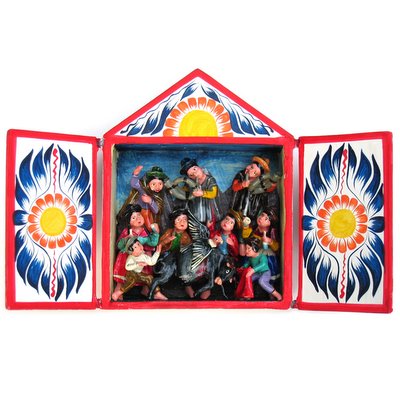
Traditionally, the centerpiece has been a rough and ready bullfight, in which representatives of the various ayllus that constitute the town's indigenous majority compete for the honour of their clan by braving the fiercest wild bulls brought down from the remote upland puna. This contest can be a brutal and bloody affair, in which young men fortified by copious quantities of drink hurl themselves at the untamed animals, often coming off worst in the encounter. Indeed, much of the anticipation and excitement surrounding this "Festival of Blood" is provoked by the evident danger and the likelihood of serious injury or death.

This year, however, things will be different. An order has come down from the government that bans such amateur displays. The subprefect assigned to the town is determined to ensure that a "civilized" display will replace customary "savagery." He enlists the local notables in his cause, who in turn call upon townsfolk who have emigrated to Lima. These émigrés, driven by their experience with urban modernity but also new intellectual fashions, are all too keen to return to their hometown in the service of this civilizing mission. They hire a professional bullfighter, a Spaniard eking out the twilight of his career, and bring him to the Andes determined to teach a lesson as much to the provincial oligarchy as to the "backward" Indians.

So just as the ayllus compete among themselves for prestige, as well as to show the mistis what indigenous organization, bravery, and force of will can achieve, so also the local landowners and merchants are split: some more favourable to the modernizing influence brought by the state and even by a radicalism inspired by the Marxist José Carlos Mariátegui; others, including the largest and most feared landowner of all, strangely allied with the Indians they admit to oppressing in their desire that this semi-Rabelasian carnival should go ahead.

Nothing is simple in Arguedas's delicately poised account. It is the indigenous, for instance, who have themselves opened Puquio up to modernization by building, of their own accord and with impressive industriousness, the highway that links the highland town to the coast. We are led to feel a certain sympathy for the gamonal Don Julián as well as for the shopkeeper Don Pancho, both of whom profit from exploitation, but who are incarcerated by the subprefect for daring to champion tradition against the state's purported rationalization.

Even the Lima-based mestizos are treated with much subtlety and ambivalence: they are at least prepared to recognize and name the oppression endemic to these semi-feudal relations, even if their educative desires are portrayed as ill-judged and arrogant: "We'd need a thousand years to save the Indians from their superstitions," says one (128). "That depends," another replies.
If we were the Government, my brothers! What would happen? We would do away with the causes that have allowed primitivism and servitude to survive for so many centuries. (129)
These men, whose most vocal member is the "student" Escobar, aspire to be the organic intellectuals of a liberated peasantry. They show their willing affiliation with the indigenous by literally putting their shoulders to the effort of bringing the bull Misitu into town at the same time as they try to frustrate the very purpose of that effort, by also importing the professional matador to substitute for Misitu's indigenous challengers.

In the end, the carnivalesque trumps this attempted imposition of a hegemonic relation. The Spaniard serves up a particularly unedifying spectacle, running for cover almost as soon as Misitu is let loose in the ring. The mistis themselves, led by Puquio's mayor, reject the subprefect and the émigrés' authority alike, calling on the indigenous challengers to enter the scene. And blood is indeed spilled. The novel ends with the mayor's assertion of nativism, of pride in the locality and in the prowess but also the sacrifice of its indigenous multitude:
Do you see, Mr Subprefect? These are our bullfights. The true yawar punchay! (156; emphasis added)
And the possessive "our" is an assertion of ownership, but also the recognition of a complex totality in which the dominant are finally dependent upon the subaltern's constituent power.

Yawar Fiesta diorama

Tuesday, January 17, 2006

landscape

topographic map of area near PuquioArguedas portrays the Peruvian landscape as thoroughly imbued with affect. Indeed, he provides an affective topography of the highlands, and is concerned above all with gradients or folds, with charting the more or less sudden switches between different affective states: from sadness to happiness, fear to pride, cowardice to bravery, and so on.

Nature, human structures, groups, and individuals all variously affect and are affected. And in the contagion or influence that connects these different bodies, their distinctions come to seem less important than ever. So, for instance, in "Los escoleros" we see how as the schoolboys play, "fearing nobody [. . .] we filled the heavens with our happiness" (Relatos completos 67); but vice versa, equally "during the night, the sky cleared up a little and the stars happily lit up the village" (61). Or, as the narrator recounts earlier on, "the whole world seemed at peace. [. . .] The freshness of the morning and the happiness of the maternal stream consoled me once more" (53-54).

As the above reference to a "maternal stream" implies, some of this emphasis on affect being common to geographical features as much as to human individuals is due to the indigenous belief that the hills have personalities and character traits. But it's not so much a personification or humanization of nature as, by contrast, a recognition of a common, impersonal but responsive, substrate that underlies the human and the inhuman alike.

This recognition of commonality can be joyous, and vivifying; it can also be threatening, especially when (staying with "Los escoleros") young Juancha believes that he might literally be absorbed by the large rock, Jatunrami, that in a fit of exuberance he had climbed but from which he finds himself unable to descend: "I lost hope. Truly, Jatunrami did not want to let me go. I felt that at any moment a huge black mouth might open up in Jatunrami's head and that it would swallow me up" (51).

It's at this point that Juancha, like Arguedas himself child of a mestizo lawyer, in panicked Peter-like denial insists on his difference: "I'm not for you; I'm son of a white lawyer [. . .] my hair like corn, my eyes are blue; I'm not for you!" (52). The irony being that Juancha uses Quechua expressions ("Tayta"; "mak'tillo") and sentence forms in his address, showing the extent of what Angel Rama would term his transculturation.

Though it is not as though the mistis (whites or mestizos) are absent from this affective landscape. "El vengativo," one of the less characteristic of Arguedas's stories, in epistolary form and told from the perspective of a "principal," makes clear the emotions that course through the veins of the dominant: "how happy man can become through rage as much as through love" (Obras completas 33); "my heart was engorged with rage" (35).

Nor is it quite that the indigenous feel only happiness while the principals are defined solely by their rage: the common people ("comuneros") too have learned to hate, if often ineffectively and impotently, while in "Yawar (Fiesta)" the mistis soon repent of the rationalizing innovations that they themselves have imposed upon traditional Indian celebrations. As the drunken native bullfighters replace the refined but cowardly imported Spaniard, the misti spectators' "hearts jumped with elation. And as they could not resist the force of their contentment, they broke out into nervous applause, shook each others' hands; they congratulated themselves. 'At last!'" (133-134).

It's in these twists and turns, this scarred and unpredictable landscape, these affective dependencies and openings, that much of the interest and motivation of Arguedas's stories reside.

Monday, January 16, 2006

fragile

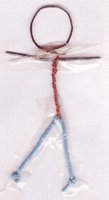
Glass GraduateA brief note in the July 2003 edition of The American Journal of Psychiatry, entitled "Delusional Self-Portrait", concerns the case of "Mr A, a 32-year old Caucasian man" who had asked
to have some wires that stopped him from sleeping removed from his leg. He said there were many more wires inside his body that he had discovered after experiencing that "a magnetism of storms" produced multiple internal sensations in the form of erratic contractions and "electric currents," which he tried to alleviate by sticking needles into himself so as to "discharge the current by touching the wires with a metallic object."
Mr A depicted his condition by means a stick figure, made of wire, which he had taped to the cover of his diary: "That’s what I’m like inside—all made of metal."

The psychiatrists treating him diagnose "cenesthetic schizophrenia," a condition characterized by "a peculiar conservation of affectivity." Chambers defines cenesthesis (also, coenaesthesis) as "general consciousness or awareness of one's body." Webster defines it as "common sensation or general sensibility." It is, in short, affect without specific object. It is affect in common, affect as such; an unspecific but decidedly concrete consciousness of materiality.

It is not then so surprising that the treatment prescribed for Mr A should have been markedly literary: the point was presumably to (re-)enable representation, to give this non-specific affect subject and object. So the patient was recommended to read Miguel de Cervantes's "El licenciado Vidriera" ("The Glass Graduate"). Upon reading Cervantes's short story, we are told, Mr A gained a measure of relief:
I was relieved that somebody else had experienced the same as me, and I realized that reality is a very broad, diverse concept, not something unique and the same for everybody.
This Golden Age "exemplary novel" thus proves its exemplarity: providing both a literary precursor against which experience can be (re-)cast as similar, a repetition; and also ironically modelling singularity, that is the unrepeatable, itself. The singular becomes representable only through its iteration, its doubling.

We have something here of what Jacques Derrida, in Monolingualism of the Other, terms "the exemplary or testimonial singularity of martyred existence" (27; emphasis in original). Cervantes becomes a proleptic witness to Mr A's pain. And Derrida is precisely interested in this establishment of representation by means of the paradoxical meeting of the singular (an unrepresentable affect, a pain no-one else can feel) and the universal (a sign system available to all):
As regards so enigmatic a value as that of attestation, or even of exemplarity in testimony, here is a first question, the most general one, without the shadow of a doubt. What happens when someone resorts to describing an allegedly uncommon situation [. . .] by testifying to it in terms that go beyond it, in a language whose generality takes on a value that is in some way structural, universal, transcendental, or ontological? When anybody who happens by infers the following: "What holds for me, irreplaceably, also applies to all. [. . .]" (19-20)
The only twists here are, first, the pre-emptive character of Cervantes's exemplarity--a "classic" written almost 400 years ago--and second, the analytic scene. But this is precisely how analysis works: transforming immanence into a relation with transcendence through representation, by provoking identification and recognition on the part of the analysand: the conjunctive synthesis, "so that's what it was!" (Deleuze and Guattari, Anti-Oedipus 20).

Miguel de CervantesThat moment of realization is, of course, the fruit of interpretation. In his Prologue to the Exemplary Novels Cervantes underlines, albeit circuitously and somewhat ironically, the ways in which they demand readerly hermeneutics:
I have called them Exemplary, and if you look closely, you will see that there is not one from which you cannot extract some profitable example; and if it were not for the fact that it would make this over-long, perhaps I would show you the delicious and wholesome fruit which could be pulled both from the collection as a whole and from each one alone.
He is not going to show us the moral to be gleaned from his writing, precisely because a large part of that moral--perhaps the moral--is the requirement to "look closely" and to decipher the texts' meanings, apparently for yourself (your self?).

The story prescribed to treat Mr A, "The Glass Graduate," is in many ways an allegory of interpretation: it deals with clarity and obscurity, and, equally, the difficulties of knowing either the self or the other.

Very briefly, the plot concerns a boy, who initially adopts the name Tomás Rodaja and is in turn adopted by two "gentleman students" from Málaga and sponsored through the course of studies in law at Salamanca. He subsequently takes up with a Captain of the army, and tours Italy before going on to Flanders. Returning to Salamanca, he is poisoned by an ardent suitor, as result of which
The unfortunate young man imagined that he was all made of glass, and in this delusion, whenever anyone approached him, he would shriek, begging and pleading with coherent words and arguments, for people not to come near, because they would break him, because really and truly he was not as other men--he was made of glass from head to foot. (73)
Taking as his name the Glass Graduate, or just Glass, in his madness the youth wanders the streets delivering caustic aphorisms on contemporary social mores, and as such becomes something of a character and celebrity. After two years as a semi-itinerant holy fool, sleeping and travelling packed in hay to ensure that his fragile body is well protected, he is rather abruptly cured by a Hieronymite friar. But, as a notorious former madman, he is unable to return to the practice of law, so with the name now of Tomás Rueda he sets off instead to seek fame in arms in the company of his friend Captain Valdivia.

The graduate's sense of self is shown to be brittle in a host of aspects. As I've indicated, he's forever changing both his social role and his name: there's more than a little of the picaresque about his adventures, except that he is for all intents and purposes without character; he is instead consistently renamed and re-adopted by those around him. We learn next to nothing about his background, and never, for instance, learn his real name (if indeed he has one). Until his final (un-narrated) incarnation as valiant soldier, he is notably shy to commit or invest in anything or anyone. (Elaine Dunn's "Fashioning Identities in 'El licenciado Vidriera'" is good on the ways in which he "resists all forms of intimacy and social relations" [130].)

He never really acquires an ego, then: he serves rather as a lens through which others are led to believe they see the hypocrisy and corruption of their own society all the clearer. In this sense, he's not far wrong to imagine himself as made out of glass. (Indeed, as George Shipley implies in "Vidriera's Blather", perhaps that's about the sum total of what he's not wrong about.)

But at least he is of interest. For all the desire for a cure, or for all that this like the other exemplary novels is designed to be curative, in the end the normalized subject is, frankly, portrayed as rather boring. In fact, he's not portrayed at all, but is dispensed with in a final, single sentence, paragraph. When the exemplary becomes universal, it no longer holds any pull on narrative; it has simply flattened out into language as such. It is only in so far as the exemplary remains singular, and so resists representation, that it also demands narrativization, even if that narrative ultimately irons out and eliminates the very singularity that is at first so seductive.

The same is true, for instance, of the eponymous "Jealous Old Man from Extremadura." As soon, at the tale's resolution, as he comes to his senses and gives up his jealousy, he is promptly dispatched without further ado, expiring within seven days and a single sentence. (On a rather different tack, I heartily recommend Shirfa Armon's analysis of this story in "The Paper Key", which persuasively argues that it is a critique of Spain's unprofitable investment of American spoils, and an anticipation of the shift from faith in precious ore to the fluidity of paper money.)

Finally, though, is there not another way of thinking about creatures of glass? One outlined in a poem by Keith Walton that also takes the title "The Glass Graduate". This gives us a voice whose glass self is not distanced and packaged away from the world, but vibrantly expectant and affectively, joyously, erotically responsive to the slightest liquid touch:
I sing
          as the wetted finger
                                           circles my rim
vibrate
wait
terrified -
                  Sing!           Sing!           Sing!

Sunday, January 15, 2006

Bachelet

Michelle BacheletAnd now Chile.

Also here, from Las Últimas noticias, and here from La Tercera; El Mercurio has yet to register the news... update, that's not quite fair as El Mercurio Online, a separate site, has, under the subhead "Histórico triunfo de la candidata de la Concertación".

Only the second woman to be elected head of state in South America, a socialist and former detainee under Pinochet, a single mother in a country that only legalized divorce last year.

(Other elected women heads of state in the region: Violetta Chamorro, Nicaragua, in 1990; Janet Jagan, Guyana, in 1997; and Mireya Moscoso, Panama, in 1999. The first woman head of state in the Americas was Isabel Perón, from 1974 to 1976, who assumed power on the death of her husband. Indeed, all these four were widows of prominent public figures.)

Here's Michelet's campaign blog. Its post-victory entry stresses the affective, reading in part:
Still it's not words that matter today, but the emotion, the embraces, the happiness of the friends with whom we have shared this long campaign, all those who put up posters, went door to door, convinced a friend to share a dream, the possible dream of a fairer country in which a woman who was once the victim of hate is today the President-elect of Chile . . . We have made history. But that history has only just begun.
And el teléfono rojo, a group blog dedicated to covering the election. Who note that one Chilean TV channel showed Bullworth immediately after concluding its election coverage.

See also Matthew Søberg Shugart, who at Fruits and Votes stresses the continuities rather than the changes registered by this election, in that "It has now been 48 years since Chileans elected a president who was neither a Socialist nor a Christian Democrat". Which is true enough, but the move within the Concertación from Frei to Lagos to Bachelet is also definitely a leftward drift. (While the Concertación and the Unidad Popular are hardly cut from the same cloth.)

But for a well-merited word of caution, here's Marc Cooper: "Her potential to enact more than symbolic change, however, is something that must be viewed with a certain dose of skepticism". Echoed by Beautiful Horizons, who underlines particularly the issue of military finances.

Friday, January 13, 2006

name change

[A service announcement...]

See above for this blog's name change. If, however, there is any kind of clamour calling for the return of "Posthegemonic Musings," I may change it back.

[Here ends the service announcement.]