Sunday, January 21, 2007

tolerable

Isabel AllendeIsabel Allende's Eva Luna is perhaps not a terrible book; but nor is it a very good one.

It particularly goes off the rails towards the end as the various narrative strands--the story of eponymous Eva's success as a writer; the long-awaited consummation of her romance with film-maker Rolf Carlé; and her abandonment of previous love interests guerrilla Huberto Naranjo and General Tomoleo Rodríguez--come to an end more or less abruptly and unconvincingly. In this light, Allende's decision to give us two possible conclusions, in one of which Eva and Rolf's love eventually dissipates whereas in the other they live happily ever after, is less a sign of metafictional play than a signal that the book itself has ground to an unceremonious halt.

All this in a book that sets out to celebrate the power of the word, and of story-telling in particular, yet in which (as our narrator tells us) "when all was said and done, everything came down to the elemental fact that I had found my man" (285). All the gestures towards politics, whether feminist or socialist, half-hearted at the best of times, are sacrificed for the sake of a romantic dénouement that even Eva Luna herself finds vaguely unsatisfying.

This sense of dissatisfaction permeates the novel, not least when it comes to the various stories within stories that it presents. Eva Luna gains an audience among her friends by reworking the stories provided her by mass culture: "They'd ask me to tell them what would happen next in the soap opera of the day, and I'd improvise a dramatic conclusion that never coincided with the way things turned out on the radio, but they didn't mind" (121). Yet it emerges that the book we are reading is itself the basis of Eva Luna's own soap opera, one which goes by the title of Bolero; perhaps she's challenging us to come up with a more fitting end to her characters' serial adventures and (mis)fortunes.

If Eva Luna is some kind of doppelganger for Allende herself, it's notable that she is a writer unashamedly oriented towards the market. Throughout, she offers her stories in exchange for some kind of benefit; and as she suggests in the self-reflexive terms of the only story told within the novel itself, "she traveled all over touting her merchandise, adventure stories, mysteries, tales of horror or vice, all at a reasonable price" (262). She makes no grand claims for her fiction, only that in the face of an unknowable and chaotic reality she tries "to put a bit of order to so much chaos, to makes existence more tolerable. When I write, I picture life the way I'd like it to be" (280).

Is it too severe to characterize such sentimental escapism as "bad" literature? Perhaps, though it's notable how deficient it is when Allende (or Eva) comes to account for violence or any other unpleasantness: describing a torture scene, for instance, our narrator tells us "The officer lifted his hand, brought his arm back, and punched me. I don't remember anything else. I awoke in the same room, tied to the chair, alone, they'd taken my dress off. [. . .] I tried to move, but my entire body hurt, above all the cigarette burns on my legs" (183). No wonder Luna's response to another character's bloody suicide has been to clean things up and tell her corpse a story as though (almost) nothing had happened.

And it's an irony if Allende's readership comes to her work looking either for creative imagination or for some kind of political commitment, when all they get are these gestures.

Tuesday, January 16, 2007

cover

There's quite a lot you can judge a book by its cover. A book's cover is a very visible means by which publishers seek to sell their product to readers: indicating what kind of book they're selling, establishing associations to point to a particular market niche.

Isabel Allende's own website has a page featuring all her covers, at least of English translations. There are a variety of designs, though most of them feature cover art that bleeds to the edges. The design for Paula is the simplest, with prominent text imitating handwriting either side of a very small central image. Daughter of Fortune and Portrait in Sepia have covers more suitable to a classic: subdued, neither too busy nor too colourful.

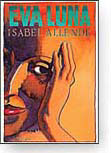
Eva Luna, on the other hand, has a cover dominated by a quasi-modernist painting of a woman's head in close up, in warm but also slightly menacing orange (in which the forehead and background merge), over which the book's title is superimposed in rather clashing green. There seems to be no other text and the overall effect is decidedly garish.

Eva Luna, SpanishHarperCollins (via its Spanish-language imprint Rayo) sells the book in Spanish in the US and Canada with an early twentieth-century sepia photograph and a crescent moon set against a dark brown ground and with a prominent recommendation from the Village Voice right alongside the title itself. Allende's name is more prominent than the title, but only marginally so; beneath is the reminder that she is also the author of La casa de los espíritus This cover is simpler and more tasteful, right down to the use of a lower case sans serif font.

Eva Luna, EnglishIt's Bantam (a mass market division of Random House) that sells the current North American English translation, whose cover depicts a woman writing against a colourful floral background. The type face is more elaborate, reminiscent of art deco, while the artwork itself is fairly interesting: faces lurk in the background; and on the desk at which a woman is writing (though she's looking straight at the viewer) can be found both a sepia photograph of what seems to be an Edwardian woman with parasol, and also a hand grenade. Again, there's something menacing about this cover, especially the woman's somewhat odd gaze, but here perhaps this disconcerting effect is deliberate, rather than accidental.

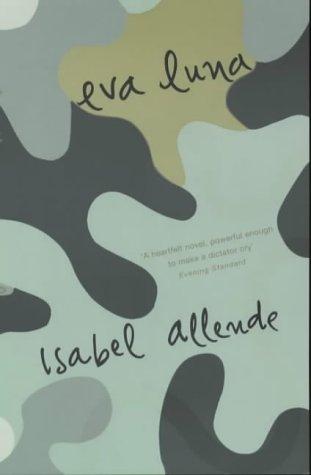
The Penguin (UK) cover picks up on the military theme, but takes it to some extreme: no longer the romantic image or woman's portrait, but an abstract study in camouflage, with a blurb from the Evening Standard placed aslant between title and author's name. I can't but think this is a strange and possibly counter-productive way to sell Allende's work. Maybe the idea is to position her more as an avant-gardist, and to remove all traces of femininity from her image.

Perhaps this is a tension for her publishers: whether to sell her as Virginia Woolf or as Gabriel García Márquez. Likewise, if on a different axis, there seems to be a tension between positioning her as a modernist, experimental writer or as an author of romances (albeit romances with an exotic and politicized edge). Where exactly does she lie on the scale that leads from Barbara Cartland to James Joyce? The truth is, as in so many other things, she's quite squarely in the middle.

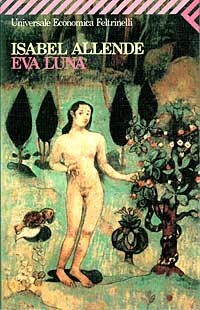
Meanwhile, here is the book in some other languages: Dutch, Czech, and Italian. The Dutch have gone for a fairly plain cover, with a childlike drawing; the Czechs have decided that sultriness is what will sell the story for them. It's not clear what exactly the Italians were thinking.

Eva, DutchEva, CzechEva, Italian

Again, Allende's own website has a page dedicated to covers of translations in a still wider range of languages, from Turkish to Japanese.

Tuesday, January 09, 2007

worst

Here's material for a meme, no doubt: what was the worst book you ever read, and why?

A quick search around the web, however, turns up several lists of notoriously bad films (e.g. Wikipedia's "Films considered the worst ever"), and indeed there's an annual award for bad films, the Razzies, but I can't immediately find anything similar for fiction.

There is the Bad Sex in Fiction Award; and also the Bulwer-Lytton Fiction contest, "wretched writers welcome." But nothing for entire books, so far as I can see.

[Update: I now see that The Observer started such a discussion a couple of years ago, though even in starting the debate Stephanie Merrick (who picks Wuthering Heights) notes that "if favourite books are subjective, nominating the 'worst' books is even more so". The ensuing comments, over 1100 of them, can be found here.]

Of course, a document such as the Vatican's Index librorum prohibitorum tried to establish some theologically-validated consensus on what makes a bad book. But not only is the question of moral danger rather different (if not altogether so) than the issue of aesthetic failure; also even the Vatican eventually gave up any attempt to distinguish between bad and good when it comes to literature.

Perhaps that's because there are just so many more books--and therefore so many more bad books than bad films. There are too many contenders. But perhaps it's because there's much less unanimity on what makes for a bad book than on what makes for a bad film.

Here's my contender for at least one of the worst books I've ever read... and what makes it even worse is that it's a trilogy.

Many years ago a co-worker and friend lent me Robertson Davies's The Cornish Trilogy (which consists of The Rebel Angels, What's Bred In The Bone, and The Lyre of Orpheus), telling me I must read them. And read them, I did; every word. Perhaps my effort to continue through these three thick tomes indicates some kind of masochism. Because almost every sentence I found ponderous, overwrought, and yet strangely banal.

I'm really not sure why I persevered in the effort. Maybe I thought that at some point Davies simply must turn the corner, that things had to improve. But no: the oh so slow trainwreck of language and plot continued inexorably, each sentence and each page as poor as the previous one. The trilogy was long; it was tedious; it was pretentious. And it gave no pay-off whatsoever.

Fortunately, I have repressed almost all memory of the books themselves. I only have the memory of the execrable experience I spent reading them. An experience I would be loath to repeat.

Meanwhile, I now find myself in a land in which Robertson Davies is a literary hero. The Canadian Encyclopedia declares that he is "acknowledged as an outstanding essayist and brilliant novelist". And I should admit that a couple of my other contenders for worst books also emanate from the Great White North--not least Elizabeth Smart's By Grand Central Station I Sat Down and Wept, though that at least has the benefit of a decent title and a commendable brevity.

But I should assure my Canuck hosts that there's no Canada-bashing here: I love the novels of Leonard Cohen and Michael Ondaatje, for instance. But Robertson Davies? Forget about it.

Crossposted to Long Sunday.

Monday, January 08, 2007

family

Literature and the family are intimately connected.

No doubt this is in part because the family is such a fertile source of narrative: stories are handed down from parents and grandparents to children and grandchildren; and also we tell ourselves and each other stories about the family in an effort, perhaps, to understand who we are and where we come from. These familial and familiar stories, for which we now draw on the narratives provided for us by psychoanalysis and culture at large, help to place us, to give us a sense of place. There's something reassuring even (or especially) about a story of troubled family origins. Perhaps it gives us a way out, but at the least a way to cope with and come to terms with ourselves.

There's also something about troubled families in particular that seems to demand a story. Perhaps it's the inherent interest of the "unhappy family," as Tolstoy's famous first line to Anna Karenina suggests. The family serves as something like a primordial site of speculation and gossip, as looks or words or anecdotes are exchanged about more distant relations: uncles and great-aunts, cousins and great-grandfathers.

But in the novel (at least) the family is not only context or source: it is also traditionally motivation or prospective future. Think of Austen's heroines and their search for a fit husband (and so another famous opening line, that of Pride and Prejudice). They're not just about coming to terms with origins, but also about leaving one family and starting up another, and the anxious moments of transition in between, the fear that in leaving the frying pan we are simply jumping into the fire.

So typically novels in end death, birth, or marriage: the end of a lineage, the beginning of another, or the establishment of a tie between lineages.

But the family is also a social metaphor for other sites within which identity is constructed, contested, or even broken down. For Latin America this is perhaps especially the case: Doris Sommer has famously argued that the region's foundational fictions are "family romances" in which the fate of the nation is allegorized through the vicissitudes of family plots. No wonder that this heritage should bear also on the literature of the twentieth century, that so many of the great books by which Latin America made its literary name should carry with them family trees, as though the novels themselves were merely commentary on such diagrams of familial interconnection.

Friday, December 22, 2006

prediction

A friend was asked for a prediction for what might happen in Latin America over the next twelve months. This is what I suggested (with a little help from another friend, Eric)...

Castro dies. Nothing happens. So some fool Florida gusano tries to assassinate Raúl, but fails. We find out that US special services have helped him out on the sly, and that Cheney's given them the nod. Scandal. Cheney has a heart attack. Bush is impeached. Hillary is the only one with the machine to step in, and so in these exceptional circumstances she becomes president. But the perverse result is that, as the first woman commander-in-chief doesn't want to look soft on defence... she invades Cuba by the end of the year.

Meanwhile, happy holidays and all that.

Thursday, November 23, 2006

promotion

Via Left Turns? (and also my colleague Max Cameron), an interesting article on "democracy promotion," and specifically Canada's role supporting and providing an alibi for US "overt operations" in Latin America: "Canada's Contribution to 'Democracy Promotion'".

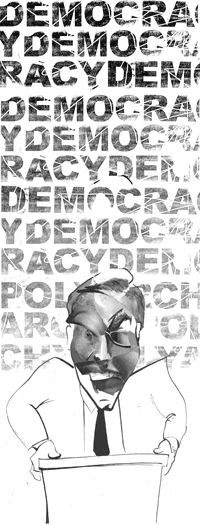
democracy cartoonWith a particular focus on FOCAL, the Canadian Foundation for the Americas, Anthony Fenton describes Canada's role as a National Endowment for Democracy "proxy" in "this new genre of political intervention into the affairs of the nations of the Global South."

The article is of special interest to me in part because (along with Max) the other day I met up with Carlo Dade, a former World Bank employee who is described here as "a FOCAL senior advisor" and "the main point person for FOCAL’s 'Canada and the Rebuilding of Haiti' program." Dade is quoted quite unabashedly arguing for Canada's proxy role in support of US policy objectives in Latin America:
The U.S. would welcome Canadian involvement and Canada’s taking the lead in Haiti. The administration in Washington has its hands more than full with Afghanistan, Iraq. . . This is a chance for Canada to step up and provide that sort of focused attention and leadership, and the administration would welcome this.
Dade was a nice enough guy to have a beer with, but it was indeed quickly apparent that his version of "democracy" was unashamedly tied to free markets and private sector interests.

Canada's role in these overt operations, to push a particular formula of social governance on Latin America, is legitimized by the linguistic slip that ties the country's self-image of itself as a "civil society" (in the sense of peaceable and polite) to the concept of civil society, or Hegel's "bürgerliche Gesellschaft" (bourgeois society), as a bulwark against authoritarian states and radical social movements alike.

Wednesday, November 22, 2006

touch

Titarenko, Untitled (Boy)"I'll keep in touch," they say, you say. But as with all metaphors, it's a porous and ineffable boundary that separates what's in and what's out of touch. Perhaps it creeps up on you after a while, perhaps you catch note of it while it's happening, seemingly unstoppable like a glacier slowly falling towards the sea: you've lost touch, you're losing touch, you may even be losing your touch.

I'll phone tomorrow; I'll send that email tonight; you promise yourself. But the first deferral makes the second easier, and so progressively until you no longer remember what you might have said, what you might have written.

In part it may be because now there are so many more ways to keep in touch: letter, phone, email, instant message.

You can look up addresses and phone numbers with lightning speed: the other day I was naively shocked by how easy it was to locate people at WhitePages.com, and even more by how much more information (and for only $39.95) US Search could offer me.

Plugging in my own name, I saw US Search had details of 22 former addresses. Had I really moved so much? I wondered. And so the feeling with which that left me was more a sense of being irrevocably out of touch, now with my own life, with all that I had managed to forget even about myself.

It's like the strange shock of looking at old photos, seeing yourself among a smiling group of people, and realizing you have no idea who these others are: people who obviously meant so much, so intensely, at one point, but who have now drifted irredeemably out of your memory.

There's something brutal, then, about technology's power of memorialization and recall, when set alongside our own dwindling capabilities to keep in touch with the many now nameless individuals who at one point touched you, whom you at one point touched.

And with all the power we now have to remedy these deficits, increasingly we allow it to fall into disuse. When was the last time I sent or received a letter? Or did much with email beyond barely trying to keep abreast of my inbox?

Perhaps we teachers are (if we allow ourselves to be) especially susceptible to this sudden shock of realizing how much we have lost touch. The other day I stumbled across a sheaf of essays that students had forgotten to pick up a couple of semesters ago. Looking over the names of my former students, while some images suddenly flashed back into view, I realized how many names I could no longer put a face to, how many of their personalities and characteristics had been obliterated in my attempt to learn the names of ever new student cohorts each semester.

But somewhere here is simply the same old, same old vertigo of modernity: the experience of rapid change, even during one lifetime, the sense that expanded social circles and social mobility casts its shadow in transience and oblivion.

And no wonder paranoia becomes our age's defining neurosis, generating on the one hand the conpiratorial theses that suggest everything is connected, and on the other hand the worry that if I have lost touch it's somehow their fault. But at least if they're all after me, then they're thinking about me after all.

Titarenko, Begging Woman
images by Alexey Titarenko


Crossposted at Act 13. Touch.

Monday, November 06, 2006

inscription

To return to my first post in this series... There I suggested that rights could be seen as "surfaces of inscription, sites within which the current balance of forces in a given struggle is marked." I suppose I mean by this that rights discourse produces a series of texts within which can be read (albeit in coded form, perhaps) a history of struggle and repression. Those texts would include both rights declarations (the UN Declaration and so on) and also the reports produced by rights organizations (such as Amnesty).

Two issues therefore arise:

First, the mechanisms of encoding. These are perhaps successive. For instance, what happens as pain is expressed or transmitted first affectively (paradigmatically, in the scream; see John Holloway on this), then narratively (say, in testimonio), and then as a legal plaint (taking rights discourse to be a version of juridical deliberation)? How, in other words, is the discourse of rights produced? Looking at this would involve understanding the ways in which struggle and repression become encoded, enter into various types of representation. I think it's out of a concern with this process that Deleuze argues for the importance of jurisprudence:
Creation, in law, is jurisprudence, and that's the only thing there is. So: fighting for jurisprudence. That's what being on the left is about. It's creating the right.
One would have therefore also to think further about the theory of representation at work here. Deleuze argues in terms of "creation" rather than a perhaps more customary emphasis on the dislocation between referent and sign.

One would also consider all the various groups, institutions, and (in short) agencies in all senses of that word that contribute to the mechanics of rights discourse: the role of human rights groups, for instance; or the relays between international bodies such as the OAS or the UN; or the part played by truth commissions and the like.

Second, however, why think of rights discourse as the final text, as an end product? Indeed, though rights as often presented as goal as they are assumed as origin--hence the notion of "fighting for" or seeking to gain rights--it's surely best to see them as an instrument, as one more cog or chain in a much broader arrangement. After all, does anybody really care about the right to (say) shelter, privacy, or free speech? No, they care for the achievement of those goals. In rights discourse, this is finessed as the distinction between an exercised and an unexercised right; but an unexercised right is dead, useless.

What then (and here I'm inspired by some discussion at Serena's blog) of rights discourse as one part of a broader mechanism of social justice? Rights here (as Peggy implies) would be the abstract moment bridging two concrete practices: crime and its punishment.

A few concerns:

First, all this sounds worryingly dialectical, as the abstract universal mediates concrete particulars.

Second, would the above not also apply to law tout court? (What difference is there between rights and law? Are rights not just a (fictitious) model for an entire legal constitution?)

Third, such talk of mechanisms seems to obscure the importance of interpretation.

Fourth, we shouldn't forget the sovereign instance (state or divinity, or even the idea of the human) that ultimately guarantees the possibility of any such mediation.

OK, for a moment there I thought I might be on the road towards salvaging rights, now as mechanism rather than discourse. Perhaps not.

Magnetic Aids to Skaters to be installed in the London Parks during the Skating SeasonBut it might be worth figuring out how the machine of rights discourse functions, and how it compares with the machine of state power or sovereignty.

Reading about the 1954 Guatemalan coup, I'm struck by how much what the CIA cobbled together was a Heath Robinson contraption (Rube Goldberg machine for North Americans) constantly in danger of breaking down, but finally anchored by US President Eisenhower's say so.

How different is that from (what would be more charitably described as) the network by means of which human rights abuses are charted, publicized, and acted against? I'm thinking here for instance of Amnesty's decentralized collection of letter writers, assiduously (as I imagine them) sending postcards off to jailors and generals throughout the Third World. But again, does this network not also depend upon a sovereign instance as anchor?

Sunday, November 05, 2006

coup

Reading Stephen Schlesinger and Stephen Kinzer's now classic account of the 1954 Guatemalan coup, Bitter Fruit, comparisons with the United States' more recent adventures in regime change and nation-building are inevitable.

anti-Arbenz rebelsAs in Iraq, toppling the Guatemalan government proved easier than many expected. Indeed, in 1954, and despite some nervous moments, US provision of air power to its small proxy army meant that the overthrow of reforming (and democratically elected) president Jacobo Arbenz was almost too easy. On being debriefed by the CIA operatives who orchestrated the coup, and hearing that the rebel force had suffered only one fatality in the whole process, "Eisenhower shook his head, perhaps thinking of the mass slaughter he had seen in World War II, and muttered 'Incredible!'" (218).

What's striking, in fact, is how modern were the methods used to bring down Arbenz. Beyond buzzing the capital and strafing a few provincial towns, the CIA relied for the most part on PR and psychological warfare. In short, their aim was to sow fear--or better, terror--within the country, and to ensure complacency outside. Precisely in its paucity of casualties (and loyalist forces themselves only lost "a total of fifteen soldiers, with another twenty-five wounded" [194]), the coup was very much a media event, complete with the US ambassador feeding the foreign press (dis)information over drinks at Guatemala City's American Club (186).

Together with the covert operation to topple Iran's Mohammed Mossadegh in 1953, the coup against Arbenz marked a departure for the CIA, which under Truman had since its foundation in 1947 mainly confined itself to passive intelligence gathering: but with John Foster Dulles as head of the State Department, the Agency had "embarked on an activist course" (100). One might speculate that had the outcomes of these two operations been different, the US might have thought twice in subsequent years about such aggressive intervention in overseas jurisdictions. As it was, however, "the CIA as an institution got a renewed lease of life" thanks to its apparently almost effortless success (228).

But that success was short lived. Schlesinger and Kinzer quote "the 'official' historian of the coup, Ronald Schneider," as saying that "in the light of subsequent events it might reasonably be considered little short of disaster" (227). They also cite a former advisor in the US Embassy to Guatemala: "Having a revolution is a little like releasing a wheel at the top of a hill. You don't know where it's going to bounce or where it's going to go" (227).

For, in the first place, the US had installed a military class that was almost comically divided and fractious. Though they, in conjunction with the influential United Fruit Company, had set up Colonel Castillo Armas to be the country's putative "liberator," soon a rather squalid power struggle erupted. Castillo Armas, chosen in part "because he was a stupid man" was in fact the Americans' third choice, and he soon had to face the contending claims of various other army leaders, not least General Miguel Ydígoras Fuentes, who eventually came to power upon Castillo Armas's assassination in 1957.

Second, and in part because of the precarious legitimacy of the regimes subsequent to the coup, the history of Guatemala since 1954 has been remarkably violent and bloody. The country holds the dubious distinction of being the first place to see the practice of "disappearing" political opponents, a fact that Greg Grandin underscores in The Last Colonial Massacre (which I review here) and also in an interview on the University of Chicago Press website:
In March of 1966 [. . .] over thirty leftists were captured, interrogated, tortured, and executed between March 3 and March 5. Their bodies were placed in sacks and dropped into the Pacific from US-supplied helicopters. Although some of their remains washed back to shore, and despite pleas from Guatemala’s archbishop and over five hundred petitions of habeas corpus filed by relatives, the government and the American embassy remained silent about the fate of the executed.
More generally, though the 1980s genocide in the Guatemalan highlands is relatively well known, as Bitter Fruit (as also The Last Colonial Massacre) makes evident, this was merely the culmination of years of slaughter: more than 30,000 people "abducted, tortured, and assassinated" in the 1960s and 1970s (247); already by 1976 René de León Shlotter can speak of "a spectacular form of violence" over the previous two decades, notable for its "intensity--the high number of victims and the cruelty of the methods used" (qtd. 250).

Third, however, Grandin also argues that the coup was
perhaps the single most important event in twentieth-century US-Latin American relations [. . . leading] to a radicalization of hemispheric politics. [. . .]

The overthrow of Arbenz convinced many Latin American reformers, democrats, and nationalists that the United States was less a model to be emulated than a danger to be feared. Che Guevara, for example, was in Guatemala working as a doctor and witnessed firsthand the effects of US intervention. He fled to Mexico, where he would meet Fidel Castro and go on to lead the Cuban Revolution. He taunted the United States repeatedly in his speeches by saying that "Cuba will not be Guatemala." For its part, the United States promised to turn Guatemala into a "showcase for democracy" but instead created a laboratory of repression. Practices institutionalized there—such as death squad killings conducted by professionalized intelligence agencies—spread throughout Latin America in the coming decades.
In some ways, the whole cycle of violence that will later lead to such concern for human rights in the region starts here, in 1954. In other ways, it's in Guatemala more than anywhere else that we see the clearest continuity with the kinds of practices documented by Bartolomé de las Casas as early as the 1530s.

But again, if only the US had taken to heart at the time the lesson that regime change is easy; yet political legitimacy and stability cannot be assured thereafter.

Saturday, November 04, 2006

left?

A pointer to a new(ish) blog: Left Turns? Progressive Parties, Insurgent Movements, and Alternative Policies in Latin America. It's an investigation into the so-called "turn to the Left" in Latin America, from Chávez in 1998 and on through Kirchner in Argentina or Bachelet in Chile to, most recently, Lula's re-election in Brazil and the prospect Ortega might return to the presidency in Nicaragua.

The blog is one element in a broader project, with which I'm involved in collaboration with (among others) Max Cameron, Eric Hershberg, and Andy Hira. For more on that project, see our conference proposal.

As is probably too obvious, I'm more or less responsible for the "insurgent movements" element. I had to sneak "insurgency" in somehow. Here's how we describe that section:
From Venezuela’s Caracazo of 1989 to Mexico’s Zapatista campaign from 1994, and from the Argentine protests of December 2001 to the Bolivian protests that came to a head in October 2004, a multitude of new movements have emerged, often marginal or even actively opposed to traditional organizations such as unions or NGOs. Some of these spectacular displays of popular protest quickly disappeared. Others created the conditions for the electoral successes of a new breed of leaders. Each has often appeared spontaneous and surprising, generating new strategies of protest and grassroots self-organization or appropriating old tactics in new ways. We will ask how far left-leaning governments are expressions of such social insurgencies, whether they translate movement demands and desires into action, or whether rather they function as reactive pressure valves: venting steam, but little else. In other words, as well as examining the differences between left parties and movements across national and cultural borders, it is also necessary to examine the tensions between social movements and the electoral campaigns that claim to be their vehicles.
The "multitude" is also smuggled in there; again perhaps too obviously, I'm interested in seeing how much this so-called "left turn" fits with the framework that poses constituent against constituted power.

More is to come, including some cross-posted entries from here to there and vice versa.

Thursday, November 02, 2006

aberrations

Marguerite Feitlowitz's A Lexicon of Terror: Argentina and the Legacies of Torture examines the relation between language and state violence. In some ways it's a companion piece to Diana Taylor's Disappearing Acts, which analyzes a similar connection between performance and terror, also focussing on Argentina.

The New York Times has an online version of the book's first chapter, whose title is likewise "A Lexicon of Terror", and where we find her most sustained examination of the role of language under Argentina's military regime of 1976 to 1983.

War is PeaceSince Orwell at least, we've been familiar with the concept that authoritarianism impacts language, bending it out of shape and introducing a whole series of figures and double meanings that violate common sense: war is peace; freedom is slavery; ignorance is strength. Doublespeak. And in "Politics and the English Language", for instance, Orwell insists upon linguistic clarity as a remedy to political obfuscation: in so far as "the present political chaos is connected with the decay of language [. . .] one can probably bring about some improvement by starting at the verbal end. If you simplify your English, you are freed from the worst follies of orthodoxy."

But as Feitlowitz observes, while the Argentine junta made use of language's slipperiness precisely in the service of something like Orwellian doublespeak (e.g., in a distortion of human rights discourse, "We Argentines are human, we Argentines are right"), they were also quite self-conscious and wary about the sign's inherently arbitrary relation to its referent. In the words of Admiral Emilio Massera, with which Feitlowitz opens her chapter, "Unfaithful to their meanings, words perturb our powers of reason" (19).

So in that "the whole regime was intensely verbal," as Feitlowitz contends, with its "constant torrent of speeches, proclamations, and interviews" such that "Argentinians lived in an echo chamber" (20), not only did the junta remake language, it also opened up the possibility that its own language could be turned against it. Indeed, this was (as Taylor argues) something that the Mothers of the Plaza de Mayo realized: that they could take the regime's rhetoric about the centrality of the family and women's role as nurturers and guardians, and turn it against the practices that separated mother from child through kidnap and torture.

There are two possible positions: one insists on clarity and common sense against the obfuscations and euphemisms of overweening power; the other thrives on the fact that even the most powerful cannot fully control their language (or anybody else's).

The problem is that Feitlowitz never fully chooses either one of these possibilities. And as such, she constantly falls prey to the worst of all worlds. Consider her chapter's conclusion:
The repression lives on in [. . .] aberrations of the language, in the scars it left on the language. When a people's very words have been wounded, the society cannot fully recover until the language has been healed. [. . .] When, like skin, the language is bruised, punctured, or mutilated, that boundary [between inner self and the outside world] breaks down. [. . .]

We must pay attention to this dis-ease, we must document its signs. We must make an artifact of this Lexicon of Terror, so that it will no longer be a living language. (62)
Here is a denunciation of language's aberration expressed in the most aberrant of language. Is it not, after all, a form of "doublespeak" to use such a richly figural, metaphoric mode of expression as to refer to language's "scars," its bruises, punctures, and wounds? And while we're at it, why does this linguistic cure depend upon killing a "living language"?

How far, after all, are we from the Argentine junta's own metaphorical analogies, condemned by Feitlowitz, to the "cleanliness and health" that they propose to bring to an Argentina purged of political aberration (33)? If Massera is wrong to appropriate what Feitlowitz terms "Neo-Nazi 'germ theory'" when he declares that "we must cleanse the country of subversion" (33), is it not equally problematic to portray language itself as a body whose sickness is to be cured or as a life that is to be euthanized . . . especially when it is metaphorical aberration that is to be purged, linguistic excess to be eliminated?

In other words, Feitlowitz uses metaphor to argue for de-metaphorization.

We should either use metaphor or denounce it. And if it turns out that we cannot rid our language of figures, then perhaps there's a limit to the political blame we can pin on figuration per se. All the more so when we've borrowed our most powerful figures from those we claim to be condemning.

(Paul de Man's "Semiology and Rhetoric" [JSTOR access required] has something to say about this, too.)

Wednesday, November 01, 2006

Slavoj?

The Giant of Ljubljana was giving a talk on campus today.

In advance, some lack of coordination was obvious, in that his lecture clashed with one by Simon Schaffer. The two events were organized by people who one would otherwise have thought should have been in some kind of communication with each other.

I went to the first thirty minutes of Schaffer's talk. Entitled "Single Vision and Newton's Sleep," it was good: on the politics of optics, Blake, Newton, Hobbes, and so on. The argument revolved around scientific and political attempts to make one appear many, and many to appear one. Sadly, I had to miss his conclusion, as I sloped off, making my way to the theatre where Zizek was to be speaking.

On arriving, ten minutes early, I find a group of disgruntled intellectual types milling around. Apparently the place is already full, and nobody more is to be admitted. I chat to a couple that I know.

Then, seeing a fairly dissolute figure in the middle distance jog up to the building and start peering into the windows, seeking access, I comment "Actually we seem to be in the right place, as Zizek is also shut out." "Who? Where?" they ask. And I point to the man himself, trying to catch the attention of somebody inside so that he can enter and give his talk.

A minute or so later, from another door, nearer us, one of the so-called organizers emerges and asks if anyone has seen Slavoj. "Yes," I say, "he's over there." "Where?" I am asked, again. "Which one is he?" "The guy at the end there," I reply, "who's trying to get in."

So the so-called organizer goes up somewhat nervously and asks "Slavoj?" With this interpellation presumably successful, the two head back in to the theatre.

And still the rest of us remained outside, unhailed.

Zizek
Zizek in happier times. He's the one in white.

Tuesday, October 31, 2006

property

s0metim3s argues that
One has rights – or does not have them, as the case may be. One can be right, of course, but this particular formulation of the claim to legitimacy, this assertion of rightness, is not necessarily of the same register as an assumed, or claimed, legal or moral entitlement which might transform the circumstantial, concrete instance of being correct about this or that into having just claim or, more simpy put: of being right into having a right – which is to say, into a property. The language of rights is, in its grammar, the language of property.
It's certainly true that the language of rights and the language of property overlap. But I'm not entirely sure that the two can be conflated so quickly. Or rather, it might be worth unpicking the differences that someone such as Locke (whom s0metim3s quotes) obscures.

So, yes, property discourse infiltrates rights discourse at almost every turn. The UN Universal Declaration, for instance, delcares in its first article that "All human beings are born free and equal in dignity and rights. They are endowed with reason and conscience and should act towoard one another in a spirit of brotherhood." And for "endow," the OED gives "1 a. To give a dowry to (a woman) [. . .]; 2. To enrich with property; to provide (by bequest or gift) a permanent income for (a person, society, or institution)."

(Let's hold off for a moment on the familial language of "brotherhood" and the innate connection between rights and reason.)

On the other hand, rights constitute a peculiar kind of property, if property they are.

First, in that (some?) rights are held to be, as the US Declaration of Independence puts it, "unalienable." They are not to be bought and sold; they are innate, whether that innateness stems from the fact that they are natural, or from some legal or constitutional framework. Human, natural, and civil rights can all be considered "unalienable" from this perspective. They may be abrogated or abused, but they can never be taken away.

Yet, second, rights discourse also sometimes indulges in the language of alienability. Some rights can be won or lost; they are precarious or (again, from the US Declaration) need to be "secure[d]." In so far as we can be deprived of our rights, then it is simply not true for instance that (as the UN Declaration has it), "everyone has the right to freedom of movement and residence within the borders of each state."

So rights are at turns almost ontological, in that they are coterminous with existence: I am, therefore I have rights. And at other turns, they are a precious commodity, all too easily forfeited (if we do not act upon them) or lost (if we are deprived of them).

To what extent then can rights be exchanged? Social contract theory seems to suggest precisely such an operation, as natural rights are given up in favour of civil rights. But Spinoza (for instance) implies that in fact such rights can never be surrendered; indeed, that it is pure ideology to suggest so.

Do we have the right not to have rights? I suspect that this is what's at issue when the state steps in to criminalize suicide or euthanasia, for instance. But then suicide, or self-harm of any sort, is rather a tricky issue for Spinoza, too.

Somos derechos y somos humanos decalMeanwhile, as to the slippage between "being right" and "having rights": Marguerite Feitlowitz points out that the Argentine junta played out precisely such a game of words in the context of other games at the time:
This war of words culminated in a dramatic display in 1978, when the World Soccer Championships were held in Argentina. Taking advantage of their access, foreign journalists pressed the regime for information on reported disappearances, torture, and secret concentration camps. "What do you mean, 'human rights'? the commanders fumed. "We Argentines are human, we Argentines are right." The message was writ large on a huge banner in the reception area of Ezeiza, the international airport. Shiny decals with this slogan appeared in shop windows and offices, on private cars and taxi cabs. Employees at the Ministry of the Interior--who routinely shredded writs of habeas corpus--wore the decals and demonstrated in Plaza de Mayo. This group came face to face with another demonstration--parents, spouses, and children of desaparecidos who marched silently, wearing pictures of their loved ones and signs that asked ¿Dónde están? "Where are they?" The official reply? "We Argentines are human, we Argentines are right." (A Lexicon of Terror 35-36)
Clarín has an article on this same campaign, ""Somos derechos y humanos": cómo se armó la campaña", and see also Rubén Morales's "Somos derechos y humanos". Morales also bears out Feitlowitz's contention that public relations (PR) functioned for the Argentine military in the way that radio served the Nazis (41).

Saturday, October 14, 2006

balls

Ball posterThe Secret Policeman's Ball is back. After a hiatus of over fifteen years, the comic fundraiser for Amnesty International is returning.

The event was first organized in 1976, as human rights were high on the international agenda, thanks in large part to a series of military takeovers in the Southern Cone (Chile, 1973; Uruguay, 1973; Argentina, 1976).

In "Chase Heads Policeman's Ball Bill", the BBC quotes Amnesty's UK director Kate Allen as saying "The reason we brought back The Secret Policeman's Ball is that it's never been more important to stand up for human rights. They are coming under threat in ways that we hadn't anticipated."

I take the return of this event as yet another sign both of a new era of rights discourse, and also of the distance between this era and the previous one.

We're no longer, in fact, in an era of secret policemen, the leaden-footed apparatchiks of the Eastern Bloc or the national security state that could be so easily parodied by Monty Python et al. (A parody that no doubt drew on second world war folk memory, in which the dictator's genitalia are offered up for derision.)

But what era are we in? And why did the previous rights discourse fail, it seems, so disastrously to anticipate it?

Sunday, October 08, 2006

quotation

I half-followed the brouhaha over various weeks in the Letters pages of the London Review of Books about John Mearsheimer and Stephen Walt's article, “The Israel Lobby”. (Links to the correspondence that the article provoked can be found on the LRB site, at the end of Mearsheimer and Walt's article.)

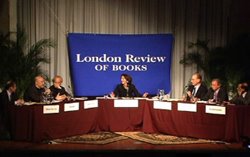
LRB debateAnyhow, in response, the LRB organized a debate at Cooper Union, entitled "The Israeli Lobby: Does it Have Too Much Influence on US Foreign Policy?" Thanks to ScribeMedia, the entire debate can now be viewed online. I recommend it.

Panelists at the debate were John Mearsheimer, Shlomo Ben-Ami, Martin Indyk, Tony Judt, Rashid Khalidi, and Dennis Ross, with Anne-Marie Slaughter as moderator.

Just one small thing I noted, which could perhaps be added to Charlotte Street's Notes on Rhetoric, is that Mearsheimer and Walt are repeatedly accused of "selective quotation."

While I guess I understand what is meant by this accusation, in fact it is nonsense, a tautology. Of course quotation is selective. Even when an entire article or speech or discourse is quoted, that too is a selection. We may not like or may disagree about the principles of selection, but the charge of selectivity is itself bogus.