Paraguay has a significant population of German immigrants and their descendants. It's not the only Latin American country with a German influence: see Colonia Tovar in Venezuela, for instance, or the now rather nefarious Colonia Dignidad in Chile. And there's little more surprising in the Yucatán and Belize than the sight of packs of blond Mennonites on the move, all cowboy hats, check shirts, and overalls for the boys and men, headscarves and dresses for the girls and women.
But in Paraguay the German presence is particularly notable. At times it is as though German were the country's second language (or third, after the indigenous Guaraní). This page on German genealogy suggests there are 166,000 speakers of the language in the country. And at the hotel where I was staying last week, for instance, the guide to room services was in Spanish and German, rather than English. Most of the other visitors were speaking German, including a large group of young girls from the Chaco, in town for some kind of sports tournament, chaperoned by a tall young blond man with the air of a Christian youth leader, who spoke heavily accented Spanish.
The German colony in the Chaco are Mennonites who peaceably enough raise cattle and make cheese. By all accounts, the Chaco is a pretty desolate place, and the Mennonites and the Guaraní have it pretty much to themselves. (Even so, early last century the Paraguayans managed to lose a war with Bolivia over the territory.)
But then there are Germans and there are Germans. And the topic of Nazis or former Nazis in South America is always a subject of intrigue and speculation: luridly fictionalized as The Boys from Brazil or The Odessa File, but on the basis of real cases such as most famously Eichmann's flight to and capture from Argentina. Josef Mengele, though he initially fled to Buenos Aires, spent signficant post-war time in Paraguay.
Still, I had either forgotten or repressed from my only previous visit to Paraguay the shock induced, this time, by noting the first day of my stay a Spanish translation of The Protocols of the Elders of Zion on sale at a street corner kiosk. Or, a little later, just off one of Asunción's main squares, on the pavement outside a cybercafe, seeing two pencil drawings of Hitler on sale among the usual collection of secondhand textbooks and shabby novels. No irony, no self-consciousness as far as I could see: just a couple of portraits of the Führer, should I have wished to buy them as a souvenir of Paraguay.
I take it that most Paraguayan Germans shudder somewhat as I did in seeing such reminders of the Reich. Not least now that Germany itself is, with the World Cup, trying to rebrand itself beyond the clichés of either jackboots or dull efficiency. But perhaps more likely, these signs of history's unsavoriness merely blend in with their adopted country's long history of dictatorships (Doctor Francia "the Supreme" as well as that other son of Germany, Stroessner) and injudicious wars of aggression and catastrophic defeat.
UPDATE: Royden Loewen's Mennonite and Nazi would seem to be a book to read, complicating my account above.
Showing posts with label paraguay. Show all posts
Showing posts with label paraguay. Show all posts
Saturday, June 24, 2006

Wednesday, June 21, 2006
Ycuá Bolaños
Posting is hereby resumed...
One of the most interesting (and also moving) experiences of the past two weeks was to visit the site of the Ycuá Bolaños tragedy in Asunción.
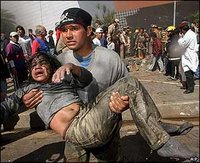 From Paraguay, ABC Digital has a page on "La tragedia de Ycuá Bolaños", with links to many articles on the case and recent updates. There's also "La investigación de Ycuá Bolaños", a site with pieces that are more reflective or critical. And here is the BBC report immediately following the incident.
In short, however, on August 1st 2004 a fire gutted a huge supermarket in suburban Asunción. The fire started thanks to design flaws (a chimney that couldn't be cleaned), and was aggravated by inattention to building codes. But it became a disaster in which over 400 people died when the supermarket owner ordered the doors locked so that shoppers wouldn't rob the store of its produce en route to escaping with their lives.
Almost two years later, though the owner is in custody, he is due to be released if the Paraguayan judicial system doesn't come up with at least a provisional verdict (a "juicio oral") that assigns some culpability for the blaze and for the ensuing deaths.
The ruin itself is still remarkably intact: you can see the check-out counters, the shelving, piles of half-incinerated toothpaste tubes or bags of flour, half-melted crates of coke and so on. To one side, families of victims have constructed a kind of sanctuary, full of shrines to their deceased relatives. And though (because?) these shrines are decorated in typically kitsch Latin American style--fairy lights, plastic figurines of angels, and so on--the place is incredibly moving.
Relatives come by the sanctuary, to comb once more through the wreckage, to meet up with other victims, to hang out, to talk, to plan their next demonstration against an incredibly corrupt and inefficient judiciary.
Different movements have sprung up in the wake of the disaster, some more militant than others. The most radical is the Collective "Ni olvido ni perdón" ("No forgetting, and no forgiveness"). I talked for some time with a very articulate--and justifiably enraged--member of this group. But even for the more moderate elements of the movement, the attempt to win justice has become a fully-fledged battle against the state.
Many of these groups' slogans (such as "Nunca más" or "Never again") are taken directly from the movements that struggled against the Southern Cone dictatorships of the 1970s and 1980s. Moreover, the Paraguayans now have links and contacts with organizations such as Argentina's Mothers of the Disappeared.
So what's interesting is that some time after one of the longest dictatorships in Latin American history (Stroessner's 36 years in which the country was his personal fiefdom), and as a result of an incident in which capital, the state, and the law directly coincide, something in Paraguay may finally be awakening.
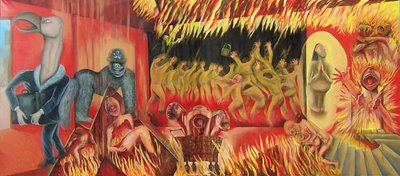
One of the most interesting (and also moving) experiences of the past two weeks was to visit the site of the Ycuá Bolaños tragedy in Asunción.
 From Paraguay, ABC Digital has a page on "La tragedia de Ycuá Bolaños", with links to many articles on the case and recent updates. There's also "La investigación de Ycuá Bolaños", a site with pieces that are more reflective or critical. And here is the BBC report immediately following the incident.
In short, however, on August 1st 2004 a fire gutted a huge supermarket in suburban Asunción. The fire started thanks to design flaws (a chimney that couldn't be cleaned), and was aggravated by inattention to building codes. But it became a disaster in which over 400 people died when the supermarket owner ordered the doors locked so that shoppers wouldn't rob the store of its produce en route to escaping with their lives.
Almost two years later, though the owner is in custody, he is due to be released if the Paraguayan judicial system doesn't come up with at least a provisional verdict (a "juicio oral") that assigns some culpability for the blaze and for the ensuing deaths.
The ruin itself is still remarkably intact: you can see the check-out counters, the shelving, piles of half-incinerated toothpaste tubes or bags of flour, half-melted crates of coke and so on. To one side, families of victims have constructed a kind of sanctuary, full of shrines to their deceased relatives. And though (because?) these shrines are decorated in typically kitsch Latin American style--fairy lights, plastic figurines of angels, and so on--the place is incredibly moving.
Relatives come by the sanctuary, to comb once more through the wreckage, to meet up with other victims, to hang out, to talk, to plan their next demonstration against an incredibly corrupt and inefficient judiciary.
Different movements have sprung up in the wake of the disaster, some more militant than others. The most radical is the Collective "Ni olvido ni perdón" ("No forgetting, and no forgiveness"). I talked for some time with a very articulate--and justifiably enraged--member of this group. But even for the more moderate elements of the movement, the attempt to win justice has become a fully-fledged battle against the state.
Many of these groups' slogans (such as "Nunca más" or "Never again") are taken directly from the movements that struggled against the Southern Cone dictatorships of the 1970s and 1980s. Moreover, the Paraguayans now have links and contacts with organizations such as Argentina's Mothers of the Disappeared.
So what's interesting is that some time after one of the longest dictatorships in Latin American history (Stroessner's 36 years in which the country was his personal fiefdom), and as a result of an incident in which capital, the state, and the law directly coincide, something in Paraguay may finally be awakening.
Subscribe to:
Posts (Atom)