Showing posts with label music. Show all posts

Wednesday, September 05, 2012

sombrero

Watching this footage (which I've just come across) gives me goosebumps.

It comes from a pro-Sandinista solidarity concert held in Nicaragua in 1983, billed as a "concierto por la paz centroamericana." The soundtrack was released as "April in Managua." I used to own the cassette version, which I was given in Honduras sometime around 1988. I practically wore it out listening to it.

Wikipedia tells me that Alí Primera, the singer here, died a couple of years later, at the age of 42, which only adds further poignancy to this video.

Saturday, January 21, 2012

Miserere

Someone has uploaded footage of last year's Vancouver riot and put it to music (Allegri's "Miserere") sung by my brother.

Sunday, May 29, 2011

raincoat

A particularly marvellous cover of Leonard Cohen's "Famous Blue Raincoat."


Via New APPS.

Thursday, February 03, 2011

Brazilian

While I'm posting videos and thinking about Neruda...

Here are the Brazilian Girls (perhaps my new favorite band; incidentally, they're neither Brazilian nor, for the most part, girls) with a rendition of "Me gustas cuando callas":


Sadly the visuals for the above video are far from inspiring. It's worth seeing the song live. Here's a performance from a couple of years ago in New York:


One of the things I like here is that this rendition is something of a performative contradiction: though the poem speaks of absence and a woman's silence, in the person of singer Sabina Sciubba we see a woman very much present and the focus of attention (while the male members of the band hide behind their instruments) and it is her voice that sounds out, rather than being hushed.

Indeed, is she telling us to be quiet?

Meanwhile, Sciubba is renowned for hiding her eyes. So while making herself the center of visual attention, she also seems to want to resist the gaze. In her words, "I can do whatever the fuck I want because nobody is going to recognize me in the street."

Saturday, November 06, 2010

normal

Pulp's "Common People" in Catalan, performed (by a group called Manel) in the Boqueria market, Barcelona:

Thanks to Jaume Subirana for this, and for his (and his family's) splendid hospitality in Barcelona.

Tuesday, December 01, 2009

Weakerthan

Smug liberality is one of Canada's less endearing traits. Some (too much) of that was on display yesterday at an event I attended that went under the title of a "Foreign Policy Camp" organized by something called Canada's World. The basic impulse was to ask how Canada could lead the world, as it was apparently born to do, by spreading its fine liberal values to the less fortunate mass of humanity who sadly live elsewhere on the globe.

I participated in person (with a call for Open Borders that went down surprisingly well), but some of the discussion can be found on twitter. In the fray, I seem to have started a bit of an argument with one of Canada's best and brightest after she was quoted as saying that the influence of "diaspora communities" made the country "vulnerable". Oh well.

(And yes, those who are so minded can follow me on Twitter here.)

I also, incidentally, got to meet up with my old buddy and sparring partner Carlo Dade, who mentioned what to me is the astonishing fact that immigration has never yet been on the agenda of the Summit of the Americas.

Anyhow, I happily admit to having an ambivalent relationship to Canada. But increasingly I come to discover that such ambivalence is itself rather Canadian... and in so far as it can be considered a potential antidote to the temptation to smugness, it is one of the country's virtues.

Perhaps the same fundamental insecurity drives the smugness, too. But far better for it to be articulated as openness to others, and a willingness not to tout "Canadian values" but to rethink them. For indeed, this country is far more hospitable to others than many. And, for instance, fear-mongering against immigrants has yet to make great inroads here, unlike (say) in the UK or the US.

But all this is prelude to the following video, which I was indirectly recommended by a guy, Gord McIntyre, whom I first met twenty years ago, at a very difficult moment, in Guatemala, when we were both attached to a human rights NGO in Santa Cruz de Quiché. (It was that experience that first really made me doubt the whole discourse of human rights, by the way.)

Recently Gord got back in touch, and it turns out he now lives in Winnipeg. He suggested I might like one of that city's local bands, the Weakerthans, and I find that they wrote this marvellous song that encapsulates something of Canada's virtuous ambivalence and self-doubt. Long may it continue thus. And long may Canada continue "weaker than" it would rather be.


To put this another way: let us all hate Canada in exactly the same way as the Weakerthans hate Winnipeg.

Sunday, September 13, 2009

ukelele

In the same spirit as my love for ballboy, I'm now rather keen on getting hold of this record.

Meanwhile, I'm reading David Peace's Tokyo Year Zero, and despite my previous praise for his work, my feeling is that he's becoming too close to a novelty act for comfort. I very seldom abandon a book midway, but here I'm sorely tempted to do so.

Peace's style, and particularly his insistent use of repetition, is becoming downright irritating. James Meek wrote a very good review of this novel's sequel (Occupied City) in a recent London Review of Books. The title he chose for his review, "Polly the Bleeding Parrot," is both a quotation from a character in one of Peace's books, and also (as Meek observes) a rather good indication of the gore and the excessive doubling that characterize them.

Wednesday, April 22, 2009

consolation

The Wednesday quotation, part XII: Anthony Lane on "Lips" (on the right in the photo), the lead singer of Canadian heavy metal band Anvil:
How can you not love a man who thinks like that, dredging the television of consolation from the swimming pool of disaster? ("Rock Solid", The New Yorker [April 20, 2009])

Wednesday, January 28, 2009

ballboy

I have been accused of having a taste for "novelty" books, and perhaps this is simply another instance of the same poor taste, in another sphere... but a large part of the reason why I like the Scottish band ballboy is because they consistently have the best song titles in pop.

I don't think I've ever met anyone else who has even heard of ballboy, yet alone a fellow fan. Their albums are hard to obtain, and don't seem to circulate in North America. I ran into them first when I came across their single, "All the Records on the Radio are Shite." How could I resist?

I later picked up Club Anthems (sample song titles: "Essential Wear for Future Trips to Space, "I Hate Scotland", and "I've Got Pictures of You in Your Underwear") and A Guide for the Daylight Hours (featuring "Where Do The Nights Of Sleep Go To When They Do Not Come To Me," "You Can't Spend Your Whole Life Hanging Around With Arseholes," "I Wonder If You're Drunk Enough To Sleep With Me Tonight," and "I Lost You, But I Found Country Music"). And I've just belatedly received The Royal Theatre ("I Don't Have Time To Stand Here With You Fighting About The Size Of My Dick" and "There Are Only Inches Between Us, But There Might As Well Be Mountains And Trees").

Here they are live, with "You Can't Spend Your Whole Life Hanging Around With Arseholes." Though as they sagely observe, in fact you can spend your whole life hanging around with arseholes; but you shouldn't.

Monday, December 10, 2007

demolición

It's Peruvian (proto)punk. From 1964, would you believe? "Los Saicos" (pronounced "Psychos") and "Demolición" ("Demolition")...


The lyrics:
Echemos abajo la estación del tren / demoler, demoler, demoler, demoler / Nos gusta volar estaciones de tren / Ye ye ye ye ye ye ye.

Let's bring down the train station / Demolish, demolish, demolish, demolish / We like blowing up train stations / Yeah yeah yeah yeah yeah yeah yeah.
To hear how that might sound today, here's a cover version.

Los Saicos are featured, along with other Peruvian groups of the sixties such as "Traffic Sound" and the "Shains," in an exhibition "Arte nuevo y el fulgor de la vanguardia" (El Comercio's note here) that has just opened in Miraflores, curated by Emilio Tarazona and Miguel López. Go see it if you can.

Friday, August 10, 2007

manchester

Tony Wilson"Look at Tony Wilson, live on Channel Four."

Sadly, no more. And the earth itself groans. (Via Who Knows Where Thoughts Come From, who likewise was put in mind of The Times's song, "Manchester.")

NB even the BBC can't decide if the man's name is (Cambridge-educated) Anthony or (Salford lad) Tony.

Now watch 24 Hour Party People in which Wilson, played by Steve Coogan, meets God on a Manchester rooftop. "It's a pity you didn't sign the Smiths, but you were right about Mick Hucknall: his music's rubbish and he's a ginger." Marvellous.

Oh, and then there's this (via Blood and Treasure):
And you, forgotten, your memories ravaged by all the consternations of two hemispheres, stranded in the Red Cellars of Pali-Kao, without music and without geography, no longer setting out for the hacienda where the roots think of the child and where the wine is finished off with fables from an old almanac. That’s all over. You’ll never see the hacienda. It doesn’t exist.

The hacienda must be built.

Sunday, May 28, 2006

Bruce

Bruce CockburnIt turns out (wood s lot tells me) that yesterday was Bruce Cockburn's birthday.

I don't have much to say about Bruce, and don't even listen to his music much if at all any more; at a certain stage, it somewhat lost its appeal. But, back in the day, songs such as "Nicaragua" and "Dust and Diesel" were a large part of the motivation for me to go to Central America in the 1980s, and so to start the process that has led to my teaching Latin American studies for a living.

And one of the highlights of being in Nicaragua in 1988 was to find out that he was in town, cycle to his hotel, grab him and chat for an hour or so. Later, he played a small concert at an Arts Centre in Managua, of which I no doubt have the only bootleg recording in existence.

Meanwhile, he also was one of the first Canadians I had heard much about. And I know that next week, in Toronto, songs such as "The Coldest Night of the Year" will come to mind, as I too try to take in "Yonge Street at a glance."

We saw him play Vancouver three years ago (on my birthday). At some point, while Bruce was tuning up (as he endlessly does between songs), a woman shouted out "Sexy Beast!" It was so un-Canadian, and so unlike Bruce's followers, so unlike Bruce, that it took the whole theatre aback for a moment. Bewildered, he shook his head, thanked her politely, and went on with the next song.

So here's to Bruce (belatedly).

Wednesday, May 24, 2006

reticence

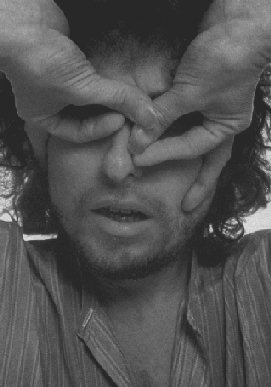
Bob DylanBob Dylan is 65 today.

I've seen Dylan live a few times: in London, Earl's Court, about fifteen years ago; in Manchester, the MEN Arena, about four years ago; and most recently in Vancouver, the Orpheum, just last year.

Each time there's been something unimpressive about these shows. Dylan refuses the spectacle more than any other musician I've seen. No doubt others refuse it more: The Jesus and Mary Chain, for instance, used to be notorious for playing sets sometimes only ten minutes long with their backs to the audience. At the same time, in both cases, this refusal is part of these performers' mystique: the fact that they refuse to perform is what makes their performances stand out. Put another way, they perform refusal.

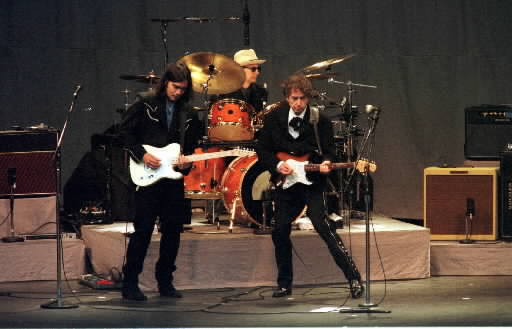
In Dylan's Vancouver show, he and his band were arranged in a rough semi-circle around the stage. At the center of this semi-circle, and so front and center of the stage, was a microphone on a stand. One expected and hoped that at any moment Dylan would break formation from his backing singers, and come to the microphone. But though he did enter the semi-circle a couple of times, this was mainly for his harmonica solos, and the stand at the front remained an empty site of non-performance.

No doubt part of the point is also the notion that there is no distinction between Dylan and his band. Indeed, he seems to want us to believe that we are simply eavesdropping onto some kind of jam in which a few friends are laying back and playing some riffs. Not that there's much all that laid back about (what I'll continue to call) the show: everything was up tempo, with scarcely a break between songs, each of which came to sound increasingly similar. It was as though we were witnessing one long medley of Dylan cover versions.

"Witnessing" is probably the best description of the subject position that Dylan appears to want for his audience. Neither spectator nor participant, we seem to be there but strangely not quite there in his mind. Only the most minimal gestures (a slight wave of the harmonica after a solo) are overt signs that he even notices our presence.

There's something attractive, almost seductive about such reticence. But it is of course all in immensely bad faith. There's no doubt that Dylan is the star, however much he may wish to deny it. And we are indeed spectators: spectators of a performance of a very particular type.

It's been some thirty five years since David Bowie articulated Dylan's relationship with his public (the public?) as one of abandonment or betrayal:
Now hear this Robert Zimmerman
Though I don't suppose we'll meet
Ask your good friend Dylan
If he'd gaze a while down the old street
Tell him we've lost his poems
So they're writing on the walls
Give us back our unity
Give us back our family
You're every nation's refugee
Don't leave us with their sanity
("Song for Bob Dylan")
This was after Dylan's famous withdrawal, following his 1966 motorcycle accident. It's no great coincidence that the recent fuss around Dylan (the Scorcese documentary with its accompanying CD and book, "Bob Dylan's American Journey" at Seattle's EMP, even Bob's own Chronicles, however coy) has centered around this pre-1966 period. It's as though we were seeking to reconnect, to bring Dylan back. And so ironically to bring back a presumed "unity" even from the social divisiveness of the 1960s protest movements with which the early Dylan was so associated.

But the real truth of Dylan is in this betrayal, this reticence, a sort of mutiny from above which may even have begun before 1966, but is now ensconced and strangely celebrated in the "never-ending tour".
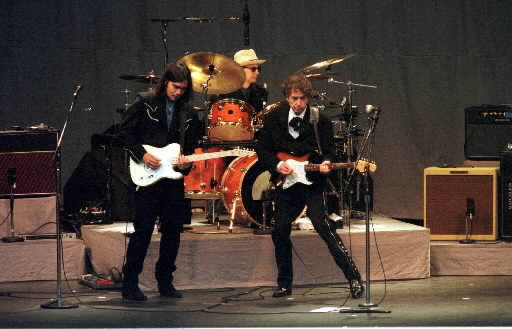
Dylan on tour