Hugo Chávez is in the news again, now thanks to Pat Robertson's outrageous call for his assassination. The Venezuelan president is no stranger to the headlines, of course, nor does he shirk them. He takes on his (many and vociferous) opponents directly and publicly, whether by baiting the so-called "escuálidos" who are his domestic opposition, or by taking on the US government, most recently
accusing DEA agents of international espionage.
I've never been a great fan of Chávez. His personalist style is deeply problematic. In typical populist manner, he deploys his charisma to conjure away the fact of state domination. I have been ambivalent about his regime despite recognizing that anti-
chavista forces are far more unsavory. I remember asking a friend, who was at the time editor at the excellent Caracas-based
Nueva Sociedad, whether the military might come to power if Chávez were overthrown. "Ah, but the military is already in power," was his response.
And it's true that Chávez is an ex-paratrooper, who came to attention first as head of an unsuccessful coup attempt in 1992. Also, if the 2002 effort to unseat him failed in part because of
the multitudinous uprising that ensued, another reason was the loyalty shown by the military rank and file, most of whom still see him as one of them.
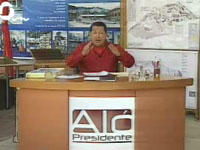
Ironically, in that he depends so much on television to construct and maintain his popular appeal, complete with his own talk show,
Aló Presidente, and given his direct, over-dramatic, evangelical style, Chávez is in some ways the mirror image of his latest critic, the tele-evangelist Robertson. And Chávez's tele-populism undoubtedly depends upon and engenders the power of popular belief.
But is there anything more to
chavismo than its faith in a leader?
I was (quite by accident) in Venezuela during the 2002 coup and counter-coup. It was an extraordinary week. And one thing was obvious: Chávez's supporters, who constitute, as has now been repeatedly demonstrated, the majority of the population, expected a lot of his government; but it had yet to deliver. The regime had not made much of a difference to Venezuela's poor. It was long on rhetoric, but short on results. It had proposed a number of creative and controversial foreign policy initiatives (from seeking to resuscitate and reorient OPEC to improving links with Cuba), but had been mostly on the defensive domestically.
That may now be changing. The fact that populism still figures the people as expectant (and so dependent) on a power alien to them remains its great limitation. But at least the people are no longer simply waiting. And the reforms that the government is effecting, in the wake of the counter-coup, suggest further change may be on its way. In the space of a few months, Venezuela has come to attention for its
empowerment of workers on the shop floor, its
education and health programs, and its
ambitious land reform initiative.
One could draw a contrast with the government over which Brazil's Lula presides. Unlike Chávez, Lula has long been the darling of the international left. His Workers' Party grew out of struggles against military repression in the 1970s and 1980s, his personal biography is compelling, he has made all the right noises in terms of regional solidarity, and has hosted and encouraged the Porto Alegre gatherings of the World Social Forum. But, also unlike Chávez, his government has become mired in
a corruption scandal that, if it doesn't reach to the very top, goes pretty close to it. Meanwhile, Lula's much vaunted social programs, particularly the "Zero Hunger" program, have so far proved insubstantial and ineffectual. And his economic policies have been a continuation of the neoliberal orthodoxy already in place, which have kept the markets happy but done little to reduce his country's appalling wealth and income inequalities.
The Council on Hemispheric Affairs has two useful articles detailing how
the mess that Lula finds himself in contrasts with Chávez's status as
Latin America's rising superstar.
I've always found it strange that Venezuela, despite its strategic importance and economic weight, has commanded so little attention outside its borders. (The number of prominent Latin Americanists with expertise on the country can be counted on the fingers of one mutilated hand, compared to the myriads studying, say, Argentina, Mexico, or Peru.) It's time for us to take a little more notice. A good place to start is
www.venezuelanalysis.com. And Gregory Wilpert, as evidenced in articles such as
this one, has for some time been among the more astute commentators on the so-called Bolivarian Revolution.
"We are the expression of the multitude", declare Venezuela's community media association. Well, maybe. Chávez continues to hog the headlines, but there may indeed be something rather interesting going on within the organizations that have been established under his regime's aegis, or
in parallel with the regime itself.


