Showing posts with label brazil. Show all posts

Sunday, June 21, 2009

found

Boa Vista is not far from the site of Arthur Conan Doyle's "Lost World," and at times it feels that way. The capital of Roraima State in Brazil's far north, near the border with Venezuela and Guayana, is a tropical backwater.

Down by the Rio Branco, the river on whose banks the city sits, there is a small complex of restaurants, bars, and cafes, but even on Saturday night half of them were closed and the other half were almost empty. Two solo guitarists, singing Brazilian popular hits, competed for what little attention that there was. A few couples lounged around, either at the outside tables or on the benches of the park alongside. A small child running around provided what little life that there was.

Earlier in the day there had been some kind of festivities on the other side of town, part the "Festa Junina," celebrated throughout Brazil in honor of the Summer Solstice and the Saints Anthony and John. Stalls and playgrounds had been set out, and loud music blared. But by five o'clock things had already wound down, tables were being cleared and chairs stacked.

The architecture, and the history that that architecture reflects, probably doesn't help. Boa Vista is quite clearly a planned town, with wide avenues radiating from a large (but quite unfrequented) central park. From above, or rather from Google Maps, it looks rather like the "arched window" from Play School.

Though there are a few older buildings down by the waterfront, mostly (with the exception of a beautiful church, painted in strident yellow) in a state of some disrepair, the town is now characterized by broad expanses dotted with the occasional modernist monument. The cathedral, for instance, is composed of sweeping concrete curves. A stadium further out shows similar attempts to make an architectural statement. The tallest structure in town (and no doubt the only one from which a "good view" can be found) is a concrete tube whose purpose is not immediately evident. Overall, it's as though Boa Vista had been envisaged as some kind of mini-Brasilia, a means to impose order on an otherwise dauntingly vast landscape of forest and plains.

But Boa Vista's history goes back further than Brasilia's. The small cluster of older buildings has been supplemented by a concrete, three-dimensional mural commemorating the pioneers and their "courage and hope" that founded the city back in the early to mid nineteenth century. It depicts a mounted settler who is leaping out of a canoe, his arm thrusting forwards, only to land on the shoulder of an oversized, naked indigenous youth.


For this is also the territory of Macunaíma, and so in some ways of some of Brazil's founding mythology. Macunaíma, here represented as the first inhabitant of the Rio Branco, is the eponymous subject of Mário de Andrade's 1928 novel, which traces the young man's journey from the jungle to Rio and São Paulo and back again, in the process uniting ancient and modern, indigenous and white, interior and coast in the image of a single if diverse national culture.

In such narratives (and there are many other similar ones--the successful film Central Station comes to mind, for instance) backwaters such as Boa Vista are recreated less as the site of a lost world than as the place where Brazil finally finds itself.

Perhaps no more. When I asked at my hotel's reception how to get to the town center, I was directed neither to the historic nor to the modern centers, but to what turned out to be a huge supermarket some blocks from either. Are Brazilians, too, now lost in the supermarket?

Friday, April 20, 2007

schlock

After many moons of silence, a new post over at Latin American on Screen...

Jesús (Jess) Franco, prolific Spanish-born master of schlock and exploitation, has shot more than his fair share of movies in or about Latin America. Indeed, he has pretty much cornered the market in the genre of women-in-prison-on-unnamed-South-American-island-or-in-unnamed-South-American-jungle films. (See for instance 99 Women, Women in Cellblock 9, Quartier des femmes, or Sadomania).

Girl from Rio posterIn The Girl from Rio (like many of Franco's films, released in various different versions and under different titles, including The Seven Secrets of Sumuru and Rio 70), the women are, at least temporarily, on top.

[. . .]

The film is full of hokey and low-budget special effects, copious soft-core nudity not least in its dream-like pre-credit sequence, bizarre futuristic outfits, bikini-clad lovelies cavorting in swimming pools, torture scenes involving either portable fans or a contraption that looks like a dentist's x-ray machine, and unavoidably a chase scene through the crowds of Rio's Carnival.

Girl from Rio Torture scene
More...

Monday, August 22, 2005

affect

I'm starting to revise another chapter of my book manuscript, and there are a number of short, fairly self-contained, readings that will most likely disappear. One is about Nancy Scheper-Hughes's Death without Weeping (a title that always reminds me of Nick Cave's magnificent "The Weeping Song").

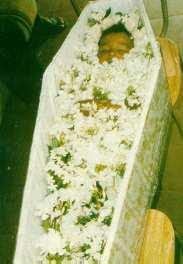
Scheper-Hughes picture of child in coffinScheper-Hughes's book (which also forms the basis for a special issue of New Internationalist) is a study of women in a Brazilian shantytown and their attitudes in the face of extraordinarily high rates of infant mortality, "the routinization of human suffering in so much of impoverished Northeast Brazil and the 'normal' violence of everyday life" (16). As such it is an investigation into affect. Scheper-Hughes aims "to recuperate and politicize the uses of the body and the secret language of the organs" (185). She shows how fear, grief, mourning, joy, anger, and so on, make up a "political economy of the emotions expressed in the somatization of scarcity and deprivation" (326).

Scheper-Hughes writes of "emotions," but I think it is better to describe her project in terms of affect. Unlike emotion, affect has no clear subject or object. So if I fear the dark, that is a feeling that I have about something. It is an emotion: personalized, individualized, tied to an object. In affect, by contrast, subjects are overwhelmed by and dissolved in a feeling that can seem to encompass the whole world. Emotions are personal; affects are impersonal.

Indeed, Death without Weeping indicates that emotion is secondary to affect. In the shantytown, individualized emotions expressed for a particular object by a particular subject are slow to emerge. Because infant death is so prevalent, feelings are not at first ascribed to persons. Infancy in the Alto do Cruzeiro (site of Scheper-Hughes's fieldwork) is fundamentally impersonal:
The women of the Alto are slow to "personalize" infants by attributing specific meanings to their whimpers, cries, facial expressions, flailing of arms and leg, kicks and screams. [. . .] Alto women do not scan the infant's face to note resemblances to other family members. Naming practices follow a similar logic: many Alto infants can remain unnamed and unbaptized until they reach their first birthday. (413)
Alto women avoid (or delay) interpretation and the attribution of meaning. They do not weep for what the death of a child means; the care of these unnamed children is not a cognitive process that would accord particular weight to their personal individuality.

But the lack of emotion does not imply that affect is absent; it is just that "the affection shown the infant and young baby is general and nonspecific. 'Who doesn't enjoy a baby?' people ask" (415). While neither the object (the baby) nor the subject (the mother) are personalized, an affect of enjoyment ("Who doesn't enjoy?") encompasses and supersedes individual persons.

See the photo above: the child is almost buried by the flowers that crowd his (or is it her?) coffin. Even his face, marker and sign of individuality, is half obscured. It is not that there is no affect attending the child's funeral; far from it, as the coffin is overflowing with these tokens of love. But the affect is general, depersonalized.

Depersonalization is not homogenization. Affect traces what Gilles Deleuze terms "singularities," here the whimpers and cries, kicks and screams, that make childcare anything but monotonous. Deleuze describes infancy precisely in terms of the prevalence of singularities over individuality: "very small children all resemble one another and have hardly any individuality, but they have singularities: a smile, a gesture, a funny face--not subjective qualities" (Pure Immanence 30). In rejecting the logic of representation, the women of the Alto emphasize these singularities of the infants in their care: by refusing to "note resemblances to other family members" (Scheper-Hughes 413), the mothers highlight the infant's incomparable power to affect and be affected.

Individuation would mean seeing meaning elsewhere: reinforcing filiality, referring infancy to adulthood (this kick or that smile finds its model in a paternal gesture or a shared familial feature), making individuals out of infants at the cost of subordinating them to a transcendent domestic hierarchy. Hence it is individuation and the social rituals of naming and baptism, not the impersonality of a generalized affect, that homogenize and impose social stasis upon the growing child. In the meantime, before this is allowed to happen, in the Alto "small children circulate among relatives and are often reared by more than one mother; on moving into a new household, the child may be given a different name or nickname" (414). Each Alto child is a multiplicity, flexibly adopting a number of different social roles and incarnating multiple identities.

Only later, and "gradually and slowly," does the Alto infant come "to earn his personal claim to full human status and with it his claim to a personal name and his right to the affections and passionate attachment of his mother" (415). But as multiform affect gives way to the attachments of a subjectified emotion (governed by rights) linking mother and child, the resulting humanization is also a limitation. Multiple and mobile singularities are reduced to a single, fixed identity. One of Scheper-Hughes's informants states that before this point "the infant is without history. The infant's story is not yet made up" (437). But we could also say that the child incarnates a pluriform history, or multiple potential stories, yet to be reductively shaped by the single linear narrative that will lay down the law for his or her future.